As we wait for Dr Sharpe to reach Santa Cruz and the Fraser Point nest of Andor and Mrs Cruz, I want to also celebrate the on-going success of the Black Stork rescue and adoption in Estonia. This is a video of Kaia finding the fish basket that Urmas left for her and Karl II to help with the food needed for four storklets when he placed Bonus on their nest. Bonus is one of two surviving storklets from Jan and Janika’s nest. The other storklet, Extra, is in the nest of Eedi who also has a fish basket.
It is thrilling to see this project working. With the rising temperatures, warming waters, fish dying, and streams drying up, we should begin to think of how we can provide fish for all the birds that require them to survive. This includes diverting water, raising and stocking streams, etc. I am certain you can think of many more ways but also big tanks – like those used to raise fish for people – could be provided for the birds. Yes, this is a big endeavour but, it is not too big that it cannot be funded with monies spent on human entertainment, like fireworks. One City. 19 million dollars. That buys lots of fish! Add up every city and town. (I will definitely not be invited to any Canada Day celebrations next year, for sure!)
We already know that the tanks for raising fish are enjoyed by the Ospreys because our fish hawks take the fish and make the fish farmers very angry! We also know approximately how many fish are needed by an Osprey family during breeding season. I believe this data would also be available for the rare Black Storks in Latvia and Estonia.
Intervention as a necessity at its best.
At 15:14 the first Welsh osplet of the 2022 breeding season fledged! It was 554 from the Llyn Clywedog nest of Dylan and Seren. Congratulations everyone.
Seren watches.
554 made a good controlled return. All is well. Congratulations everyone!
Mama Thunder got fed up with the intruder that has been harassing the kids and fighting with her and them. She gave that intruder the boot today!
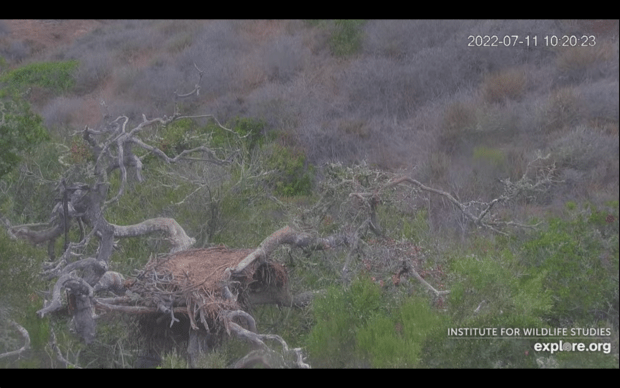
Lillibet has come to keep Victor company while nearly 500 people wait and watch for the rescue team. Victor has been in the brush for 24 hours now – as Dr Sharpe makes his way by car and boat to save him. There seems to be a very special bond between this pair similar to that I saw in E17 and 18 at the Southwest Florida Eagle nest.
Everyone is urging Victor to hold only just a little longer.
Lillibet stayed with Victor until he left. Rescue time was 13:30:37. Dr Sharpe and his assistant wasted no time but they did show everyone that Victor was alive. He will now go to the Ojai Raptor Centre in Ojai, California. Thinking of donations – think about them as well.
Victor is protesting. That is good.
And he is off!
Wow. Terribly sad to see the two siblings separated but so happy that Victor was alive and protesting at the time of his rescue. Another great intervention, a very necessary one.
Thank you for all your good wishes for him today. This is wonderful. Dr Sharpe seemed to be very happy and relieved. Take care everyone. It has been such an intense day…I will see you tomorrow.
Thank you to Explore.org and the Institute for Wildlife Studies streaming cam at Fraser Point where I took my screen captures, to Lady Hawk for her video of Mama Thunder, CarnyXWild, and the Eagle Club of Estonia.
I want to start by putting a smile on everyone’s face. Ervie. The photo was taken yesterday around the North Shore where you will see that Ervie has caught a really nice sized fish – not a puffer! Thank you ‘B’ – I have been so preoccupied with Victor and a couple of osprey nests that I missed checking on Ervie since they posted his last tracking. — Good things happen to talons. They grow!
That is a beautiful fish and good form, Ervie! Does everyone realize that Ervie could be the best thing that happened to Port Lincoln tourism? Maybe, as a male, he will just hang around til he can take over the barge from Dad. Why not? There is lots of fish and he will not bother Mum and Dad – house rules.
Update on Victor, Sunday morning: Victor was active around 0619. He was doing some wing flapping and some hopping. He stood for a short while. He appeared to sleep better during the night.
This is the latest posting from Dr Sharpe about 42 minutes ago- 9am PST.
These are the images from this morning.
Andor and Mama Cruz are bringing in bedding for Victor. He was more alert. I understand that Dr Sharpe has approved a banner with a link for donations. If you have been wanting to donate, this is a great chance to support the wonderful work that Dr Sharpe does for these eagles on the Channel Islands. as ‘B’ and I were discussing, the only person we know that would work so hard to save this eaglet is Dr Sharpe. — I will also add that donations are tax deductible and you can give $100 and have it spread out over 12 months at $8.96 a month. You will get a beautiful thank you and a gift. Mine was an embroidered T-shirt and a super digital image of the nestlings of Thunder and Akecheta.
The information below on Victor comes from late Saturday.
Some close up images of Victor’s left leg and talons and a reminder of the many challenges and obstacles that need to be cleared away before Dr Sharpe can get the fledgling help.
Lillibet stayed with her brother – these two have always been close. They remind me of E17/18 and E19/20. It would be comforting for Victor to have his sister beside him. It has been a hard day to watch Victor. He has clearly appeared to be in pain. Hoping that Andor or Mama Cruz will feed him tomorrow.
Dr Sharpe is not the only person that is having trouble getting volunteers. Around the world it is the same – fewer and fewer people are stepping up to assist in the rescue of our wildlife. The high rise in the cost for everything has placed many who have helped in a situation where they cannot – fuel is one of those issues. I do not know a wildlife rehabilitation centre that is not overwhelmed in the middle of the summer. Every one relies on donations. It has been mentioned twice that Victor will need a place to go to get the care and treatment he requires. Will there be someone answer Dr Sharpe’s call for help if he gets permission to retrieve the eaglet. Will someone provide a boat? Is there a motel that will allow Victor in its rooms? Each leg of the rescue of eaglets in the Channel Islands has its many challenges and its costs.
I am actually starting Sunday’s blog Saturday night. It has been a roller coaster day in Bird World. The Osprey expert who is my go to -if I do not know the answer about an issue or who fills me in on the back story to everything happening in Osprey Land -sent me a letter. It said: “Isn’t it amazing how people are in denial about what is happening to juvenile ospreys?” It was ‘just the other day’ that ‘A’ wrote and said she will never look at an adult raptor the same – she now appreciates the struggle that they went through to live beyond their first year never mind to 8 or 10 years! As everyone reading my blog knows, ‘that list’ grows but, at the same time, I told my friend that there is a silent army out there working for the betterment of our birds and I meant all of you! Thank you for what you do for the birds – the smallest gesture can have the most impact.
Case in point. Just look at the Osprey nest below. The original one kept being destroyed in high winds. It was decided to consult some experts on design in order to shore up the nest and make it safer for the Ospreys on the Sunshine Coast in Australia. There is information in the posting below the image – but everyone there deserves a huge shout out. Well done.
Iris is, of course, a miracle. At the age of 28 or 29 she is as fit as they come. She is an excellent fisher and she continues to work on her nest in Missoula, Montana. and what a nest that is! Iris is an example that we should all follow – she eats well, has lots of exercise, and keeps herself busy. Iris is truly amazing and we are so glad that she is spending so much time this summer on this ever growing penthouse of hers because we get to watch. Beautiful wings, fabulous legs. By every measure she is a real senior but she looks like a fit youngster.
Mr President and Lotus teach Takoda life lessons since he is an ‘only’. They are doing a great job showing him how easy it is to steal his fish!
The four storklets are waiting for either Kaia or Karl II (or both) to bring some nice fish for breakfast. Frogs would be OK, too.
Bonus is squatted down on the left, facing right. He is fully transitioned into the family. The intervention appears to have been very successful – a rare Black Storklets life is saved by two people taking a chance on an idea – Urmas and Dr Madis V.
The climate is changing and it is having an impact on our feathered friends around the world. Warming seas, a shortage of fish, high day time temperatures. You name it. It is harming the bird’s ability to thrive. They are not birds but those cute little penguins that visit the Royal Cam chick on occasion are not the only New Zealand wildlife that could be having trouble.
‘H’ has reported that all three have fledged from the Carthage Tennessee Osprey nest. Congratulations everyone! That is fantastic news. ‘H’ also reports that there is really good hovering going on at the Mispillion Harbour Osprey nest. The kids are 52 days old and they were doing some super hovering as well as being nice to one another and trying self-feeding. Thanks, ‘H’. Like Ervie these two got forgotten with Victor’s injury.
All eyes are on that egg in the Chesapeake Conservancy nest of Tom and Audrey. The first hatch is doing fab…
So far it looks like at least 2 fish have come to the Osoyoos Osprey nest this morning. 07:28 and 08:11.
Dory and Skiff’s trio are doing fine as well. Lots of fish come to this nest. I would like to give one of them to Osoyoos sometimes. The chicks at both Osoyoos and Hog Island are getting feathers coming out of those shafts. Lovely.
That is a hop skip and a jump through the nests. Great news on Ervie. Always makes my heart stop – that Osprey! Thank you Dr Sharpe for all you do – this man needs to be given an award with a huge prize for all he does. Everyone else seems to be holding and doing good.
Thank you for joining me today. Take care everyone. See you soon.
Thank you to the following for their streaming cams and or F/B or web sites where I took my screen captures: Port Lincoln Osprey FB, Institute for Wildlife Studies, Explore.org and The Institute for Wildlife Studies, Bald Eagles Live Nest and News, Sunshine Coast Council, Montana Osprey Project, NADC-AEF, Eagle Club of Estonia, Mispillion Harbour Ospreys, Chesapeake Bay Conservancy, Osoyoos Ospreys, and Audubon Explore.
I hope that everyone had a lovely day today. It is relatively quiet in Bird World. That is a good thing!
It is so nice to get an update of WBSE 27. At her second stint in wildlife rehabilitation, WBSE 27 was kept and the staff did not release her until she was flying and hunting prey in a way that ensured she would survive in the wild. A real round of applause for Ranger Judy Harrington and Australian Raptor Care and Conservation. The most important thing is that the raptors are not released before they can manage completely on their own otherwise the stay in rehab has been futile.
The ‘problem’ with the WBSE nest in the Sydney Olympic Forest are the Pied Currawong. When the WBSE chicks fledge, the Currawong chase them out of the forest so they are not able to return to the nest to be fed. As a result they do not: 1) have the GPS coordinates imprinted in their mind for the nest; 2) do not have the time to allow their flight training to gradually progress; and 3) they do not get lessons on hunting from their parents; and 4) they generally starve as they cannot hunt. If located after flying off the nest, the birds are emaciated, like 27 was twice, and being beaked and attacked by all manner of smaller birds. It is a tragedy.
This is WBSE 27. Isn’t she gorgeous? She was ringed and fitted with a tracker the the rehabbers. What a good move. There is a very good report under the picture. What a blessing that the staff worked so diligently with her to ensure that we can be reading such a great progress report.
Lady and Dad have been busy incubating the eggs for WBSE 29 and 30. Here they are changing shifts. Pip watch should begin in about 4 or 5 days.
Here is the link to their camera:
The big news in US Osprey Land is that Tom and Audrey at the Chesapeake Conservatory Nest had a successful first hatch with their second clutch. Time was 0341. Oh, fingers crossed for all of them and that the chicks grow fast and healthy so that they are ready for that big migration south in the fall! Congratulations to everyone. Thanks ‘H’ for those two screen captures. Big Bob is adorable. So happy for Tom and Audrey.
Audrey looks down at her little upside down bundle.
Hi Dad, is that my fish?
What in the world is Bukacek doing? He started working on another nest the other day and now Betty is over there with him — and the kids are at the old nest!
Great timing. Just got there when Skiff brought Dory a fish for the three kids.
It looks like Little Sloop is in the middle. Which one is Schooner? and Slipjack? I have yet to be able to tell Big and Middle unless they are really looking at me.
Skiff has been on and off the nest all day. Is there an intruder about?
The kids have been pancaked on occasion. See how close big and Middle are…can you tell them apart? Any tips would be welcome.
For those watching the Osoyoos Osprey nest, Little Bob got himself on the other side of Mum today to get some fish. I wonder if that Big Bob is a female? She can be rather bossey.
We are definitely on fledge watch at the Mispillion Harbour Osprey nest. It is a good thing that the pair do not start wing flapping at the same time. Poor Mum. Either or both can take off anytime…they just don’t know yet that they can fly.
Idris has been filling the nest full of fish today. Pedran and Paith (Big and Little) both took turns feeding off of one fish. Telyn might be wondering when she can relax on the perch and they can feed themselves. It sure has been a busy season for her and Idris with these three whopping females.
Pedran is the one feeding herself. Paith is learning but she needs to figure out how to hold the squiggly fish down with her talons.
Louis has been busy today, too. I just feel for Dorcha. She has had so much bad weather this season in this nest. But today they are dried out. Big kids like those at Dyfi, almost ready to start thinking about learning to self-feed.
As the chicks get bigger they sure can eat a lot of fish. Laddie flew in with a really nice salmon for Blue NC0, Big, and Middle. The kids are also starting to think about what wings are for! I can’t help but think Blue NC0 is tired this year and she will need a time to get her strength up and her weight.
The wind was really blowing at Loch of the Lowes but it did not stop Laddie. Here he comes with that tea time whole fish!
What a scramble on the nest as he gets closer. Gosh, Laddie looks so tiny.
Blue NC0 got it. Best to let her take that fish and get off that nest. Talons could be in danger.
He’s off.
Karl II comes in with tonnes of fish for the four Black storklets. At the beginning, Bonus is in the back but he moves up the left side to come to the front. You can tell Bonus because his plumage is still whiter than the storklets of Karl II and Kaia. This intervention is doing great. So very happy.
Alden has been loafing. What a character. So happy to know that Annie has accepted him as a mate…we can prepare ourselves for more loafing and moth chasing next season.
As Suzanne Arnold Horning was leaving the Cornell campus, she spotted 2 Ls on top of the Riley Robb Building – a first ever she says. Big Red and Arthur are moving the chicks further around the campus as they get more hunting and flying skills.
I was able to pick up an ex-library copy of Alan Poole’s Ospreys. A Natural and Unnatural History. There are no big colour images like his other book, Ospreys. The Revival of a Global Raptor but this book is choked full of really interesting information on Ospreys. If you are an Osprey fan and want to learn more or are just beginning to appreciate these amazing books, see if you can find a used copy. Well worth it!
Thank you so much for joining me today. Take care of yourself. See you soon.
Thank you to the following for their streaming cams, videos, and/or FB pages where I took my screen captures: Australia Raptor Care and Conservation Ltd, Sea Eagles@Birdlife Australia Discovery Centre, Chesapeake Conservatory, Capi Mlade Buky, Audubon and Explore.org, Osoyoos Osprey Cam, Mispillion Harbour Ospreys and DDNR, Dyfi Osprey Project, Friends of Loch Arkaig and the Woodland Trust, Friends of Loch of the Lowes and the Wildlife Trust, Must-Tooneburg and Eagle Club of Estonia, Cal Falcons and Suzanne Arnold Horning.
The beautiful day gave way to heavy rain and dark grey skies. Manitoba is water logged.
It was fantastic to have the commentary of someone actually watching Idris catch this fish – it took him 5 tries to pull it out. I do wish the cameras gave us a better idea of the size of some of these amazing catches. The ‘girls’ of Dyfi were appreciative of his efforts.
The three females now take up more than half of that big nest. Eating, sleeping, growing, and getting their flying muscles stronger. Sleeping now!
Hi Dad!
Telyn arrives to feed the girls.
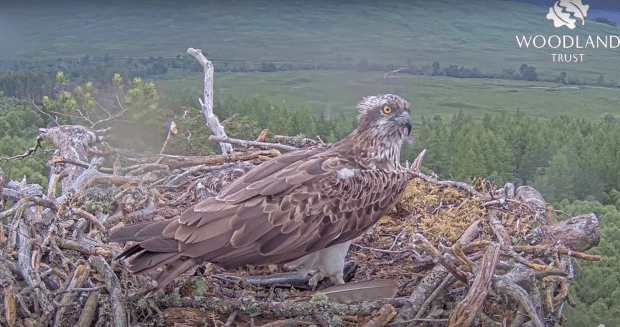
One of Wales Osprey couples – Aran and Mrs G. Mrs G is the oldest osprey in the United Kingdom. She is very dark with a large necklace. Dorcha at Loch Arkaig reminds me so much of Mrs G. I love Aran with his penetrating eyes.
Dorcha has, perhaps, even slightly darker markings than Mrs G.
Louis does not fail to deliver the tea time meal to his Loch Arkaig nest – he is an extraordinary fisher.
Speaking of crops – the female osplet at Loch of the Lowes has quite a large one this evening! Blue NC0 looks tired to me this season. I hope these two fledge and give their Mum time to replenish the weight and fat that she has lost caring for them before she leaves on her migration. The females leave about a fortnight before the others. That is, however, an average as nests can vary greatly.
The two chicks at the Mispillion Harbour Osprey nest were happy when a fish arrived too…what is with feeding them when they are resting duckling style??
Wonder what they are looking at?
Neither of the two appear to be overly hungry. Thank goodness. It looks like a teaser.
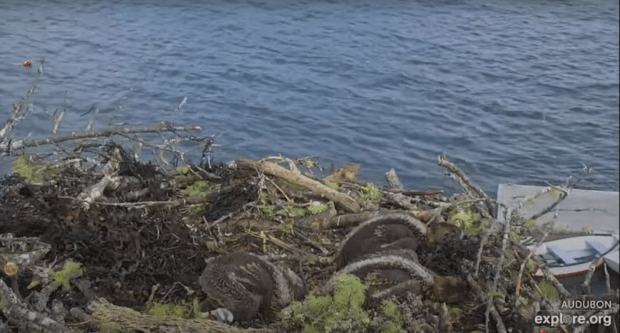
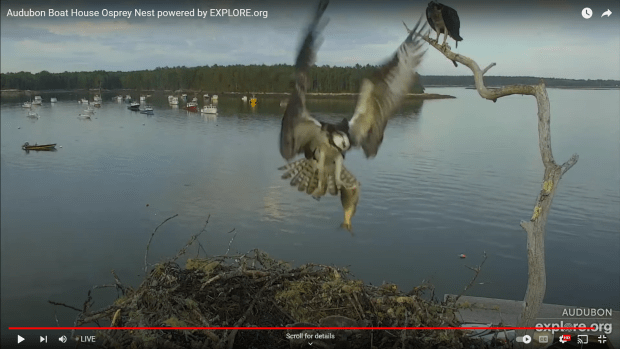
At the Boathouse on Hog Island, Skiff brought in a really nice fish. Big was full and Middle and Little got a really nice feeding from Dory. This is just wonderful to see!
In Montana, they are ringing/banding all of the Osprey nests. If I recall there are about 200 along the Clark Fork River. Those who make up the Montana Osprey Project will also test the birds for toxin residues that remain in the water and the fish from the mining around Missoula. Here is an article with some images of the events.
How many successful Osprey nests fledge 4 chicks? Maya and Blue 33 did it two years in a row. This year it is a Kielder nest and there is a short but nice article in the BBC celebrating this great achievement – and it is. Some nests do well with 2 but give them 3 chicks and there are often problems. 4 chicks would keep Mum and Dad busy 24/7. Ironically the literature on siblicide notes that the % of events is higher in nests with 3 chicks than with 4.
Two of the fledglings at the West End nest have locked talons and fallen off the nest! I am not 100% sure who the pair were but I think that it is Ahote on the nest and Sky coming in but – without seeing those bands it is so difficult to be certain.
The talon tumble happened yesterday and as far as I know both fledglings are fine – just their pride wounded a little.
The other fledgling can be seen flying in the distance. The one on the nest is alerting.
The one on the nest goes up and lunges forward.
Talons engaged.
They go down and then without having good footing both tumble down the cliff talons engaged with one another.
There is something very strange going on in Mlade Buky. Bukacek is building another nest! The storklets are watching him. This could get interesting. Does anyone know about this behaviour?
There is Bukacek down below the nest. Some of you may remember that the two engineers that set up the camera and saved the storklets last year when Bukacek’s mate died, did sometimes put fish down in that area. I wonder what is going on??
What is a crop? The crop is a muscular pouch. It is part of the bird’s esophagus and is used to store extra food before going being digested. Often birds will eat and eat and eat – because they do not know when they will find more food. Thank goodness that crop is expandable. Vultures and condors are known for filling their stomach and then eating – if there is enough prey – until their crop is entirely full. Some birds that regurgitate food for their young often use the crop to soften it so the wee chicks can eat easier. Hawks, vultures, condors, eagles, falcons – they all have a crop. Pigeons and doves use the crop to produce ‘crop milk’ – pulverized food – that they feed to their babies.
One of Karl II and Kaia’s storklets today with an extended crop.
Do you live in the UK? Near Rutland? ‘L’ just reminded me that the annual Birdfair will take place on the 15, 16, and 17th of July. Here is the information in case you want to attend. Thanks ‘L’! If you do ever find yourself at Rutland, please go on the water tour. You might be lucky enough to see Blue 33 land one of those huge fish he brings to Maya.
This has just been a hop, skip, and a jump to check on our nests. It appears that all of them are doing alright. No strange events – unless I have missed them! In that case, please feel free to let me know.
Thank you to the following for their streaming cams and/or FB pages where I took my screen captures: Dyfi Osprey Project, Bywyd Gwyllt Glaslyn, Friends of Loch of the Lowes and the Wildlife Trust, Friends of Loch Arkaig and the Woodland Trust, Mispillion Harbour Ospreys and the DDNR, Mlade Buky, Looduskalender and the Eagle Club of Estonia, Boathouse Ospreys and Audubon, Explore.org and the Institute for Wildlife Studies.
Good Morning Everyone. It isn’t raining!!! The weather forecast was entirely wrong (so far). The sun is shining bright and it looks like it is going to be a fantastic day on the Canadian Prairies.
I mention Daisy the Duck quite often. It was Daisy that got me into loving ducks — despite the fact that I had a pet duck as a toddler – as an adult. She tried so hard – against the odds of a forest full of Crows and Ravens – to raise those little ones. I think it is why I am always out checking on the ducks at our local parks. But, today, I found a very interesting streaming cam and I thought I would share it with you. A female Wood Duck (oh, those females are so cute and sweet) has taken over an owl box and is sitting on eggs! Here is the link:
Fireworks. No one will ever invite me to their party! When we had our Canada Day celebrations there were fireworks set off 3 blocks away from the Peregrine Falcon scrape. I was equally upset and vocal locally – my comments could apply to any City.
Tonight, ‘B’ sent me a note about the fireworks and poor Takoda. 45 minutes later, they are still going off but are closer to the nest in the National Arboretum. Takoda is not the only wildlife impacted – every bird, every animal, every pet – and even humans – could have their hearing and/or breathing compromised. Tonight, I am ‘Miss Stick in the Mud’. At the same time I also wonder how much these big displays cost and how those funds could be used elsewhere. The US Government Accountability Office said that the display cost 19 million in 2019. Wow.
These are not silent fireworks either…just in case you were wondering. No, as ‘B’ said – it sounded like a battle zone. They started at 2109 on either side of the Lincoln Memorial Reflecting Pool and I still have screen captures near to 2200.
Someone may ask you ‘What is the importance of Raptors or Birds of Prey anyway?’ In 2013, the British Columbia government did a study on raptors titled, Guidelines for Raptor Conservation in Urban and Rural Land Development. Section 4.2 lists the benefits that raptors have for all of us – not just the residents of British Columbia. Indeed, there is a lot of wisdom in these 151 pages. Do look at section 4.2. It is quite interesting and not so long.
Checking in on the Black Stork intervention by Urmas, Kaia was caught on the camera finding the fish basket today. She returned and fed the four storklets who are growing and growing. Bonus appears to be fully integrated into the family.
You are doing great, Kaia. Look at those beautiful babies with those gorgeous black feathers. Just imagine. These four will take to the skies and fly all the way to the centre of Africa – and hopefully, return to Estonia.
The two chicks of Mr and Mrs AX6 at Llyn Brenig were ringed yesterday. One is showing off its new bling. Were we not just worried about these two in the cold rain last week and they were so tiny? Ringers think it is one female and one male. That gives the Welsh Osprey nests 6 females and 5 males so far.
Idris and Telyn have three big girls to feed and get off the ground. Some of the running jokes is that they are too heavy to fly! Pedran, Padarn, and Paith will do just fine. They will return in two years time looking for a Scottish mate, perhaps, or maybe they will check out any Rutland males that are about.
Aran and Mrs G have been keeping close watch over their territory today as it appears there are intruders about.
All of the nests seem to be doing very well. Dylan has brought a fish in and the three Bobs at Llyn Clywedog are being fed by Seren. It is a good way to keep one of them from taking over the fish – at least at the moment.
It looks like Blue NC0 has a nice crop – she looks so tiny compared to the two big chicks. So grateful that everything is going well on this nest after losing Little Bob. Should be two successful fledges soon.
Does everyone know Iris? the oldest Osprey in the world? She is, I believe 29 years old this year. Her nest is in Missoula, Montana and just look at that nest. Iris no longer has chicks. Her partner, Louis, since her devoted mate Stanley did not return, also has another nest in the baseball park with Star. Louis takes care of Star and her chicks. Every year Iris lays eggs and because one parent can’t do it all, the Crows or Ravens get them. Iris then spends the summer fishing, working on the nest, and taking care of herself. With the toll that chick raising takes on the female, this could be part of the secret to Iris’s longevity.
This morning Louis joined her early to keep intruders at bay but what interested me the most was how much work Iris has done on her nest. Just look at the amount of twigs! I wonder if Dr Green is going to gather up twigs from under the nest and have pens made as a fundraiser? The two I purchased from last year are beautiful and you can easily buy refills which makes them very sustainable.
Iris is a great fisher. Just look how strong she is. She has been working on this nest every day and it is so nice because we get to see her!
There is a lot of new nesting material arriving on the Mispillion Harbour Osprey nest in Delaware. The kids were hoping for a nice big fish but it looks like new straw. Is Mum going to weave a basket?
I was interested in this image because of the dark bands on the tail. For Red-tail Hawks, you check to make sure that there are 5 dark bands. It is a simple trick to see if the chicks are near fledging. It seems to also apply to Osprey. These two are getting very close to being able to fly. Whether or not they will want to is another story.
At the Boathouse Osprey platform on Hog Island, everyone seems very happy with the morning feeding. Dory did a crack up job making sure all three were absolutely full – including Little Bob.
‘H’ sent a screen capture – so happy that the wee one had a bit of a private feeding filling up its crop. Yeah for Dory our first time Mum. Thanks so much for this great image, ‘H’. — Look at those little fat bottoms.
At the Osoyoos Osprey nest, it looks a little drier this morning. The kids have already had a small fish for their breakfast and are cuddled under Mum.
I don’t remember a pair of Cal Falcon fledglings that have loved to spend so much time together. It is such a delight to see Lindsay and Grinnell Jr play together – and what a welcome to relief to catch them on the camera of The Campanile.
Thank you so much for joining me today. Everything ‘appears’ to be quite fine in the nests that we have been watching. Fingers all crossed and toes, too, that it stays that way. Take care everyone — stay safe.
Thank you to the following for their streaming cams where I took my screen captures: NADC-AEF, Eagle Club of Estonia and Looduskalender Forum, Llyn Brenig Ospreys, Dyfi Osprey Project, CarnyXWild, Friends of the Loch of the Lowes and the Scottish Wildlife Trust, Montana Osprey Project and Cornell, Mispillion Osprey Project, Audubon, Osoyoos Ospreys, and Cal Falcons.
Good Morning Everyone. I hope that you had a marvellous weekend and for those celebrating independence day in many countries around the world, have a fun and safe time.
With all the talk about storks, ‘L’ asked a question in the comments. Did I know what happened to the White Stork couple, Malena and Klepetan? Thank you ‘L’ – that is a great question and I bet many are wondering too.
Klepetan and Malena are the best romance story in all of Bird World. The intervention to save Malena’s life after she was shot by a man in Croatia is a testament to what love can move us to do for our wildlife friends.
If you do not know the story, before you read further, please watch at least the first one of these videos so you know the background to this truly remarkable story.
Perhaps the most famous stork couple in the world were Klepetan and Malena. Malena stayed year round with Stjepan Vokic in Croatia. As you will know from the video, Malena was shot and it was only through the gentle care of Vokic that her life was spared. What devotion to keep her, clean her, feed her, prepare the nest and fish for both adults and chicks so that Klepatan and Malena could spend all their time together.
For 20 years, Klepetan migrated back and forth from South Africa to Brodski Varos, Croatia. Malena died peacefully on 7 July 2021 of old age. She was 28 years old. Klepetan was by her side when she died along with her other faithful companion, Vokic. Malena was buried in one of her favourite places. Klepetan continued to come every day wondering where his mate was. They had been together for 20 years and had raised 66 storklets. Klepetan was fitted with a transmitter. He did not return to the nest he shared with Melana in 2022. Did he also die? or find a different nest with a new mate? I am hoping to be able to find the time and help to see if Klepatan’s transmitter is still working.
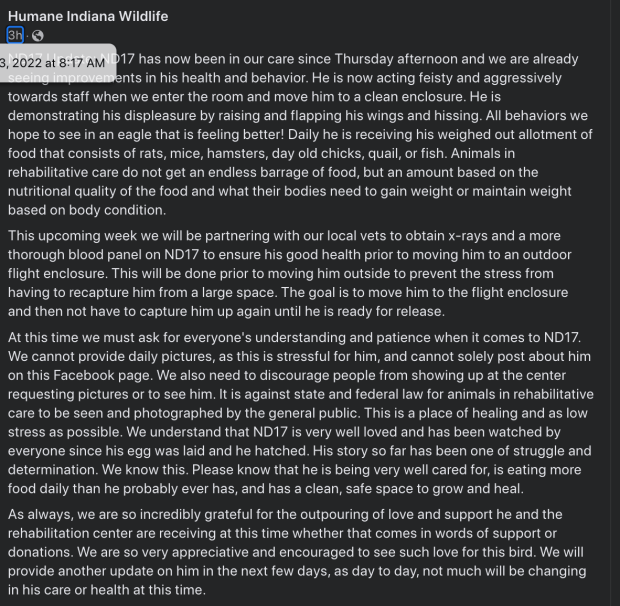
Want to help out Humane Wildlife Indiana? They have an extensive wish list on Amazon including a xylophone for chickens. I have learned through one of our readers, ‘L’ how important it is to have creative stimulation or enrichment for all of the animals in care. Who would want to live strapped to a perch with nothing to do? There are lots of things on the list from a few dollars to $30 or $40. Here is the link. It is good to see what the wildlife clinics are asking for. You can always help out your local clinic too – they always need laundry detergent, bleach, hand sanitizer, wipes, and those old clean towels I keep repeating…Even if you do not intend purchasing anything for the clinic, have a look. It is possible that you intend to get rid of items that could be used at your local clinic.
So busy with Little Bit and the JJ storklets that some others get forgotten so I am also playing catch up this morning. The only surviving eaglet at the Fort St Vrain nest in Colorado, 46, fledged on the 1st of July. Congratulations everyone!
It is not just Annie and Alden bonding in the scrape! As breeding season in Australia gets closer, Diamond and Xavier are doing a lot of bonding rituals in the scrape – some short, some long. Oh, you are going to fall in love with little Xavier if you don’t know him already. Here is that video clip.
‘B’ sent me a newspaper article on the rescue of the US Steel Eaglet. It is a good read with one troubling bit – they state that he eaglet will learn to fly and be released in an area away from the natal nest. My concern is that they must teach that eaglet to hunt – just like Little Bit needs that training. In order to do that the eagles need a little of time, trained professionals, and specialized structures. It is expensive and time consuming and well worth it if neither wind up back in care. Thanks ‘B’.
I want to include a screen capture that ‘H’ sent me on Sunday. It is just a beautiful sunrise at the Boathouse Osprey nest on Hog Island, Maine. How stunning. Thanks ‘H’ for sharing this beautiful image with all of us!
The boathouse osprey cam on Hog Island is currently offline and is only showing highlights.
Two chicks on the Osoyoos Osprey nest on a misty wet morning. Let’s hope that dad gets a pile of fish on the nest today since the weekend festivities have passed.
There is a severe thunderstorm watch in the area of the Canmore Fortis Exshaw Osprey nest…send positive wishes to all!
There was also beautiful sunrise in Mlade Buky, The Czech Republic. Betty has flown in and is feeding those four great big storklings.
It is early morning in the Karula National Forest in Estonia. The four chicks of Karl II and Kaia are sound asleep. It is so good that Bonus, one of JJ’s chicks, has integrated so well into this family. It is Day 5 for Bonus.
‘T’ sent me an image of Karl II. Last year he discovered the fish basket that Urmas provided. It is about 9-10km from the nest and this year Karl II has been visiting the fish basket and bringing lots of fish to the four storklets on the nest. They are hoping that the herons do not find the basket as it will limit the fish Karl II will find.
This is the other nest where Janus, the middle chick of Jan and Janika, in Urmas and Dr Madis V’s experiment has been placed. It is doing well. Thank you ‘T’.
Takoda decided to come and visit the National Arboretum nest on Sunday. He has found his reflection in the camera. There are some great ‘selfies’ that Takoda is taking! Have a peek.
Some of you became very interested in what your country is doing to help stop avian electrocutions. Knowing what is being undertaken to help the birds is a good way to begin understanding what you can do to spread the word about the dangers and solutions. ‘A’ wanted to find out what Japan was doing and she discovered that there is a special institute working on this problem on the northern most island of Japan, Hokkaido.
“Birds of prey have the habit of perching on high places with a good view and will use tall trees as well as man-made structures such as streetlights and utility poles as perches. When raptors perch on utility poles or pylons, or when they are about to take off from a perch, they are electrocuted when their wings or other body parts come in contact with parts of the body that conduct electricity.
In Hokkaido, accidents involving electrocution of Blakiston’s fish owls, hawk eagles, white-tailed eagles, and Steller’s sea eagles have occurred to date. Electrocuted birds of prey may show severe burns and blackened feathers. Red spots called electric current spots may also be seen on the skin where the electric current was applied.
To prevent electric shock accidents, electric power companies install insulators on current-carrying parts and devices to prevent birds of prey from perching on utility poles. They also install safe perches on top of utility poles to prevent electrocution. The Institute for Birds of Prey Medicine is working to prevent electric shock accidents by analyzing electric shock accidents and consulting with electric power companies and other parties in order to develop more effective countermeasures in areas where electric shock accidents have occurred or are likely to occur.”
Thank you, ‘A’.
I wanted to see what work the Institute for Birds of Prey Medicine is doing and came across something very interesting. Fifteen years ago the use of lead (Pb) ammunition was outlawed in Japan. Today, lead poisoning remains a serious problem for raptors who accidentally consume lead pellets from illegal hunting in various places in Japan but the overall testing of raptors and discovery of those who have ingested lead has dropped significantly (lower than 25%). In comparison, the US Geological Survey discovered that between 2010-2018 (the end of the study) more than 50% of all raptors in the US had been poisoned by lead either in hunting or fishing equipment. The soft lead bullets that break into fragments have the worst impact on the raptors. Other lead fishing equipment can be mistaken by birds such as Loons who think these lead weighs are pebbles and eat them!
There is no nationwide ban in the US for the use of lead. California is the only state to ban the use of lead entirely. New Hampshire, New York, Vermont, and Maine have partial bans in fishing gear. In 1987, Minnesota banned the use of lead shot for waterfowl hunting. In 1991, a federal law in the US also banned lead shot for waterfowl hunting. The problem rests with the DNR who has lobbied against imposing any other lead restrictions on hunters. In April of 2021, three states – Maine, Minnesota, and New York introduced bills that would ban lead completely in all hunting and fishing gear. I am checking to see if HF2556 has been signed into law in Minnesota in 2022.
Do you remember the ‘Old Warrior’? He was taken into care after being found on the side of the road lethargic. He went to A Place Called Hope, another great wildlife rehabber. His lead levels were measured at 49. Very extensive lead removal treatments resulted in the old eagle with the broken leg and beak being able to go into an outside enclosure. A Place Called Hope applied to the USFWS for a license to keep the Old Warrior as an educational bird. I reached out to A Place Called Hope and they said that sadly the lead issues had caused so much damage that the Old Warrior had died. He was a poster child of trying to beat the odds. There are other kinds of ammunition – stainless steel and copper. Lead is not the answer!
There has been some concern about Blue 022 at the Poole Harbour nest. He has now been caught on camera and all is well. The two chicks have been ringed and they are both girls! Well done Poole Harbour. Congratulations and relief.
At the Rutland Mantou Bay nest of Maya and Blue 33, 1H2 and 1H3 fledged this morning. All girls are flying about and there is definitely an empty nest! They will return to harass dad for fish, no worries.
Whew! You might need an extra cup of tea or coffee to make it through this today – sorry! Lots happening in Bird World. The kids up at Loch of the Lowes are starting to get the hover going, too. Thank you for joining me today. Please take care. Thanks to everyone who sent news, photos, or comments. They are always appreciated. See you soon!
Thank you to the following for their streaming cams and/or FB pages or videos where I took my screen captures: The Dodo, HRT, Ft St Vrain and Excel Energy, Falcon Cam, Audubon Explore.org, Osoyoos Osprey Cam, Fortis Exshaw, Mlade Buky, Eagle Club of Estonia, NADC-AEF, A Place Called Hope (APCH), Poole Harbour Ospreys, and LRWT.
I hope that you have had a really lovely weekend. Thank you for taking the time to join me this evening.
There are two important moments in a young Red-tail Hawks life. Their first flight marks them as a fledglings. They need to fly out and return to the nest for the proper definition to apply. They become juveniles only after they catch their first live prey item by themselves. So everyone give a big shout out and congratulations to Big Red and Arthur’s L4 (that little cracker) and L 2 who officially became juveniles today. Wow. Didn’t I say that L4 is amazing. No fear. I will never forget him climbing right over those big siblings to get at the front of the food line. No worries about siblicide on Big Red and Arthur’s watch.
Across the pond, Osprey parents are working hard to get their chicks in perfect condition for migrating. While Osprey chicks will fledge and fly and return to the nest for a feeding from Dad, they normally do not catch their own fish until after they have begun their migration. The parents do not teach them. Fishing is hard-wired into 60 million years of Osprey DNA and memory.
Blue NC0 flew out and brought in a whopper to her two – a big girl and a boy.
Idris is trying to beat every Welsh record that there is for fishing! This is an unbelievable catch! Three big girls and Seren to feed plus himself! Idris is up to the challenge!
Dylan took the approach that more deliveries are the best so he recorded 8 fish deliveries for Seren and the kids before 1700. Wow. It looks like a perch this time.
It was very sad news to learn of Pikne’s demise on the 6th of June on a hydro pole in Turkey. Searchers for her body and the transmitter could find nothing so she has been taken by humans or larger animals. My immediate concern after hearing this is where is Udu, the only surviving juvenile of Karl II and Kaia of 2021. Finally some indication of his transmitter on 16 June but questions lately. He was in the Central African Republic at the time. But this was April 2nd…with battery power at 0%. Since Urdu’s tracker tries to send data but the location is the same as April 2nd. Perhaps someone will be able to establish what is happening. My fear is that Udu’s transmitter is in the hands of a human playing with it and Urdu is no longer with us. Please let me be wrong.
I continue to watch the experiment of Urmas and Dr Madis V with the Black storklet chicks of Jan and Janika with much interest. Bonus was been placed in the nest of Karl II and Kaia and this morning Bonus was not defensive when Karl II brought food. It would appear that Bonus has now accepted he is part of Karl’s family. Amazing news. Bonus has been in the nest for 4 days.
As you know I believe in intervention when it is more likely to benefit the bird. This is the first time that anyone has tried to raise Black Storklets in a clinical setting and then foster them with other Black Stork families. Urmas and Dr Madis V went to great lengths to try and ensure the success including decoy parents, the feeding Toto and making certain that sounds of the forest was present. Urmas also distributed fish baskets to try and take the burden of feeding an extra storklet off the parents. We celebrate today that Eedie has found the fishing basket provided by Urmas. Jan and Janika’s storklet, Janus, is in Eedie’s nest. There is a picture of Eedie going to the fish basket to get food for the family. Thank you ‘T’ for sending us this confirming image. Tears! So many are learning about the behaviour of the Black Storks in these circumstances — this will prove important in the future should another nest lose a parent during the breeding season.
When there were statements about the Bald Eagles feeding ND17 it was important to have ‘proof’ in some form. There wasn’t any. In fact, ND17 was either fed little or nothing due to his condition when the rehabbers picked him up. To demonstrate that the intervention is working and what aspects are helpful to the storks, photos are being taken. This photo proves that Eedie found the fish and now will return to the nest to feed the four storklets.
At the nest of Karl II and Kaia, there were 5 feedings today – 3 by Karl and 2 by Kaia. Bonus has now been part of their family for 4 days. Is he eating enough? Yesterday his ‘ps’ was thin but today there is an image of a healthy ps by Bonus proving that he is eating well.
At 12:12:55 Akecheta flies to the nest with a fish. He looks around wondering which one of the fledglings was going to fly down and grab it.
It was Sky!!!!!!
That is a great mantling job!!!!!!
At 16:02 it is Ahote’s turn to get the fish drop! Oh, I so admire these parents who continually risk their legs and talons to feed their fledglings. It is amazing.
If you see an empty nest at Two Harbours, do not despair. Lancet has been seen eating on the overlook cam.
This is a very short report. It was warm on the prairies today with a beautiful blue sky and lots of happy people. I was out counting American White Pelicans and Double-Crested Cormorants. I will not bore you with the panorama of photos that I took to ensure the count was accurate but..they are such beautiful birds. It is an honour to see them fishing and raising their little ones in the summer. There are places where sport fishing is popular where the pelicans are not appreciated. Authorities can, even with the Migratory Bird Treaty, give permission for people to shoot them! Pelicans were fishing out of the rivers long before people were sport fishing. If people needed to fish for their survival that is one thing (and some do) but…I will let you finish the sentence. You know me well and what I would say.
If you are ever sent to help out with a bird count, it is much easier if you take various shots of the stationary birds and then try, as best you can, to count those flying about.
Take care everyone. Thank you for being with me this evening. See you soon.
Thank you so much to the following for their streaming cams and/or FB or forum pages: Looduskalender, ‘my friend T’, Explore.org and The Institute for Wildlife Services, Dyfi Osprey Project, CarnyXWild, Eagle Club of Estonia, Scottish Wildlife Trust, and Ferris Akel Tours.
Do you live in an area where farmer’s are baling hay or straw? and using baling twine? It was baling twine mixed in with some other nesting materials that caught on the male Ospreys talon at Osoyoos and pulled the chick off to fall to its death. Dr Erick Greene at the Montana Osprey Project finds literally tonnes of baling twine in the Osprey nests he studies. He also finds dead chicks and others nearly dead and tangled. If you live in a farming area help our Ospreys by spreading the word. Here is an information pamphlet that Dr Greene prepared – it is quick and to the point.
It is surprising that the nest at ND-LEEF is still holding. It looks like bits and pieces of it are falling away each day. Mum and Dad are still bringing fish to the nest for ND15 and 16.
15 was on the nest when the adult arrives with a nice fish. Soon 16 arrives.
I believe 15 kept the fish!
There is an update today on ND17 – and it is a good one. There is that sweet baby. It appears that individuals have been showing up at the clinic wanting to see 17. Please do not go there. The clinic staff has addressed this issue in their posting. ND17 is doing great and it is the clinic’s business to help him so that he can be returned to the wild. Everyone who works at a rehabilitation clinic is overworked and underpaid – it is a very sad situation in many instances where they do not get celebrity birds and good donations. Send them a thank you letter! Tell them you don’t expect a reply. Make a donation! Give to your local rehabber — I keep saying clean old towels but gosh, they are much needed. Give the towel a second life, too.
Isn’t he adorable?
Problems with nests and falling out of nests happens everywhere. It has been awhile since I checked on the two White-tail Eaglets in their nest in the Tucholskie Forest in Poland. Last time I remained somewhat cautious about the second chick surviving. Their names are Uno and Duo. (The third chick was a victim of siblicide). Uno fell off the nest and spent 4 days on the forest floor. He must have glided – as he flew back up to the nest. There are now some concerns that Duo has not been fed since 1 July and Uno is taking all the prey. They are big eaglets – just beautiful. Both will hopefully survive.
Sleeping and waiting for food.
Last year, Karl II and Kaia had three storklets. One of those Pikne who stayed with Karl II for a long time having him bring her food before fledging. She hatched on the 28th of May and fledged 4 August. She has a perfect flight to Ethiopia where she arrives on October 24, 2021. Pikne stayed in Africa and set off for her return flight to Estonia. She was in Israel on 1 June 2022 and everyone was so happy to see her transmitter working. Sadly, on 6 June, she on a power line and was killed in the middle of nowhere in Turkey. Such promise. A day does not go by without adding another one to ‘the list’.
Pikne is the storklet getting ready to stand up at the front.
As ‘S’ reminded me last year, countries can make laws that power companies must make their poles safe for wildlife but the companies must follow through in a timely manner. Last fall we lost Solly in South Australia and the individuals that make up Port Lincoln Osprey were on a mission to get the government to fix the power poles. Must check with them to see how they are doing. It is, sadly, a worldwide issue for our beautiful raptors and storks. In Pikne’s case, it is thought that she was tired and landed to rest as there was no place to feed near that pole — so it is not just poles near feeding areas but all poles that should have a protective cover.
This is the nest of Karl and Kaia this morning. Bonus made no reaction to Karl II which means that he has accepted him as his father, the male on the nest and is home with the three siblings. This is such good news for the success of the intervention by Urmas and Dr Madis V. Actually it is fantastic news.
What can you do to help so that our beautiful birds are not electrocuted? Here is a story of a Bald Eagle and an individual who got their power company to retrofit the power lines – 12 of them – in their neighbourhood. Remember! Each of us can make a difference by seeking solutions for the birds that live where we do.
Most everyone is following the story of Malala, the Red-tail hawklet meant for dinner but adopted by the Gabriola Island Bald Eagle family. This article covers this adventure from the beginning to the present. It is a really good read.
Every once in awhile I feel compelled to give a shout out to the New Zealand government and specifically their Department of Conservation (NZ DOC). I wonder how many of my readers follow the exploits of the Royal Cam chick on Taiaroa Head? There she is – QT (Quarry Track) chick doing her morning stretches. What a beauty.
This year has seen at least 10 supplementary feedings for QT and a few of the other chicks on the peninsula. Her parents are YRK and OGK. Just like Janika could not provide enough food for her storklets alone, neither can YRK. There is little talk on the Royal Cam FB group but the much beloved OGK was last seen on the 19th of May. Some believe he came in on June 10 but that is not confirmed and many believe it was not him but, rather, YRK. OGK doesn’t choose to not return to feed his chicks. He is one of the most devoted Royal Albatross I have ever seen. He is either injured or dead. Two years ago OGK suffered a leg injury and returned limping after 40 days. If the 19 of May date is correct – he is missing for 46 days now. Send all good wishes his way, please.
US Steel Eagle 4 (USS4) is in care from tumbling out of the tree with severe feather injuries but USS5 is doing great – learning how to fly and returning to the nest for prey from the parents. Congratulations 5 – you are doing very well, indeed.
‘H’ reports that Dory has really mastered the art of feeding her three osplets on the Boathouse Osprey nest – making sure that each and everyone has bites. Dory purposefully gave Little Bob several nice mouth fulls this morning. Fantastic. Thank you ‘H’.
Dad was in early with fish for Mum and the two osplets on the Osoyoos Osprey Platform. It was 0554. Fingers crossed!
That is a brief look at some of the news today. Everyone seems to be doing well.
It is not a good image – taken with my phone at a distance. But this is the tiny rabbit that comes to the garden now grown – 4x his size. Grass and birdseed!
In celebration of ND17s progress, I am sending each of you a virtual piece of that Yokohama Orange cake…Sorry to all food designers. Fall plate and spring flowers! But delicious cake…it was worth all the effort.
Thank you for joining me today. Take care everyone. See you soon!
Thank you to the following for their streaming cams and/or FB postings where I took my screen captures: Humane Wildlife Indiana, The Eagle Club of Estonia, Bieliki Online Bory Tucholskie, NZ DOC, ND-LEEF, Explore and Audubon, Pix Cams, Osoyoos Osprey Cam, and GROWLS.
The fireworks in my City for those celebrating Canada Day at the historical meeting point of the Red and Assiniboine Rivers started around 10:30 Friday evening and – continued in what seemed private locations – until around 0200 Saturday morning.
In their studies, the Animal Ethics Board has found that fireworks can cause permanent hearing damage in wild animals and pets. They say, “The hearing of many animals is much more sensitive than it is in humans, so the explosions of fireworks are not only more disturbing to them, but they can damage their hearing more severely. Fireworks can emit sounds of up to 190 decibels (110 to 115 decibels above the range of 75 to 80 decibels where the damage to the human ear begins). Fireworks generate a higher noise level than firecrackers, gunshots (140 decibels), and some jet planes (100 decibels).” Zoos report that wild animals such as cheetahs have continued stress with repeated noises – something that causes phobias of noises in pets.
It is not only the noise. Fireworks release harmful and poisonous particles in the air such as fine dust PM10 that is toxic when inhaled. Here is an excellent article that provides much information on the damage that fireworks cause. It is a good read.
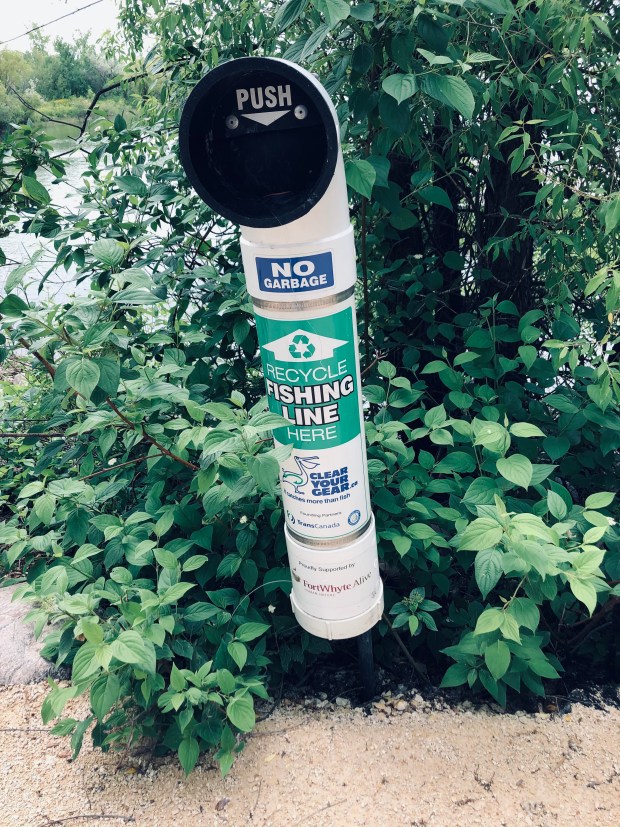
I was also delighted to see another monofilament line disposal tube when I was at Wildlife Haven yesterday by the pond. I wonder if we can get our City to place these at fishing spots along the river? and actually have people clean them??
A wonderful conversation with a fellow bird lover caused a discussion about Imperial Eagles and weights of eagles and well – all things stork and eaglet! In the posting about Little Bit, the staff at Humane Wildlife Indiana stated that he weighed 2.7 kg or 6 lbs. In his study of Bald Eagles and in other research since, Northern Bald Eagles (Michigan and Alaska, Canada) are larger than those hatched in the South (Florida and Texas). In addition, fledglings are larger but lighter than their parent of the same gender. Because he survived on so little food, it is unclear what gender Little Bit is – I have always referred to him as a male because he is so tiny. At any rate, the conclusion is that he is 50% underweight and should be approximately 4.08 kg or 9 lbs.
So far over $2500 has been donated to care for Little Bit! The Notre Dame Eagles FB group is hoping that will reach $3000 by the 4th of July. That would be fantastic.
You may have tried to find the little storklets inside the vet clinic in Estonia but, they are not there and there is no camera. They were named Bonus, Janus, and Junior. Their nest was moved outside near the clinic. But, also, there are no storklets there. Bonus was moved to live with Karl II and Kaia in the Karula National Forest. Janus has been placed in the nest of male Eedi (no camera) and sadly, little Junior fell and broke its wing in many places. Here is the statement from Urmas:
Bonus has adapted to living with Karl and Kaia and their three chicks and just a moment ago I got word from ‘T’ that “a trail camera was placed next to the nest and its pictures show that the foster child has also adapted to life in the nest like Bonus.” This is excellent news. Now they can spend the last part of their nest life being with live storks, growing, fledging, and migrating. So happy for the team in Estonia.
“At night I brought back the chick to the outdoor nest in vet clinic. That is actually the same nest you watched, we moved it in whole from indoor isolator box outside. So the chicks knew the nest nearly 20 days already. If placed back the chick which travelled, I added some fish to the nest. As it was in darkness, they did not see the fish, but probably noticed the food in morning. It is speculation, but there had to be some accident in early morning. Maybe they started to fight for fish and smallest appeared in wrong position. It is only about 1m from ground, but for quite fat juvenile it could be too high, if to fall to the side, with opened wing… Nobody could enter there simply so to disturb the chicks, so it is not easily understandable accident, with that serious injury. Today there will be another attempt to add fourth chick in natural nest.”
Bonus is well integrated into the family now. I am delighted for the team who worked so hard at interventions that would save Jan and Janika’s chicks. Two have survived. This is a feeding by Karl II showing how well Bonus and the other biological chicks are doing.
A conversation with a friend in France led me to return to check on the Imperial Eaglets whose nest is in Russia. They are so gorgeous and the two of them are big! Have you been checking in on them?
They are just getting their juvenile feathers. Have a look at their size in relation to the female. Beautiful – and two of them!
Big Red and Arthur’s Ls are really quite amazing. I am shocked at their flying skills – although I would like them to stop flying so low over Tower Road! They are also doing a lot of ‘hunting’ along the fence lines. Suzanne Arnold Horning took these images this morning. Thank you SAH for allowing me to share!
It is what we have been waiting for – a fledge at the Rutland nest of Maya and Blue 33 – those three big girls. It was 1H1 that took off and returned first! Congratulations on your first fledge of the 2022 season Rutland.
The departure was at 0534:
The return!
There are three growing chicks this morning in the Boathouse on Hog Island. Sadly, we now have to count them carefully after so many spills out of the nests this year.
Skiff.
Dory and the three chicks. They are now in the Reptile phase. Their plumage is changing and they will appear thin and lanky. It is often, during this phase, that they also begin beaking one another. It is a period of very rapid growth and they require lots of fish.
Osplets triple their body weight during the first 8 days and then during the next 4 days they will double that weight. In the Reptilian Phase which begins at about 20 days, the osplets will molt all their lovely light grey down and it will be replaced with the darker thermal down. Feathers begin to emerge and you will also see a lot of preening. I do not know if the growth and itchiness of the feathers causes osplets to get anxious and aggressive but on nests with lots of fish you often see some beaking before the juvenile feathers are really starting to emerge.
Dory and the chicks.
There are three chicks on the Fortis Exshaw Nest in Canmore, Alberta. Yes! The nest is holding. They were enjoying a nice fish when I checked in on them this morning.
The two at Osoyoos are also still on the nest and their feathers also appear to be changing into the Reptilian Phase. I watched one lean way over the side of the nest — a little scary. Fingers crossed for this family!
The two older osplets at the Mispillion nest are doing great! This is a nest that needs information – dates eggs laid, hatch dates, etc. These two have a full body of juvenile feathers. Fledge is not long off.
It is noon on the Canadian Prairies and it is a gorgeous blue sky day with bright sunshine. The three Blue Jay fledglings have more feathers and are so quick to get into the lilacs to hide from my camera and to eat the solid nutty cylinder – well, I would like to get a good look at them! At one time Mr Crow was taking exception to their presence on his turf but that seems to also have settled. Little Red is happily settled in his new tree home and the three little ones are as big as he is today. I might get some images of them today. Hedwig was here yesterday as was the wee baby rabbit who is now 3x the size he was when I first spotted him in the grass. This afternoon I am going to try and a new park for walking and bird watching. I hope to have some images for you later today.
Thank you for joining me. Take care everyone! See you soon.
Thank you to the following for their streaming cams and/or FB pages where I took my screen captures: Humane Wildlife Indiana, EMU, LRWT, Mispillion Osprey Cam and DDNR, Explore and Audubon, Osoyoos Osprey Cam, Suzanne Arnold Horning and Cornell Chatters FB Page, Russian Imperial Eagle Cam, and Fortis Exshaw.
It is a hot sunny and beautiful day on the Canadian prairies. The Farmer’s Markets are opening up, there are still lilacs blooming, and well…I wish the ice cream truck would come down the street!!!!! I did my walk. 5.8 km and it was way too hot!!!!!! Dreaming of winter. LOL.
SF Ospreys posted a video on YouTube showing Molate incubating the nonviable egg. Just look! Perfect aerating, rolling, and incubation! They asked viewers if it was an accident or deliberate. What do you think?
ND16 has joined fledgling ND15 up on the fledging branch at the ND-LEEF Bald Eagle nest in Indiana. Little Bit 17 is still enjoying being the baby on the nest!
Update: ND16 has fledged. It has not been located as far as I know.
Little Bit 17 is doing just fine. With the two older siblings having fledged and thinking about flying, Mum flies in at 15:57 and 17 gets a private feeding. So far the nest is holding fine. Dad and Mum have some work to do. I wonder if they will rebuilt this nest??
Can you tell the difference between Idris and Telyn’s chicks? I sure can’t anymore. Ringing next week and then names given!
All three of Thunder and Akecheta’s fledglings (doesn’t that sound nice?) can be seen. Some nice soaring in the thermals this morning by at least one of them. I think it was Ahote but not 100%.
‘H’ reports that Mum brought in a Horse-shoe Crab yesterday late and arranged it on the nest – and Dad brought in 9 fish, too. Wow. ‘H’ also had a screen grap that shows what is in that second plastic bag – a water bottle! I wonder where she finds these things. This female does like to decorate her nest. Oh, I would love to get into her head about that love of yellow. It is striking and certainly brightens up the nest. Thanks, ‘H’!
That worrisome piece of yellow mesh wire was still on the nest. One of the chicks was using it as a pillow!
Mum is very smart. Maybe she is worried about that mesh as well.
She removes it from the nest!!!!!!!! The raptors are extremely intelligent. Never think that we are smarter than they are. Some of you will know my huge respect for falconer, Laura Culley. When Big Red’s daughter J1 had been killed by striking a window, someone asked her if Big Red knew. Culley’s answer was, “And why wouldn’t she!”
She has returned unharmed and Dad can be seen, too. It is extremely windy. I am hoping those plastic bags will fly off as well.
Cal Falcons has posted the cutest video clip of Grinnell Jr – loudly saying he wants his breakfast!
If you are following Jan and Janika’s three surviving storklets that are in care at the Vet School at EMU (Estonia Medical University), they have done exceptionally well in care. They are all standing (only one not completely steady is the smallest storklet) and are flapping their wings an getting their juvenile feathers. In two days they should be going to an outside location to help prepare them for when the fledge.
The storklets of Karl II and Kaia are also growing and are doing so, so well. Notice how they form an immediate circle when it is feeding time.
Betty and Bukacek’s storklets are doing fantastic, too. So all three of the nests that I follow – Karl II and Kaia, Jan and Janika (in care), and Bukacek and Betty are progressing well in order to fledge in August. They will return for feedings and then they will fly all the way to the central part of Africa! Incredible.
It is pretty quiet in Bird World – for a change! Thank you so much for joining me for this check on some of the nests. Do take care. See you soon.
Thank you to the following for their streaming cams where I took my screen captures or their videos: EMU, Capio Hnizo- Mlade Buky, Eagle Club of Estonia, Cal Falcons, ND-LEEF, Mispillion Harbour Osprey Cam and the DDNR, Dfyi Osprey Project, SF Ospreys, and the West End Eagles and the Institute for Wildlife Studies.