Things are happening in Bird World

Oh, just look who showed up on the NorthEast Florida Eagle’s nest in Jacksonville today – none other than the resident male, Samson! It was 7:23. So very nice to see you, Samson.

Samson is the son of Romeo and Juliet. Samson hatched on this very nest on 23 December 2013. Samson fledged and left the area on 22 April 2014. He was 120 days old.

At the end of the summer in 2019, in August, Samson arrived at the very nest he hatched from and began bringing in sticks. His mate, Gabrielle arrived on the nest on 12 September. In May of 2020, their two chicks, Jules and Romey, named after Samson’s parents, Romeo and Juliett, fledged. In 2021, they fledged their only hatch, Legacy.

The picture below is of Mama Gabby and baby Legacy in February 2021.

Samson has been seen at the nest earlier this month when the technicians came to do the maintenance on the streaming cam. Samson remains in the area of the nest year round while Gabby migrates to a cooler place – although, as I have often said, I don’t know where that would be this year! She will return about the middle of third week in September. It will be wonderful to see her back. Can’t wait.

Samson may be working on a nest but the Peregrine Falcon couple, Diamond and Xavier, are expecting eggs in the nest week or a week and a little bit. Their scrape box is high on a water tower, 170 steps up, on the campus of Charles Sturt University in Orange Australia.

This is Diamond on the ledge of the scrape box today.

Diamond and Xavier’s 2021 fledgling, Izzi, was the joy of everyone. As the only little falcon he was loved and spoiled by his parents. There was some concern he would not leave the scrape box before this year’s eggs are laid. This is the latest message from Cilla Kinross, the head researcher on the Falconcam Project:

“Izzi has not been in the box now for 12 days, but we think he is still around from calls. Parental behaviour continues as normal, with up to three prey a day being delivered to Diamond and preparation of the scrape. Eggs are expected soon (within a week or two). Generally, Diamond starts to spend more and more time in the scrape and her backside looks large and fluffy.”

You can watch Diamond and Xavier here:

Peregrine falcons are nothing short of amazing. Bald Eagles are big but Peregrine falcons are fast.

“Peregrine Falcon” by Jon David Nelson is licensed under CC BY-NC-SA 2.0

The cere is the yellow part above the beak. Now look at the nostrils in the cere. There are small keratinous tubercules – they look like small little bumps inside the nostril. Can you see the one on the right nostril of the falcon above? Those are what help the Peregrine Falcon fly so fast. They serve as a baffle against the wind driven in so forcefully into the lungs of the falcon as they do their high speed dives. Otherwise, their lungs would burst.

“Faucon pèlerin / Peregrine Falcon / Falco peregrinus” by FRITSCHI PHOTOGRAPHY is licensed under CC BY 2.0

Most Peregrine Falcons that you will see on a streaming cam lay their eggs in a scrape box like the one of Diamond’s, above. Some make their nests on the side of cliffs like this one in Japan on the island of Hokkaido.

“Peregrine Falcon Nest” by Ken-ichi is licensed under CC BY-NC 2.0

Peregrine Falcons do not make their nest out of twigs. It is believed that this helps to stop the spread of disease from twig nests pests like flies and parasites.

Here is a short 8 minute video to introduce you to the speed and hunting methods of the Peregrine Falcon:

It’s a great day for Malin! We do not know Malin’s exact hatch date. There were three chicks and the youngest hatched on 18 June. Two chicks perished in the heat. So Malin is either celebrating his two month hatch today or his two month hatch and a couple of days, more or less. His first delivery came around 9am and the second was at around 10:14. Malin is really growing.

Here is Malin next to mum, Marsha, this morning. You can see that Malin’s feathers are growing in nicely. Look at the crossing of those wing feathers. Yippeeeeeee. This chick has really grown with the increase in feedings.

And look at all of the bands on those tail feathers – looks like a clean 7 – while, at the same time, there are no spaces in the wing feathers.

Oh, Malin, aren’t you beautiful?

Malin has gotten very good at self-feeding.

Malin is off to a great start on Wednesday. Terrific.

It is raining heavy in Latvia at the nest of Grafs and Grafiene. There are some concerns on the amount of energy used to keep warm by the nestlings.

This is the nearby ditch. It is 200 m long. A portion of the ditch has been closed off and fish have been placed in there along with the decoy of Grafiene. The decoy of Grafiene was painted by an active chat participant and installed by Janis Kuze, the ornithologist.

I hope you don’t mind if I correct just minor details. The beautiful decoy was painted by the active chat participant B.K. and installed by the ornithologist Jānis Ķuze.

These are the size of fish being put into the feeder for Grafs. So much effort. Now we need Grafs to find this spot for his three storklings. It is a very, very difficult time for everyone especially with the rain. If you would like to check on the Latvian Forum for progress, please go to this link:

The situation of the Black Storklings in the nest in Jegova County, Estonia appears to be better than in Latvia. Jan has come to the nest to feed the storklings 3 times today. The storklings have not almost completely depleted the fish that was brought on the 13th when they received their transmitters and bands. They appear to be healthy and doing well. It is not raining on this nest today.

The three storklings are 63 and 64 days old today. The average for fledging appears to be 71 days but then the young storklings are dependent on their parents for another two to three weeks before leaving the nest area. That only puts us at the end of the first week of September for these three to be totally independent of Jan — but, of course, those numbers are only averages. It appears there is time! We all must hope for these birds. They are very rare and very special and there has not been a lot of studies done on them.

The Forum with ongoing information on the Estonian Black Stork nest is here:

Karl II has been in to feed the one fledgling on the Black Stork Nest in the Karula National Park in Estonia. Oh, that fledgling was so happy. That was at 18:33. It is Urmas, the only chick still being fed by a parent. Kaia has left for her migration and the other two siblings appear to have left the nest area and might be travelling as well.

I know that there is much sadness and anxiety in the region for the two Black Stork nests that had late hatches. But, we must also celebrate the happiness of this nest in Estonia, that of Karl II and Kaia. Three fledglings, all healthy! We need to send the most positive wishes for Kaia and the other two siblings as they make their way through Europe trying to get to Africa. And, then, of course, for Karl II and this storklet when they begin.

I have tried to catch the number to confirm this storkling but it is nearly impossible.

The smudge is right in the way!

For those of you watching the North American migration, it kicked off Sunday, the 15th of August at Hawk Mountain in Pennsylvania. The first over the ridge that day was a Broad-winged hawk. There was a strong wind that day and the count was 4 Bald Eagles, 2 Cooper’s Haws, 25 Broad-winged Hawks, and 3 American Kestrel. If you would like to check on the migration in North American on the route over the mountains with all their thermals, here is the place to go for a day to day check in:

https://www.hawkmountain.org/conservation-science/hawk-count

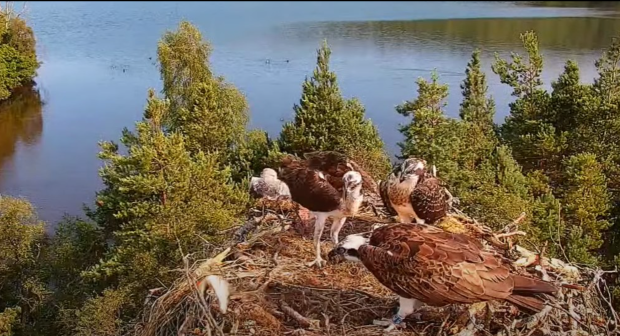
It’s 17:16 in Cumbria in the UK and our second great Osprey chick survivor this year – Tiny Little Bob on the Foulshaw Moss nest – is waiting for dad, White YW, to bring her the teatime fish! Every day is a blessing to see you on the nest, Tiny Little (Blue 463).

Thank you so much for joining me today. Please send all your positive energy to our friends in Latvia and to Grafs for him to find the feeder and for the safe migration of all of the birds. Take care everyone. See you soon.

Thank you to the following streaming cams and forums where I grabbed my screen shots: The Forum for the Latvian Fund for Nature and the Sigulda Black Stork Nest, The Eagle Club of Estonia and the Black Stork Nest at Jergova County, The Eagle Club of Estonia and the Black Stork nest in the Karula National Park, Collins Marsh Nature Centre, Northeast Florida Bald Eagle Cam and the AEF, Cumbria Wildlife Trust and the Foulshaw Moss Osprey Nest, and Cilla Kinross and the Falconcam Project at Charles Sturt University in Australia.

Monday in Bird World

There is some sad news coming in from the Kakapo Recovery. During routine checks, Tutu was found dead. He hatched in 2019 and the team says he was quite ‘the character’. This brings the total population of Kakapo in the entire world to 201.

Photo of Tutu @ Petrus Hedman Kakapo Recovery FB

The news coming in is not all bad but, it could be a lot better. I reported that Grafs had provided two feedings for the Black Storklings on the nest near Sigulda. As it turns out, after I posted my newsletter, Grafs returned two ore times making a total of four feedings on 15 August. The team are hoping that Grafs will find the feeding table. If Grafs does and accepts the food, this nest could turn around quickly! At the present time the storklings are in a critical condition.

This is the news from Janis Kuze:

“I can report that fish were let into the feeder last night, the place is a few hundred meters from the nest and is easy to see from the air, but the bird still has to find it.
Thanks to everyone who provided support!”
Jānis Ķuze

Grafs arrived with some larger fish for the storklings at 14:47. He has yet to find the feeding table. Some are thinking that it might not be in his territory. There is a discussion about putting a decoy black stork to attract Grafs.

A feeding table has also been set up for the Estonian Black storklings of Jan and Janika. I understand a decoy – a White Stork decoy painted black – is at that table to try and lure the male to the fish for the storklings.

Yesterday I said that the storklings had eaten all of the fish. That was incorrect. They have been stomped into a pile but the Estonian storklings are still eating from them today and they have had a feeding from Jan. You can see the remaining fish today on the back left of the nest. Thankfully the nestlings are eating from them. If you look at their bills they are still a dull colour which is good. They are also not getting stress lines in their feathers like the storklings of Grafs. Stress lines are translucent feathers caused by all manner of stresses not just lack of food. Regular growth in feathers is not translucent.

Here is the link to the streaming cam of the Black Storklings in Latvia:

Here is the link to the streaming cam of the Black Storks in Estonia:

If you want to keep up to the minute with what is happening at either or both of these nests, please look under the information of each streaming cam. You will find the link to the English forums.

Please be mindful that these are extremely difficult times for the moderators and helpers on the chats and the forums. These two nests showed great promise – the best – and as I have said many times — the fate of our birds hangs on a fragile piece of thin thread. It can change any moment. The biologists and vets are doing everything possible. We need for the male storks to find the fish tables. Send your warm thoughts to all. The little ones need a miracle.

UPDATE: It appears that Jan has found the fish table. He has flown in and brought 2 very large fish to the nest in Estonia. There are also fish left there from the bander! Great news. Let us hope this continues and now we just need Grafs to find the fish.

And now on to some rather silly news. Blue 462 at the Foulshaw Moss Osprey Nest in Cumbria, got the breakfast fish. And, of course….Tiny Little was right there making sure her big sibling could not eat in peace. Tiny Little is giving them back what they gave to her as a youngster in the nest!

Tiny Little loves moving around the sticks. It is really disturbing to the one who is trying to eat.

One of the cameras got knocked but what it did was give us a nice close up of all those sticks Tiny Littles moves and returns, moves and returns.

There were others wanting some of that fish – those pesky crows who seem to be around, too.

Tiny Little kept running at the crows to get them to go away but finally, it was 462 that flew away leaving Tiny Little that great big fish all to herself. Do you think Tiny has enlisted the crows to help her? with the promise she will leave some food? Normally, Tiny Little is like a vacuum cleaner removing every piece of fish!!

In the image below, 462 has just flown off the nest. Tiny Little is moving towards that big fish she is going to have for breakfast.

Tiny Little spends some time making sure the siblings and the crows are not going to bother her. At one time or another the crows were climbing and flying around that part of the nest. But never mind. Tiny Little started 16 August off with a nice big crop. Well done Tiny Little.

It’s now 17:30ish on the Foulshaw Moss nest and Tiny Little is there calling White YW for food along with another sibling. It looks like 464 to me but I cannot catch the band number. Tiny Little is the fledgling at the back.

Tiny Little is such a character. She is one of the good news stories of the year for sure! I really hope that when she returns to raise her family it is on one of the nests with a streaming cam.

Do you recognize this view?

That is the scrape box for the Collins Street Falcons in Melbourne! and the YouTube channel is up and running. This is fantastic news to all of us that have waited to see this couple and their eyases again. Dad is just the cutest.

Both parents are working on the scrape box. That is mom in the image below.

Here is the link so you can be in on the action from the very beginning:

It doesn’t get any cuter nor any happier than the little sea eaglets in the nest on the old Ironbark Tree in Sydney’s Olympic Park.

Both of them are thriving! That is 27 facing us with its big crop and 28 is still eating.

Yesterday, Malin went to sleep with his head on a fish and another whole Bullhead on the left side of the nest. He woke up this morning and finished off the “pillow fish” and Marsha flew in and fed him and ate a lot of the Bullhead herself.

Malin has a nice big crop! Mom is getting some fish and that catch did not go to waste. And that is a good thing.

Thank you so much for joining me today. This newsletter comes about six hours earlier than I expected. It is nearly 100 degrees F on the Canadian Prairies and the birds are in hiding. No photography until later. I will continue to monitor the two Black Stork nests and bring updates. Send your prayers and your warm wishes to those two Black Stork nests. They need a miracle to get the males to accept the fish! Bukacek did so we need Grafs and Jan to do the same!

Thank you to the following for their streaming cams or their FB pages where I took my screen shots: The Kakapo Recovery FB, Collins Marsh Nature Centre Osprey Cam, Sydney Sea Eagles, Birdlife Australia, and The Discovery Centre, Cumbrian Wildlife Trust and the Foulshaw Moss Osprey Nest, 367 Collins Falcons, The Eagle Club of Estonia and The Latvian Fund for Nature.

Four rare Hen Harrier chicks fledge in Derbyshire

One of the big announcements came today when four extremely rare Hen Harrier Chicks fledged in Derbyshire, England. They were predated by hunters and owners of estates where grouse hunting was popular as well as ‘land management practices’. They are now protected under the 1981 Wildlife and Countryside Act.* In North America, the Hen Harrier is called the Northern Harrier while in France it is the Buzzard of St Martin.

Hen Harriers are a bird of prey like most of the birds that I write about. They are related to kites, hawks, and eagles. Have you ever heard of them? or seen one?

The males are pale grey as in the image below. The primaries are a dark espresso colour. Here the male is flying low over the countryside looking for prey.

“Hen Harrier” by ressaure is licensed under CC BY-NC-SA 2.0

Here is an image of the underside of the male Hen Harrier.

“Hen harrier male, Circus cyaneus” by peter.v.b is marked with CC0 1.0

The females are brown as are the juveniles with a white rump and long barred tail. The females are often called ‘Ringtails’ because of the bars or bands on the tail. Like the Honey Buzzard their heads are rather small in comparison to other raptors. They will measure no more than 42 cm with a wing span of 120 cm. They weight less than a pound at 300-400 grams. Hen Harriers eat small birds and mammals. Besides flying low and finding prey, they also use the cover of bushes in the woodlands to surprise and take their prey on the ground (normally).

“Hen Harrier (Circus cyaneus)” by gilgit2 is licensed under CC BY-SA 2.0

When hen harriers are courting, they do a fabulous sky dance or rolling and tumbling. The Hen Harriers normally lay 4 to 5 eggs in a nest on the ground or in cattails or long dense grass. The male and female both take care of the chicks but the males provide the food. They hunt it and when successful pass the prey to the female by tossing it at them mid-air. They would make great softball players!

Look carefully at the image below. Notice that the facial features of the Hen Harrier look like an owl. Like owls, they have a parabolic facial disk which allows them to hunt by sound (like owls) as well as their incredible ‘hawk’ eyes.

“Hen Harrier (Circus cyaneus – Albanella reale)” by Lorenzo L M. is licensed under CC BY-NC-ND 2.0

*There continues to be the debate between the grouse hunting societies and those that protect birds and want grouse hunting banned. Any number of associations who do not support the killing of animals are active in supporting the reintroduction of the Hen Harrier. You can do a simple search on Goggle for ‘Hen Harrier Myths’. There is even a Hen Harrier Day celebrated in the Highlands of Scotland.

Other Bird World News:

Foulshaw Moss Osprey Cam, Cumbria: After waiting and moving about sticks, Tiny Little (Blue 463) was prey calling and in flew big sibling chasing after Dad or White YW. 464 took the fish and then flew off with it. Poor Tiny Little.

Nasty older sibling!

WBSE in Sydney Olympic Park, Australia: Well, they just can’t stop getting cute!

Collins Marsh Nature Centre, Wisconsin: Malin is looking really good to me. I focused on her wings whenever I checked in. She has been fed and the feathers look grand. I can also see four bands or bars on the tail now so Malin is continuing to grow and develop.

Besides this lovely tail growing and those gorgeous scalloped back feathers – I adore Osprey, can you tell? Malin is no longer dragging one of her wing feathers. It just seems it took almost 7 weeks to get these things sorted. Joy. Real joy. What a beautiful Osprey chick?!!!!!!

Patricia Fisher, the local wildlife rehabber just wrote and agreed that Malin’s feathers are looking much better. They still have to cross but fingers crossed on that one. More Joy. Thanks, Patricia for keeping an eye on this little one with all you have to do.

Port Lincoln Osprey Barge, Australia: Mum is busy rolling two eggs and I believe there remain two, awaiting third. Dad and her have been taking turns incubating.

Dad has returned to see if Mom would like a break. He is annoyed by the blue rope material and Mom seems to be annoyed by him pulling it out from under her! What a pair.

Fortis Red Deer: It is embarassing. I have not mentioned our Canadian Ospreys in Alberta for awhile. When I last checked you could only see Legacy’s little head hardly extended above the sticks. Look at this beauty now. Wow. These chicks have grown. This is what I want to say about Malin’s growth at Collins Marsh in a week!

Fortis Exshaw, Canmore, Alberta: It looks like the ospreys were practicing with their ‘ps’ or there was rain and enough blowing wind to throw mud balls up on that lens!

The good thing is that you can hardly tell which are the two chicks and who is the adult. Incredible.

It has been hot but more than that the smoke pollution has made it difficult to breathe at times on the Canadian Prairies. I am keeping an eye on the White Rock fire in British Columbia. You might all know Dr Christian Sasse and his love of Bald Eagles and Osprey. He often streams live generously showing us these beautiful birds. Well, his cottage where he streams them is in the path of the fire. Send warm wishes his way as well as all the wildlife in the region. The White Rock fire is misbehaving badly, not doing normal things so the firefighters are really having a time of it.

Thank you for joining me today. I had hoped to bring you some local hawk pictures. I am heading out hopefully later. Take care everyone.

Thanks to the following for their streaming cams: the Collins Marsh Nature Centre, the Sea Eagle Birdlife Australia, and Discovery Centre, Cumbrian Wildlife and Foulshaw Moss Osprey Nest, Port Lincoln Osprey Project, Fortis Alberta Red Deer, and Fortis Alberta Exshaw. A Special thanks to Patricia Fisher from Wisconsin who cares about Malin and takes time to answer all our questions. I am so grateful.

Tiny Little, it is good to see you!

Friday morning started off fantastic with Tiny Little on the nest alone food calling. She was later joined by older sibling, 462.

What you need to know is that Tiny Little had an entire fish to herself a little earlier for breakfast! Just look at her enjoying that fish!

7:45 nest time. Nice fish delivered by White YW to his girl.

Tiny Little returned later and was joined by 462. Yes, I said that already! They waited and waited. All that waiting and food calling paid off! Both Tiny Little (or Bobbie to some) and older sibling got a fish – older sib gets the flounder, Tiny Little has something else (?). Dad, you are fantastic. This is the way to keep the kids happy and quiet.

Tiny Little is the fledgling on the right. She is a ‘big’ girl! I am just so delighted to be able to see her. She is growing and growing. Tiny simply doesn’t fit anymore!!!!!!

This is the link to the Osprey Nest at Foulshaw Moss managed by Cumbrian Wildlife Trust:

https://www.cumbriawildlifetrust.org.uk/wildlife/cams/osprey-cam

But there was more happiness. To top it off, the little Osprey nestling at Collins Marsh Nature Centre had two feedings before 9:30 this morning. If this pace keeps up Malin is really going to have a big growth spurt this week. Already the tail and back feathers are remarkably changed from last week.

And another feeding here. So happy to see these parents stepping up the food. Malin is really starting to present as a juvenile Osprey now. I keep looking at those little feet – wonder if we have a little boy here? Male or female it doesn’t matter. Malin is really a gorgeous/handsome.

The link to the Osprey nest at Collins Marsh is here:

https://www.cumbriawildlifetrust.org.uk/wildlife/cams/osprey-cam

One of my readers was asking about the nest for the Black Storks in Latvia. I was able to find some information and a couple of images so that you can see the beautiful forests in the area.

The nest is in a forest in the Sigulda region of Latvia. It is 53 km southeast of the capital, Riga. It is the orange area on the map below.

The area is home to Sigulda New Castle and the remains of a medieval castle built in 1207.

The image below is the New Castle.

“Siguldas jaunā pils (Sigulda Castle)” by twiga_swala is licensed under CC BY-SA 2.0

Through the forest you can see the New Castle.

These are the remains of the medieval castle. It is a major tourist site and because of this, Latvia has stabilized some of the walls so it can be fully appreciated.

The nest in the forest is on a pine branch that extends about 1.8 metres from the trunk of the tree. So, in plain English, the nest is on a branch that is sticking out —- just a big branch! I know. Take a deep breath. It could make you nervous. The nest is 18 metres from the ground. Imagine these storks on such a branch! I kept thinking they could slide off the edge.

The youngest storkling is 53 days old today. It is flapping its wings and gets really excited. The eldest is 56 days old and the middle one is 54 days.

The adults, Grafs and Grafiene, have to be very careful when they come to feed their little ones now so they do not slide off the nest. It is getting a little crowded as the nestlings grow!

One of the moderators for the nest forum created a video of Grafiene coming to feed the storklings about one month ago. It is very short but shows us just how much these nestlings have grown in that time. Just look how tiny they were.

All of the storks meet to begin their migration. ‘S’ tells me that they land on the tops of all the houses, the hydro poles, and the trees. And then they begin clacking and this is the beginning of their long journey as far as South Africa. Everyone is a little sad when they leave.

The link to the Latvian Black Storks is here:

Don’t all babies look sweet when they are sleeping? The little sea eaglets are no exception. You would never know that they are so tired from all the mischief they cause when their parents aren’t watching.

They look like little angels.

Dad is making sure that there is lots of food on the nest.

Here is the link to the White-Bellied Sea Eagle nest in Sydney’s Olympic Park. It is the only WBSE nest in the world that is streaming live. One of the really neat things is just listening to the forest sounds when the streaming cam is on. You will hear many Australian birds. There are lots of YouTube videos of the birds and the sounds they make. Just do a search of ‘Australian Bird Sounds’.

There has been a lot of chatter about when the female ospreys in the UK will be leaving the nests and heading off on their migration. Blue NC0 is still up at the Loch of the Lowes working hard, along with Laddie, to feed LM 1 and LM 2. She is known to catch big fish and this morning she brought in a whopper. The sad part was NC0 worked so hard to get this fish out of the water and on to the nest and one of the kids let it fly off the nest. It happens but we all must appreciate the real effort these parents put into feeding these juveniles especially when they must be eating themselves, fattening up, to make their journeys.

NC0 has turned into one wonderful mom over the season. It has been such a joy to watch her develop from when the little ones hatched and we had no idea if she was going to figure out how to feed them!

The fledglings still associate the nest with food so you might still get in some good action. This has to be one of the most beautiful nest locations in the world. When I went to check, I could see the Ospreys flying around and food calling on the branches at the top left of the image below. So turn up your sound and look there when you check on this nest.

Here is the link to their camera:

I checked to see if the names had been announced for Louis and Dorcha’s chicks on the ‘other’ Lock Arkaig nest. There seems to be no mention or I have missed it. So hold on. Will let you know as soon as I hear anything! I am also waiting for the Collins Street Peregrine Falcon cam to come on live. You are going to be in for a real treat with that falcon nest! I promise.

Thank you for joining me today. I hope everyone is well. Tomorrow I am heading out to find the local hawk. Expect news to come in the late afternoon for all the nests. Enjoy your weekend. Stay safe.

Thank you to the following for their streaming cameras where I took my screen shots: The Latvian Fund for Nature and the Sigulda Black Stork Nest, the Collins Marsh Nature Centre and Osprey Cam, the Sea Eagles, Birdlife Australia, and Discovery Centre, the Scottish Wildlife Trust and the Friends of the Loch of the Lowes.

Bird World Happenings. 27 July 2021

Oh, so many of us are having Empty Nest Syndrome. It is that time of year. You go and check to see if there are any Osprey fledglings on the nest – and no. Poof. Gone. It suddenly sets in that those precious little fluff balls have grown up. They have fledged and are gaining their flying skills for migration. Osprey breeding season is almost over. There are a chicks few trailing behind – Collins Marsh and Chesapeake Bay to name a couple in North America. There are still chicks on the nest in Manitoba but there are no streaming cameras. The Port Lincoln couple on the barge are only ‘thinking’ about eggs. Those will come mid-August most likely. So what does one do?

One of the first things is to treasure the moments we got to spend with these bird families. It is a privilege to see them living their daily lives. There is a saying in Japanese – Ichigo ichie. It was coined by the great tea master, Sen-no Rikyu. His meaning focused on the sharing of the tea ceremony and the realization that you can repeat the ritual but you can never re-create that moment with the same person ever again. You must live it to the fullest with the deepest respect. In terms of our birds, I would like to think that we must treasure every moment that we can share with them and give them our attention. It truly is a once in a life time encounter. Tiny Little will never again receive a huge fish and fend off its sibling with that same sibling later getting a little tiddler from dad. Those were two precious moments that will never again be repeated. Indeed, I wonder if we will ever see Tiny Little again before her migration. That nest has been awfully empty today.

Some of us began to focus on the few nests that do have chicks. My attention has been on the Collins Marsh Osprey Nest in Wisconsin. It is easy to notice the very odd behaviour of the bonded pair at the Collins Marsh Osprey Nest. It truly is strange. The female disappears for 21 hours! That was when ‘S’ and I began to find other strange tidbits about this nest. The female returns on Sunday morning and Dad spends the day bringing in several fish deliveries. Then on Monday the male brings in the first fish and we don’t see him anymore. It is the female catching the fish and bringing them to the nest. So is there a pattern here? or are we just losing our minds? The female brought in two fish today in the afternoon. One was cream coloured with gold scales but the last one was pink inside and out with gold scales. Any help on IDing these would be much appreciated.

In the image below, it looks like a salmon-red colour. Needless to say the chick went to bed quite full. Every time it started chirping mum was offering fish. She has been very devoted since she returned.

Thanks S for this great screen capture.

A couple of hours earlier Mum brought in this fish. I could not readily identify it either. Regardless of the species, the chick is delighted with the arrival! The faces this chick makes are incredible. Very animated.

This is the approach to the nature centre that is near the Collins Marsh Reservoir and the Mud River in Wisconsin. Look at the left and you will see the ‘retired’ fire tower which is now home to the Osprey nest on the very top of the glass enclosed space that appears above the ‘red’ in the image. Snowy Owls inhabit the nest in the winter. The tower is 33.5 metres or 110 feet tall. The staff of the Osprey centre access the camera within the glass enclosed area. At one time it was thought that there was a portal from the glassed area to the nesting platform but it turns out that is not correct. There is no ‘easy’ access to the Osprey nest. Getting to the nest physically to do a wellness check on the chick, right now, would mean finding a person with particular skills and then being certain that it was safe for them.

courtesy of Wikimedia Commons

You can see that the nest is slightly off centre and is situated on a sort of cone hat with the camera on the pole at the corner.

Looking at this got me to thinking about access. It is quite true that there are raptor nests that can never be accessed. Eagles and Ospreys love to make their nests in extremely high places away from us! That said I have known or witnessed ‘tree climbers’ in Germany whose skill set is such that no tree defies them unless the tree itself is unsafe. This is an interesting situation at Collins Marsh. The Wisconsin DNR Biologist and the Wildlife Rehabilitator continue to monitor the chick in terms of feather growth, etc. That is great news. The question then arises: if the chick displays in another week or ten days problematic feather growth, what can be done? With the access so difficult, it would seem nothing. So let’s keep our fingers and toes crossed that nothing is wrong with the feathers! It would, however, seem prudent to explore the possibility of a portal access to the nest once the Ospreys have migrated and before the Snowy Owls take over. I hope that it is never needed but, if it were, it would be a win-win for everyone. All of that said, it would require the services of a structural engineer to figure out the best way to do this. Maybe there is someone who is qualified and loves the raptors that might, at least, consider if this was possible and do it as a donation of time to the centre. That would be grand.

Tuesday morning at Collins Marsh Osprey Nest: The day began with rain and then wind.

Mum left later and returned with a small fish/ a twiddler.

Mum leaves the nest three times after this. Very different behaviour than Monday. Dad does come to the nest and delivers a piece of fish. The chick winds up with a bit of a crop.

At the moment, the chick is on the nest alone. It is windy and the temperature is currently 24 degrees C going up to a scorching 30 degrees.

Mum returns and the chick joins her in fish calling to Dad. Oh, I hope the fish arrives and mum stays to shade the baby today.

The Cornell University Red tail hawks are still putting smiles on everyone’s faces. Suzanne Horning was out yesterday evening checking on them. I remain ever so grateful that she lets me share her images with you.

K3 and those beautiful celadon eyes just strikes right at my heart. This little one has, according to the boots on the ground, turned into a magnificent flyer.

K3 sees Arthur and immediately starts calling for food. You will notice that when the chicks do not see an adult they generally do not food call but when they do see someone who might bring ‘a food delivery’ you can hear them crying several blocks away!

K1 had a nice spot on top of one of the light stands. These stands have been, in past years, great places for the chicks to eat their prey. They are nice and flat on top.

If you cannot see their tails it takes a few moments to sit and figure out which K you are looking at. In this instance, the belly band has more red than the chick in the image above.

This is such a beautiful close up of K1. Look carefully at that beak – that very sharp point for tearing the food – and then look at how clean it is. You will see the chicks cleaning their beaks on all manner of things – sticks, tree bark, grass. At the same time they are also sharpening them. Like their feathers they need this ‘tool’ of theirs clean and sharp.

Here is a great little article that goes into more depth on the reason you see birds rubbing their beaks. It is short and very informative!

https://www.audubon.org/news/heres-why-birds-rub-their-beaks-stuff

Big Red is doing a kind of hawk walk while she is looking for prey. She is our gorgeous matriarch and every second seeing her reminds us how precious she is.

The Hornings did see Arthur but I don’t have an image for him. Both adults are moulting now and look a little scruffy.

Some of you have been asking about Arnold. Well, look at that picture of Arnold with his mate, Amelia. His wounds have healed enough that he now has a waterproof bootie and can spend some outdoor time with Amelia. If Arnold continues to improve – and why wouldn’t he with Amelia there cheering him on? – he could be released in a couple of weeks. That is wonderful!

@ Cape Wildlife Center

A few nest checks for the UK Ospreys and wow, lucky was with me.

There is one very loud food crying fledgling on the Loch of the Lowes nest. Looks like it is LR2. He wants his breakfast ‘now’!

Telyn is on the perch of the Dyfi Nest in Wales and Ystywth is eating her breakfast. How lucky she is. LR2 is so unhappy. I wonder if his big sister, LR1, took the first fish?

Ystwyth eating a fish on the Dyfi Osprey Nest in Wales. Telyn is o the perch.

One of the reasons for the big smile on my face is that when I checked the Glaslyn Nest of Aran and Mrs G someone was on the perch! And it is Mrs G. The timing could not have been better.

There she sits – the oldest Osprey in all of the United Kingdom – looking out over the territory that she shares with Aran.

Mrs G on the perch at Glaslyn.

Perhaps if I took one more peek at the Foulshaw Moss nest someone might be there having breakfast. Let’s see!

Well, not only is there no one on the nest but there is not an Osprey to be seen on the parent’s tree in the distance. I wonder if White YW and Blue 35 have taken everyone to the reservoir to try some fishing?

It is now 17:00 on the Foulshaw Moss nest and there are two fledglings hunkered down because of an intruder. “Hello, Tiny Little!”

Ah, maybe there isn’t much of an intruder. Wonder what Blue 464 is hiding? It is a big fish! No wonder Tiny Little is there. I will try and check back later to see if he gets some of it. The fish looks large enough for both as long as 464 doesn’t fly away with it. You can see its tail extending out to the left of the log. Hopefully 462 won’t come around!

Oh, Tiny Little is wanting that fish! She is up to her old tricks. It is a huge fish. Blue 464 will get tired of working at the mouth and walk away if Tiny Little can be patient.

Tiny Little has stepped back. She caused Blue 464 to move the fish a bit and she might be remembering that he did fly away with part of a fish the other day. Just wait, Tiny Little. There will be fish left!

But life throws birds wrenches and today, Blue 464 flew away with that huge fish! Tiny Little is yelling at White YW to go and get another one. Poor Tiny Little!

This is a good overview of what is going on at the nests today. So happy to catch Tiny Little. These moments are very precious.

Thank you so much for joining me today. It is so nice to be with fellow bird lovers. Just a reminder. If you live in a place where it is hot please, if you can, leave out bowls of water for the birds. Old ceramic serving bowls work great. The clay does not get as hot as metal containers. If you leave water for the hummers, make your own. It is 4 cups of water to 1 cup of sugar. Make sure the sugar is dissolved. You can heat it and allow it to cool before putting in the container. Do not use the red commercial hummer food. It actually kills the birds! How sad is that? A company allowed to make a product that actually kills the thing it is supposed to help! OK. It happens with humans, too. Terrible.

Thank you to Suzanne Arnold Horning for allowing me to use her images of Big Red and her family in my blog. Thank you to the following for their streaming cams where I get my screen captures: Cumbrian Wildlife Trust and the Foulshaw Moss Osprey nest, Scottish Wildlife Trust and Friends of the Loch of the Lowes, Bywyd Gwyllt Glaslyn, Carnyx Wild and Llyn Clywedog Osprey Nest, and Collins Marsh Nature Centre. A big shout out to the Cape Wildlife Centre who is caring for Arnold. You are fantastic!

An evening with Big Red, Arthur and the Ks

If you hear the name Ferris Akel, you might recognize the individual that gives a regular Saturday afternoon virtual birding tour of the area around Montezuma National Park, Wildlife Drive, Sapsucker Lake, and the Cornell Campus at Ithaca. Ferris also surprises us with ‘pop up’ tours of the Cornell Campus at other times so that he can see what is going on with Big Red and her family and share it with us. Tonight, we got a special tour and were able to see all four members of the Big Red family.

For those of you unaware, Big Red is a Red-tail Hawk. Red tail hawks are easily identified by their bright orange-red tail feathers once they are adults. The females are larger by approximately 30% than the males. This is called reverse sex size diamorphism. Red tail hawks have amazing eye sight. They will scan for food while they are soaring or are know to sit quietly on a perch for long periods of time watching for their prey. They will immediately fly to get it. Unlike the Peregrine Falcons who take their prey in the air, Red tail hawks normally fly down and get their prey on the ground. They do not normally eat carrion (dead animals) unless they are really starving. Their wing span is 1.2-1.5 metres for both males and females or 3.9 feet to 4.9 feet.

Big Red is a huge celebrity within the birding community. Big Red is now 18+ years old. She was banded near Ithaca, at Brooktondale, on 20 October 2003. Her current mate, Arthur, hatched in a territory next to the Cornell Campus in 2016. He has been Big Red’s mate since her mate, Ezra, died in March 2017. Arthur was first spotted visiting the nest in April of 2017. Big Red and Arthur were an ‘item’ by the fall. Their nest is on one of the light boxes across Tower Road from the Fernow Building. This year they hatched three chicks, the Ks. Two of the three fledged – this is the only time that Big Red did not have all of her chicks that hatched fledge. K2 sustained an injury to her right cheek and beak in the nest and had to be euthanized. She would never have been able to live in the wild nor would she have been able to have any quality of life in captivity. The two surviving chicks, K1 and K3, have already proven themselves to be excellent flyers and it looks like K1 has already had some successful hunts.

K3 on the nest. 21 June 2021. She was taken into care the following day.

Big Red was named after the territory she dominates, the Cornell Campus. She is also a large Red-tail Hawk with a lot of the beautiful rusty brown colour and bring orange-red tail feathers. In the image below she is beginning to become ‘Big Blond’ as she is moulting.

She is the matriarch. It is estimated that she has probably hatched chicks for fifteen years. Ezra was probably her first mate. If she hatched three chicks per year, that means that she has fledged 44. That is an incredible record! Sadly none of the chicks were banded so there is no knowledge of their whereabouts or status. A small number are known to have died after fledging. One was injured and is an ambassador bird for Cornell, E3.

Big Red is noted for her very dark plumage and that amazing red feathered apron.

Ferris first spotted one of the Ks on a light tower.

Big Red was spotted on the Water Cooling Plant.

You can see that her feathers look a little ruffled, untidy. This is the moulting.

Those piercing dark eyes just make you melt.

Can you spot the hawk? Seriously I believe that Ferris Akel has ‘hawk eyes’!

Oh, look it is Arthur! He is Big Red’s mate and is one of the most amazing hunters I have ever seen. He is also moulting!

This is K1 looking out. She is a really good flier and is also believed to have already made a couple of ‘prey kills’. Yesterday she had a little chipmunk and was doing a war cry when K3 came around hoping to get some of it. Normally if the bird is war crying they are the ones that caught the prey and will not share! Even if it is their cute little brother.

At first Ferris and the gang were not sure but once we saw the stripes on the tail, we knew it was K1. K3 has a muddy tail almost verging on red – a first for all of Big Red’s chicks.

K1 is gorgeous and very dark. These images are soft not because Ferris could not focus but because of the heat shimmer off the buildings.

And here is cutie pie, K3. All those little third hatches just soften my heart.

Oh, you wanted your sister to share her chippie and she told you to go and catch your own! Poor little thing.

And that was a wrap. Ferris persisted in finding all of the Ks and trying to get some good images of them despite the heat shimmer and the fact that it was getting dark.

Good night Big Red, good night Arthur, good night K1 and K3.

Big Red and Arthur are moving the Ks around the buildings on the Cornell Campus. They can now be found around the Water cooling buildings, Bartels, and across the ravine. It will not be long til they have them out by the buildings with the cows and the open fields. It is part of their training – enlarging their territory bit by bit. How do they do thus? Food is a great motivator and the adults will carry prey to different areas of the campus and the Ks will follow! It is that easy.

If you see the hawks coughing and shaking their heads and necks and something gets ‘thrown’ out of their mouth, this is called a ‘cast’. It is the bits and bobs of the prey that cannot be digested that is sort of compressed into a small pellet. The raptors cannot digest this and so they throw it up. This is properly called ‘casting a pellet’. This is with the exception of the owls that have a gizzard for digesting these parts of the prey.

It is now getting towards the last week of July. The Ks will be with us for a bit longer. I remember last year. Once J2 and J3 had been catching their own prey around the barns they began soaring. It was not long after that that J3 went poof and was gone with the winds to be followed by J2 the following day.

The last bit of news this morning is that Tiny Little and siblings were fed by White YW (dad) this morning. 462 was first followed by Tiny Little.

It is now around tea time, late afternoon, and Tiny Little has been like a ducking food crying in the nest for a bit.

Thanks so much for joining me. It was a great evening with Big Red and the Ks. They are progressing so well towards their own independence. Sadly, they do not get bands and we will not know where they go or what they do. Lucky for us Tiny Little is Blue 463! Take care all.

Thank you to the following for their streaming cams where I took my screen shots: Ferris Akel’s Livestream and Cumbrian Wildlife Trust and the Foulshaw Moss Osprey Nest.

Late Thursday and early Friday in Bird World 22-23 July 2021

The Royal Albatross ‘Cam Princess’ for 2021, Taiki, was banded on Taiaroa Head, New Zealand on 22 July. Taiki is Maori and means ‘protector of the land and sea’. She now has a permanent metal band with a unique number to her and a white plastic band with the number 60 on it on the other leg. The white designates the chicks that were born this year. All 34 of them will get a white band. When they return to land, after being at sea from 4-6 years, they will receive the adult colour bands. For example, Taiki’s mother is Lime-Green-Lime (LGL). Can you imagine being at sea and only returning to walk on the ground after being away for all that time?

Here is an image of Ranger Sharyn putting on the bands.

And here is the video that the Cornell Labs did of the entire banding session.

It is unclear how many fish came up to the Collins Marsh Osprey Nest today. ‘S’ noted one medium fish. I did check in on the nest and caught the chick standing. That is very good. It is getting its juvenile feathers and it is beginning to get strength in its legs to walk and stand up. Excellent.

One of the most beautiful times of day at the White-Bellied Sea Eagle nest in the Old Ironbark Tree in Sydney is early morning. The forest is waking up. You can hear all the birds singing including the Sulphur-Crested Cockatoo, the Noisy Miners, and the Currawongs. We are just getting a trade off on incubation duty (I believe) when I checked the nest. We should be on hatch alert in a couple of days!

It is so calm and peaceful in the forest. No one is allowed inside this restricted area other than the Rangers and specific staff of the Discovery Centre.

Here is another hand off around 13:30 this afternoon.

The adult plumage is this beautiful slate blue grey with a white head and underbelly. The juveniles are the most gorgeous rusty-espresso.

I want to give you the link to the Sea Eagle camera so that you can start watching. It is very exciting. The little ones are fuzzy white when they hatch. So cute.

It is 4:59 and Tiny Little has already flown off the Foulshaw Moss Osprey Nest.

Just looking at that nest reminds me how grateful everyone was when Tiny Tot stayed around the Achieva Osprey nest for so long. In fact, for four months we got to enjoy seeing that wee one grow up. We saw her change from the beaten, pecked, and starved little one to a ferocious independent fledgling. What a gift we were given! We never know how long we are given with these ‘special survivors’ so we have to savour every minute. Tiny Little will, no doubt, return to the nest when there is a fish drop unless the parents begin to feed the fledglings off nest.

Ah, and before I stopped writing it seemed like a good time just to check on that Foulshaw Moss Nest again and guess what? Tiny Little is there with another sibling waiting for the breakfish drop!

Tiny Little, 463 on the left and 462 on the right.

And they both got their wish!

Some good news was posted today. Seventy eggs of the Black Foot Albatross from Midway Island were transported to Guadalope Island, Mexico. I mentioned this in an earlier blog last week. It has now been confirmed that all 70 of the eggs hatched and all 70 of the chicks have fledged. You can’t get any better than 100%.

One of my friends and readers lives on the Hawaiian Islands. She mentioned the colony of Albatross Hawaii they have. That reminded me to introduce you to a very special person who founded the Kauai Albatross Network.

Her name is Hob Osterlun. In this short clip, she is doing a one person play on her life as a nurse for nurses and doctors and she talks about how the albatross changed her life.

That short video, Kapuna Life, mentions Hob’s book, Holi Moli. I recall the first time I read it. I devoured the pages reading from late in the evening to the wee hours of the morning.

So many of you reading my blog have been moved by ‘the birds’. Whether it was during the pandemic or before, a two legged creature with feathers – that fly or not (we can’t forget about the Kakapo) – touched you in a way that is probably hard to describe. For Hob Osterlund, having that Laysan Albatross touch her foot was extremely powerful.

Here is a beautiful video about Hawaii and the Albatross. It is an hour long. Watch pieces of it or the whole thing when you have time. These are such beautiful birds. Hob never gets tired of talking about them!

It is a scorcher in southern Manitoba and Winnipeg today. Yesterday my daughter and her sons got to see an Osprey dive for its fish at Lake Winnipeg. She saw the nest using binoculars with its two chicks, too. We have a number of Osprey platforms placed by Manitoba Hydro around Victoria Beach, Grand Beach, Grand Marais and on the way to our Iceland city, Gimli. How lucky they were!

Thank you for joining me. Stay safe everyone! Stay cool. Remember to leave water out for the birds.

Thank you to the following whose streaming cams I use to get my screen shots: Cumbrian Wildlife Trust and the Foulshaw Moss Osprey Nest, Collins Marsh Reservoir Osprey Cam, Cornell Bird Lab and NZ DOC, Sydney Sea Eagles, Australian Bird Life, and the Discovery Centre.

Tiny Little – you had a great day!

It doesn’t really matter what you call him or her, the third hatch on the Foulshaw Moss Osprey Nest in Cumbria has had a really great 24 hours. Everyone was waiting for Tiny Little (aka Little Bob) to do some more flying, to get a little aggressive towards nabbing a fish drop, and for her to sleep like an adult. Well, all of that has now taken place.

Last night, for the first time, Tiny Little slept on the perch, head tucked in sometimes – and sometimes standing on one leg. Grown up style.

Between 6:00 and 18:00 (a long period of time) I did not see what Tiny Little accomplished.

At 18:25:41 Dad, White YW, delivered a fish. 464 grabbed that one. By 18:34 Tiny Little had moved up and was trying to get that fish. Tiny Little is so funny. He was trying to take bites out of 464’s mouth and was doing his usual ‘stare down’. 462 had arrived on the nest but he was hanging back from the action around the fish. At 18:53 sibling 462 moves in for the steal and takes the fish from 464. Tiny Little then focuses its sight on that fish.

In 37 minutes, at 19:02 White YW flies in with another fish! This time Tiny Little fights Dad for control of the delivery.

White YW must be looking down at Tiny Little feeling very proud. These are the lessons these parents want their children to learn and do. It will be a hard world out there for Tiny Little and White YW and Blue 35 need their youngest to be able to survive.

Tiny Little uses her beak to try and tear that fish off Dad’s talon. Dad just wants to get out of the nest!

Tiny Little has moved around and opened her wings to keep sibling 462 from the fish.

Tiny Little did not win the battle but she did not get injured either. Sibling 462 won this one but, it is the very first time that Tiny Little has shown any aggression during a fish drop. Bravo, Tiny Little!

At 19:04, Tiny Little moves over and finishes eating the last of the first delivery. There is still a bit of fish and the tail for her.

Once she finishes that little tidbit, Tiny Little is still hungry. Sibling 462 is chomping away at that big fish dad brought in. So what does Tiny Little do? You guessed it right – she starts doing her antics. She stares, she picks up sticks, she moves around the fish getting right close to the face of her sibling.

Wouldn’t you just like to share a little, 462?

Then Tiny Little tries pulling pieces of fish out of 462’s beak when she is pulling the pieces from the fish to their beak. That must be very annoying. And, of course, that is precisely what Tiny Little wants to do — annoy their sibling to give up the fish without having to have a fight and get injured.

Tiny Little begins to focus more on the location of the fish and the balance of 462. Look at how Tiny Little is staring between the legs of its sibling.

Tiny Little is beginning to remind me of Tiny Tot on the Achieva Osprey Nest. She is getting smart. She is moving in to get that fish. She has spotted that 462 does not have complete control of the fish.

Feeling very confident, Tiny Little steals the fish from sibling 462 at 19:20:49. Wow. Tiny Little, your fan club is cheering you!

Tiny Little gets the fish and pulls it over to the other side of the nest so that 462 will not try and take it back.

Yum!

Tiny Little is focused on eating. She knows that at any moment the other sibling could arrive on the nest and want some fish. Tiny Little is learning to eat fast and not be distracted.

Despite sibling Blue 464 arriving on the perch at 19:32, Tiny Little pays no mind and continues to eat.

Ah, nothing like eating almost an entire fish to warm a little one’s tummy.

It looks like Tiny Little is going into a food coma for the night. Nite nite Tiny Little. Happy fish dreams!

It has been a great day for Tiny Little. That is about as much excitement as one can take in a day! Thanks so much for joining me. Please take care. See you soon.

Thank you to the Cumbrian Wildlife Trust and the Foulshaw Moss Osprey Nest for their streaming cam where I took my screenshots.

You can watch the antics of Tiny Little and her Osprey family here:

https://www.cumbriawildlifetrust.org.uk/wildlife/cams/osprey-cam

Thursday Morning in Bird World

Living on the Canadian prairies, we know that spring is coming when the Canada Geese return from their winter migration. Indeed, Canada Geese are usually one of the first birds to arrive. You can hear them honking flying overhead in their large ‘V’ shape formations. They arrive in late March and stay with us until late October or November.

Like other bird species, Canada geese bond for life. They also return to the same nesting site year after year. That is the sad part. Our City is growing so fast that to see these beautiful creatures laying their eggs on dirt in the midst of broken up pieces of concrete on a building site is a tragedy.

It is spring and these geese have arrived at one of our nature centres, Fort Whyte.

You can easily tell a Canada Goose from other geese with its long black neck, its white chinny chin chin, its black legs, and light grey-brown underparts and wings.

I had gone to the park near me to put up signs not to feed the birds bread. A group of the geese came over to see what was on offer and, when they saw corn and peas, they grumped at me. These geese are so used to eating bread that they will shun the food that is good for them! That is sad. The bread makes its way into the water and decomposes creating horrible algae.

This guy was particularly offended by an offer of peas! Geese will hiss and if you get close to their nests or goslings they can bite really hard. Be forewarned!

In the fall, there are several places where you can go – including the Fort Whyte Nature Centre – to see them fly in and land on the pond. There are thousands of them. The sky fills up with the silhouettes against the orange and pink at dusk. It is beautiful.

Our nature centre had – until the pandemic – an annual Goose Flight Dinner. It was a charity event with a great meal and an opportunity to see the geese up close flying in. I had my phone. There are geese in the apricot background but they are too difficult to see. So close your eyes and imagine a black blur honking.

Have you been following the love geese? Their names are Arnold and Amelia.

On 13 July the staff at the Cape Wildlife Centre in Barnstable, Massachusetts noticed that one of the geese that lives on a pond behind their centre had a limp. The staff knew the wild bird and wanted to help. The goose was caught and it was determined that he had two open fractures in his leg. The staff explained that an open fracture means that the tissue and skin are pulled away from the bone. You can see this in the top right photo. Their best guess was that a snapping turtle had harmed Arnold. Arnold had surgery and while he was recovering, there was a tap tap at the door. It was Arnold’s mate, Amelia. Amelia waited for the surgery to be complete watching Arnold from the glass window.

@ Cape Wildlife Centre

The couple became instant celebrities. Who doesn’t need a warm fuzzy story these days?

Arnold is healing nicely. His bandages get changed and he is getting stronger. Amelia comes to visit him every day, looking in the glass door of the porch. The staff were so moved by the devotion of the geese to each other that they fixed up a pen so that Arnold and Amelia can share a meal. The good news is that Arnold will be moved to an outdoor pen once he has finished his medications. He will be returned to Amelia and the wild once his foot has completely healed.

Wow. That puts a smile on your face! Everyone loves a love story – especially if it is two birds – ‘love birds’ or is it ‘love geese?’

@ Cape Wildlife Centre

Some quick Osprey news. At the Foulshaw Moss Osprey Nest, Tiny Little slept like an adult on the perch. White YW (dad) brought in three fish so that everyone could have a nice meal during the day. That is fantastic.

After calls for emergency numbers, I received an e-mail from Katherine at the Patuxent Osprey Nest 2. They have now included the park e-mail at the top of the streaming cam. This is fantastic. There is no phone at the park that is operable 24/7.

I still recommend that everyone who watches particular nests make their own list of emergency numbers so that if you see something happening you can act quickly.

Here is a better look at that Patuxent Osprey nest as it sits in the water. Thanks ‘S’ for sending me the time stamp! Gosh, that is a really nice place for a nest.

When I checked the Foulshaw Moss nest last, no one was home! Tiny Little is out working those wings. That is fantastic.

Thank you for stopping in today to check on the birds. Everything appears to be fine on a Thursday morning in Bird World. The Osprey fledges are working their wings and getting stronger in the UK. There are still chicks to fledge there and in the US. No doubt there will be a flurry in the next couple of weeks. Take care everyone. Stay safe. I will be checking on Tiny Little throughout the day!

Thank you to the following for their streaming cams where I grabbed my screen shots: Cumbrian Wildlife Trust and the Foulshaw Moss Osprey Nest and the Patuxent Park Osprey Nest 2. Thank you to the Cape Wildlife Centre where I grabbed the images of Arnold and Amelia from their FB Page.

Late Monday 19 July in Bird World

When every fledgling is hungry and Mum brings in a fish:

This is currently the state at the Foulshaw Moss Osprey nest where the three fledglings are waiting on the nest for a fish drop and each one of them is food begging. Tiny Little has lost out today so let us hope that Blue 35 shows up and feeds him. The birds do not need to eat every day – a lesson that they will have to learn.

I have watched and watched but was away for a couple of hours. It is unclear if Tiny Little had any fish today. At 22:00 one of the big siblings was on the nest eating. At first Tiny Little food called to Mum but then he laid down like his cute duckling self and didn’t continue. The big sibling ate the entire fish, flew off, and then Blue 35 left also.

Nite Nite Tiny Little. Have some sweet fishy dreams – and if you are hungry tomorrow, let everyone know it.

The film, Brave New Wilderness, is only showing in New Zealand on Vimeo right now. It is about the recovery efforts going on for the Kakapo and the Takahe. Watch for when it will be released worldwide on Vimeo. Here is that trailer:

There are now only 202 Kakapo in the world. Kakapo parrots that cannot fly. They are loners. They rarely interact with one another. The only time that they come out of their ‘own space’ is during the summer and fall breeding season or you might find 2 to 4 gathered at a food dispenser on the island. Kakapo will only breed if there is lots of food and that food must be Rimu fruit. It is sometimes called Bush Tucker and is a group of Indigenous foods that grow wild.

“Ripe rimu fruit” by Department of Conservation is licensed under CC BY 2.0

This is Sinbad and he has been fitted with a very special transmitter by the Kakapo Recovery. This transmitter will not only will give Sinbad’s GPS but will also tell the researchers and staff of the recovery if Sinbad has mated.

Because of their solitary nature the Kakapo have to be fitted with transmitters so that they can get their health checks. It has made a huge difference in the population as any ill birds can be sent out for wildlife veterinary assistance.

Some people thought it was funny but right now it is such an effort to feed four people that Laddie, LM 12, losing a fish over the side of the nest on a delivery at 17:05 feels rather tragic. I know that Tiny Little would have liked to have been under that nest to catch that fish!

The storkling that fledged is back up on the nest with her other siblings. So everything is fine in Mlade Buky with the White Storks. Good news. So happy when the fledglings don’t get themselves into a spot of mischief.

It’s 5:54 at the Patuxent Osprey Nest 2 and Mom has a fish and there are three hungry chicks. The chick that fell into the water is doing fine. What a relief to have that little one back on the nest! One of the rescuers told my reader ‘L’ that they were fortunate because it was still low tide when they went to find the baby. Everyone is still so grateful!

I have to admit to almost having a mini-meltdown. One of the chicks was so well hidden behind mum that it looked like this nest had lost another one overboard. Thank goodness it was just the angle of the camera!

That is a short round up today. All of the UK Osprey nests are doing great. The fledglings are all flying and getting stronger save for our little one, Tiny Little. Her confidence is growing and no doubt by this time next week we will be wishing she was back being a duckling on the nest.

Thank you so much for joining me. So happy that you enjoy the birds! It is lovely to have you with us.

Thank you to the following for their streaming cams where I get my screen shots: Mlade Buky White Stork Cam, Scottish Wildlife Trust and Friends of Loch of the Lowes, Cumbria Wildlife Trust and Foulshaw Moss Osprey Nest, and the Patuxent Park Osprey Nest 2 as well as the Kakapo Recovery FB Page and SF Bay Ospreys and Golden Gate Audubon for their video.