Fledge at Mlade Buky and other news in Bird World

We have a fledge at the White Stork nest in Mlade Buky!

Oh, this is just so wonderful. The people of this community can be so proud as these three beautiful birds leave their nest. It was their help that made it possible for these three to be alive today. Bravo.
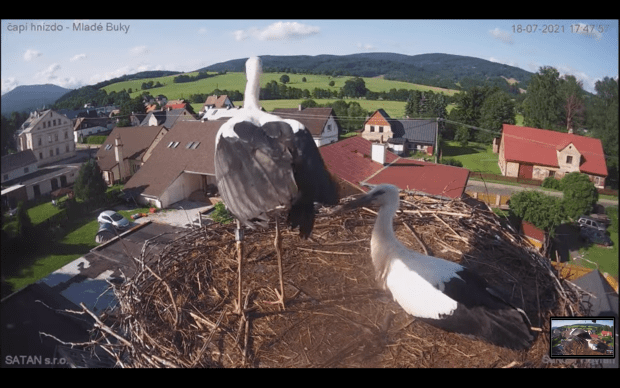
Here is the video so you can watch it.

The heat wave has taken more tolls on birds in the Pacific Northwest not just the Osprey chicks that literally roasted in the nests. Cooper’s Hawks have been jumping off the edge of the nests so they do not get cooked by the hot sun. This is a real tragedy in the making. Even the number of birds at my feeders is down. They spend the day in the myriad of vines in the shade of the house and the lilac bushes only coming out to drink and return to shade. The outside temperature near the water bowls reads 34 C. That is hotter than it is in the West Indies! So please put out water for the birds! Find old dishes and provide them with something. Thank you!

I hope that you are able to open this. If not you could Google ‘hawks jumping out of nests to avoid heat’. This is just so sad.

The streaming cams for many of the nests are being turned off as the season ends. Glaslyn will turn off the feed to Aran and Mrs G’s nest shortly as will Rutland Water on the Manton Bay Nest of Blue 33 and Maya. We will look forward to another season with them in the future. Blue 33 and Maya are a super Osprey couple – celebrities if you will allow me to call them that. They have been together since 2015 and have fledged 17 chicks. They raised a nest of four in 2019. That is almost unheard of and really takes a strong male to feed that many. I am impressed. I told someone if I came back as an Osprey in another life I wanted Blue 33 for my mate. He is incredible. They will return to the Rutland Manton nest in late March – usually within an hour of one another.

I expect many others will follow as it is costly to run the cameras. If you go to the camera and it is not functioning check the nest’s FB page. They have probably turned off the camera til the next season. But please remember that the breeding season is only beginning in Australia with the Peregrine Falcons, Port Lincoln Ospreys, and the WBSE.

NC0 up at the Loch of the Lowes nest is out fishing for her chicks. She is incredible. She spots the fish from the nest and dives down and gets it. Here is a very rough cut of a video of the two Loch of the Lowes chicks enjoying themselves.

I never thought I would say that a Golden Eagle nestling was cute but Zenit certainly is.

Zenit is really working on his wing flaps and from his crop it appears that he has had a feeding. That is good. I am just thinking how lucky Zenit is to be in a tree nest with shade.

Kindness is one of the cutest Bald Eagle nestlings I have ever seen! Here she is again trying to nibble around mom.

Oh, how beautiful. Kindness sitting next to Mom. Everyone thinks Kindness is a female because her Dad loves to feed her!

You are getting to be a big girl, Kindness. You are 52 days old today! More than halfway to fledge which will be around 89 days – the average for the Glacier Gardens nest. (The average in Alaska is 80 days).

Tiny Little has been in the nest every time I checked on her. A fish came in and 462 ate and ate. Then 464 came and couldn’t get the fish tail down. Tiny Little was playing with it when White YW brought in another fish. Tiny Little ignored it and dad left with the fish! Silly Tiny! Some dads will feed their chicks but White YW doesn’t seem to do this very often preferring that Blue 35 take on those duties almost exclusively. Tiny Little has yet to get confident in opening up a fish with a head.

White YW returned to the nest at 17:39 and Blue 35 flew in to feed Tiny Little. Tiny did not ignore that fish this time!!!!!!!

Oh, she just loves being fed by mum. Tiny Little eats for about forty minutes.

This kiddo should be stuffed.

At 21:00, Tiny Little and big sib 462 were cuddled up duckling style read to sleep.

It is not clear to me if Tiny Little ever did a second flight today. She was flapping those wings really hard and walking around the nest looking down for a long, long time. Often I had to leave only to return to find Tiny on the nest. Maybe someone saw her fly again?

Tiny tried everything but getting over on the middle left side of the nest and just going for it like she did when she fledged was something she did not do. There were a few good hovers. Fingers crossed for tomorrow. Need to get those wings strong and self-feeding down for migration.

The couple who saved the little osprey chick that fell into the river at the Putuxent Osprey Nest 2 were surprised that so many people from around the world watch their birds! I mentioned to them the need for an emergency number on the streaming cam. Fingers crossed! Thank you to everyone that sent them a thank you note. The chick is doing well.

Thank you for joining me for a quick look at a few nests on a Sunday evening. Take care. It is very hot in so many places or there are torrential rains and flooding. So where ever you are be careful.

Thank you to the following for their streaming cams where I took my screen shots: Glacier Gardens Park, Cumbrian Wildlife Trust and the Foulshaw Moss Osprey Nest, Mlade Buky White Stork Cam, Patuxent Park Osprey Cam 2, and Asociatia Wild Bucovino.

Late Saturday and early Sunday 17-18 July in Bird World

If you have watched Kindness, the Bald Eagle nestling at Glacier Gardens, then you might have caught her nipping at her mum’s beak. It looks like she is trying to kiss mum. A couple of days ago a video was made showing Kindness interacting with her mum. My goodness, Kindness, you are lucky your mum is so patient! Have a look.

At the Port Lincoln Osprey barge, it looks like the final touches have gone on the nest renovations. The egg cup is now lined with very soft pieces of bark. Mom decides to try it out!

Dad flies in with something else on his mind! No eggs yet but mating is taking place. Season will begin soon!

As we approach fledging at all of the Northern Hemisphere Osprey nests and migration in a month to six weeks, if you fear Osprey withdrawal, here is the link to this nest. Just a warning. This nest has had instances of siblicide in the past.

The Port Lincoln’s eldest chick from the 2020 season, a female named Solly, was fitted with a satellite tracker. Solly is 301 days old and she is still hanging out at Eba Anchorage and Kiffin Island. It sure seems that Solly has found her forever home at Eba Anchorage. For those of you unfamiliar, the movements of Solly changed what everyone understood about Ospreys in Australia. It was believed that ospreys stayed near to where their natal nest was located. Solly travelled over 200 km to Eba Anchorage and Perlubie giving the researchers fresh insights to the behaviour of these ospreys.

To my knowledge there has been no sighting of DEW, her younger brother. He did not receive a tracker but he did get a metal ring and a Darvic colour band.

Suzanne Arnold Horning was on the Cornell Campus again this evening. How lucky she was to get some great images of Big Red with a squirrel down on the ground – and it wasn’t raining. (Send the rain to the Canadian Prairies when you get tired of it, Suzanne!).

It was wonderful to see Big Red with prey that she was going to eat herself. She needs to build up her strength after laying eggs, incubating those eggs, and feeding and caring for the three Ks until fledge. Even now she is doing some prey drops and is busy training the Ks to hunt.

Big Red with Squirrel. @ Suzanne Arnold Horning

The Robins were giving Big Red a lot of grief. Could it be because Arthur has been up at their nest eating their babies? Or the fact that K1 caught a bird today and it was rumoured to be a young Robin?

Robins being rather assertive around Big Red. @ Suzanne Arnold Horning

Big Red and her squirrel also attracted another visitor – a Turkey Vulture!

Would you mind sharing asks the Turkey Vulture. @ Suzanne Arnold Horning

The pair also attracted a human who was said to have tried to interfere with the situation. Both of the birds were fine. Big Red was eating and the Turkey Vulture appeared to be waiting to see if she left anything.

One of the things that I have learned is that hunting is difficult and prey is not abundant always. Raptors can wait for hours, half a day, or even a day to catch prey to eat. It is estimated that only 1 out of 3 juveniles live to the age of two years – mostly due to starvation. Humans should not interfere when a raptor is eating. As a result of the human intrusion, Big Red chose to fly away from the human who was interfering. This also caused her to leave part of her meal. The vulture did eat the rest – so in the end everyone ate- but it was a situation that should never have happened. Remember if you see a hawk hunting or eating, please leave them alone. Finding their meal is not that easy.

Turkey Vulture at Cornell. @Suzanne Arnold Horning

The scientific name for the Turkey Vulture – Carthartes Aura – means ‘cleansing breeze’. They are scavengers, eating mainly carrion. They have dark espresso coloured feathers, red legs and head, with a white beak. Like the condor, there are no feathers on their head. This is a great evolutionary trait so that pieces of the dead do not stick to them causing disease or parasites. The Turkey Vulture’s sense of smell is so great that they can find a fresh killed animal a mile away! The only raptors larger than the Turkey Vultures are the Eagles and the Condors. What I find interesting is that they are the only raptor that cannot kill their own prey. They simply do not have the right talons to do this – their feet are more like that of a chicken. That said they can tear through really tough hides with their beak. In other words, the Turkey Vulture was never a threat to Big Red.

As I prepare to settle in for the night, Tiny Little is waking up. The early morning fog over the marsh is just starting to clear. You can see the parents, or siblings, or both back on the parent tree. Tiny Little is still sleeping like a duckling on the nest. Good Morning Tiny Little! Let’s get that gear box into forward today.

Tiny Little is also checking the nest for any little tidbits of leftover fish. And just like Tiny Tot he has found some lurking under those sticks.

Tiny Little was doing some prey calling and looking up in the sky. The morning fog doesn’t seem to be clearing. What a beautiful colour it is – that sort of golden pink gradually fading into the grey-blue-green. Lovely.

Update: Tiny Little had a huge breakfast. It is now mid-afternoon and Blue 462 is working on a fish that arrived. 464 is standing next to that fish and Tiny Little, 463, is ignoring it right now. She is probably still full enough from the morning not to bother. Unclear if Tiny Little has taken a second flight today. I stayed up waiting! But had to give in to being tired.

This is the image of the afternoon line up for a fish! 462 is eating, 464 is pretending to be Tiny Little and bugging his big sibling. Tiny Little is over at the side duckling style. Tiny Little is full from breakfast and knows that Mum will come to the rescue later if she gets hungry.

There is a beautiful peachy almost coral sky as the morning begins at the Poole Harbour Osprey nest. CJ7 and Blue 022 are roosting elsewhere.

Golden diamonds are falling on the nest of Blue 33 and Maya at Rutland Manton Bay. No one is home. They are all perched elsewhere. Blue 33 does make food drops at the nest for the two Bobs.

A little later, Blue 095 flies into the nest and settles down and then flies out again.

Blue 095

Oh, wow. Just look at that sun coming up over the Dyfi nest of Idris and Telyn in Wales. It is so bright you cannot see the perch!

A very short video of Ystwyth fledging at 7:59 am on 17 July is here:

It is serene up at The Loch of the Lowes. No one is home but it sounds like there is a fledgling on the camera perch.

What you don’t see here is that later, NC0 is on the nest, spots a fish, goes out and gets it, and gives it to LM2.

Early Morning at Loch of the Lowes. 18 July 2021

The only thing you can hear at Glaslyn are either bees or wasps on the microphone! Oh, it is so beautiful and green. It has been hot at this nest, 26-29 degrees C – and the birds are staying cool in the shade of the trees. Even with the heat the landscape looks so lush. What a gorgeous way to begin the day.

Early morning at Glaslyn. 18 July 2021

Thank you so much for joining me today. I so enjoy hearing from all of you. Stay safe! See you soon.

Thank you to the following for their streaming cams where I took my screen shots: Byrwd Gwyllt Glaslyn, Dyfi Osprey Project, Scottish Wildlife Trust and Friends of the Loch of the Lowes, Cumbrian Wildlife Trust and the Foulshaw Moss Osprey Nest, Poole Harbour Osprey Project, LRWT and the Manton Bay Ospreys. I would also like to thank the Port Lincoln Osprey Research Project and the PLO FB page where I took a screen shot of Solly’s recent tracking. And last but never least, I would like to say a huge thank you to Suzanne Arnold Horning for allowing me to use her images on my blog. She holds the copyright on them so please do not use elsewhere. Thank you.

Adventures in Ospreyland and other bird tales 16 July 2021

Imagine that you have one child. Everyone is happy – it is easy to provide for the one. Then imagine one day you blink and think you are seeing double. But you aren’t. There are two children. Now imagine that you are away from home and return to find three. Osprey families have the same difficulties in providing for multiple children just like humans. The adults at the Patuxent River Park in Upper Marlboro, Maryland, Osprey nest number 2 now have that challenge! The pair had only one chick of their own and are now fostering two chicks about the same age as theirs.

Cathy Cohen of the Jug Bay Natural Area posted the following image on the park’s FB page today of the mom and the three chicks. The first foster chick was placed on the nest on 30 June. Nest 2 was chosen because the foster chicks are about the same age as the one hatched on the nest. There they are. It is incredible. They look like a perfect match. How wonderful to give those two lucky ones another chance. Intervention can be a good thing.

The foster Mom was said to have welcomed the chick who had fallen from a barn silo with open wings yesterday! Here she is looking over the babies while they are sleeping (or supposed to be sleeping).

And here they are this morning. It is getting warm and the new babies are getting shade.

Most of the time if I say the name ‘Iris’ everyone knows who I am talking about. If you don’t, here is a mini-bio. Iris is an Osprey. She is 26-28 years old. This makes her the oldest Osprey in the world. Iris has her nest at Hellgate in Missoula, Montana. The platform was put up for her and her mate, Stanley, to save them from getting electrocuted on the hydro lines. When Stanley did not return from migration, Iris bonded with Louis. They have only had one chick survive. That was a female, Le Le, in 2018. The reason for this is that Louis has another mate and another nest at the ballpark. For years, people have watched Iris perfect the renovations on her nest, catch magnificent fish, mate with Louis, lay her eggs and then either have the ravens steal and eat the eggs or have the chicks die because the female cannot protect them and fish at the same time. Individuals are very vocal in their support of Iris. They want her to have another mate and to be able to raise chicks. I have always thought maybe she could retire with dignity and just take care of herself during her summers in Montana. At the same time you know just seeing her work on the nest and the fish she brings in that she would be an amazing parent. The issue is one of territory. Iris’s nest is in Louis’s territory – according to Louis. Louis has protected Iris on a couple of occasions this summer from intruders. Iris has also managed on her own to thwart them. She is strongly independent.

When someone posted an image of Iris sitting on a branch with another Osprey on Twitter 15 July 2021, people got excited.

The notion that Ospreys mate for life is not consistently true. When Blue 5F, Seren, got tired of laying a nest full of eggs only to be abandoned by Aran because he also had a nest with Mrs G at Glaslyn, she left Aran’s territory and found another mate, Dylan, at Clywedog. According to Google Maps, Seren moved a distance of 67.4 miles. Seren and Dylan are the proud parents, this season, of fledgling Blue 396 otherwise known as Only Bob.

It will be very curious to see how things develop over the end of the summer.

We all worry about Tiny Little. It is easy to forget looking at Blue 463 that at one time his older siblings kept him from eating and were quite aggressive. Because of that Tiny Little is hesitant to engage with the older siblings and, in particular, Blue 462. So there are worries that he will not get enough to eat. Today White YW brought in a fish and within about 15 minutes he brought in another fish. Blue 35 took that one and fed Tiny Little while the other two were eating fish pieces. What a beautiful image of Mum and her three chicks on the Foulshaw Moss nest having a nice meal of fish.

People have been asking if Tiny Little has been flapping. OH, yes, he flaps those wings all the time.

If you want to join in the fun watching Tiny Little prepare to fledge, this is the link to the Cumbrian Wildlife Osprey Cam:

https://www.cumbriawildlifetrust.org.uk/wildlife/cams/osprey-cam

Erick Green with the Montana Osprey Project posted some images of chicks who were entangled with baling twine. They saved three chicks a week ago but sadly one had died. Another chick had twine cutting into his right leg to the bone. Dr Green reported today that the chick is doing fabulous today. In his posting I learned something interesting. He says, “One thing that seems to work in their favor is that ospreys (and all birds) have very high body temperatures – about 105 degrees Fahrenheit. These high body temperatures help birds fight off many bacterial infections.”

Only Bob, Blue 396, has gotten really good at flying and zooms in when Dad Dylan does a food drop. Poor Seren might have to discuss Dylan bringing in an extra fish for her. Only Bob can finish them off pretty good! Look at how big this fledgling is. Wow. Dylan delivered the fish around 13:09.

At the Dyfi Nest, Idris and Telyn are waiting for Ystwyth to fledge! So is her brother Dysynni. He is sitting there urging her to come on and join in the fun while the parents are up on the camera perches watching. Ystwyth was getting some really good height to her hovering and she will go soon if not today. She is 53 days old.

Here is Ystwyth hovering. Isn’t she great?

Other nest news:

There is sad news coming out of Taiaroa Head, NZ. One of 33 Northern Albatross chicks died yesterday. The chick was not gaining weight and the NZ DOC rangers gave it a supplementary feeding. When the chick died following this it was discovered during the necroscopy that it had a piece of charcoal stuck in its trachea. As Sharon Dunne notes, charcoal floats on the surface of the ocean and it can easily be taken in by the parents when they are out fishing for food for their chick. I never imagined charcoal! Everyone is distraught. The rangers do such an excellent job taking care of these parents and chicks. Condolences go out to all of them including the albatross parents.

Our little Golden Eagle, Zenit, has had a prey delivery – a bird – and is beginning to stand really tall and strong on its legs – adult style. All good news! The Golden Eagles eat the bones – absolutely every part of their prey so Zenit will have something later. Still, having lots of meat is what this young eaglet needs right now. Excellent news.

Ferris Akel has posted a nicely edited version of his tour on Wildlife Drive on the 14th. The editing is well done and there are discreet bird names in case you do not recognize what you are looking at. There are some really nice shots of a Black Tern. Here is that short clip.

My friend, ‘T’ tells me that there is a stork with an injured food that is getting a prosthesis. Will try and find out all the news on this incredible intervention.

And speaking of storks, there are still three White Storklings on the Mlade Buky nest in Czechoslovakia:

That’s a short morning round up of happenings late Thursday night and early Friday morning at some nests. Remember that Ferris Akel does his tours on Saturday. He begins at noon NY time and ends up at the Cornell Campus. It is a great opportunity to see the Red tail fledglings in action. They have now moved from flying near to the nest to other buildings farther away. Big Red and Arthur do this with prey drops gradually to expand their territory. It will not be too long til they are down by the barns at Cornell. Always fun. You can search Ferris Akel Livestream on YT. Thank you so much for joining me. Take care everyone.

Thank you to the following for their streaming cams where I get my screen shots or add their videos: Ferris Akel Live Tour, Patuxent River Park Ospreys, Montana Osprey Project FB Page, Cumbrian Wildlife Trust and Foulshaw Moss Osprey Cam, Dyfi Osprey Project, CarnyX Wild and Llyn Clydewog Osprey Cam, Capi Hnizdo- Mlade Buky, and Asociatia Wild Bucinova.

2 Fledges in Ospreyland — and More and more threats to their health

Let’s start off with the fledges. Wow. They almost happened simultaneously.

Only Bob, Blue 496 at Clywedog, the son of Dylan and Seren fledged at 12:34:54 on 12 July.

And he’s off. He first flight was short but it was a fledge – he went to the camera pole. Congratulations Only Bob!

Dysynni, Blue 490, fledged from the Dyfi nest, the son of Idris and Telyn, at 12:26.

Gorgeous take off! Congratulations.

And now to the serious stuff for the day. It is wonderful to see the birds fledge but we need to take care of them afterwards.

If someone stopped you on the street and asked you to list all of the threats to the well being of our beloved Fish Hawks, what would you say? Think about this and jot down as many issues as you can. You can even use some historic examples because in parts of the world some of those could still be threats.

“Pandion haliaetus Osprey” by David A. Hofmann is licensed under CC BY-NC-SA 2.0
  • Methamphetamines. The Smithsonian Magazine picked up a story running in several newspapers about a week ago. That article focused on the minute amounts of meth amphetamine that were in the water and that the fish had gotten addicted. The diet of Ospreys is fish. How might this impact the adults and their chicks?
  • Fishing Equipment. Every year adults and chicks alike get tangled in monofilament fishing line. Without doing any research to find the latest examples, there was the incident of the dead Osprey near London, Ontario about a month ago and just a week ago Fortis Alberta was called to the Red Deer Osprey Nest to remove monofilament line around the only surviving chick on that nest. I am going to guess that anyone reading this will have several examples. Then there are the hooks. And hooks attached to monofilament line.
“People fishing on the shores of Loko Waimaluhia (Hoʻomaluhia Reservoir)” by nsub1 is licensed under CC BY-NC-ND 2.0
  • Non degradable Baling Twine. The banders who went to Warm Springs, Montana, found four chicks entangled in bailing twine. One had died. It took 20 minutes to remove the twine from another chick. The twine was so tightly wound that it had cut through the skin and had halted the chick’s circulation. As a result the chick was in pain and the leg was very swollen.
Copyright Montana Osprey Project
  • The impacts of climate change can include a long list of side effects. One of those is heavy winds that can tear down trees and nests.
  • The impacts of climate change can include a warming planet. Everyone witnessed the high temperatures that hit the Pacific Northwest (the US and Canada) recently (June 28). Heat kills Osprey chicks that cannot regulate their own temperature to survive. The heat also causes the fish to go to the bottom of the river or lake so that they are difficult to catch. This causes the birds to become dehydrated and die if there are not sufficient deliveries. You can probably name several nests where you witnessed chicks die due to the heat. Ospreys want open nests or platforms where they can see the environment around them. Because of this the nests are not shaded and the temperature on the nests can be higher than that reported. The sun bears down on the little ones and they die quickly. A good example is the Cowlitz chick. Electra went to get fish despite the fact that the chick had a crop. Temperatures were in excess of 40 degrees C. The mother was only gone from the nest for a few minutes when the chick began calling for her and died of heat stroke. Osprey chicks in British Columbia and in Alberta also suffered death from the high temperatures.
  • Decline in fish stock numbers due to pollution, high temperatures, and drought. The diet of Ospreys is 99% fish and if the fish numbers are low, the Osprey have nothing to eat.
  • Snowpack. Warming temperatures mean that there is less of a snowpack at the top of the mountains. The snowpack will melt faster causing flooding making it difficult for the Osprey males to catch fish when the chicks are hatching.
  • Mine waste and heavy metals. Eric Greene studies the toxic heavy metals in Montana from the old mining sites. He tests for these when Osprey chicks are banded. He has found 30% more arsenic in 2018 than he did when he began his study in 2006. Greene has also found very high mercury levels that result in egg mortality. The rate is up to 50%. Greene also found that the level of mercury in Osprey chicks blood is 100 times higher in the chicks than what is considered a problem for humans. Imagine. In other areas of the Clark Forks River, there is so much dioxins, furans, and PCBs that humans have been told not to eat the fish. The Osprey continue to eat the fish and feed it to their chicks. I do not know if you can open it but here is a report from Montana on the clean up and issues related to heavy metals in the Osprey:

https://hs.umt.edu/osprey/heavyMetalStudies.php

  • Soil Remediation to remove the contaminants from the rivers causes a temporary decline in fish stock.
  • Egg collecting. In the late nineteenth century and early twentieth, the collection of Osprey eggs was very much ‘in vogue’. This caused the numbers of Osprey to decline significantly. There remain some egg thieves today. The eggs of Osprey were considered the most beautiful and were highly prized. A man in the United Kingdom, Mark Gonshaw, was convicted of illegally acquiring eggs of endangered species including eight Osprey eggs in 2011. He had more than 700 eggs in his possession and on 22 December 2011 he was sentenced to prison. You can read about this here: https://focusingonwildlife.com/news/british-egg-collector-sentenced-to-prison-term/
  • Vandalism. A good example is the instance when one or more persons came to the Lyn Brenig Osprey Platform where there was egg/s and cut down the platform with a chainsaw.
  • Shooting. This year it is known that at least two Ospreys were shot over Malta on their return flight from Africa to their breeding grounds in the United Kingdom and Europe.
  • Other Birds of Prey or Animals. Other birds and animals often predate the eggs or take the chicks out of the nest such as the attack on the nest by a Northern Goshawk in Latvia recently. Great Horned Owls are also problematic as are Ravens who love Osprey eggs.
  • Urban Development and loss of forest habitat.
  • Power Lines. Many power companies are now creating artificial platforms so that the birds are not electrocuted on the lines.
  • Pesticides. Ospreys were the first of the large raptors to warm about DDT. Today DDT still exists in the soil of some areas and causes reproductive and thinning of the egg shells.
  • Poor Water Quality. You might recall that there was an enormous spill of toxic material into the water near the Sarasota Osprey nests. Those toxins will spread with the flow of the water.
  • Hypothermia. Hypothermia is believed to be the cause of the deaths of the surviving two osprey chicks at the Urdaibai Biosphere in Spain.
  • Human disturbance. Ospreys are much more tolerant of humans than many of the other large birds of prey. Still humans can come near the nests and frighten the birds causing them to abandon their nests with eggs or chicks.
  • Avian Flu. The impact from this is not clear. I continue to research.
  • Competition within their own species for nests and territories.
  • Competition within their own nest.

The article from The Smithsonian is here:

https://www.smithsonianmag.com/smart-news/meth-pollution-waterways-turning-trout-junkies-180978133/

Another article:

You have probably thought of many more ways that these beloved birds are threatened. I would love to hear from you!

I will leave you with a couple of images of Tiny Little taken around 6:15 am Monday 12 July 2021 nest time. Tiny you are not looking so Tiny! No one needs to worry about you and that is fantastic.

Tiny Little seems to really be enjoying himself up on that perch instead of being on the soggy nest this morning. Look at those wings. Tiny Little has grown like a very bad weed in my flowerbed. Unbelievable! Maybe that bander is right and he will be the second to fledge! We wait. This afternoon, Little Bob was getting some bites in between Fledgling Bob, 464 being fed.

Thank you so much for joining me. Stay safe and take care. See you soon.

Thank you to the following for their streaming cam where I took my screen shots: The Cumbria Wildlife Trust and the Foulshaw Moss Osprey Nest, the Dyfi Osprey Project, and CarnyX Wildlife and the Clywedog Osprey Cam. I am grateful to the Montana Osprey Project FB site for the link to the recent report on threats to the Ospreys in their state and for the photo of the entangled Osprey chick which I took from their FB Page.

Oh, Tiny Little….and friends

I thought I would check on the Foulshaw Moss Osprey Nest in Cumbria. That streaming cam does not have a rewind and so it is hit or miss as to what the chicks are doing. All three were on the nest and Blue 35 was feeding them. And bless his heart, Tiny Little was right there getting many bites – lots. It was magnificent. He was pecking for bites at Blue 35’s beak before she was ready!

Blue 35 is finished feeding in the image below. Honestly, if you can’t see the bands it is getting difficult to tell which chick is chick. Can you believe it? Tiny Little looked like a mere babe two days ago!

Blue 35 gave 464, who waited patiently without being a nuisance, the skin and the fish tail. Tiny is not taking his eyes off of that tail! 462 has moved up to the front where she is moving a branch. All Tiny Little wants is that fish tail!

Then 462 gets rather exciting and starts doing wing exercises. Tiny Little is still staring at the fish tail.

Tiny Little ducks when 462 starts flapping but his eyes are locked in on that fish tail, still. 464 seems to be having trouble eating. Tiny Little is probably saying, “Let me have a try!”

462 got some good lift. I thought she was going to fledge but she didn’t. I don’t think Tiny is next. To me his tail is not long enough! Tiny Little isn’t so Tiny anymore – almost overnight this third hatch changes. He is going to bed with a nice crop. Well done, Tiny ‘Not so’ Little.

Fledgling 464 left the nest and Blue 35 returned. She moved over and found the fish tail and some fish and just guess who was right there beak to beak wanting some more dinner!!!!!!!!!!!!!! This is why Tiny Little is not so Tiny anymore.

It is very interesting. There were individuals who thought that Tiny Tot on the Achieva Nest would to be doomed once the older siblings started self feeding. You know – we need to give these Osprey mothers some credit. They try and make sure everyone is fed. Tiny Tot blossomed before our eyes at Achieva once the other sibling 1 and then sibling 2 were flying – and it looks like having one off the nest (sometimes) at Foulshaw is helping as well.

I reported that one of Monty and Glesni’s chicks, Merin, was breeding in the Lake District. Emry Evans posted some images of Merin and his beautiful daughters in his blog. You can have a read and see the lovely images, too. If the link does not open automatically, do the old cut and paste method. You should also be able to sign up for Emyr’s blogs at the bottom if you wish to do so. Emyr includes a very helpful family tree on his blog today.

http://www.dyfiospreyproject.com/blog/emyr-mwt/2021/07/07/merin-breeding-england?fbclid=IwAR1X6b1Qy5bYFNfXyFVgib_ah941eRBYXjaumRJsAZxMexV5xIGLknUz9wg

Janet Sampson is working on a very nice chart of the Rutland relatives in Wales. She has not polished it off completely but she said we can share as long as we give her credit. So thank you Janet Sampson! This is really brilliant.

Someone sent me a note and asked me if I had a favourite Osprey. Oh, my goodness. That is a difficult question to answer. So let me tell you a story first and then I will try and answer this for you.

I have always wondered what makes a ‘great’ Osprey. I have, in fact, praised the two nestlings daughters of Merin’s as being the most beautiful osprey chicks I have ever seen. Their picture is in Emry’s blog. That led me to wonder if it is performance or appearance or both. So, in that wonderful chat the other evening with Tiger Mozone, I asked him what makes a ‘great osprey’. {Tiger has an encyclopedic mind on Osprey history and Ospreys}Tiger answered with a question: “What do you know about horses?” “Well, some”. At one time I lived on an acreage and there were five horses. Had I heard of Northern Dancer was Tiger’s second question. I ask you, is there anyone who hasn’t heard of Northern Dancer? So there was my answer. Performance. Then one day my friend ‘T’ and I were chatting. If we came back in another life as an Osprey female who would we want our mate to be? Now there is the heart of the answer to my original question. I knew that ‘T’ would say Monty. I am actually quite fond of Blue 33 (11). Today I realized for me it would be a toss up between Blue 33 (11) and Idris if I were ever to return as a female Osprey….of the choices currently available. They perform for their families. These are the guys – Monty, Blue 33, and yes, Idris will prove himself – that get the fish out of the water and on the nest. There are lots of fish. Someone said today they thought that Idris could feed a four chick nest. I think he could, too and I think Blue and Monty could as well. Take good care of the females and the chicks, fledge those babies, and then have them return to breed successfully. That is a ‘great’ Osprey. I think Tiger might agree. Of course, every great male needs an equally great female. Nora, Glesni, Telyn, and Maya are doing fantastic. So think about your favourite Osprey.

There is Telyn feeding Dysynnis and Ystwyth late today. But this appears to be a first —— Telyn caught the flounder and brought it to the nest for the chicks! Yippeeeee.

Ferris had a great tour today. These are a few shots from the beginning to end.

There were two Green Herons along the drive.

When Ferris got to the Cornell Campus, he spotted K3 right away on top of the Rice Building.

Looking for K1, there was a lovely Mourning Dove family in the trees around the Fernow Building.

Big Red was up on Bradfield. Word came to the group that she had delivered prey to both K1 and K3 just a little earlier so they are both full and not food begging.

Isn’t she beautiful? She is already beginning to moult. In a week or so we will call her Big Blonde!

There she is again, same place.

Ferris looked in the pines. He could hear Robins vocalizing and thought K1 might be around. What he found was a lovely very young Robin. Oh, I wish this little one would hide! Those hawks would like you for breakfast – maybe. Robin is not their favourite treat for sure.

K1 was discovered on one of the light towers.

And then something happened and K3 came to join K1. K1 is on the top left and you can just see the little duckling, K3 laying flat out.

Arthur has joined Big Red. All four hawks are accounted for and they are fine. Good night Big Red, Arthur, K1 and K3. Have lovely hawk dreams.

That is it for a late Saturday evening. It is once again in the 33-34 C range on the Canadian prairies. The birds are draining the water bowls every couple of hours.

Thank you so much for joining me. Take care everyone and oh, tomorrow my blog will appear in the late afternoon or early evening. I have promised myself to clean out my office for several months —— it is now time! Stay safe.

Thank you to the following for their streaming cams where I get my screen shots: Ferris Akel Live, Cumbria Wildlife Trust and the Foulshaw Moss Osprey Nest, and Bywyd Gwyllt Glaslyn.