Fingers crossed. Rutland made a short video of the feeding. Magnificent.
I am not sure that Maya is believing what she is seeing. I wonder if Blue 33 knows?
Gosh. Middle was getting some nice bites of fish at 13:28 at the UFlorida-Gainesville nest. Just grand. Big was getting more but fish is good. Any fish is good.
Earlier, there had been a fish. Around 11:28. The second fish, I believe, for the day. Big had spread her wings. They are big. She is a big girl! When Middle moved to even appear as if he was approaching the fish, she stood up, took a couple of steps towards him and he went into submission. Not good.
But then…Middle watches and listens making his way to the other side of Mum where he got some bites of that fish! And that is a good thing. Middle will survive as long as there is enough fish.
It took six minutes from the time of the intimidation but middle is eating. Lovely.
It is 28 degrees C but the humidity has dropped to 33% in Gainesville and the Barometric Pressure is dropping which should be good for fishing but the winds are at 16 kph. Let’s hope Dad is out taking advantage of any good fishing conditions in the heat.
Rosie and Richmond are having a beautiful day. Boats are going under the bridge and we will be on pip watch tomorrow.
It is a good day. It just can’t get better than what happened at Manton Bay. Let us continue to hope that wee one gets stronger and stronger. It was still exposed to the cold and wet for some six hours. Incredible.
Thank you for joining me. That is it for today. Middle has eaten and we continue to hope for the two wee ones at Manton. Take care.
Maya is exhausted.
Thank you to the following for their streaming cams where I took my screen captures: LRWT, SF Ospreys, and UFlorida-Gainesville Ospreys.
I want to start this newsletter with something that is pretty wonderful before we get on to the big story of the day coming out of Rutland Water’s Manton Bay Osprey nest.
Forgive me if I am wrong but it looks to me like Alden is feeding the two chicks at Cal Falcons! Why do I think this is Alden? and why is this such a big deal? Well the left foot has a problem or did something happen to Annie? or is this just nothing and I am seeing things? Annie likes to feed the kids so that is why this is a big deal. But Alden has been nervous and seemingly shy of feeding. So what is going on?
Well this looks like an experienced parent.
The time is 06:03 and I am confused. The adult behaves like Annie but I am confused by the left foot.
At any rate, the chicks are fine. Gosh, golly. Do we have a foot injury on Annie??????? or has Alden suddenly turned into a pro at feeding chicks?
Everyone watching the Manton Bay nest of Blue 33 (11) and Maya are simply at a loss for words. A large fish came on the nest and flipped from the side over to the top of the nest cup hitting both chicks and the third egg. Just as watchers were stunned so was mum, Maya. Ospreys are used to fish flapping. Indeed, one of the historic reasons that the males eat the heat is to ensure that the fish is dead when they deliver it to the nest. Of course, that is not always the case. It can be a tragedy when day old osplets are on the nest.
One of the chicks has survived. The other was still breathing but was left exposed for a period of time. At 13:17 Blue 33 (11) comes to check on Maya. With what we can only believe as his encouragement, Maya moves the fish out of the egg cup and to the side of the nest where she eats some fish. With the fish out of the egg cup, she gathers both chicks under her to brood. Am I crazy to hope that wee one will survive?
Is the little one stuck under a stick or something? I wonder.
By 14:35 the rain is pouring down on Maya. She has both chicks and the egg under her and is hunkered down. Send your most positive wishes to this Osprey family. Hope for a miracle for that wee babe to come around and for two healthy osplets.
It is 15:30 and the rain has stopped. That is really good news for this Osprey nest. Maya is feeding a chick and eating herself. The other chick is drying off and is still moving but, honestly, it would be a miracle if this one makes it. Still, I hope.
Its little wing was raised up and moving. It is in front of the egg towards us. Maya will cover up both chicks and the egg. Mum is looking a wee better. We must remember that Maya may have had fish flop around in the nest before but she has never had a chick fatally injured by one. She has little time for mourning but did appear stunned and very lethargic when the event happened.
More tragic news has come from the Dahlgren Osprey nest. The third hatch has died. That nest is located at the mouth of the Machodoc and William’s Creek in King George County, Virginia. It is the nest of Jack and Harriet. The creek has had very high water and has flooded in places causing murky fishing for Jack. It is not clear but as of the 8th of May the third hatch was getting little food. It died this morning.
Things are, however, continuing to go well on the Captiva Osprey Nest. Middle Little or Captiva’s Daddy Long legs fledgling has been flying on and off the platform with a very large fish. He is flying like a pro now. So good!
There he goes in the middle to the 8island to enjoy his late breakfast!
After the Ospreys, it is often reassuring to check on the falcons and the hawks.
Everything appears to be fine as the day starts for Annie and Alden and the two eyases at the U-California Berkeley scrape.
All five eyases are alive and either preening or trying to sleep at the Manchester, New Hampshire scrape.
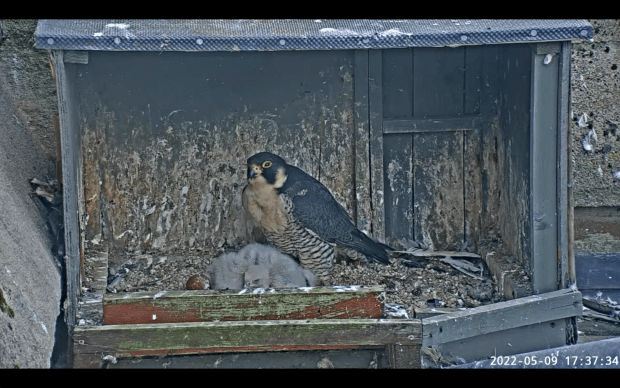
The three chicks at St Mary’s Church in Andover, Hampshire, UK had a really good feed today and all are doing well.
The two at the Indiana & Michigan Power scrape are also fine!
These two are really losing their baby down.
There are still only two eyases at the Utica NY scrape. Both are doing well and with sadness on the nests overall, two energetic chicks is great.
Sadly, there has been a unexplained death of the youngest eyas at the Cromer Peregrine Falcon scrape in the UK. Both chicks were eating fine and developing well. There appeared to be no problem. Sometime between 1315-1430 yesterday the youngest on died. I was not expecting that news. The fact that the chick ate well does not indicate Avian Flu. The owners of the scrape commented on its pale egg and feet thinking that there was something the matter with the wee ones health all along. Condolences go out to all the individuals associated with the Cromer scrape who work so hard to reintroduce the Peregrine Falcons into the UK.
All is well at the Dolina Baryczy Peregrine Falcon nest in Poland.
The chicks ate for a very long time and it was recorded. They look healthy. They are losing their down around the eyes and you can see the feathers coming in on the wings and the tail.
All is well at the nest of Big Red and Arthur on the Cornell Campus in Ithaca. the four eyases are growing like bad weeds, getting their feathers, and starting to spend a lot of time preening. Relief. They are sure taking up a lot of space along that ledge of the lightbox!
Thank you so much for joining me as I continue to monitor the situations at the Manton Bay and UFlorida-Gainesville Osprey nests. Take care all.
Thank you to the following for their streaming cams where I took my screen captures: LRWT Manton Bay, Captiva Ospreys and Window for Wildlife, Cornell Bird Lab RTH, Cal Falcons, Peregrine Networks, I & M DNR, Utica Falcons, Sokoi D Baryczy Zdenka, and Cromer Peregrine Falcons.
Are you following Ares and Astrid at the Utica Peregrine Falcon scrape? Melissa Richards provided a link to this great blog bringing you up-to-date on all things regarding the nest and the intruders around the nest. There are two lively chicks and two more eggs but, it appears that those two are not viable. Just remember. Most often not all the eggs on a falcon’s scrape will hatch!
Last year Dr Erick Greene, University of Montana and one of the leads of the Montana Raptor Project warned all of us about the changing conditions on the Clark Fork River. Besides recognizing that the extreme heat was heating the water and/or drying it up in spots, he also spoke to how this would impact the Ospreys that depend on that river system for their fish. Recently Dr Greene wrote a letter to the members of the Montana Osprey FB group attempting to stress how the fish for the Ospreys could be very limited due to changes in snow and rainfall that feed into the river system. The news coming out of Dunrovin similarly speaks to the difference for Ospreys fishing in large lakes and oceans as opposed to rivers. They said, “Rivers are notorious for their fluctuating water flows, which can substantially alter fishing conditions. In western Montana, climate change is causing adverse fishing conditions for osprey populations. Snowmelt in the mountains is now occurring earlier and faster, resulting in higher and more turbulent spring river flows when osprey families are most vulnerable and need a consistent food source to feed the chicks. Over the last decade, University of Montana researchers have documented a nearly 60% decline in osprey chick survival in nests along western Montana Rivers.”
It is good to keep this in mind when we look at our beloved Iris. Iris is the matriarch of American Ospreys. She is 28 or 29 this year. She has one of the most well maintained nests that I have seen. She works diligently. We get mad at Louis for mating with her and then not caring for her or the chicks. While many are sad that Iris does not have a mate and a large clutch of eggs, it is prudent to listen to the warnings of Dr Greene. There is not enough fish to feed chicks. They die. Instead let us adore Iris – let her incubate the eggs and then let the crows get them. Iris can have a lovely retired summer taking care of herself. I know that none of us would want to see her chicks die of starvation.
Indeed, Iris was on her nest this morning but was off it for about 7 hours. She went and got her dinner and is eating it on the owl pole. She knows what we all know. Still, she can pretend for a bit. Why not?
There she is, the Queen of the Ospreys, on the 10th of May around 11:00.
Iris left her nest and has been away for some 7 hours. The eggs still seem to be there. As evening is arriving, Iris has herself a nice fish that she caught and is enjoying it on the owl pole. You can see the mountains in the distance with some snow.
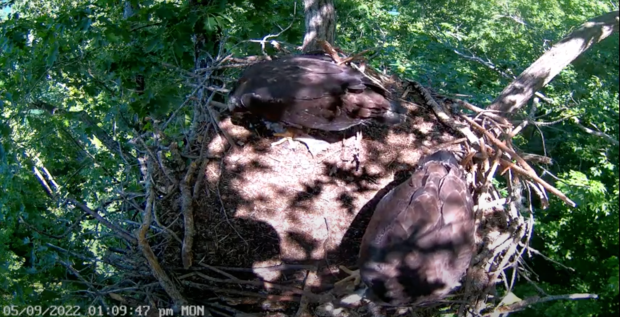
I checked and Middle at the UFlorida-Gainesville Osprey nest had a nice crop heading into the evening. Tuesday was a good day for Middle. Let’s see if we can get this to happen tomorrow! Middle is a beautiful osprey.
Sadly, the first fish delivery on Wednesday morning at 07:23:28 caused Big to intimidate Middle. After the fish landed, Middle put its head down and Big pecked at its back causing Middle to go into submission.
At 07:37, some fourteen minutes later Middle is still trying to find a way to get over to the other side and get some fish as Mum frantically feeds Big.
At 07:41 Middle managed to get to the other side of Mum and get a few bites of fish before it was all gone. It is 14 degrees C and will reach a scorching high of 29 degrees C today in Gainesville. Hot and humid. Barometric pressure is 1020 and the humidity is 82%.
When I checked on one of my favourite UK Osprey nests – and I have many – Idris was down on the perch preparing a fish for Telyn who is incubating their three eggs. He will take the head and fly over and leave the other piece for her.
Look to the left and ddown. You can see Idris with the fish on the perch on the pole.
Look at those legs. That is why Idris is known as Daddy Long Legs.
Idris left Telyn a really nice fish. This is good. The weather is going to start getting really bad over the evening.
Indeed, the winds are really gusting and Telyn is hunkered down over those eggs. It would be really nice if the summer storms in Wales would just wait until fall. The Osprey nests can do without the cold damp when chicks are hatching.
Oh, my. It is not a good day at the Manton Bay platform of Blue 33 (11) and Maya. Two eggs have hatched and the rain is pouring down. It is difficult to keep those wee ones dry and feed them. You will get accustomed to me being anxious about the weather and the little ones. They cannot regulate their own temperate. The damp seems to settle in and cause them to get sick.
Blue comes in with a fish for their lunch. It is difficult to see what is happening with the chicks and eggs. Everything is wet.
Blue is there to see what he can do to help Maya with the kids.
In the morning when it is dry there are clearly two active chicks.
At 07:19 a large headless fish comes on to the nest. Both babies are up, alert and hungry.
The chicks are eating well. At 07:19 something terrible happens. The fish is still alive and it whips over onto the chicks and the egg.
At 07:19 the fish is on the egg cup.
Maya is in shock! Her two precious babies are under that big fish.
Maya does not appear to know precisely how to get the fish off of the chicks with the least harm.
Both chicks are still moving a bit at 07:22:11.
By late afternoon (17:00), I cannot see the smaller chick moving about. We are witnessing one of the best osprey mothers that I know in dire straights. She has no idea what to do to remedy the situation and it appears that her babies could be dying.
And then it starts to rain.
It appears that the youngest chick may not have survived. What a sad, sad day for this super Osprey couple. Let us all hope that this wee babe has no injuries that we cannot see and that the rain and the damp do not impact it. The condition of the egg is unknown.
Blue is there with his sweet Maya mourning the loss of their chick while, at the same time, surely being grateful that one survived. There are fish everywhere. So much fish. So sad.
I am stunned. We see fish on the nests all the time flopping about but these two little ones, nearly newly hatched, could not bear the weight of that big fish. Personally, I feel jinxed. I am going to stop praising raptor nests. Every time I do something seems to go sideways. This is nothing short of a very freak accident but it is another reminder of the fragile lives our bird friends have. I hope that this wee one has the stamina and is able to literally weather the storm. Devastated.
At 13:15, the other wee chick is moving a bit. Maya sees it there in front of the egg all blue. Is it going to oome around or is it too late?
Maya had a very difficult time getting the chick and the egg under her with that fish still in the egg cup. I am unclear why she did not drag it out. The other chick is still moving but Maya has not gotten it under her to brood. I cannot imagine that it would survive in the cold wet. It will probably die of exposure unless there is a miracle.
My heart goes out to Maya and to Blue 33 (11). Note: At 13:42 the other chick is moving and the feathers appear to be drying but it is not clear if it is going to survive. Maya is not brooding it.
It is only 07:35 on the Canadian Prairies. We are due to have rain start soon. On the sad note of the Manton Bay nest, I am going to close. What a tragedy. All of us would have liked to have reached through that screen and helped this otherwise very collected, very strong Osprey Mum and her chicks.
Thank you for joining me everyone. I wish I had closed with better news. Hopefully this is the only tragedy of the day for our Osprey families. Take care all.
Thank you to the following for their streaming cams where I took my screen captures: UFlorida-Gainesville Osprey, LRWT Manton Bay, Dyfi Osprey Project, and the Montana Osprey Project.
Gosh, golly. 21 degrees C. This means summer!!!! The parks, both of them, were full of joggers, walkers, people having picnics, playing ball, or tennis. The Cricket pitch was busy. Canadians are wearing short sleeves and shorts and we are happy and smiling! Last week was a different story. If it rains again on Thursday we will be back grumbling. I promise. Summer is way too short. You realize I did not say ‘spring’. Honestly we don’t have it any more. A normal summer temperature a couple of decades ago was 18 degrees C. Of course can hit 35-38 C easy. Then we all go inside grumbling. There is a sweet spot around 21-23 degrees C that is just perfect for humans and for the birds on the Canadian prairies.
Note: Bear with me. I did not edit this today!
I left this morning in search of wood ducks. Where are they? I found one couple at one park and three males and one female at another. Even more absent were the Mallards. Sadly, what else I found was that the torrential rains and rising water levels everywhere have made many of the duck and goose eggs non-viable. If the outside coating gets wet, there is no oxygen. This was sad.
The water has receded and you can see some of the clutch that has been abandoned. This area is a small island – there are two islands – in the centre of the pond. It appeared very, very crowded with geese further back incubating and a pair of Wood Ducks walking through.
I wonder how man of our waterfowl lost their eggs this season? Some goslings have hatched but I did not see a single one today. Last year I could not walk for wee ducks and geese. Let’s see what next month brings.
This Mallard couple were taking turns trying to find pond vegetation and keeping an eye on me – I was about 20 metres away but they still knew I was there. The birds around the Witches Hut at St Vital Park are very friendly. During nesting season they get a bit touchy but I think they were waiting to see if I brought any food with me.
The light was not great today. In fact, it gave some rather bizarre colours to the birds.
The colours on this Mallard might even make a Peacock envious.
The Black-capped Chickadees, six of them, were dive bombing me. Did they know I had seed for them in my pocket? or do they now see humans and think seed? Probably the latter. It is a very popular spot for walkers and people that live close by to spend an afternoon, always with birdseed. The lens I had on the camera really compromised what would have been great images taken with a phone camera rather than a 600mm lens.
They came and went many times while I stood and watched. Picking up a single seed, flying up to the tree nearby to crack it on a branch and then back for another one. I wonder how many calories they burn flying back and forth??
The Canada Geese were everywhere – and I do mean everywhere.
Tucked in near to them was a Chipping Sparrow hunting for sees and bugs.
None of those images will win any awards for photography but they are a nice memory of my day and some of the birds that I saw.
When I got home I went back and checked on the Manton Bay Osprey Nest in the UK to see if the third chick had hatched for Blue 33 (11) and Maya. Not yet but you could clearly see a crack forming. One of the reasons that this couple has such huge success is that the eggs normally hatch within a couple of days. Maya always delays incubating the first two eggs until the last has been laid. Talk about a remedy to help with food competition. Of course, it helps to have a big lake with lots of fish in it and not much competition right under your nest!
There was Blue checking out his newly hatched Big and Middle Bobs.
Big Bob looks like it is going to have an attitude.
If you stare at the egg long enough at the back on the left at about 2100, it appears there are some cracks forming. Of course, I could be losing my mind also.
So all is well at Rutland. Then skipping over to the UFlorida-Gainesville Osprey nest and gosh. Middle had a crop at 16:18. So I went back and it appeared that another fish had come to the nest around 15:00.
The fish has arrived. Middle is just lucky. If Mum moved the wrong way she would knock him off that nest. He is on the far side. The chick you are looking at is Big.
Mum is feeding Middle!
Mum continues to feed Middle.
So, today, Middle ate and had a couple of crops. This nest is like a roller coaster. Did you know that birds can get stress lines in their feathers? I don’t know if all banders check but when they checked the three lads at the Port Lincoln Osprey nest they checked for stress lines and found none. Of course, they would not have. Those three males were like three choir boys until they fledged. They they really began to do the ‘dust ups’ shoving one another off the nest, intercepting fish, stealing fish and whatever else three brothers can think to get into. Here is a ‘dog fight’ between Ervie and Falky.
And here is the ‘dust up’ between Ervie and Bazza on the nest where one falls off:
For those of you that do not know the PLO nest it is on a barge at Port Lincoln, Australia. The nest always had a history of siblicide. This year everyone held their breath when the three eggs hatched and there was Little Bob. Well, Little Bob was quite the character. He had to always be at the beak, in front. When Bib Bob tried to bully him, Little Bob just didn’t let it happen and Big Bob got tired and quit. Still we worried until everyone realized that Little Bob was getting rather dominant. At the time the three were to be banded, it was decided that the heaviest of the three would get the one satellite-pak. Everyone was sure it would go to Bazza the eldest. No. Ervie – who never missed a meal and who had been right up front that morning – got the GPS system! And we cheered! The three were Bazza the eldest with the red band, Falky the middle with the yellow, and Ervie the youngest with the dark green band. Falky – being the middle – did not always get much attention until he dove off the barge and caught a fish! Falky was also the one spotted 300 km north of Port Lincoln. Bazza was the reluctant flier and stayed on the nest to let Mum feed him. Then he left. I hope we hear about Falky and Bazza. Ervie was flying about and then Ervie got one of his talons pulled out. Who knows how. As a result he stays around Port Lincoln and has a fondness for Puffer Fish! He is adored by many.
Sometimes it is nice to sit back and remember those really wonderful nests and last year, PLO was one of the best!
If you are into the translocation project that has been going on in the UK, you will be excited to read the announcement by Poole Harbour today on their FB page:
Single Bald Eagle Mums have a difficult job especially if the nest is in an area where there are constant intruders. There had been a bit of a dry spell at the MN-DNR nest but today around 16:15 nest time, Nancy brought in a huge fish. E1 ate well. I understand that a group of school children are calling E1 – Harriet. If it isn’t official, it should be. It is a perfect name to honour her missing and believed dead young dad, Harry.
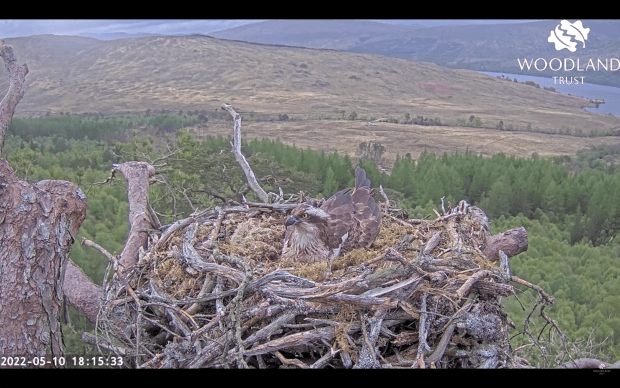
The winds are still blowing strong in Scotland and the rain will start pelting down at the Loch Arkaig nest in the West. Dorcha is doing a great job keeping those eggs incubated.
At the Loch of the Lowes, the wind is blowing but you can hear the ducks and geese flying in for the evening. Blue NC0 looks pretty content on the nest of hers and Laddie’s. Not long til there will be chicks here.
One of the things that people/researchers/naturalists and lovers of Osprey look at it is the return rate. How many fledglings from a nest in a particular year with particular parents return as juveniles and are officially seen? Well the Llyn Clywedog nest is doing a bit of celebrating today. So far two out of three of the 2020 trio have returned – 550 and 551. They only need 552 and they would have a 100% success rate. They are going to have bragging rights regardless for some time. This is fantastic news.
Richmond and Rosie have been fighting off intruders this entire season. We are a few days til hatch watch. Here is the banner for SF Bays Hatch Watch announcement at the SF Bay nest of these two great Ospreys.
Here is the link to Richmond and Rosie’s streaming cam:
This is the 15:49 feeding at the Cal Falcon nest of Annie and Alden. Cute. So cute.
This is the 16:55 feeding at the Manchester New Hampshire Peregrine Falcon scrape. Crazy!
Everything is perfectly fine at the nest of Big Red and Arthur on the Cornell Campus. L4 can almost be heard saying, “My crop’s as big as your crop! Nah, nah, nah!” Every time L1 does something, L4 seems to copy her.
Big Red looks like she is ready for an evening break before she snuggles down with these four Ls.
So far, so good. Food was on both the MN-DNR and the UFlorida-Gainesville nests. One day at a time. Today it was all good. So from me and all the garden gang and TH1 at the Two Harbours nest in the Channel Islands, good night. Take care. See you soon!
Thank you to the following for their streaming cams or FB pages where I took my screen captures: LRWT, UFlorida-Gainesville, PLO, Birds of Poole Harbour, MN-DNR, Woodland Trust, Loch of the Lowes, SF Bay Ospreys, Cal Falcons, Peregrine Network, Cornell Bird Lab RTH, and Explore.org
It is a gorgeous morning with the promise of 20 degrees C. There is a blue sky and that tinge of green on the trees. By afternoon many of those leaf buds will be leaves. It is also a good day to go and check on those cute little wood ducks!
I lucked out this morning at the UFlorida-Gainesville Osprey Nest. There was a fish delivery around 10:00. The nest was civil! So, I am going to make a assumption and see how far I can go back. There had to be at least one big fish, if not two, for Big to be nice and let Middle eat first.
Yes, there is a fish that is being fed to the two that comes prior to 06:35. I cannot tell you what happened when this fish arrived. Mum is feeding Middle nicely when I re-wind.
At 07:23:06, the pair are snuggled together in the centre of the big nest. It is hard to tell them apart. The hint is the plumage. Big remains darker than Middle. There is a little more juvenile plumage coming in. Big is bigger but when they are moving around on the nest, it is really difficult to determine who is who. Both are walking well now.
At 09:09, Big is self-feeding on a piece of fish left on the nest.
This is interesting. This is at least a second fish (perhaps there was an earlier one also to the first). Big has no interest in harassing Middle who is obviously hungry and up at Mum’s beak.
Big does come up for food and Middle begins to do his quick grab. There is no attempt to harm Middle, however.
It helps to have Big get caught up in eating a small piece of fish. Indeed, both of the chicks appear to have a piece of fish tail that they are trying to eat.
Mum was still feeding Middle at 10:25.
Now, I would like to rewind to what happened when I wasn’t able to access the camera so that we can appreciate what is happening this morning. I am very grateful for a very detailed report on the nest from ‘R’ who also knows the area well and was able to clarify where Dad goes fishing.
This is a broader map of the UFlorida-Gainesville campus showing several lakes. ‘R’ tells me there is no boating on most of them and limited boating on the larger lake. When I am looking at the reasons for there to be issues of food competition, the first thing I wonder about is the source for the fish. As some of you may realize, in Montana the Ospreys up near Missoula whose nests are on the Clark Fork River are having difficulties – or will – if the high temperatures and lack of snow pack and rain continue. The trout die. Here, this does not seem to be an issue. I did have to giggle. We know nothing about alligators in lakes in Canada that I am aware of – but apparently the lakes in Gainesville have gators and they do eat the odd dog when the walker gets it too close to the shore. Goodness, that would be a shock! As ‘R’ pointed out, the gators should not be a problem to the Osprey.
The nest is located on the Soccer Practice Field. That is the red indicator below. You can see that Dad has a large lake close by and further to the right another. Unless something is killing off the fish in those lakes, access is not an issue. Perhaps temperature is? It is 69 degrees F this morning in Gainesville. A respectable temperature for fishing. Does the temperature impact fish delivery if it gets up in the high 80s? Good question to find the answer.
‘R’ reports that Dad brought in little food on Friday. That evening, that big storm with the high winds that swept through the area and the nests – they were blowing on Captiva – took out the camera. There was on and off camera access Saturday but nothing steady with the camera until Sunday. It is unclear about food deliveries during this time but typically it is difficult for an Osprey to fish if it is a very bad storm. There is also an issue of barometric pressure. Easier to fish when the pressure is falling as opposed to rising. I am going to have to set up a graph and see if this is impacting Dad. ‘R’ was sadly able to report that a few years ago in another storm both of the chicks were knocked out of the nest. How tragic.
The report for Sunday and Monday were not good. As ‘R’ notes, this was probably due to a lack of fish deliveries. Bit was extremely aggressive attacking Middle constantly. Middle tried to position itself to get away from Big but this did not help. At this point Mum is favouring feeding Big over Middle.
The pattern continued to Monday morning – Big being clearly aggressive and Mum favouring Big in the feeding. It was estimated by ‘R’ that Big got ten bites to Middle’s one. Also noted was the fact that Middle went into submission easily whereas last week, Middle was showing some ability to deal with Big’s dominance.
The factors that are leading to food competition continue to be a lack of fish delivery by Dad, weather, and at least one instance of an intruder that was seen landing on a light near the nest.
I am extremely happy that something has happened this morning to turn this aggressive behaviour around this morning. If it is possible I want to go back and build up a graph checking on the barometric pressure in Gainesville and compare it to the days we know there were good fish deliveries and little. Is this the culprit? or is it intruders? the temperature?
I want to take you to an Osprey nest where – for the past five or six years – there has been not a single problem. That is the Manton Bay nest of Blue 33 (11) and Maya. Three eggs this season. Two have now hatched. I will expect the next one to hatch tomorrow. The eldest hatched last evening and the second is still wet! You can barely see it in front of Big Bob. — A note. All of the Ospreys are Bobs in the UK. The Bob refers to the bobbing head. so it will be Big Bob, Middle Bob, etc.
That is that big fish I was talking about yesterday. The Manton Bay nest is right in the water at Rutland. There is nothing cuter than a day old Osprey chick. Nothing. OK. Maybe a Red-tail Hawk or a Peregrine Falcon.
Big Bob is already eating well.
Maya is a bit like Big Red, the Red-tail Hawk matriarch at Cornell. She wants her babies full to the brim and more. No need for a hungry wiggly baby while one is trying to dry off and get used to having hatched and the other is thinking about hatching.
Brooding and incubating. It will be much easier for Maya when the third hatches. Again, I am not expecting any issues at this nest over food competition. Blue 33 (11) always has the fish on the nest at dawn. If he doesn’t then we should start worrying about him! This is a terrific nest.
Here is the link to the streaming cam at Rutland Manton Bay:
I have not checked any other nests this morning but I will do later today. The sun is bright and it is getting warmer and it is time to do a hike around a lake to check on some ducks and geese.
Have a wonderful day everyone. Thank you so much for joining me. See you soon!
Thank you to the UFlorida-Gainesville Osprey Cam and the LRWT for their Manton Bay cam where I took my screen shots. A special thanks to ‘R’ who educated me in potential fishing sources for Dad at Gainesville and for bringing me up to speed with great detail over the weekend and Monday happenings at Gainesville.
Oh, it is pouring down rain and, as such, is a great day to drink hot tea and read. A friend sent me an article from the New York Times. [ Thank you ‘WW’ for that]. I do have a subscription but, as of late, I just haven’t had the time to forage through the paper or, for that matter, read it at all, sometimes. I like Margaret Renkl’s writing style. Her book Late Migrations looks down at me from the bookcase and like her, I have stacks of books all around, some read, some waiting. Today, she has written an opinion piece on the Ivory-billed Woodpecker. It is a good – it is a hopeful read. That is something we can all use on a cold wet dreary day.
So apparently I can gift the article to you to read. I don’t know about you but good news is uplifting and I will take all of it that I can find including the discovery of a bird living in quiet isolation that was believed to be extinct. I just hope that thousands of humans don’t converge on Louisiana with their long lenses and ruin it! Seriously, it is important not to give away the locations of some nests and these would be one of those instances to stay quiet!
Did you know about the Peregrine Falcon scrape in St Mary’s Church in Hampshire in the UK? I didn’t! This nest has been here for a number of years. Listen to the discussion at the end to find out how the nesting birds were discovered.
The chicks are just slightly older -but not much – than Big Red’s. They are getting their itchy blood feathers. The scrape looks successful. Why do I say that? Look at all the ps on the walls!!!!!!!!!!
This is a great 51 minute talk about Peregrine Falcons by Ornithologist Keith Betton who is also the Country Bird Recorder for Hampshire. It is interesting.
There was a bit of a prey tease the other day at the Cromer scrape. They made a short video of it. Cute.
It is dinner time at one of Poland’s Peregrine Falcon nests – and it wasn’t a tease. Also notice – it is a nest! Just like the other one in the Polish forest, Dolina Baryczy.
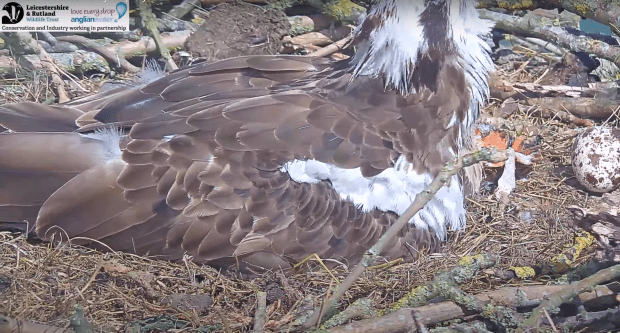
It is evening – 20:21 – at the LRWT Manton Bay nest of Blue 33 (11) and Maya. We are definitely on pip watch but, if there is one, our Mum is not revealing it. Maya has been extremely restless since late last evening. Is she hearing her chicks? I feel like a very restless expectant parent!
I am not familiar with the Osprey nests in Finland but, last year, a lovely young woman wrote to me to tell me that they have ten nests. That is fantastic. This is the link to one of those. Last year the couple laid three eggs. All three hatched. The youngest died at the age of 2 days for an unknown reason according to the streaming cam information. There was not a threat from the goshawks so I want to continue to check on this nest. The location is splendid. Just look at the water with all the fish for the babies and parents.
The female is Manta and the male is Manu.
The eldest eaglet at the Pittsburgh-Hayes nest is getting closer to branching. She was up on the top of the nest rim called ‘The Baby Gate’ today. The others are just too curious and they will be up there soon!!!!!!! Just don’t go crowding one another knocking someone off!!!!!!!!!
Anyone still worried about L4 at the Red-tail Hawk nest of Big Red and Arthur? I sure hope not. There is the tiny one right up front having lunch! If he isn’t on the edge, he will climb over the others to get up to Mum’s beak. Partially this is because he eats less food but needs to eat more frequently than the older siblings. But oh, what a little cutie pie.
Oh, those wings look like soft cashmere. Wee one is tucked in under them keeping warm. Every chick has a big crop!
The weather in Scotland around Loch Arkaig has not been good. The winds have been very very gusty with rain. One of those gusts almost completely blew dear Louis’s mate, Dorcha, off the Loch Arkaig nest around 16:00 today. Unbelievable. It always frightens me when this happens. Last year and the year before, Big Red was almost blown off once with a chick holding on to her.
Dorcha recovered but gosh, golly.
Nancy is on high alert at the MN-DNR nest after a juvenile eagle stayed on the perch tree and another flew overhead. Oh, I wish they would leave her alone. She cannot go and hunt for her and E1 with these interlopers about. It is pretty clear that the success of the reintroduction of the Bald Eagles (and Ospreys) in the US has caused a lack of good territories and nests causing much of the disruption and harm we have seen lately. I would also include the Peregrine Falcon population in the California area. What is the answer? More artificial nests? the stocking of ponds for fish for the birds?
Alden may be shy of the chicks but he is keeping the pantry full for Annie and the two wee babes. Don’t they just melt your heart?
Seriously sweet.
Some much bigger birds in the Dale Hollow Eagle nest were both enjoying a nice fish today for lunch. Both of them are perching up on the nest rim and each is doing very well. Looking forward to their successful fledge!
The UFlorida-Gainesville Osprey nest cam is back up and running. Excellent news.
I continue to hope that there will be a new wee babe on the Manton Bay nest by the time I wake up tomorrow. All of the nests I have checked are doing fine except for the continuing intrusion at the MN-DNR nest of Nancy and E1.
Thank you for joining me today. Take care everyone!
Thank you to the following for their streaming cams where I took my screen captures: UFlorida-Gainesville, Ospreys, DHEC, Andover Peregrines, LRWT, Cal Falcons, MN-DNR, Woodland Trust, Cornell RTH, and Pix Cams.
As citizens of Manitoba, we are really learning about what it means to live on the floor of what was once Lake Agassiz —- in other words, a flood plain. Two more Colorado Lows are set to dump more water on a province that is flooded south of Winnipeg and north of Winnipeg. One big lake save for those communities who spent funds on creating their own dams. The loss is enormous but looking at it from a wildlife perspective, one has to wonder where all the deer, the nests, and the animals have gone. I have seen one image of deer walking along a railroad track that runs from Winnipeg to the US border trying to find dry land and food. That border is now closed as are many highways and even some bridges in my City. Years ago one of our Premiers decided to build what was teasingly called ‘Duff’s Ditch’. Well, everyone should be grateful to Duff Roblin for having that kind of insight. The City is mostly dry and safe.
There are few birds in the garden as the raindrops begin to fall on a grey day.
I am as nervous as Blue 33 (11) is as he comes in and off the nest at Manton Bay checking on Maya and the eggs. There are three. At one point you could only see two, has there been a hatch? So, we wait for confirmation one way or the other! I cannot see any egg shells so I suspect that pesky egg is hiding!
It is certainly time to begin checking on the Black Stork nests in Estonia and Latvia. There is something curious that I noticed which I suspect my friends in Estonia have known all along. Jan and Jaanika laid their eggs a whole month earlier this year than last. In 2020, the eggs were laid on 12 May, 14 May, 16 May, and the 18th of May. Hatch from 14-17 June. This year the eggs were laid on 15, 17, 19, 21 April, 23 and the sixth and final egg on 25 April! This is excellent – the timing. Last year the couple was so very late that Janika started her migration before the chicks had fledged. It was a very difficult time and the food for the chicks was supplemented by fish being brought to the nest by the wildlife specialist, J Kuze.
The Black Stork in Estonia is so rare that every effort is made to help them that is possible.
I am not a stork expert. It would seem, however, that the parents cannot support six storklings very easily and they will probably select the three strongest. But, we wait to see.
Here is the link to Jan and Jaanika’s streaming cam in Jogeva County, Estonia:
I also checked on the nest of Karl II and Kaia in the Karula National Forest in the south of Estonia. The eggs for this year were laid on almost the identical dates as last year. Those days were 24, 26, 29 April and 1 May. Hatch began in 2021 on 28 May.
This is the link to Karl II and Kaia’s nest in the forest.
Sadly, it appears that Grafs and Grafiene did not return to their nest this year in the Sigulda Region of Latvia. Did they not survive migration? or did they decide to locate their nest elsewhere? I do know the answer to this but I will try to find out.
There is only one osprey nest in Latvia. This year only the male returned, Theo. He tried to attract many females to his beautiful nest. It is hoped that a young female, tagged UV and an Estonian female, will stay with them. Mating was attempted this morning but UV was not receptive. Sadly, this nest is a bit haunted. None of the former chicks have survived due to goshawk predation.
Here is the link to the Kurzeme camera of Theo:
In comparison, the Osprey nest of Ivo an Iiris in Tarta County, Estonia has done well. All of the couple’s chicks fledged last year!
Pip watch will begin on the 21st of May. That is only 12 days from now. Here is a link to Ivo and Iiris’s streaming camera:
Gosh, Big Red is gorgeous. It is so hard to believe she is 19 years old. She is in such good shape this year. What a beautiful golden glow on her and the four eyases as a new morning wakes up on the Cornell Campus.
This is a great nest to watch! There is plenty of time to watch these eyases develop, fledge, and then learn to be a ‘hawk’. Arthur will teach them flying and hunting with Big Red joining in. There is nothing better than seeing the parents teach the chicks how to hunt a squirrel in a tree!!!!!!
The two eyases at the Red-tail Hawk at the Presidio Trust Building in San Francisco are doing fine. These two are really growing. Look at the size of that wing. Wow.
Peregrine Falcon chicks are doing well this morning, too. The chicks at the scrape in the tower of Chichester Cathedral just had their afternoon tea.
All five eyases were fed and happy this morning at the Manchester, New Hampshire scrape.
Sleeping babies at Utica, New York scrape. Will the other eggs hatch? We will see.
Henry and Poppy do a great job taking care of their two chicks at the Cromer scrape. If you are interested in their day to day activities, there is a great blog with this nest that has images and comments of everything that happens on the nest. I will post it after the image of the chicks!
If you are wondering about the third egg at the U-Cal Berkeley scrape of Annie and Alden, don’t. It is non-viable. If it were going to hatch it would have happened on Saturday. What will they do with it? Incubate it, roll it around, or break it – or maybe Sean or Lynne will collect it for the museum when they clean the scrape.
Two healthy chicks are good. They are incredibly adorable.
All three eaglets are accounted for on the West End nest of Thunder and Akecheta.
TH1 at the nest of Chase and Cholyn is getting its blood feathers. There are a few lingering dandelions on the top of the head. It will not be long until this wee one looks like its cousins at the West End.
I checked on two nests in the East – PIttsburgh Hayes with its triplets and the National Arboretum nest. They are all awake and looking good this morning.
The three are beginning to fill up the nest!
Breakfast time for DC9. Looking good. There was a little concern earlier for DC9 because a bird had been brought on the nest as a prey item. Everything seems to be alright.
I want to leave you with a smile. A Canada Goose has chosen a planter on the deck of a Calgary, Alberta couple to lay its eggs three years in a row!
Lots happening today. Some exciting. Some sad. The youngest golden eaglet has been killed at the Estonian nest. It had been beaked by its eldest sibling earlier and prey became scarce and the oldest killed the youngest today. That was the Golden Eagle nest in the Soomaa National Park in Southwestern Estonia. As I mention often, the rate of siblicide is much higher in nests other than falcons and hawks.
Thank you for joining me on this rainy grey day in Manitoba. Take care everyone. See you soon – hopefully with a news of the first Osprey hatch in the UK!
Thank you to the following for their streaming cams where I took my screen captures: LRWT, Eagle Club of Estonia, Latvian Fund for Nature, Cornell Bird Lab RTH, Presidio Trust, Chichester Cathedral, Peregrine Networks, Utica Falcons, Cromer Peregrines, Explore.org, Pix Cams, and the NADC-AEF.
I had a lovely letter from a friend today. Like so many of you, she has tried to watch some of the nests and gotten attached to the birds only to have her heart pulled out when an older sibling shoves them out of the nest or, in other instances, they were starved or killed by beaking or both. It has been a tough year on the nests. Tough even for me.
My friend pulled back and has started watching Big Red and Arthur’s nest on the campus of Cornell and Annie and Alden on the grounds of UC-Berkeley. Her question this morning was simply to clarify that hawks and falcons do not practice siblicide. The answer is that the preponderance of siblicide occurs in eagles (some species more than others), egrets, boobies, herons, pelicans and, I am going to add ospreys to that list. There are lots of reasons, some explored in earlier blogs but, it is safe to say that if you wish to enjoy the birds on the streaming bird cams, falcons and hawks are generally a very safe choice as are ducks and geese. Because the chicks are precocial (are fully feathered, can walk and swim and eat on their own), the ducks and geese need those chicks to hatch all at once. They delay full incubation until the last egg is laid. Robins do that too and so do hawks and falcons. In this way, the older chicks are not that much bigger (normally) than the younger. The ducks and geese and even the raptors need their babies to fledge at the same time. So incubating them so they will hatch together really helps. It is called synchronous hatching (begins hard incubation after the last egg is laid) as opposed to asynchronous hatching where the parent immediately begins hard incubation immediately after the first egg is laid.
Annie makes a kind of chee-up sound when she is ready to put the food in the beak. The chicks learn this. Annie might well give the biggest chick the first few bites but she immediately moves around giving the youngest some. Today, the Peregrine Falcon Mother at the scrape in Oudenaarde, Belgium spent a whole hour making sure that all 5 of her eyases were fed and full. No one left the table hungry. The Mum at the Manchester NH falcon nest also has five eyases. Not one of them went to bed hungry tonight despite their size difference – the smallest had a big crop just like the largest. That is what hawks and falcons do!
A clump of falcons in a feather bed.
The wee one is piled on top of one of the siblings to stay warm.
Here is Annie feeding her two chicks brunch on Mother’s Day! Watch carefully how she feeds the big one several bites, then the small one and then goes back and forth. Annie is a pro. Both are well fed!
And Cal Falcons posted a second feeding just a short time ago. It is really cute. Alden checks in on the babies who see an adult and open their beaks. Alden is so cautious and nervous. He It very happy when Annie arrives with lunch he provided in her beak from the other side of the scrape!
Here is that feeding. It is so cute. Notice how the little one gets full and then gets back up for some more. Falcons eat everything. Nothing is wasted. Some of the first few bites were feathers.
It doesn’t get much better than the Red-tail Hawk nest of Big Red and Arthur at Cornell. Little L4 is growing and surviving and well, I haven’t watched this nest 24/7 but I have not seen any tendencies by the oldest to interfere with the younger ones.
SF Bay Ospreys does not want us to forget about Rosie on Mother’s Day. I adore her and if there is an osprey nest in the US to watch that is stable – Rosie and Richmond in SF are it! —- Oh, and no. Ospreys are not prone to Avian Flu. They eat fish.
Someone dressed Spirit up. LOL. Good thing I don’t have the software to do this!!!!!!! I think Spirit is a Jackie in the making, too.
We all loved Kindness at Glacier Gardens. Many have been watching the nest cam and have been wondering where the eagles , Liberty and Freedom, are. Well, they have built a new nest! Here is the video reveal of that find:
The camera remains off line at the UFlorida-Osprey nest if you have been checking. It is unclear when it will be back on. If it is a mechanical issue it would be difficult since the chicks are older.
The Dale Hollow Eaglets have full crops and are drying off today. These two are doing very well.
Some nest renovations have been going on at the National Arboretum. I don’t think DC9 appreciated some of those branches.
At 2045 there is still no hatch at the Manton Bay nest of Blue 33 (11) and Maya. Maya is certainly restless tonight.
If you are a fan of Lady and Dad at the Sydney Sea Eagle nest in the Olympic Forest, you will know that the couple have been working on the nest. We are about three weeks away from the first egg being laid.
Where’s Ervie? Looks like he still hanging around the barge area of Port Lincoln. Fine by me!
It has been a busy day at all the nests and throughout different regions as the migratory birds continue to move through. My garden was full of White-throated and White-crowned Sparrows again today along with the usuals. The little Chickadee couple love to have a swim!
The Starling was not so pleased when Dyson came along and wanted some of the seeds.
Dyson is trying to try out for the local gymnastics team. Look at her stretch! She is losing her winter fur and the tufts on the end of her ears are gone. Ironically, her tail is much thicker. She is in really good health. Good to see.
I hope that each of you have had a wonderful day today and, hopefully, if you could, got to spend some time outside. It really is energizing – even for a few minutes sitting in the sun. Thank you so much for joining me today. It is a joy to have you here. See you soon!
Thank you to the following for their streaming cams and/or FB pages where I took my screen captures: SF Ospreys, Cal Falcons, Peregrine Falcon Network, Cornell RTH, Friends of Big Bear Valley, NADC-AEF, DHEC, Sea Eagle Cam@Birdlife Australia Discovery Centre, Port Lincoln Osprey Project, and the LRWT.
The five peregrine falcon eyases at the Manchester, New Hampshire scrape have been fed four times before 0930. Meal times were 0531, 0627, 0712, 0917. Mum doesn’t get finished quick. She will wait til there are no beaks open wanting food. Just look at the youngest right up there!
There are five eyases in the scrape at the Walburga Tower in Oudenaarde, Belgium, too.
Here is the link to the camera in Belgium:
There is still one eyas at the scrape box on The Campanile on the grounds of UCalifornia-Berkeley. The wee one hatched on 5 May. There are two more eggs. One appeared to have some cracking of the egg but that could have been light or debris.
Bingo!
A really nice fish arrived for the two soggy eaglets at the Dale Hollow Nest at 0813.
It is not clear to me which of the eaglets claimed the fish. Note: the cam is flickering (or was) in and out of IR mode).
There was some headway made on the self-feeding and later both decided to sit it out on the rim of the nest.
Lessons are still being taught at the WRDC Bald Eagle nest in the Miami Zoo. Rita arrived with a nice fish at 0926.
She waited eating morsels. It was not until 1024 that a fledgling arrived on the nest.
Mum left them empty taloned. Wonder what lesson she was giving out today????
Both R1 and R2 seem to be hanging around the nest. Hi there.
The three eyases at the Weissenburg scrape in Bayern are really growing. Look at the change in their plumage. The soft dow gives way to a rather matty looking cotton that reveals feathers!!!!!! Pink beaks begin to change colour.
Louis is an amazing partner. I adored him with Alia and so sorry she did not return last year. He has settled in with Dorcha and despite the pelting rain in Scotland landed a nice fish for her. Well done, Louis.
Dorcha is so dark. She reminds me of Mrs G at the Glaslyn nest.
We might be checking in on the Osprey nests scattered about the UK but all eyes are on one nest – that nest belongs to Blue 33 (11) and Maya at Manton Bay. They should be having a pip and a hatch today or tomorrow.
Maya is not giving anything away! Gosh she is beautiful.
If you are looking for a solid Osprey nest to watch, one that fledges all their hatches then this is the nest to watch. Here is the link to the streaming cam.
It is raining a lot of places in the US and much of that rain is really welcome especially up in the Pacific Northwest. You will notice that I do not list any of the Osprey nests in that region. The ones I know have suffered from the extreme heat.
It is also raining on Long Island at the PSEG Oyster Bay Osprey platform. Did you know that there are over 2000 Osprey nests on Long Island? Most are located on the eastern end. PSEG has two platforms. The one at Oyster Bay in Nassau County and the other at Patchogue. The Ospreys return each year with the arrival of the Menhaden. It is a species of fish in the herring family. They travel south in the fall and winter and north in the spring in slow moving tight schools. Sadly they have been over fished.
We are waiting for hatch at the new scrape box mounted on the top of the Spartan Stadium at the University of Michigan. It is raining there today, too.
Dad has come to relieve Mum but she isn’t budging. Will we have a hatch today? Maybe. Here is the link to this new streaming cam and scrape.
These falcons made the news!
Some images from this morning at the nest of Big Red and Arthur on the grounds of Cornell University in Ithaca.
Nancy has fed E1 and a cherry picker has gone up to the nest. It is banding day!
E1 properly defended the nest he shares with Mum. Sadly, Dad Harry has not returned to the nest. He disappeared on the evening of 26 April. Once Nancy realized what was happening, she started bringing food to the nest. As we know, it was too late for E2.
Despite early worries by some watchers when there were four eggs, Big Red has shown that this is not a problem. Indeed while it might be one extra to her norm, you can see by some of the peregrine falcon nests that it is possible for five to do well. Life is so different on the hawk and falcon nests than it is for the eagles and the ospreys.
It is going to be a gorgeous 21 degree C day in Manitoba. It is a good day to get outside – before the next rains come – and go and see some of the new arrivals in the City while I wait for the second hatch at Cal Falcons and for their Q & A at 5pm Pacific Time.
The Dark-eyed Juncos that arrived in mass during the horrible storm a few weeks ago seem to have departed. The numbers of birds at the feeders are returning to the norm. Even Mr Blue Jay dropped by this morning.
Take care everyone. Thank you for joining me. See you soon.
Thank you to the following for their streaming cam where I took my screen captures: Cal Falcons, WRDC, Woodland Trust and People’s Post Code Lottery, LRWT, Cornell Bird Lab RTH, Spartan Stadium Falcon Cam, I & M Falcon Cam, PSEG Oyster Bay, Weissenburg Falcons, DHEC, Oudenaarde Falcons, MN-DNR, and Peregrine Falcon Networks.
Tonight, the Audubon Society believes that 380 million birds will be on the move from the south where they wintered to the north to their breeding grounds. Manitoba is set for a huge number of birds flying in especially to the very north near Churchill and to the wetlands in the middle of the province. I draw your attention to the Wapusk area because I want you to see Churchill. Churchill is now as the ‘accessible Arctic’. Here beginning in June you can see many species including Ross’s Gull, the Northern Hawk Owl, Smith’s Longspur, Spruce Grouse. the Three-Toed Woodpecker, and Harris’s Sparrow. Of course, the list is endless for the ducks and geese that make Hudson’s Bay and the area around Churchill their summer home. Raptors include the Northern Harrier, Gyrafalcons, Merlins, Bald Eagles, and Golden Eagles. Lots of other wildlife abound in the area including Polar Bears.
North of Riding Mountain National Park, also in Green to the south and west of Wapusk is Winnipegosis. This is the place to see Osprey. Directly east and north of Gimli near Hecla Island is a large concentration of Bald Eagles. Canada Geese have arrived and the Trumpeter Swans are arriving now along with the American Pelicans and Red-winged Blackbirds. The shores of the two very large lakes, Lake Manitoba and Lake Winnipeg, are home to a huge variety of shorebirds that are beginning to arrive.
It felt like I watched Annie and the wee hatchling all day under a microscope. Alden got to see the chick and brood it and incubate the other two eggs. There is a dent in one of the two remaining eggs.
Alden checked earlier to see if Annie wanted a break and she wasn’t ready yet.
The baby was wanting food so Annie gave Alden a shift. I noticed how extremely careful he was with his lame leg not to stop on the chick. Well, done, Alden.
Annie arrives with a bird for the little one’s first meal. I could not possibly tell you what species this is. It is not familiar to me in Manitoba.
First hatch had a nice meal.
Annie catching some sleep. She is going to need all she can as the next eyas appears to be working on its shell. So happy for Annie. Things feel like they are going to turn out just fine.
Afterwards I went to check on the osplets at the UFlorida-Gainesville Osprey nest. I had been watching earlier in the day but not early enough to catch a morning feed. It was apparent that the chicks and Mum had eaten as all three had crops heading into the evening.
It is good to see the Mum on the nest and the osplets – and her – nicely fed. Middle is the one closest to Mum.
Middle is growing. A few days of good meals makes all the difference in the world.
Big Red has a nest full!!!!!!! She must be in her glory. Oh, I hope the weather holds.
L4, the smallest one, hatched a week after the first, likes to be at the front of the line. Gosh, sounds like another Ervie!
At 19:32, two Crows arrived at the Achieva Osprey nest in St Petersburg, Florida. This is the nest of Jack and Diane. Last year Jack and Diane fledged three – this is the home of Tiny Tot -. Those chicks hatched the beginning of March. Jack and Diane had a previous clutch of eggs that went down a hole in the nest. Diane laid three more eggs but the dates were unknown because the cam was offline. I know that the Achieva nest is a favourite of many but, perhaps this is a blessing in disguise. It is really late to have osprey chicks in Florida due to the extreme heat.
It is doubtful that any of the eggs made it. Crows watch and wait just like they did with Daisy Duck’s clutch. Eggs left alone even for a few minutes will be eaten if there are Covids around.
Bird flu continues to be in the news as 37 million factory farm birds are killed.
We are one week away from pip watch for Richmond and Rosie at the SF Osprey nest on the Whirley Crane in SF Bay.
One of my favourite Osprey nests in the UK belongs to Idris and Telyn at the Dyfi in Wales. Idris is know as Daddy Long legs but he is also one of the best fishers amongst all the UK osprey. Look at this one he hauled in today!
Beautiful Maya at the Rutland Manton Bay nest she shares with her mate Blue 33 (11). We are on pip watch for this couple!
Another fantastic Osprey Mum, Blue NC0 at the Loch of the Lowes nest in Scotland that she shares with Laddie. We will be watching for her eggs to hatch after Maya’s. What a beautiful setting for a nest!
The oldest Osprey in the UK is Mrs G. She is believed to be 22 years old. She is incubating the three eggs of her and Aran’s. They will be hatching late as Aran was late returning from migration. Today Aran was busy keeping intruders away from the nest.
Of the nests I have checked, all seem to be doing just fine.
Thank you for joining me. Take care everyone. See you soon.
Thank you to the following for their streaming cams where I took my screen captures: Brywd Gwyllt Glaslyn, Dfyi Osprey Project, LRWT, Friends of Loch of the Lowes and Scottish Wildlife Trust, UFlorida-Gainesville Ospreys, Cal Falcons, Cornell Bird Lab RTH, SF Ospreys and Golden Gate Audubon, and Achieva Osprey.