Fraser Point eaglet, Victor, who had suffered from acute zinc toxicity and had been in care at the Ojai Raptor Centre in Ojai, California has been released today!
Absolute tears. Thank you to Dr Sharpe, his team and the great folks at the Ojai Raptor Centre for returning this amazing eaglet to the wild.
A special thank you to ‘B’ who sent me the wonderful news!!!!!!
Thank you to the Ojai Raptor Centre for their posting and video on their FB page where I took my screen captures.
Good Morning Everyone! I hope that you had a fabulous beginning of the week. Here we are at the middle. My calendar tells me that thing are going to begin happening in Bird World soon. First up will be the Port Lincoln Ospreys who should have a hatch in 4 days. Then it should be the Melbourne Peregrine Falcons on the 27th quickly followed by Xavier and Diamond. By the time those nests have feathered osplets and eyases, we will be fledge watching for SE29 and 30. It is going to be wonderful!
Tuesday was a big ‘T’ day but that doesn’t stand for Tundra Swan but, ’tiler’. It was fantastic to see the floor tiles in the sunroom being grouted today with the news that tomorrow I can move back in and watch my beloved garden birds. Oh, how I have missed seeing them from that perspective. A new book arrived in the post, too. Having purchased Crosley’s Guide to Waterfowl – well, logically, it seemed to me that the volume would cover Shore birds but, no. Definitely not. The new book is The Shorebird Guide by O’Brien, Crossley, and Karlson and it is wonderful. Most appreciated are the excellent images of the plumage during the seasons. It still is missing the inclusion of the females in great numbers just like all of the other bird guides who continue to focus on the more colourful plumage of the males. Yes, I am growling. LOL. Quiet and monochromatic can be viewed as ‘classic’ beauty. It certainly is with many of the female Sparrows.
Just like the ducks, my mind has been taken over by the Greater and Lesser Yellow Legs and Willets at one of our local ponds. If I close my eyes I am transported to the marsh where the shore birds are tapping away at the mud with those long long bills. Incredible. If you stay quiet and don’t move, they will completely ignore you, going on with their deep quick probing for food. They are really quite lovely. Learning to identify them is going to take some time.
The Greater Yellow Legs from the other day.
The plumage on the Mallard is really lovely.
It is overcast and cold at 13 degrees C this morning. The Crows have been for their morning hotdogs, the sparrows are wanting a bath, the Blue Jay has been flitting in and out (only one), and the cat has already been chased once. Meanwhile Little Red has been running back and forth on top of the new fence which now meets up with that of the neighbour so he never has to get on the ground to get to his new home. Yes! Little Red has found a place to live since his penthouse was torn down. So thankful. The torrential rains this year and saturated ground meant that all of the trees literally tripled in size. He found a hole in the big tree and if I look carefully, I can see him going in and out. So relieved after feeling so quilty about the shed. With my chair back in the sunroom this morning, I can watch over them and hopefully get some good images of Dyson who is looking ever so healthy and fluffy these days. Gosh, that squirrel is quick. I wonder if the Crows frighten her?
In the Mailbox:
‘A’ writes that I have awakened a love of ducks for her. That is fantastic. They are often very unappreciated, like the geese, in my City but, there is nothing so peaceful as sitting on a clean bit of lawn or blanket and watching them go about their daily paddling and preening. This is wonderful news. Thank you for letting me know! In honour of this, I have used one of our favourite ducks for ‘From the Archive’ today.
Making News:
There is growing disillusion within the environmental and raptor groups in British Columbia, Canada at the decision by the Department of Forests and the University of British Columbia to cone a long standing Bald Eagle nest on the campus of the University. Their are ongoing campaigns to stop the coning which is due to take place today, the 14th of September.
Also in British Columbia, this time in Surrey, the David Hancock Wildlife Foundation is attempting to stop the cutting down of a Bald Eagle nest on the property of a Costo in that city–or get the owner to agree put up a platform nest for the eagles.
British Columbia is home to more Bald Eagles than any other area in North America. Because of this their conservation status and threat is very low – often cited as an excuse to cone the trees or cut down the nests — some 140 Bald Eagle nests were destroyed at the Site C Dam project by the province this year. Of course, what is the real count? With Avian flu still with us and in Manitoba nests and eggs destroyed by flooding with few goslings, perhaps we should be re-thinking our approach to preserve. Declines can begin to happen and spiral.
If you are in Southern Manitoba, Wildlife Haven is having its annual Open House on 23-24 September. Tickets can be pre-purchased and space is limited. It was gorgeous weather last year and the event was sold out. I can’t think of a better way to spend a few hours on a fall afternoon than getting to meet the ambassadors, tour the new flight training buildings, and check out the great vet facilities. These are the people giving our wildlife a second chance.
Do you live in New York? do you love Bald Eagles? Here is a fundraiser event you might not want to miss.
Would you like to be an Albatross detective and help get a true worldwide count of these sea birds? Here is the information.
The Bald Eagles have been returning. Yesterday it was Gabby returning to the Northeast Florida nest to Samson.
NEFlorida Eagle Nest
Samson and Gabby love to ‘kiss’ just like Alden and Annie.
Anna and Louis are back at the Kisatchie National Forest and now Mr President and Lotus are at the National Arboretum Nest in Washington, DC.
National Arboretum Nest
They are really coming home. If you see a return, send me a note!
Thunder and Akecheta were caught sitting together on the cliffs of the Channel Islands yesterday. Oh, goodness. What an incredible year we had with Ahota, Star, and Kana’kini.
Thunder flew into the West End nest with a super fish yesterday, too… Ah, it would have been grand if one of the kids swept in and took it! Everyone misses those three amigos.
Andor was at the Fraser Point nest. I haven’t seen any new updates on Victor. We can all presume that he is doing lots of flying and strengthening those wings!
The nest that our dear Little Bit ND17 grew up on had dwindled down to only a bit of mud and straw at the joint of the branches. Everyone has been concerned that the adult eagles would not return and rebuild – knowing that if they didn’t St Patrick’s County Park in South Bend, Indiana, would not be moving the camera. Well, guess what? Dad has been caught returning to the nest! This should be a ray of sunshine for everyone. It will take work but each of us has marvelled at how quickly the raptors can whip a nest into shape. No, it will not be huge like a decade old nest but it will be a new beginning.
In the image below you can see what little is left.
It appears that Idris is finally alone to enjoy his fish and that Padarn has left the territory for her migration.
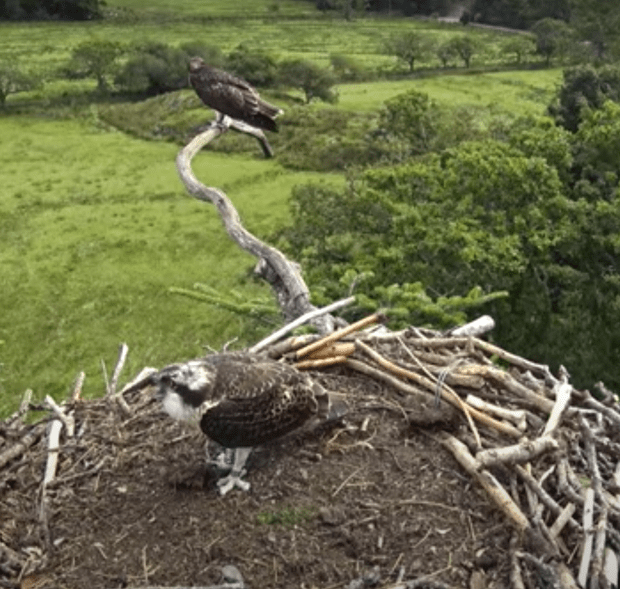
At Glaslyn, however, Aran is still bringing fish for Blue 497. It won’t be long, Aran!
497 is an incredibly beautiful osprey.
To my knowledge, Blue 497 is the only fledgling left on an Osprey streaming cam in the UK to migrate.
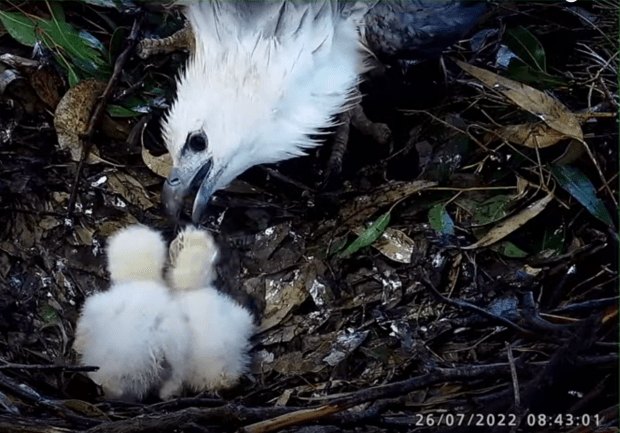
Did I mention mantling (when a raptor spreads its wings over its prey to conceal and protect) was one of the development stages coming quickly for the Sea Eaglets in Sydney? Well, guess which of the two was the first to demonstrate this stage of growth?
If you said SE30 you would be absolutely correct! Both eaglets held the prey down with their talons and pulled. Eventually they were fed but this is very good training. So proud of 30! Go baby. Don’t you just love the look on 29’s face? (squint)
The sea eaglets have been well fed and have been sporting crops on and off for a few days now.
Watching incubation and expecting a hatch in less than a week can be nerve wrecking.
The beautiful Mum at Port Lincoln. It is the 15th. Oh, so soon we will be having little osplets –. Cannot wait.
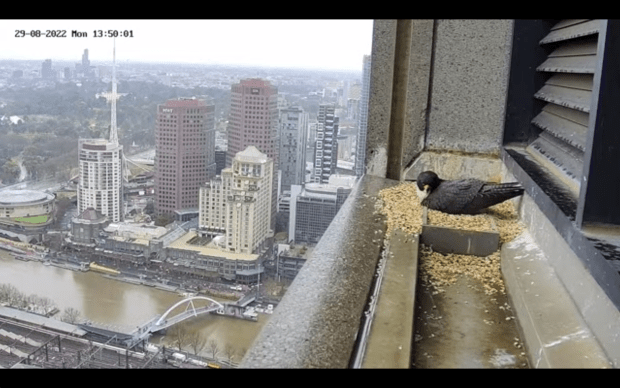
For Melbourne, mark your calendars for the 27th of September.
Xavier and Diamond will follow after Melbourne!
Migration News:
Into Hawks? Aren’t we all? Here is a new tool to follow the counts.
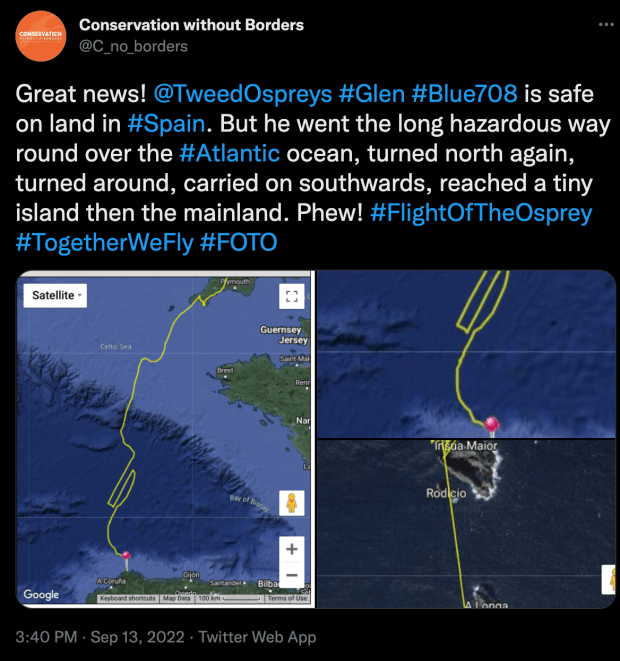
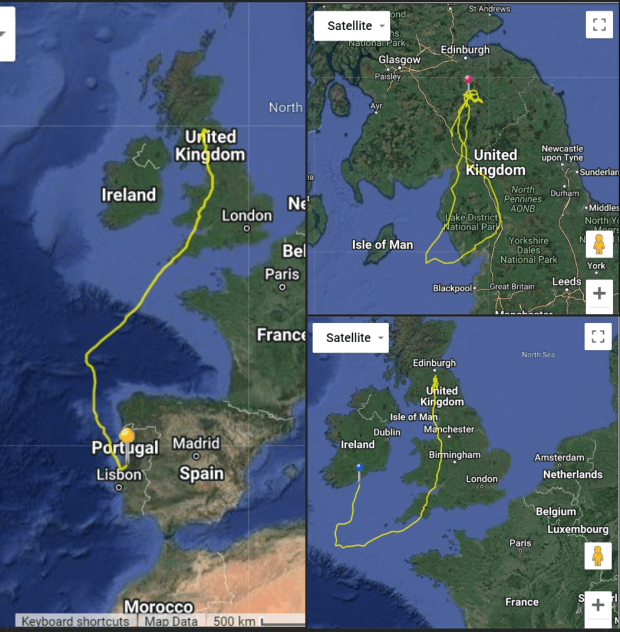
Some good news on one of the Tweed Osprey fledglings, Glen. (Sadly it appears that Kirk who had gone West and was in Ireland continued west over the Atlantic and is probably lost).
From Karl II’s family, the Estonian Black Storks from the Karula National Forest nest.
Bonus is really flying and remains in the same area he has been for several days now-the Prypjat River. He is safe. Relief as always.
Waba is at the Hrabarka River in Ukraine.
I see no transmission for Kaia or Karl II.
Audubon scientists are using data from hawk Mountain to monitor the places that raptors migrate.
I am not a cartoon character but, for many raptor watchers in Australia (and elsewhere), I am the most famous duck in the world. Do you remember me? What is my name? What kind of a duck am I? Whose nest did I lease? And do you remember what happened?
Thank you so much for joining me today and for your lovely notes. It is actually relatively quiet in Bird World but soon…so soon, there will be action in Australia – at Port Lincoln and Melbourne. Meanwhile, we can all enjoy the antics of the little Sea Eagles who are jumping, flapping, and learning to mantle and eat their own prey. Take care of yourselves. I look forward to seeing you again soon.
Thank you to the following for their tweets, their posts, videos, and streaming cams where I took my screen captures: Wildlife Haven, Bald Eagles of Centreport, Albatross Space, Channel Islands Eagle Lovers, Notre Dame Eagles, NEFL-AEF, NADC-AEF, Dyfi Ospreys, Bywyd Gwyllt Glaslyn, Sea Eagles@Birdlife Australia Discovery Centre Sydney Olympic Park, Port Lincoln Ospreys, 367 Collins Street by Mirvac, Charles Sturt Falcon Cam, Conservation Without Borders, and Looduskalender.
From the Archive: Daisy is a Pacific Black Duck. She first appeared on the nest of the Sydney Sea Eagles in December of 2020. She attempted three clutches of eggs – all predated by the Crows, sadly. The last clutch in 2021 almost made it to hatch. We were all cheering! Daisy stole our hearts and taught us many lessons about the challenges the female ducks face in being both incubator and security guard. The couple came this year to check on the nest. Oh, it was delightful to see Daisy and her mate but, equally, there was relief that she decided to lay her eggs elsewhere in the forest. Did you know that less than 15% of all duck eggs laid make it to hatch?
Good Morning Everyone. The first part of the week has flown by. I hope that you had a lovely long weekend (if you had a holiday) and that Tuesday was good.
The Crows continue to alarm every time “THE cat” comes into the garden and, in particular, when the rabbit is visiting and eating under he bird feeder. Today it happened twice. That bunny doesn’t know he has three guardian angels! How lucky.
Meanwhile Junior, the male Blue Jay, is moulting. Poor thing. He has lost his beautiful crest and he looks so out of proportion. He has finished up all of the peanuts and has decided to try some of the seed spilled when filling the feeders.
At sunset, hundreds if not a thousand gulls flew low to the ground looking for their evening resting area. The sky was simply full of them in every direction moving and looking like a swarm of mosquitoes. Several ‘V’s of Canada Geese could also be seen. The expectation is that the majority of duck and geese migration will take place starting the third week in September. If so, I hope to get some great images for you.
In the Mailbox:
‘G’ wonders how on earth an osplet could get salmonella poison and die? The necroscopy tests have revealed that the Loch Garten chick died of salmonella poisoning. The chick was lethargic several days before dying on the nest. A number of studies and several reports and articles such as “Incidence of Salmonella in fish and seafood” published in 2000 states, “Field laboratories of the U.S. Food and Drug Administration collected and tested 11,312 import and 768 domestic seafood samples over a 9-year period (1990 to 1998) for the presence of Salmonella. The overall incidence of Salmonella was 7.2% for import and 1.3% for domestic seafood. Nearly 10% of import and 2.8% of domestic raw seafood were positive for Salmonella”.
The study was, of course, related to the risk of food poisoning in humans but this would be the same way that osplets would get salmonella is by eating raw seafood that contains the bacteria.
The NZ DOC has done an 180 degree turn and has decided to hold a naming competition for the Royal Cam Quarry Track chick. QT, instead of leaving her with her code name. Here is the announcement:
Some additional images of Victor in the large flight area have been posted by the Ojai Raptor Centre. Oh. Victor is doing so well. I wonder if he is still rejecting the Trout and only wanting to eat Whiting??
Victor is getting stronger every day! Oh, how lucky this beautiful juvenile is to have such good care.
If you are intending to donate and/or purchase some items from the Ojai Raptor Centre’s shop, remember to include that it is for Victor! I might have mentioned that they have included a shopping option for Canada in addition to the US. If you live elsewhere, send them a note and they will set up the shipping. I received the two t-shirts and the tote bag today. They are super!
There is a wildfire in the Big Bear Valley. It is being called the Radford Fire. Many were concerned that it might bring harm to Jackie and Shadow and their nest but they are safe. The fire is on the SE part of the lake. We all love Jackie and Shadow and many of you might have heard about the fire and were worried. Here is that confirmation:
University of Louisiana grounds keepers saw the hawk tangled in fishing line and acted quickly in order to save its life. Remember and spread the word – be responsible. Clean up monofilament line both yours and that of others if you see it. Make the shores, lakes, and rivers safe for the birds and fish.
Nicola Sturgeon, the First Minister for Scotland has announced a draft bill on grouse moor licensing to be introduced in this year’s parliamentary legislation. Many like Mark Avery and Chris Packham have lobbied to end the senseless killing of the raptors on the driven grouse moors. This is a huge step forward and is coming none too soon.
The Guardian carried an article, “Dark matter and lithium water: 15 big issues poised to affect oceans and coastlines” today. You will already be aware of some of the concerning actions and issues including the dumping of toxic chemicals into the oceans. The example came from Senegal but it could easily have come from large westernized countries! My biggest disappointment was the glossing over – no, not just glossing over – not even acknowledging what will ultimately happen to the sea birds that depend on the oceans for food.
Mrs G and the three fledglings remain at the Glaslyn nest with the male, Aran. They are the only ‘full family nest’ still resident in the UK.
All three siblings lined up waiting for Aran and fish.
Mrs G is hiding!
News coming out of the Dyfi nest other than Idris continuing to feed Padarn is that Pedran, the first fledgling, did not fly straight south from the nest to begin migration but, rather hung around the UK and has been spotted! So remember this – the birds do not always fly directly south but can spend time flying and perfecting their fishing while getting strong! (Note- all three were deemed to be female. Disregard the use of the words he/him below).
Bella has arrived at the NCTC Bald Eagle nest waiting for her mate, Smitty.
An unknown female Peregrine Falcon interrupted Alden’s ‘loafing time’. Let us hope that this is not the female intruder that Grinnell had chased away from The Campanile scrape.
After an encounter with a female intruder at The Campanile, Annie and Alden renew their bond in the scrape.
All is well at the Australian nests. The only one with chicks is, of course, the Sydney Sea Eagles and SE29 and 30 are growing and changing and, like clockwork on the development chart, getting all of their juvenile feathers. It may be difficult to tell them apart soon!
It is incubation duties at the other three nests – the two Peregrine Falcon scrapes at Orange and Melbourne and the Port Lincoln Osprey barge.
Sunny in Melbourne.
Beautiful Diamond.
The sunshine gave way to rain later in the day at Port Lincoln.
Dad eating his portion of fish before taking it to Mum. Thanks, Dad. We don’t want any more flapping fish on those precious eggs!!!!!!
Migration News:
No tracking news for Karl II or Kaia. Karl II is in the most dangerous area of Ukraine at the moment. Their transmitters could be jammed. The only news is of Waba and he is doing fine and has found a small area to fish. We wait.
Memory Lane:
Do you remember these two cutie pies? Who are they? what is their natal nest? and what are the names of their parents?
Thank you so much for joining me today. I will be pulling out photos from the archives for the next week or so to see if we can tell who is who! Take care everyone. See you soon!
Answer to Memory Lane: This is E17 and E18 from the SWFlorida Bald Eagle nest. They were removed to CROW for conjunctivitis and safely returned to Harriet and M15 after a successful treatment. Known for their early sparring the twins became best buddies.
Thank you to the following for their posts, their streaming cams and videos that make up my screen captures: Cornell Bird Lab and the NZ DOC,, Ojai Raptor Centre, Friends of Big Bear Valley, Bald Eagles 101, Bywyd Gwyllt Glaslyn, Dyfi Ospreys, NCTC, Cal Falcons, Sea Eagles@Birdlife Australia Discovery Centre Sydney Olympic Park, 367 Collins Street by Mirvac, Charles Sturt Falcon Cam, Port Lincoln Ospreys, and SWFlorida Bald Eagles and CROW.
We are nearing the end of August. I keep saying the month has disappeared and it surely has! It is simply hard to believe. We had a magnificent rain that brought the garden back to life. There is nothing like a good soaking – watering from the tap doesn’t seem to do it. The garden also had a visitor this morning. I know the hawk has been around but, with all of the foliage it is hard to spot him. The new fence has, however, attracted a lot of attention and today it got approved to be the new plucking post! The image is not good. I got so excited that I hit the silly video button on the phone and not the photo. It is also from a distance through a screen -I was hiding in the shadows hoping that she would not see me inside the house taking her photo – hawks have to eat, too.
By now you will have noticed that I have added some sub-titles to my blog. There will not always be questions in the post to answer – that is up to you! But if you are wondering something, ask. I will absolutely not always know the answers but I have friends and colleagues to ask that do and they are happy to share what they know with all of us. There is generally some news and there are always things happening at the nests despite it being quite slow the end of August. I hope also to incorporate a book review section once in awhile —- when there is time to read a new book. I am currently working on two: Birds. A Complete Guide to their Biology and Behaviour. It is excellent so far – a great reference that includes topics such as Anatomy and Physiology, Flight, Food and Feeding, Breeding… The second is After They’re Gone. Extinctions Past, Present and Future by Peter Marren who tackles some of the very uncomfortable truths that we have to face. It is time, after all, to get our heads out of the sand and listen to what individuals like Marren have to tell us. Full review to follow in a few weeks when I have had time to digest and reflect the latter.
In the Mailbox:
‘B’ writes: “I have been watching Osprey nests for years. Why do the siblings attack one another after fledging when they have been nice on the nest?” Oh, this is such a timely question as the nests begin to empty themselves of parents and fledglings in the Northern Hemisphere.
Some of you will remember that the three osplets on the Port Lincoln Osprey barge in 2021 – Bazza, Falky, and Ervie – were sweet to one another as nestlings. Bazza tried a couple of times, early on, to boss Ervie but, even as little as he was, Ervie wasn’t having any of it. So the nest was very peaceful. Then they grew up. They fledged and even became interested in fishing. When Dad would bring a fish, they would descend on the nest and fight – or, rather, let’s use the Australian term, “a dust up” would occur. If you are watching the Dyfi nest of Idris and Telyn, two of the three girls remain in Wales. Whenever a fish comes on the nest, they practically knock each other about to get to that food. This is perfectly normal behaviour. They no longer see one another as siblings but as rivals who might take the only food supply. Soon, they will go their separate ways and no would have been hurt-normally -although Bazza and Ervie did get pretty rough. Please note that the PLO nest had 3 males and the Dyfi had 3 females – same gender on the nest. Same sex nests tend to be very civil after a brief set to at the beginning.
‘S’ sent me some news and included in it is a video/PowerPoint on what to expect at the Royal Albatross Taiaroa Head Colony in September. I know that many of you are fans of the albatross and watch Quarry Track chick, this year’s Royal cam chick, faithfully. I do not cover her but I look in on her. Sharon Dunne does an excellent job of providing all the information needed! This is a great information packet – have a peek. Thanks, ‘S’.
Making the News:
Drought and hydro poles killing off Europe’s White Storks. Only 10% of the hydro poles in Hungary are insulated and yet 150,000 beautiful White Storks are electrocuted each year. This well done video shows the birds, where they live, the deaths, and the fix that is required. It is now time for humans to step up to the plate and take care of the wildlife instead of doing what we have always done — put ourselves first.
And, of course, Hungary is not the only country that has this issue. We saw it in Canada when Junior was killed near the nest on Gabriola Island, in The Czech Republic, and elsewhere.
A Polish Photographer has been stirring up real interest on the Internet with his image of an Osprey fishing. His name is Krzysztof Stasiaczek and the image was taken in August 2022 in Eastern Masuri, Poland.
Hancock Wildlife Foundation in British Columbia used their GoFund Me and some other private donations to build a new sun-shaded nest for Ma and Dad at Delta 2. Why? Rising temperatures in the area of the nest due to the increased heating of our planet. They released the images today. That is David Hancock with the light blue long sleeve shirt working tirelessly to continually improve the lives of the Bald Eagles…he has been doing this for at least 65 years!
Somehow we all knew that the numbers of Bald Eagles on the Channel Islands is growing – thanks in large part to Dr Sharpe ensuring the eaglets do not tumble into the sea or die under a nest from zinc toxicity.
News is coming out of the Channel Islands Eagle Lovers group that there is the possibility of a new Bald Eagle pair spotted on Santa Cruz! Sauces 2016 hatch A-63, a male named Whisk, has been seen at the old Fraser Point nest with a subadult female of approximately 3 years. Fingers crossed.
A blog by Rosie Shields who monitors the Borders nests in the UK found its way into my inbox today. You might not be interested in these Ospreys but, it is the behaviour of the female that is important. She left a nest with three chicks she was feeding to begin her migration, landed on a nest she had visited before, and sat herself down now for 9 days being fed by the resident male who is willingly catching fish for her. It is always good to learn more and more about the behaviours of Ospreys – they never cease to surprise and amaze me.
Annie and Alden decided it was a good idea to renew their bond in the UC-Berkeley scrape on The Campanile after the sudden visit of a mysterious male falcon. Alden initiated the bonding session. “Annie, do not look at another male falcon. Alden is a keeper!”
Alden was caught loafing in the setting sun last evening. How adorable.
Everyone is sitting waiting really impatiently to see if Diamond will lay a third egg at the Charles Sturt Orange Falcon cam in Australia. Diamond’s average between eggs is 56 hours. The second egg was 57 hours this year. Will there be a third? and will it be on time?
Xavier loves his ‘eggie’ time and Diamond was obliging this morning to let him take a turn.
Xavier left and returned around 0700 with a Horsfield’s Bronze-Cuckoo (IDed by Holly Parsons). Xavier always brings something special on egg laying day. What a sweetheart.
Xavier waits for one and a half hours to incubate those precious eggs…it is caught on video.
Diamond looks pretty contented. Let’s see what is happening in a couple of hours.
There are still only 2 eggs at Orange. It is the middle of the night. If Diamond is to lay a third egg I would surely think that it will come before 0800 on the 31st.
In Melbourne, the little Dad is getting his turn, too and those four eggs look awfully big as he wiggles and squiggles to get them under him. Yesterday he looked down and noticed one was outside!
You can almost hear him saying he hopes the new mate doesn’t lay 5! She could. Keep hoping the population of pigeons is bursting at the seams in Melbourne!
Everything seems to be going well with the Sea Eagles. They are six weeks old and standing sturdier by the day and changing their appearance with those gorgeous feathers coming in.
At Port Lincoln, Dad took over incubation and Mum is enjoying a really nice dinner time fish before tucking it in for the night.
Updates on Tweed’s three fledglings from yesterday’s post.
A Tweet from County Cork with a great photograph of an osprey believed to be Kirk. Fantastic. He has had quite the adventure. Glad Kirk is safely on land. Now to get his GPS coordinates polished.
In the UK, Louis and Sarafina are still at Loch Arkaig. Dorcha was last seen on 18 August and it appears that Willow, LW5, began her journey on the 28th of August.
Louis delivered a lovely Mackerel to the nest for Sarafina today. She has been seen down at the loch attempting to catch a fish, too. Isn’t that splendid?
Louis brought a lovely fish to Sarafina at 16:16:33 on the 30th. She is still with us as of today.
The last sighting of Willow was on the 28th.
Maya is still at the Rutland Manton Bay Osprey platform. She flew in with a fantastic fish this morning at 0619. While many of the females have now departed, Maya raised three very large and strong female chicks with Blue 33. She is taking good care of herself so she is in good shape for migration. Normally we can expect to see her and her mate, Blue 33, back in the UK at the end of March. The first eggs and the first hatches!
Seren, Blue 5F, was with Dylan this morning at the Llyn Clywedog nest looking around their beautiful territory.
It appears that Mrs G from the Glaslyn Valley nest is now on her way south. Aran was on the nest earlier and one of the fledglings was shouting out for a fish.
At the Dyfi Nest, Telyn was last seen on the 25th of August. Pedran left before Mum, and Padarn was still at the nest today. Paith has not been seen on the 30th that I am aware of so it could just be the second hatch, Padarn, and Aran left at Dyfi.
Stephen Basly posted another great image on the Notre Dame Eagles FB Group of our Little Bit 17! It was the 25th of July and is such a great image. I think Stephen worked to get it cleaned up well for all of us. Thanks Stephen!
I have not been able to access Looduskalender today for updates on the Black Storks, Karl II and his family, as they migrate.
Thank you so much for joining me today. It is a gorgeous day here – I hope it is for you, too and that you have been able to enjoy being out in nature, if possible. Take care of yourself. See you soon!
Thank you to the following for their tweets, videos, streaming cams, and blogs that make up my screen captures: NZ DOC, BBC News, Krzysztof Stasiazek, Hancock Wildlife Foundation, CIEL Rosie Shields, Cal Falcons, Charles Sturt Falcon Cam, 367 Collins Street by Mirvac, Sea Eagles@Birdlife Australia Discovery Centre Sydney Olympic Park, Port Lincoln Ospreys, Conservation without Borders, Dave McGrath, Friends of Loch Arkaig and the Woodland Trust, LRWT, CarnyXWild, Bywyd Gwylld Glaslyn, Dyfi Ospreys, and Notre Dame Eagles.
What happened to August? It seems as if we blinked and it flew by. Despite the heat there is a look about the leaves on the trees and the wilting of the tomato plants despite their being well watered that is alerting us to the end of summer, not just the calendar. There is another 9 or 10 days before the teachers and students are back to their classrooms in Manitoba. It is a reminder that it is time to get a small delivery of firewood. There is something so cosy about a wood fire on a crisp autumn morning and if August is any indication, autumn will be here in two blinks.
The colour of the light and the water of the pond seemed to be taking on the hues of autumn.
The rain started in the early morning hours of Monday and everything has turned green in the garden again…it is raining so hard! And for once, I am so glad to see it! Monday will be a good day for reading the small pile of books accumulating on my desk.
In the Mailbox:
‘N’ writes: “Do all falcons incubate the eggs the same no matter where they live? Do all ospreys?” Oh, what an interesting question! I am not a specialist on incubation, the term used for the behaviour whereby adult birds keep the eggs warm until they hatch. My experience watching the nests of different species is that birds are very individualistic and even within a single species, the attention that they give to their incubation duties varies. I found a paper that actually discusses the different approaches to this important task. It is not a recent one but it is quite interesting. The author covers some birds that are unknown to me but, I believe the findings and the data can enlighten us as to the full answer to your question, ‘N’.
RSPB created an extremely short video about Avian Flu killing the White-tail Eagle chicks on the island of Mull. What is so intriguing is the landscape of the island and the beautiful chicks so alive in the nest. It is clearly not the be all- end all informative presentation but it was nice to see where these eagles live.
Just a couple of months before Avian Flu began killing the White-tailed Eagles on Mull, this beautiful 7 minute video was made showing them on their island setting. Have a watch:
The attempt to rid Gough Island of its House Mouse problem has hit a wall. The eradication of the mice that were biting and killing Tristan Albatross chicks and adults is now being viewed as a failure. Everyone had such high hopes that the island would be rid of these invasive mice but an unknown problem presented itself – the slug. Have a read:
In his newsletter, David Hancock of Hancock Wildlife just posted the following information about the Delta 2 nest in British Columbia, Canada: “Firstly, both Ma and DM have gone on their migration. Ma was last seen at the Delta 2 nest/territory on July 25th. DM (taking his new role as Ma’s mate very seriously) hung around for another week keeping an eye on things. He was last seen there on August 1st. Thanks to all who donated to the GoFundMe campaign, as well we received a a few private donations which are greatly appreciated. These donations are going to cover the costs associated with the installation of a sturdy new nest pole and two (2) new cameras at Delta 2.”
Nest News:
It is egg 4 for the Melbourne Peregrine Falcon couple on the ledge of 367 Collins Street! Oh, my goodness. Dad you are going to so hope that the pigeon population of the city is very plentiful!
Here is a video of that last egg being laid:
It was a prey drop and a chance for Dad to get himself acquainted with how you have to wiggle around to get 4 big falcon eggs under so they can stay warm.
It is a lot easier for Mum to get those four eggs tucked in tight. Do you think there will be a 5th?
We have a ways to go before hatch for Melbourne and Diamond might not be finished laying eggs. Incubation is a time for the females to rest. It is going to be very hectic if all the hatch at Melbourne! And exciting.
The Sydney Sea Eagles are developing right to schedule. Their plumage continues to come in and they are picking up sticks in the nest and preening. SE29 is standing and walking better each step. They really are gorgeous. The Monday morning feeding saw both 29 and 30 with nice crops full of fish. I have seen no concerning aggressive behaviour on the part of 29 to 30 that would cause me to worry.
We are about 3 weeks away from hatch watch at Port Lincoln. Mum and Dad continue to take turns incubating. That said, Mum will always have night duty and Dad will provide Mum with her meals.
You would think that Mum would be very stiff incubating the eggs all night. Dad has arrived and is nudging her off so he can have a turn. Mum goes away for her breakfast and a break, returning in about half an hour.
You are doin’ good, Dad.
There has been an unknown male visit Annie in the tower.
There is a notable change in the behaviour of the female Ospreys in the UK this year. Normally they would depart the nest about 10-14 days prior to the fledglings leaving on their migration. This year it appears the majority are choosing to remain on the nest while some or all of the fledglings depart. While we will not know the specific reason, I wonder if it is, in part, due to the raising of these large female chicks and the Mums needing more time to get in top shape. Or could it be that prey is plentiful, the weather is nice in the UK, and they just want to be home for a little longer?
Idris, Telyn, Padarn and Paith are still at the Dyfi Osprey nest in Wales as of Sunday the 28th. Idris has stayed on the perch all night. Pedran was last seen on the 11th of August at 0905.
If you follow Tweed Valley, the three fledglings are going in very diverse directions including Glen who remains on the nest. Kirk is in Ireland having flown south and turning back to the land. Tweed is nearing land in Portugal.
Ruthland is updating us on their second hatch at Manton Bay, 1H2:
Tiger Mozone says that the fledglings need good DNA and luck. 1H2 certainly has great DNA. Let us all hope she has some awfully good luck, too.
1H2’s parents, Blue 33 and Maya, along with older sibling 1H1 were all still at the Manton Bay Nest at Rutland on the 27th and there is no news of either 1H1 or Maya departing since.
Seren was on the Llyn Clywedog nest early this morning and Dylan even popped in for a few minutes to join her later.
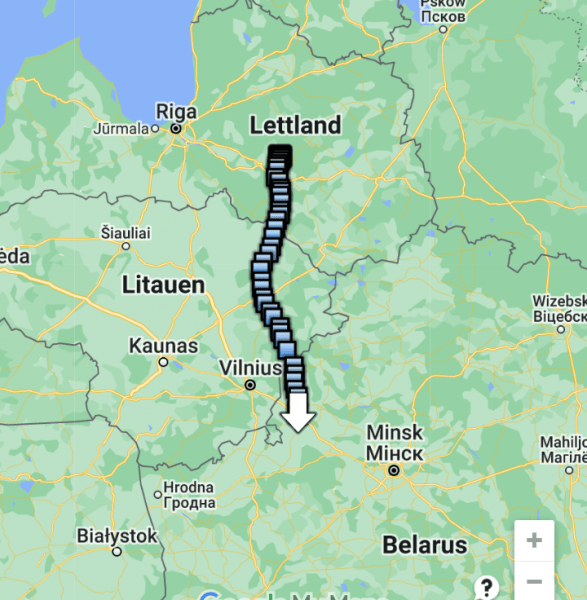
It is just incredible. Bonus continues to prove that he is a very special Black Stork! He flew from the nest in Estonia and spent the night in Latvia on the 27th. He has now flown through Lithuania and is in Belarus near Minsk. That was a total of 279 km.
Kaia, Bonus’s foster mother, remains in Belarus in the Prypjat Wetlands near Shestovicy.
So what intrigues me is this. If Kaia remains where she has been for the last several days since she flew north out of the Ukraine, is it possible that Bonus might also wind up in the same wetlands? Or will Bonus fly into the Ukraine? and remain there? or turn back north like Kaia? We should have our answer in a day or two.
Here is the distance shown by Google Maps:
Waba has begun the journey also and the tracker shows that he crossed into Latvia from Estonia on 28 August. He then flew a short distance.
I have received word that Karl II has left the nesting area in the Karula National Forest and has begun his migration. More on that to come tomorrow.
Victor has done so well since Dr Sharpe travelled to the Two Harbours nest on the Channel Islands to take him to be treated for zinc toxicity at the Ojai Raptor Centre. He has now been moved out to the big flight area! It just doesn’t get too much better than this until he is released. Wow. Victor. Way to go!
Looking forward to Lena and Andy at Captiva next year? or Connie and her mate? Window to Wildlife posted a 7 minute video about updates changes to the cameras, etc with some lovely pictures of Lena feeding the wee nestlings last year.
Thank you so much for joining me today. Please take care of yourselves. See you soon.
Thank you so much to the following for their streaming cams, their videos, and their posts that make up my screen captures: RSPB, 367 Collins Street Falcons and Mirvac, Charles Sturt Orange Falcon Cam, Sea Eagles@Birdlife Discovery Centre Sydney Olympic Park, Port Lincoln Ospreys, Cal Falcons, Dyfi Osprey Project, Tweed Valley Ospreys, Rutland Osprey Project, LWRT, CarnyxWild, Looduskalender, CIEL, and Window on Wildlife.
Good Morning Everyone. I hope that each of you had a lovely Saturday. Thank you so much for joining me today!
From the Mailbox:
‘A’ asks: What is the average time difference or gap for Peregrine Falcons to lay their eggs? Diamond looks like she is ready today. Thank you, ‘A’. That is a very timely question as we sit staring at Diamond’s bottom for her tail feathers to begin to go up and down when she is in labour. In the nest notes that Cilla Kinross, the researcher at the Orange Falcon cam compiled, it says that the average time difference is 56 hours. As I write this, the time in Orange is 13:21 on Saturday. That egg is due anytime.
‘L’ asks: What is the purpose of molting? The feathers of our bird friends get damaged just like our clothes from normal living. They break and get tears. Moulting is the annual replacement of the feathers. In fact, think about it. Feathers are so important to birds – they keep them warm and dry and, of course, are needed for flying. They should be in tip top shape which is why birds spend so much time preening. Some birds begin to moult in the spring. Others wait until nesting has finished. Moulting is really hard on the birds and it is normally done when there is an unusually high level of prey so they can keep their energy up.
‘C’ writes: “I’m glad I helped with that information about galvanized steel that contains zinc. But in stainless steel, the component is chromium. Is it also bad for the health of birds? I searched very quickly, and in a very superficial search, I didn’t find anything that chromium is also bad for.” The information you provided was very useful. As one of our other readers ‘L’ writes there are some uses for zinc that are also helpful such as in ‘Zinc Ointment’ for baby rashes. I do not know a lot about chromium. It is also used in ceramics to make certain shades of green glazes and is highly toxic in its powdered form. It is not toxic after the pottery has been fired to a specific degree, however. — We assume that the things that we use for cooking are all ‘safe’. Sometimes it is only later we discover that there could be connections to specific ailments. However, if I had a beloved bird that lived in a cage – the cage wires would be stainless. We have a metal shop in our city that made all the SS backings for my kitchen and my island top. I am certain there are similar facilities in other cities where they could make the wires. I am still finding this whole zinc toxicity that impacted Victor very curious. I wish I knew more!
In the News:
The UK is still celebrating the arrival of more than 100 Hen Harriers.
The New York Times published the following article about how climate change will impact the birds we love and which are more likely to go extinct first. The cover shows the Kakapo and my readers know that the Kakapo Recovery Group is working hard to make sure that the flightless parrots survive. Today there are 205 of them on a couple of mall islands of New Zealand.
Nest News:
Chase showed up with a nice big fish and waited and waited on the Two Harbours nest for Lancer on Saturday morning around 10:38. Lancer never showed up. What a change it must be for the parents from nearly getting their talons torn off to sitting quietly to see if anyone will arrive. If you have left the territory, Lancer – soar high, be safe and always have a full crop!
Such dedicated eagle parents. Did you know that Chase & Cholyn have been together for 19 years?
Ferris Akel had a terrific tour on Saturday afternoon around Ithaca, New York. I was listening and doing other things until he got to the Cornell Campus where he caught Big Red, Arthur, and L2 on camera. Oh, it is lovely to continue seeing L2. According to Suzanne Arnold Horning, the latest a juvenile has been seen at the Cornell Campus is 28 August. L2 looks pretty comfortable. I wonder if she will shatter that record?
Arthur was hunting.
L2 could see Big Red in the distance when she was on the pole and was prey crying really, really loud. Since L2 was the second juvenile to catch her own prey in June I am imaging that Big Red’s answer to that is: “Get your own!”
Big Red looks a little ‘rough’. She is moulting. Like other Red-tail Hawks, Big Red undergoes a complete moult once a year. Normally, hawks begin their moult in spring and every feather has been replaced by September or October. Big Red, however, appears to begin her moult after the eyases fledge.
Xavier has been bringing Diamond some extra special treats during Sunday to help Diamond keep her energy up for the egg laying. One was an Eastern Rosella which is a very colourful parrot and the other was a nicely prepared pigeon. Diamond was excited for both!
The arrival of the Rosella meant that cute little Xavier could have some time with ‘eggie’.
Diamond had a very large crop when the pigeon arrived but she certainly wasn’t going to turn her nose up at that special food gift.
It is 13:57 in Orange and Diamond is sitting on the ledge of the scrape box while we wait and watch for an indication that the second egg might be arriving.
Diamond is back on the egg at 1400.
Diamond is very focused and she looks ‘heavy in the rear’. Egg 2 could be coming shortly. Diamond normally lays 3 eggs. For the past two years, only one egg has been viable each year.
Diamond laid egg #2 at 17:27. Yippppppeeee. Why am I so excited? Well, falcon eggs do not always hatch and for the last two years Xavier and Diamond have had only 1 out of 3 eggs hatch so it makes the chances better of having a successful hatch.
Xavier arrives at 17:33 to see the second egg and to bring Diamond her dinner. Notice that Diamond is being very careful. Falcons lay their eggs standing up. She is protecting the egg while the shell hardens in the air. The gap between eggs is 57 hours.
Diamond did not want to eat. She had already had two big meals. She remained in the scrape box. During the night she would sometimes incubate or, alternatively, stand above the eggs protecting them. Remember the Currawong know there are eggs in that scrape and they will eat them if the opportunity arises!
The Melbourne couple seem to be finished with three eggs and each takes turns incubating. Dad was very anxious to demonstrate that he was well seasoned in incubation. The Melbourne crew even made a video of the persuasion.
It is a very short and cute clip. Oh, do you ever wish you could speak falconese?
Friends of Osprey have posted some photographs of Ervie near the Marina where he had dived and caught the lovely fish he is eating. They were taken by Alex Ditton. Oh, goodness. It is always such a joyous occasion when someone shows us that Ervie is doing very well indeed! Check out the Friends of Osprey for more images of Ervie.
Kaia remains in Belarus around the Priypat River. This is what the area looks like where she is resting and fishing.
Bonus, the only surviving storklet of Jan and Janika that was fostered with Kaia and Karl II has begun his migration. His tracker tells us that he traveled 109 km and is now in Latvia near the village of Vietalva.
Travel safe dear Bonus, fly high, stay out of the war zones, always have a stream full of frogs and fish — prosper.
There should be more news but it appears that all might have left for their winter homes from the Karula Forest nest of Kaia and Karl II. I will confirm this tomorrow.
Bonus was always a very special Black Storklet. He would not have survived without the intervention of Urmas and Dr Madis and his team. They would have died on the nest. Urmas’s foresight to provide fish baskets meant that everyone had lots of fish. A special thank you to all who donated towards the food for the nest.
The Dahlgren Osprey nest in the US has announced that the male, Jack, has not been seen for a few days so that now Harriet, the female, and the sole surviving fledgling from the nest in King George County are on their journey south.
No one has been seen at the Loch of the Lowes since yesterday. Laddie LM 12, Blue NC0 and both of the fledglings appear to also be heading south.
It was another successful year for Ospreys in Wales and John Williams gives us the run down in his last blow of the season for Llyn Clywedog. The numbers of Ospreys in Wales are growing. There are now 7 ‘known’ pairs who produced 17 chicks this year. John catches up with all the nest news.
John also produced a chart for all the chicks hatched at Llyn Clywedog – noting that there is simply too much grey. Were those chicks ever seen or not? Sometimes they do get missed.
Handsome Aran on the perch at the Glaslyn nest this morning. He remains bringing fish to the nest for the fledglings. Mrs G was still home as well today.
Handsome, Aran.
Emyr Evans has provided us with the data of the fledges at the Dyfi nest asking the question: what happened to Pedran? Emyr is great with statistics and this is a good read about migration and young fledglings.
Rosie was still on the perch at the SF Bay Osprey nest this morning! Brooks has not been seen at the nest for some time now – this is not alarming. She is out exploring!
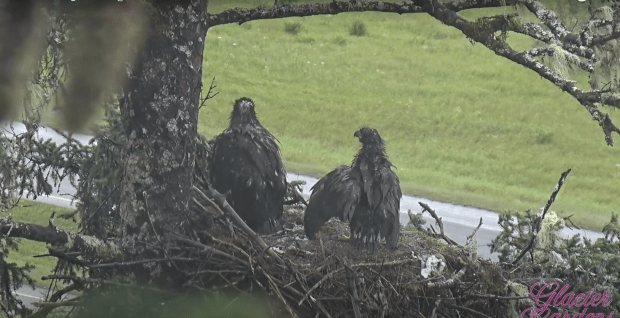
Congratulations to Glacier Gardens. Both Love and Peace have fledged. Here is a video of that moment on 25 August when Peace took to the air. Congratulations for another successful year Liberty and Freedom!
Thank you so very much for joining me this beautiful Sunday morning. I hope that you are doing well and I will look forward to having you with us again in Bird World.
Thank you to the following for their streaming cams, their posts, and their videos that form my screen captures: The New York Times, Explore.org and IWS, Ferris Akel Tours, Charles Sturt Orange Falcon Cam, 367 Collins Street by Mirvac, Friends of Ospreys, Looduskalender, Dahlgren Ospreys, Friends of Loch of the Lowes and the Scottish Wildlife Trust, John Williams and The Clywedog Ospreys, Bywyd Gwyllt Glaslyn, Dyfi Ospreys, SF Ospreys and Golden Gate Audubon.
Sometimes events are so heart warming that they need to be spread throughout the community. Sitting on a perch as I write is a 2019 hatch of the Two Harbours nest and Mama Cruz. Trey is the female eagle’s name because she was the third to hatch. She survived her migrations to return to the Channel Islands as a three year old! Just splendid.
My goodness even moulting she is gorgeous. A survivor. When you look at this three year old eagle be amazed. As we know most simply do not make it to their first birthday.
The Channel Islands eagles have graced us with their beauty in the past few days – Lancer at Two Harbours, and Thunder and Akecheta at the West End. Andor and Mama Cruz and now Trey.
Remember that the research tells us that it is the males that return to their natal nests. Well, this is a female! I hope that Victor’s natal nest GPS coordinates are hard wired into his system so that no matter where he is released, we will see him on this same perch in 3 years time.
In Canada we are familiar with Spunky, the Red-tail hawklet raised by the Bald Eagles in Sydney, British Columbia. This year it was Malala’s turn – another Red-tail Hawk – to be raised by Bald Eagles along with their chick,, Junior, on Gabriola Island, British Columbia. Well there was, at the same time, on the other side of the US, another Red-tail Hawk being raised by a Bald Eagle family in New Jersey.
It would seem that the raising of a hawklet on an eagle nest might not be as rare as we think.
A note from ‘H’ came flying across my computer screen. It is about Sloop, the third hatch at the Boathouse who has not fledged. He made his way up to the high perch and it would appear that he is afraid to come down. ‘H’ says Dory has been trying to lure him down with a fish. He has now not eaten since 1230 — and we know that Sloop loves his fish.
Sloop has now been joined by a sibling.
I have a great fear of heights and have so much empathy with our dear Sloop who has been up on that perch for almost 7 hours! Poor thing. The water looks calm and he can fly —– he just does not know it.
‘B’ gave me an idea. I am going to send Stephen Basly and Doreen Taylor snail mail thank you cards to St Patrick’s Park. I am certain they know them well – from all of us. It has been such a treat to be able to see Little Bit 17. So grateful for their efforts.
Thank you so much for joining me. Send good energy and a gentle wind to our dear Sloop in the morning. After his huge meal yesterday he will not starve. Remember in the wild eagles can go for days without eating and he had some crop. Yesterday he was too full to fly.
Speaking of crops…one last image. SE30 is the one on the right. No words needed. Take care everyone.
Thank you to the following for their streaming cams and/or posts where I took my screen captures: Sea Eagles@Birdlife Australia Discovery Centre Sydney Olympic Park, Audubon Explore, Bald Eagles 101, Explore and the IWS.
The condolences continue to pour into Poole Harbour for the loss of 5H2 due to the goshawk attack and to Loch Garten’s 1C1 to unknown causes. It is worse when the osplets are older and flying. The number of Osprey in the UK is very small compared to North America and the loss of these two chicks on significant nests took its toll today. Last year the osplets died due to weather issues when they were so little. This year we lost a wee one at Llyn Brenig, the third hatch at Loch Arkaig when its foot caught and it could not get under Mum during the worst weather. Siblicide at Loch of the Lowes. It is hard either way but raising chicks to fledge and then losing them is just tragic.
I have had many letters asking if Loch Garten is doing a post-mortem. Yes, they are! The cameras will be turned off during the removal of the chick and then turned back on. We have seen three ‘mysterious’ deaths this year on streaming cams of Ospreys -Big at Captiva, Molate at SF Bay, and now 1C1 at Loch Garten. I included Big because there was no confirmation of why she died. Molate was visibly unwell for a few days, just like 1C1. Is it the same? (It is unclear to me as to whether GG Audubon ever removed Molate’s body from the grid as fledglings Brooks and the Visitor continue to come to the nest. Speculation is a lung infection. I do recall Molate also had trouble breathing. Curious.
Elsewhere in Bird World, life seems reasonably stable but everything can change in a few seconds – without any warning – as was the case of H52.
The great experiment by Urmas and Dr Madis to save the Black storklets of Jan and Janika would have been significant if not for the loss of all the chicks on Eedi’s nest due to predation (possibly another Goshawk attack). There is one survivor, Bonus. Bonus is doing tremendously well. He is 78 days old today. Karl II and Kaia have found the filled fish baskets and the chicks are so full that when Karl II comes in with a delivery the four of them cannot eat all the fish. Yes, it is true!
Fledging could come at any time. Bonus is overdue but because of his delayed development due to stress and lack of food, he will fly once he is ready, not by a calendar. Kaia often leaves by 11 August so we are watching to see what will happen this year.
It is mostly quiet. Many of us are watching the females in the UK to spot on leaves when. Maya is still at Manton Bay in Rutland.
I could not get a good look at her face but this is that amazing female who raised three big girls with Blue 33 this year! She is the mother of Telyn at Dyfi.
1H3 has enjoyed a nice fish delivery today.
1H1 is screaming to goodness for Mum or Dad to get a fish on the nest for her!!!!!!!!! What a beauty.
All of the fledglings could catch their own fish. The parents do not have to teach them – 60 million years is hardwired into their DNA. The fledglings just do not know that they can do it! During migration they will have to begin to fiend for themselves.
These females are such characters. Blue 33 could hear his girl across the lake! “I want a fish now!” Blue 33 is one of my great loves as far as ospreys go. He is 11 years old this year and is ending his 9th breeding season. He has raised two sets of four osplets to fledge with Maya…They are a super couple in a realm of their own.
Remember that flapping fish that we thought had killed at least one of the little ones – they survived. All three nice big girls!
It is hot at the Dyfi nest in Wales of Idris and Telyn. Tomorrow it will be 30 C. Telyn is still here. She has been chasing off an intruder which appears to be annoying her to no end. I do not blame her. Now is not the time for an injury. Telyn will leave Wales and fly to The Gambia. According to Chris Woods who travels to The Gambia in the winter, he knows precisely where her favourite perch is. Brilliant. It is always reassuring to know she has arrived safely.
Just look at all the cameras.
Relaxing down by the Dyfi River.
Emyr Evans has posted a very interesting blog testing different hypotheses about the unringed visitor to the Dyfi Nest. It has some information about fledging ages and the start of migration. Thanks EE – we love the Dyfi Data!
I see no word that Blue NC0 has left the Loch of the Lowes either. Both chicks have been flying for at least 3 weeks and they are doing some fancy landings and take offs from the nest. I was able to catch them on the nest today – one with a fish and the other screaming to Laddie LM12 (Dad) to bring another pronto! These males sure get a work out at the end of the season. No wonder their legs are so strong and muscular.
These two look to be in brilliant shape!
Mrs G is still here. She is on the perch to the left while Aran is on the one at the right.
Aran and Mrs G looking out on their territory from the Glaslyn nest. Aran is in the back, Mrs G, the oldest osprey in the UK, is in the front.
Fledgling eating a fish on the Glaslyn nest while Mrs G is at the nest.
I cannot read the Darvic rings but this looks like a different fledgling enjoying a meal earlier in the day.
I was also able to catch Seren and one of the chicks on the Llyn Clywedog nest in Wales. It is so rare to see chicks on the nest that I feel fortunate checking all of the nests and finding at least one today.
Dorcha and the two fledgling chicks were on Loch Arkaig! I did not see Louis but he is about bringing in fish.
This one desperately wants a fish!
They do not know that they are getting ready for the most challenging two years of their lives. If they live to get to the South of England or parts thereabouts, they will feed up. There are scores of birds that will be at Poole Harbour making their way to their winter homes. How many of them will survive? When we hear averages, it must be the entire raptor family, not just specific species. We know that the UK birds will either land on the Iberian Peninsula and winter or they will continue to Africa and winter in The Gambia and Senegal. I hope to get some figures for Ospreys only. It will be easy to get UK figures of 2 year survival – or thereabouts – as from the Dyfi note – all known birds have Darvic Rings except for a few nests in Scotland and maybe one hiding in Montgomeryshire in Wales. The figure is going to be low and it could provide us with more insights. Less than 1 in 3 I suspect.
Remember – send me the stories you remember about migration. I am particularly interested in the huge challenges these birds face. Get it to me by Thursday night. Thanks!
I peeked in at the Osoyoos and Fortis Exshaw nest briefly throughout the day. The heat dome is definitely hitting BC again but Soo and Olsen seem to be weathering it fine. I have also checked on Titi who has been hovering but has not fledged. Titi is in a very dangerous position if he cannot fly – he is literally the sitting osprey for that Goshawk that continues to fly around the nest! I wonder why he is not moving? We saw Nuppu try to beak her youngest to fly. Titi has no mother, only a sibling and Dad and he needs to work those wings and get out of there.
The latest updates on Victor came on 3 August. If you missed it, here it is. There has been nothing since. We must assume that Victor is continuing to progress. Treatments for heavy lead toxicity take a long time.
Thank you so much for joining me today. Take care everyone. See you soon.
Thank you to the following for their streaming cams and/or posts where I took my screen captures: Finnish Osprey Foundation, The Eagle Club of Estonia and Looduskalender, Dyfi Osprey Project, Bywyd Gwyllt Glaslyn, Friends of Loch Arkaig and the Woodland Trust, CarnyXWild, LRWT, Friends of Loch of the Lowes and the Wildlife Trust.
It is a very early good morning to everyone- just past midnight. I am posting this newsletter early so that everyone will get to read the great news that is coming in – in case you do not already know. In the case of Victor and Little Bit, continued thanks to the wildlife rehabilitation staff that intervened and gave them a second chance on life.
My goodness, it is such a wonderful feeling as if you are floating on a cotton candy cloud when there is great news in Bird World. If you get emotional, I suggest you get the tissues out before reading further.
I want to thank ‘B’ and ‘L’ for alerting me to the special news about Victor in my inbox.
The Ojai Raptor Centre posted this announcement about Victor. When all of us were worrying he might not get well or he might not be able to feed himself ——– well, he is self-feeding and doing a grand job of it, too. He is in an outside enclosure not inside the clinic. Oh,, Victor, you have worked so hard to get well and all the staff at ORC have just being doing the best for you. Tears of joy, tears of joy.
Video of Victor self-feeding:
Video of Victor’s outdoor enclosure:
The other good news is, of course, Little Bit ND17. Images were taken and studied by several who go to the park on a daily basis to watch and photograph the Notre-Dame eagle family – Mum, Dad, ND15, ND16, and ND17 Little Bit. They have longed to get a good clear picture of 17 but wanted to be sure it was him. Here is the announcement in the Notre-Dame FB postings for today:
I was so skeptical when Little Bit was returned to the park without the ability to hunt his own prey. I am joyful to have been proven wrong! Notice the top right image. See how the hair kind of goes around in a partial donut shape. It reminds me of my late father-in-law who was bald but that circular band. It appears that some of the top is flat like strands of longer feathers covering up the places where feathers are missing. At the onset, I did not think he had a crop but, yes, that top right image appears to show that he has recently eaten. What a wonderful relief to see him looking and doing well. Thanks to everyone who worked hard to ensure Little Bit got a second chance on life and those birders on the ground who tried desperately to get images to reassure all of us. Thank you.
The Sea Eaglets are doing just fine, too. The crops of both of them are simply about to pop!!!!!!!
An hour later, Lady is urging them to have ‘just one more bite’! They are growing and will have a rapid growth spurt. Full crops will be the order of the day. Look at how the wings are forming and each has a cute little tail.
The two osplets on the Osoyoos Nest are looking good this evening. The forecast was correct and it has cooled down some – of course, it is still hot, just not as blistery. The chat for the streaming cams appears to be down. Not sure why unless it is all the spam.
Soo had a big crop at 10:46.
Another delivery.
Looks like one of the chicks got the last delivery and is self-feeding.
One crop fuller than the other chick who is fish crying.
I cannot give you a fish count but it appears that both chicks ate today and so did Soo. Fantastic.
Ervie is out flying about and finding nice fish for dinner. He must miss hanging out with Dad on the barge and going to the nest to eat his fish. I wonder if he will try to return to the barge after this breeding season?
It is good to know he is safe – GPS trackers certainly help with that.
In the case of each of these nests or particular fledglings, it is so good to know that they are either improving in care or are doing splendidly on their own. There has been no word on L3 or L4. We wait.
I want to mention a book called Beauty and the Beak. How Science, Technology, and a 3D-printed Beak rescued a Bald Eagle. It is by a pair of talented women – writer Deborah Rose and wildlife rehabilitator, Jane Veltkamp. I first heard of the efforts to save this particular Bald Eagle when I was looking for information about the McEuen Park eagles in Idaho. The intended audience would be children ages 8-12 (I think) but I also enjoyed the gorgeous photos and learning about how science and new technology saved Beauty’s life. It is another fantastic book about positive interventions. If you teach science or know someone who does, I would highly recommend this book. (Cost in Canada is $11.46 for the glossy paperback).
It is a beautiful story of compassion and the commitment of Jane Veltkamp to help Beauty the Bald Eagle.
My regular newsletter that normally appears around noon CDT during the month of August will appear in the early evening on 4 August.
Thank you so much for joining me with all these good news stories. Take care everyone. See you soon.
Thank you to the following for their postings and/or streaming cams where I took my screen captures: Notre Dame Eagles, Ojai Raptor Centre, Port Lincoln Ospreys and Sea Eagles@Birdlife Australia Discovery Centre Sydney Olympic Park.
Oh, I hope that you had a good day wherever you are. Everything ‘seems’ to be fine in Bird World.
The rain has started pouring down – just a couple of minutes ago. Before that the three every-growing-larger Crow juveniles were having fun in the Bird Bath, eating their sandwiches and peanuts along with Dyson, the Blue Jays, and a host of sparrows. Dyson has to have a nest somewhere. She has a very short tail and I was told that she would line the nest with the fur. She is ‘quite large at the back end’ my daughter responded when she saw her. Baby squirrels soon? We hope. Lots and lots of peanuts were put out so everyone had plenty.
I just checked on the Osoyoos Osprey nest. I could not see the time stamps but Olsen apparently brought in at least one large fish to Soo today! There was an early one and one later and maybe some in between. The chatters were happy.
The smallest eaglet on the White-bellied Sea Eagles nest, SE30, needs a shampoo. There is fish juice stuck to all of the soft down on the top of its head. You can easily identify who is 30 and who is 29. 29 is also bigger. That extra day surely makes a difference at this stage. I stayed with the feeding to make sure that 30 got fish and it did! Lady tried 29 and its beak was closed and 30 moved to the other side for bites.
I am always asked if the female Ospreys bring fish to the nests. Oh, yes, they do! They normally do not do this until well after the chicks have fledged unless there is a need (for example, the male disappears or the fish deliveries are not enough). Rosie brought Brooks a nice piece of fish today. Brooks has been doing a lot of flight training.
Blue 33 landed at 17:52 with a really large fish – including the head. Two of the female fledglings had been on the nest fish calling to Dad when the third flew in wanting any leftovers on the Manton Bay nest.
It was delightful seeing all three girls on the nest and Dad. It is always nice to ‘see’ that everything is going to plan. It is not often you catch them on the nest and all seems well.
That is such a nice fish. I wish that Soo could have just one that size for her and the Osprey chicks in Osoyoos every day. What a difference it would make in their development.
Watching Osprey and Eagle families is very educational. You do not appreciate the necessity for good plentiful food until you have seen a nest suffer from lack of prey with stress lines in the feathers of the chicks and babies dying from starvation. It is the same with human animals.
There are so many Osprey nests and Daisy and Duke at the Barnegat Light nest have fallen off the radar. There the two surviving osplets are – goodness, full plumage – ready to go! (The third was accidentally pulled out of the nest cup at a very young age and died).
Every year I remember a friend telling me that if I really loved the plumage of the Red-tail hawk juveniles then just wait til I saw the fledgling Sea Eagles! But…I know we all have our favourites – there is nothing for me that can improve on the plumage of the fledgling Ospreys. I think they are much more beautiful than their parents! And wish they did not have to change. I would say the same for the Sea Eagles – juvenile sea eagles with their creams, golds, coppers, browns are smashingly beautiful.
The three osplets of Dory and Skiff are simpy adorable. They line up nicely for dinner and no one seems to want to cause the other any big problems. They are now standing and learning how to walk on their feet instead of their knees.
Oh, just look. Kissed by the peach at the nape of the neck and on the ends of the feathers with that dark eye line. How many young women wish they could get their eyeliner to look like that?
Dory did a great job – a big shout out – for this first time Mum. Skiff did, too!
The camera at Two Harbours in the Channel Islands panned around and caught one of the adults perched. Then they did nice close ups of Lancer waiting for a fish!
Lancer waiting patiently at time for a fish delivery – until she sees an adult and she really lets them know she is hungry!!!!!!!!!!
At the West End, Thunder was out on the Lookout Rock. Yesterday Akecheta brought Kana’kini a fish on the natal nest. I did not see any of the juveniles today. Did you?
At Fraser Point, Lilibet was on the perch and then on the nest eating a small piece of prey. Gosh, she’s gorgeous.
Ah, if you go to the Glacier Gardens Eagle nest and re-wind you can find spots where the camera does not have moisture on the lens. Peace and Love are getting big and they have been working their wings! I did notice that the rain has caused them to look a little ‘rough’. They will fluff back up quickly.
It is gently raining at the Big Bear Valley nest of Shadow and Jackie. Gosh it looks lonely without Spirit and her parents. Did you know that this is the one of the highest Bald Eagle nest in the US? The nest itself is 44 metres or 145 ‘ up in a Jeffrey Pine. The elevation is, however, 2164 metres or 7100 ft.
This is just a hop, skip, and jump through a small number of the nests we are watching. The nest of concern remains Osoyoos and it is doing well today. Fingers crossed and positive wishes for tomorrow and the next day. Thank you so much for joining me. It is such a nice change when the news is all good. Thank you so much for joining me. Please take care of yourselves. See you soon!
Thank you to the following for their FB posts and streaming cams where I took my screen captures: Osoyoos Ospreys, SF Bay Ospreys and Golden Gate Audubon, Friends of Big Bear Valley, Glacier Gardens, Explore.org and the IWS, Explore Audubon, Barnegat Light Ospreys, Sydney Sea Eagles@Birdlife Australia Discovery Centre, Sydney Olympic Park, and LRWT.