Middle and L1 Fledge and other news in Bird World

8-9 June 2022

Oh, what a day Wednesday was and Thursday is starting out to be just as exciting. We have two fledges so far. Middle at UFlorida-Gainesville and L1 at Cornell!!!!!

First, Big threw a hissy fit on the UFlorida-Gainesville Osprey nest. It was so unexpected that even Mum was shocked at the oldest siblings response to Middle wanting to take her fish! Of course, we have seen this before but, in particular I am thinking of the Port Lincoln Lads of 2022. They were so polite on the nest before fledge and then after all had fledged the competition and the dust ups started. Middle is yet to fledge but he could – just needs to be ready to do it.

The action came at 16:39:45. I am grateful to ‘R’ for sending that time stamp to me. A fish arrived. Big got it – Middle wanted it. Big wanted it more. Mum couldn’t believe what she was seeing!

At 07:03:59 on 9 June Middle took his first flight off the left side of the nest!

Congratulations to Mum, Dad, and Middle and a big thank you to ‘R’ who sent me the time stamp!!!!!! Way to go Middle!

There is excellent news coming out of Lewes, Delaware. The female Osprey at the Henlopen Nest has been fishing since her mate has gone missing. It has been a couple of days now and there was concern that she might not fish. The first time she went out she came back empty taloned. But nevermind. This Mum has demonstrated very clearly that she can provide for her osplets! Today she delivered five fish to the nest. The three osplets were stuffed beyond being stuffed. Their crops looked like they would pop all afternoon. I really hope that Mum had some fish for herself, too. It is hard work playing all the roles. Fingers crossed for this family.

Here comes Mum with a really nice fish. Everyone was hungry.

Five fish. That is possibly a better delivery rate than most males.

Here is another one. Some of the osplets still have crops from the earlier feeding.

Mum must be very tired.

As the sun is setting just look at the crop on the chick that is still eating. The others are full and have walked away. No one is going hungry.

Well done Mum. I felt so sorry for her. In the evening she was calling and you could imagine that she might have seen an osprey and thought it was her mate. So sad for her. Let’s all send good wishes to this nest! And I will remind myself to check on them every day for everyone.

Little Bit 17 has been on a roll for the last few days. I often call him warrior but Lightning would be more appropriate. He is that quick to steal prey. At 21:05:17 for at least the third time today, Little Bit stole from one of the older siblings.

But first. At 19:46:16 Little Bit 17 has a nice crop. Still easy to spot with the feathers missing on his head. Squint. That crop is there!

At 21:05:02 an adult lands with a very nice fish. Little Bit is on the left and a big sibling on the right. It looks like the big sibling has the fish. But do they?

There are wings everywhere!

Middle ate for a full 7 or 8 minutes before 16 – the sibling that beaks Little Bit – took the fish from him.

Little Bit ate well today. He managed to snatch and grab several key pieces of prey showing his great skill. When he wasn’t doing that he was searching the nest cleaning up every flake of fish on it that the others had dropped. A survivor.

Checking on a sometimes neglected nest (shame on me) – Barnegat Light. Just look at those two with their mouths open wide for that fish! Cute.

If you missed it, Lady and Dad have their first egg for the 2022 season at the Sydney Olympic Park. It happened yesterday at 17:15. This is really exciting but I wished they had waited til all of the hawklets of Big Red and Arthur are all fledged. Normally they do. I got a lovely note from ‘F and M’ explaining to me that Lady and Dad are actually two weeks early laying this first egg! That is, indeed, very interesting. I wonder if the other nests in Australia will also be early? Diamond and Xavier at Orange, Mum and Dad at the CBD-367 Collins Street in Mebourne, Mum and Dad at the PLO Barge?

I find this early laying very interesting. Andy and Lena have struggled to have successful hatches and failed due to predation at the Captiva Osprey nest in Florida. This year they laid their eggs one month early and beat the Crows who normally eat their eggs. Is there a reason Lady laid these eggs 2 weeks early? could it be to avoid the Currawongs chasing their eaglets out of the forest? or is it going to be extra hot in Sydney? We wait to see if we can find out.

At the West End Bald Eagle nest, Ahote (the youngest) fledged six days ago. He has finally returned to the nest yesterday and has since been flying around. Everyone thought it would be Kana’kini that would go first. Now it is Sky that is hovering high.

All three Amigos lined up on the nest rock. Will Sky be the next to fledge?

This is also interesting. We know that Kana’kini is a big female like her Mum, Thunder. At the Red-tail hawk nest of Big Red and Arthur, anyone watching the nest believed that L1 was definitely going to fledge first. In the end it was L2. That got me to thinking. Normally the large females do not fledge first. I want to do some data crunching in the next couple of days and see how many times in the last ten years the first hatch fledged first at Big Red and Arthur’s nest.

Here was Big Red feeding L4 tonight. The other two are still ion the nest just at the other end. And if you are wondering and I am certain that you are, at least one prey drop if not more were made to L2 on top of the Rice building. Big Red does not like to feed the eyases on the nest after they fledged. Last year she did feed them because of K2 who was not well. K2 is the only chick that has not fledged in all of Big Red’s mothering – what 17 years? That is a lot of little hawks out in the world by this amazing Mum.

At 09:26:24 L1 flew!!!!! You could only see her on cam 2. L3 is watching as L1 leans down.

She is off. You can just see the wing under the light box.

L1 landed in the Fernow trees across the street.

L3 and L4 look on with amazement. Congratulations L1 – you are a fledgling. Well done Big Red and Arthur – two down, two to go!

Big Red comes in and feeds the two remaining chicks on the nest.

The Dyfi Osprey Project zoomed the camera in nice and close and we can really see the difference in appearance between Middle Bob and Little Bob. Middle Bob is in the Reptile Phase while Little Bob is losing the down on its head and you can see that the dark feathers are only starting to come in. Big Bob ate earlier and is in a food coma while these two enjoy this really nice fish Telyn is feeding them.

It is just getting light in The Czech Republic. Bukacek and Betty’s five storklets are quickly growing. The little one is very, very smart. He gets into the center of the group when there is a feeding and he gets lots of little fishes. Fingers crossed for no brood reduction here.

Karl II and Kaia have three beautiful storklets at their nest in Estonia.

You will remember that Urmas Sellis retrieved the three surviving storklets and the one deceased one when Jan did not return to the nest with his mate, Janika. A full report has come in and this is the text that was posted in Looduskalender, the English Forum for the Black Stork nest. This is very informative and you can see what good care is being given to the storklets and why it was necessary for an intervention.

Have a read:

News about our Black Storks chicks by Delfi
“The three storklets of the stork pair Jani and Jaanika, who became famous in front of the nature camera, were taken to the animal clinic of the Estonian University of Life Sciences, where they are taken care of by Madis Leivits, a veterinarian dedicated to wild animals. Despite the shock caused by the loss of parents at such an early age, birds recover nicely and have the prospect of living their future lives in the wild. Exactly what happened to the missing male bird is still unclear.

Last week, the male bird, Jan, disappeared and the female, Jaanika, had to take care of the storklets alone – it is customary in stork families for the male to take care of the food side and the mother is responsible for warming the storklets’ nests.

As the weather was not warm in the summer either, Jaanika’s attempt to leave the nest was fatal for the third storklet and it died. “The pattern of behavior of the female bird became exceptional. Instead of keeping the storklets warm at night and looking for food in sunny weather, she did the exact opposite,” explained Madis Leivits, a veterinarian at the University of Life Sciences, who has been taken care of the three surviving storklets with the help of the Kotkaklubi.
According to him, the male bird has a very responsible role in the family of black storks. “The father is a language of weight, the diet of the sons depends on him,” Leivits said. “Even if the female bird leaves the nest, the storklets will not be able to maintain their body temperature in the rain. What exactly happened to the male bird, we can only speculate.”

However, considering all the circumstances, the surviving storklets are doing quite well. “The two largest ones are growing visibly and have already gained more than a hundred grams in a few days. The third, the smallest, is a bit more passive,” Leivits described. “Of course, it can’t be called great, because a person can’t be as good a parent to an animal or a bird as they are to their own.”

He added that storklets are fed with a special decoy stork
– a decoy that resembles a black stork to make it safer for the storklets. They mainly have fish on their table. “Black stork differs from white because it finds its food mainly in water – fish, frogs, aquatic,” he explained. The path of the three storklets will probably lead to an artificial nest, where they will be gradually prepared for independent living and the natural environment. “Fortunately, they are quite early sons, they have high hopes for themselves,” said Leivits, who said that sons born later in the second half of the summer tend to be prey for birds of prey and predators. “Under artificial conditions, we can also feed them strong enough.”

On 7 June Ervie’s tracker reported that he was flying out further into the ocean from his normal Port Lincoln, Australia haunts. You may recall that it was believed that the lack of a talon on that right toe of the right foot might only allow Ervie to catch Puffers – he brought a much larger fish to the nest shortly before Mum booted him off the barge. Here is Ervie’s 7 June report.

In other Port Lincoln Osprey Project news, the platform for Turnby Island is being erected. It is hoped that Calypso (2020 PLO hatch) and her mate might make this their nest. It certainly looks sturdy! Fingers crossed. Wouldn’t it be grand? We could watch one of Mum’s chicks begin her own family.

This has been a very long newsletter. So very much is happening! Thank you so very much for joining me today. Take care everyone. See you soon!

Thank you to the following for their streaming cams and/or their FB posts where I took my screen captures: Port Lincoln Osprey, Eagle Club of Estonia, Looduskalender, ND-LEEF, UFlorida-Gainesville Ospreys, Cornell RTH, Dyfi Osprey Project, Mlade Buky, Sea Eagles@Birdlife Australia Discovery Centre, Barnegat Light Ospreys, and Henlopen State Park Ospreys.

Early Monday in Bird World

17 May 2022

The Guardian is carrying a story this morning about the overfishing. How does a government stop the current unsustainable levels of fishing? They buy out the fisheries! What a great idea. Australia is spending 20 million dollars to do just that in the south-east of their country. The government said that they are doing this “because of climate change and environmental factors, which are preventing the recovery of some populations.”

Every time we look at our beautiful birds that rely on fish — cute little Pippa Atawhai and QT, their parents, Wisdom the oldest Albatross in the world at 71, etc. we need to remember that warming seas and the use of huge fishing trawlers by some countries of the world are depleting the fish that keep them alive. We can stop this if there is a will. Australia just showed us how to do it!

https://www.theguardian.com/environment/2022/may/16/australian-authorities-to-buy-out-fisheries-citing-climate-crisis

It was so nice to turn on the UFlorida-Gainesville Osprey cam this morning and see a fish delivery at 10:41. Middle was really hungry and wasn’t going to let anything stop it from getting some fish. Bravo.

Mum started out in a position favouring Big but moved with her head at the rim which really helped Middle get some fish!

It was a nice fish this morning.

The UFlorida-Gainesville camera is having some issues today. I was, however, able to rewind til 07:08. It is not clear if there was a small fish delivered or a stick. Later, Middle chewed on an old bone. He really is that hungry. Fingers crossed for more fish today. It is 80 degrees and the winds are only blowing at around 4 kph.

It is difficult to know what is happening at the SF Bay Osprey nest of Richmond and Rosie. SFOspreys and Golden Gate Audubon have not announced any pips or hatches. The first egg was believed to hatch from 12-15 of May with the second in the range of the 13-16, and the third from the 16-17. We can only wait to see what happens. The streaming cam has no rewind so you have to wait and hope to catch a glimpse of the eggs. Rosie never gives any secrets away.

Jan and Janika continue to change off incubation duties for their Black Stork Eggs at their nest in Latvia.

It is the 17th of March. While we wait for Rosie to have pips and a hatch and the Osprey eggs to hatch in the UK, Lady and Dad are busy putting the finishing touches to their White-Bellied Sea Eagle nest in the Sydney Olympic Forest! We should be expecting eggs in about two weeks. Put it on your calendar!

It looks like Dad spent the night at the nest.

Here is the link to the WBSE streaming cam:

It is three days until 20 May when Steve and Cody are set to turn off the camera at the Kistachie National Forest Bald Eagle nest in Louisiana. It has been a great season with Louis and Anna and their second chick, Kincaid. Two beautiful juveniles the pair fledged – Kistachie in 2021 and then Kincaid this year. Kistachie was the first eaglet born in the forest since 2013. It was a ‘big deal’ for the eagles to return to this nest. Louis is such a great provider. Looking forward to next year and hoping that all three have a great summer and fall.

All five little eyases are present and fed this morning at the Manchester, NH falcon scrape.

Nancy was off hunting and E1, Harriet, got fed quite early. Fantastic. Nancy is doing a good job being a single Mum. I know that we all wished that E2 was with us. It is impossible to know – if Nancy had brought fish on the nest earlier – whether or not the outcome would have been any different. It is always sad to lose a vibrant healthy eaglet, always. And, of course, Harry. Lost before he even hit his prime.

A lot of people are watching the Dale Hollow nest in anticipation of a fledge. There were 100 this morning. Those eaglets are very restless!

Here is the link to the Dale Hollow streaming cam:

The trio at Manton Bay at Rutland are doing great. Growing and growing. Blue 33 keeps that nest full of fish and Maya continues to feed them on average 8-10 times a day.

I have seen no alerts yet as to when the only eaglet on the Two Harbours nest will be ringed. If I hear in time I will let you know! The eaglet is really growing fast – much bigger than when Dr Sharpe rescued it when it was on the side of the cliff! That was a wonderful intervention that saved the life of this baby. Thank you Dr Sharpe!

My garden is full of European Starlings and Blue Jays this morning. There is a host of White-throated Sparrows and White-Crowned Sparrows as well and the lone Harris Sparrow couple. It is drizzly. Today is removing all of the layers and layers of vines that have been allowed to grow on the garden shed so that the birds could hide from Sharpie, get out of the weather, or make a nest. They are going on the wood storage boxes where they will help for the same reasons. Lots to do – never enough time. So grateful that the flood waters are continuing to recede. Someone spotted some goslings this morning. That is so wonderful. Most of the nests have been ruined. Hopefully the drivers will practice patience and respect if the parents move them across the roads.

That is a wrap for this morning. I hope that all of you have a very wonderful day. Take care. See you soon!

Thank you to the following for their streaming cams where I took my screen captures: UFlorida-Gainesville Ospreys, DHEC, Explore.org, LRWT, MN-DNR, Peregrine Network, SF Ospreys and Golden Gate Audubon, KNF, and Sea Eagle Cam@Birdlife Australia Discovery Centre.

Early Saturday in Bird World

13-14 May 2022

First up. By the time you open this blog, it will be Saturday the 14th of May – Global Big Day. Join in. Check out the link in the notice by Cornell and follow the directions. Join in everyone around the world counting birds!

At 18:55:06 Friday the 13th, a fish landed on the Osprey nest at the University of Florida in Gainesville. Typically, Mum would feed Big almost exclusively but today, something else happened. Middle got himself positioned perfectly and he was fed, almost non-stop, for 13 minutes until the fish was entirely gone. The Mum feeds fast and this time, instead of Big getting all the fish, Middle did. He seemed desperately hungry. Relief.

Middle’s position is perfect. Big tries to get under Mum and for some reason cannot seem to move forward to get up to the beak. That was a good thing as Middle just snatched and grabbed all of those bites encouraging Mum to feed faster and faster.

I kept capturing images but, in the end, they all look the same. Big on the right side of Mum (if you face the image) and Middle on the left getting fed.

It was really nice to see Middle get a good feeding. Earlier in the day but, typically, Mum feeds Big about 15 bites to every one for little. This is a great way to end Friday!

Blue 33 (11) kept good tabs on Maya and the three Bobs at the Manton Bay nest. There was another flippy fish that came in today but no chick was injured. Thank goodness. Each time I saw Blue there I thought how supportive it was if something happened again. He even got to feed the kids a couple of times. Super Dad!

The fish came in on a regular basis and sometimes Maya fed the kids more frequently than every two hours. Look at them all lined up so sweet.

There is something so cute about the Bobs at this stage. They can get a little aggressive when they enter the Reptilian phase. I wonder if it is in part that they are growing so fast and are so itchy with the feathers coming in??

Maya feeds each one until it is so full it passes out in a food coma. Blue 33 looks on at his trio. I love this family.

Next week we will be looking for a hatch at the Loch of the Lowes nest of Laddie LM12 and Blue NC0. Last year the couple hatched three eggs with two chicks fledgling. Third Bob died within a couple of days. It was very tiny and weak and could not compete with a ‘Big’ sister.

Hatch watch will begin for Idris and Telyn at the Dyfi Nest in Wales on 23 May. That is 10 days away. Idris is incubating the eggs while Telyn enjoys her meal down on Monty’s perch.

It is just starting to get light at the Dyfi nest. The train is going by. Idris is on the nest again with Telyn on his perch having a break and a meal.

The surviving chick of Jack and Harriet’s at the Dahlgren Osprey platform on Machodoc Creek in King George, Virginia looks as if it will survive. The other two died this past week – probably multiple reasons such as lack of food and maybe cold and damp issues.

The triplets of Thunder and Akecheta are such striking eaglets. Here is a three minute short video of them – as we get closer and closer to fledge. Kana’kini, the only female of the three, has begun hovering. She will be 67 days old on the 14th.

One of the little eyases at the Cal Falcons scrape, is sleeping on the non-viable egg. It reminds me of those ‘medicine’ or exercise balls that people sometimes use for exercise or to sit on for their posture. Annie is such a sweet Mum brooding those fast growing chicks!

Every California Condor egg is precious. Many are not viable but when one begins to pip and hatch it is a time for hopeful joy. There is a Condor hatching right now. Here is a short clip of Cornell showing the pip. The egg tooth and beak are moving and the chick is alive! The nest is located in Tom’s Canyon which is part of the Hopper Mountain Wildlife Refuge. Enjoy.

It is past midnight and I am heading off to read and hopefully have ‘Sweet Osprey Dreams’. Thank you for joining me. Remember – join in and count the birds. Let’s find out where they are during spring migration! See you soon.

Thank you to the following for their streaming cams and/or FB pages where I took my screen captures: Cornell Bird Lab, UFlorida-Gainesville Ospreys, LRWT Manton Bay, Loch of the Lowes and Scottish Wildlife Trust, Dyfi Osprey Project, Dahlgren Ospreys, and Cal Falcons.

Early Monday in Bird World

9 May 2022

As citizens of Manitoba, we are really learning about what it means to live on the floor of what was once Lake Agassiz —- in other words, a flood plain. Two more Colorado Lows are set to dump more water on a province that is flooded south of Winnipeg and north of Winnipeg. One big lake save for those communities who spent funds on creating their own dams. The loss is enormous but looking at it from a wildlife perspective, one has to wonder where all the deer, the nests, and the animals have gone. I have seen one image of deer walking along a railroad track that runs from Winnipeg to the US border trying to find dry land and food. That border is now closed as are many highways and even some bridges in my City. Years ago one of our Premiers decided to build what was teasingly called ‘Duff’s Ditch’. Well, everyone should be grateful to Duff Roblin for having that kind of insight. The City is mostly dry and safe.

There are few birds in the garden as the raindrops begin to fall on a grey day.

I am as nervous as Blue 33 (11) is as he comes in and off the nest at Manton Bay checking on Maya and the eggs. There are three. At one point you could only see two, has there been a hatch? So, we wait for confirmation one way or the other! I cannot see any egg shells so I suspect that pesky egg is hiding!

It is certainly time to begin checking on the Black Stork nests in Estonia and Latvia. There is something curious that I noticed which I suspect my friends in Estonia have known all along. Jan and Jaanika laid their eggs a whole month earlier this year than last. In 2020, the eggs were laid on 12 May, 14 May, 16 May, and the 18th of May. Hatch from 14-17 June. This year the eggs were laid on 15, 17, 19, 21 April, 23 and the sixth and final egg on 25 April! This is excellent – the timing. Last year the couple was so very late that Janika started her migration before the chicks had fledged. It was a very difficult time and the food for the chicks was supplemented by fish being brought to the nest by the wildlife specialist, J Kuze.

The Black Stork in Estonia is so rare that every effort is made to help them that is possible.

I am not a stork expert. It would seem, however, that the parents cannot support six storklings very easily and they will probably select the three strongest. But, we wait to see.

Here is the link to Jan and Jaanika’s streaming cam in Jogeva County, Estonia:

I also checked on the nest of Karl II and Kaia in the Karula National Forest in the south of Estonia. The eggs for this year were laid on almost the identical dates as last year. Those days were 24, 26, 29 April and 1 May. Hatch began in 2021 on 28 May.

This is the link to Karl II and Kaia’s nest in the forest.

Sadly, it appears that Grafs and Grafiene did not return to their nest this year in the Sigulda Region of Latvia. Did they not survive migration? or did they decide to locate their nest elsewhere? I do know the answer to this but I will try to find out.

There is only one osprey nest in Latvia. This year only the male returned, Theo. He tried to attract many females to his beautiful nest. It is hoped that a young female, tagged UV and an Estonian female, will stay with them. Mating was attempted this morning but UV was not receptive. Sadly, this nest is a bit haunted. None of the former chicks have survived due to goshawk predation.

Here is the link to the Kurzeme camera of Theo:

In comparison, the Osprey nest of Ivo an Iiris in Tarta County, Estonia has done well. All of the couple’s chicks fledged last year!

Pip watch will begin on the 21st of May. That is only 12 days from now. Here is a link to Ivo and Iiris’s streaming camera:

Gosh, Big Red is gorgeous. It is so hard to believe she is 19 years old. She is in such good shape this year. What a beautiful golden glow on her and the four eyases as a new morning wakes up on the Cornell Campus.

This is a great nest to watch! There is plenty of time to watch these eyases develop, fledge, and then learn to be a ‘hawk’. Arthur will teach them flying and hunting with Big Red joining in. There is nothing better than seeing the parents teach the chicks how to hunt a squirrel in a tree!!!!!!

The two eyases at the Red-tail Hawk at the Presidio Trust Building in San Francisco are doing fine. These two are really growing. Look at the size of that wing. Wow.

Peregrine Falcon chicks are doing well this morning, too. The chicks at the scrape in the tower of Chichester Cathedral just had their afternoon tea.

All five eyases were fed and happy this morning at the Manchester, New Hampshire scrape.

Sleeping babies at Utica, New York scrape. Will the other eggs hatch? We will see.

Henry and Poppy do a great job taking care of their two chicks at the Cromer scrape. If you are interested in their day to day activities, there is a great blog with this nest that has images and comments of everything that happens on the nest. I will post it after the image of the chicks!

https://www.cromerperegrineproject.co.uk/post/cromer-peregrine-activity-log-08-05-2022

If you are wondering about the third egg at the U-Cal Berkeley scrape of Annie and Alden, don’t. It is non-viable. If it were going to hatch it would have happened on Saturday. What will they do with it? Incubate it, roll it around, or break it – or maybe Sean or Lynne will collect it for the museum when they clean the scrape.

Two healthy chicks are good. They are incredibly adorable.

All three eaglets are accounted for on the West End nest of Thunder and Akecheta.

TH1 at the nest of Chase and Cholyn is getting its blood feathers. There are a few lingering dandelions on the top of the head. It will not be long until this wee one looks like its cousins at the West End.

I checked on two nests in the East – PIttsburgh Hayes with its triplets and the National Arboretum nest. They are all awake and looking good this morning.

The three are beginning to fill up the nest!

Breakfast time for DC9. Looking good. There was a little concern earlier for DC9 because a bird had been brought on the nest as a prey item. Everything seems to be alright.

I want to leave you with a smile. A Canada Goose has chosen a planter on the deck of a Calgary, Alberta couple to lay its eggs three years in a row!

https://www.cbc.ca/news/canada/calgary/a-calgary-couple-s-unusual-houseguests-return-every-spring-to-lay-eggs-in-their-planter-1.6445267?fbclid=IwAR0ofbF90vvx29SCgnb-y60yl1bmVOCUlRz_3iiz5Cs_CasPpui7bPNEof0

Lots happening today. Some exciting. Some sad. The youngest golden eaglet has been killed at the Estonian nest. It had been beaked by its eldest sibling earlier and prey became scarce and the oldest killed the youngest today. That was the Golden Eagle nest in the Soomaa National Park in Southwestern Estonia. As I mention often, the rate of siblicide is much higher in nests other than falcons and hawks.

Thank you for joining me on this rainy grey day in Manitoba. Take care everyone. See you soon – hopefully with a news of the first Osprey hatch in the UK!

Thank you to the following for their streaming cams where I took my screen captures: LRWT, Eagle Club of Estonia, Latvian Fund for Nature, Cornell Bird Lab RTH, Presidio Trust, Chichester Cathedral, Peregrine Networks, Utica Falcons, Cromer Peregrines, Explore.org, Pix Cams, and the NADC-AEF.

Saturday in Bird World

7 May 2022

It is a gorgeous spring or summer day – feels like summer – at 19 degrees C. The Black-capped Chickadee is serenading everyone in the garden after having a bath and the White-throated Sparrows have arrived in large numbers. All are digging and scratching around the wet leaves for insects. That is one of the best reasons not to rake your lawn in the fall and not until the end of May. Not lazy. Helping the birds!

All of the images were taken through a window screen. The birds seem to like to be in a dark area of the garden where there is a lot of dead leaves and a puddle of water from the snow melting.

There are so many White-throated Sparrows in the garden today. They are all enjoying the dark wet areas, having a drink in the remaining puddles, and stomping on the ground for insects. You might think that this is a White-crowned Sparrow like the one below but look at the lovely yellow over each eye.

This is a White-crowned Sparrow. Do you know it? This little guy arrived in the garden just today. The White-crowned Sparrow is a very distinctive bird. Its black and white striped head is the first thing you will notice. Then its grey breast with its brownish and grey patterned wings and back. This little one was digging around through all of the vegetation. Notice the beak. It can be either an orange-yellow or a reddish-brown depending on the subspecies of the bird. This bird, like the one above, is passing through heading to the boreal forests north of me.

The Black-capped Chickadee, who is a regular in our garden throughout the year, really wanted time in the puddle for a quick bath!

It was nice to see Mr and Mrs Purple Finch in the square feeder today. Just lovely.

There are a few European Starlings that still come for the hard suet.

It is so nice when the migrating birds are coming through the garden heading to their summer homes. The songs and their presence are very re-assuring.

If you need a smile, Annie feeding the two chicks in the scrape on The Campanile at UC-Berkeley should do it!

As of 1300 Pacific time, there were still only two chicks hatched for Annie, Alden, and Grinnell.

oh, they are just so perfect with their little pink beaks and feet. Annie and Alden work together like mates that have been together for a long time. Alden keeps the pantry full. You will see Annie go down to the larder on a lower level and come up with something for the wee ones.

Cal Falcons just posted a video of Alden keeping an eye on the chicks while Annie is away. He is a little nervous. Many believe that this is his first time ‘dad’ stuff. He will be a great mate for Annie and dad for the eyases.

It is a pretty nice day when nothing much is going on in Bird World. It is like this sort of lull – some eggs to pip soon, a few eaglets to fledge, but steady. That is a good thing.

It was so nice to drop in and see Kincaid on her branch at the Kistachie National Forest Bald eagle nest in Louisiana. She is going to survive and do really well. Right now all she wants is to see her dad, Louis, flying in with a fish for her.

I wish I could put Kincaid side by side with the MN-DNR female. My goodness. They said she weighed 9 lbs. Eaglets normally grow at the rate of a lb a week. The MN-DNR eaglet is six and a half weeks old. She is 50% more heavy and larger than normal! Formidable is the word. She is at the high end of the large female eaglets. Those legs are strong and she has her wings folded in part way. Awesome.

Cholyn’s only baby, TH1 of 2022, has quite the crop this afternoon. Wonder if she is a big female, too? Cholyn needs to eat that remaining fish!!

Star and Sentry are really looking good at the Redding nest of Liberty and Guardian. Look at their plumage development in comparison to Two Harbours 1 above.

The triplets at the Pittsburgh-Hayes nest were soaked this morning but by afternoon late they were dried out and sound asleep.

There is an afternoon storm with rain, high winds, and what sounds like thunder at the National Arboretum nest of Mr President, Lotus, and DC9.

It is reassuring at a time when the Avian Flu is killing so many Apex raptors to stop into the nests and see that the birds and their parents are doing alright. Here are some images from the nest of Samson and Gabby at NEFlorida. Both Jasper and Rocket have fledged and, like Kincaid, they are hanging around the nest to get those wings strong and their hunting skills perfected before heading out on their own.

I was surprised to see how many fish bones are in the nest!

The same strong winds that are blowing in DC are blowing on the West End Nest of Thunder and Cholyn and the three eaglets – . Thunder came in with a big fish that was still alive. All have eaten well today.

There has been a lot of Bird Flu in the upper Midwest. It is good to check in on the nest of Mr North and Mrs DNF at Decorah. The two eaglets appear to be fine. Relief.

There is a short video clip of these two attempting self-feeding yesterday.

I showed this image in another posting but it is such a rare occasion that she allows her mate to brood or feed the chicks. So it is worth posting a second time in case you missed it.

So many nests to check and so much going on. It was a real relief to find everyone doing so well on these nests. The weather has been miserable in different places and I hope that it all warms up for tomorrow so that all of our bird mothers have a lovely day.

Thank you so much for joining me. Take care everyone. See you soon.

Thank you to the following for their streaming cams where I took my screen captures: Cal Falcons, Cornell Bird Lab RTH, Pix Cams, Explore.org, Friends of Redding Eagles, NEFlorida Eagles-AEF, MN-DNR, NADC-AEF, and Friends of Redding Eagles.

Sunday News in Bird World

1 May 2022

Isn’t she gorgeous? Anyone who has followed this nest will know that this is Iris, the grand dame of Ospreys in the US.

Everyone loves Iris. Many are baffled about her relationship with Louis since her long time mate, Stanley, died. Each of us has an opinion about that relationship with Louis and many long for Iris to have another mate and raise chicks. I have always felt that she earned the right to a summer and a winter holiday.

Dr Erick Greene is one of the lead researchers at the Montana Osprey Project in Missoula, Montana. He has studied the Clarke-Fork River, the heat that is killing the trout, and the decline in the Osprey population. He knows everything there is to know about Iris and more.

Today he posted this message about Iris to help us understand what is driving the situation with her and Louis. Please read it carefully. Dr Greene points out that Louis is not the culprit – humans changing the environment are the issue. Something to think about not only in regard to Iris but also to other Osprey nests in the Pacific NW that suffered from heat last year.

Thank you Dr Greene for taking the time to inform us!

I love this image of Iris taken shortly after she returned from her migration in 2022.

In other Bird World news, Nancy brought in a very large fish to the MN-DNR nest at 11:22 and her and E1 had a good feed! This is a relief.

We continue to hope that Harry is off healing and will return to the nest. How sad for Nancy if her wonderful young mate of two years has been severely injured or killed. Nancy seems to be getting a time to rest. Maybe the intruders are gone. I hope that both her and E1 survive. I know she can handle this if there are no interruptions.

The four Ls at the nest of Big Red and Arthur are exceptional. L4’s eyes are not yet focused and it wound up beaking one of the older siblings who caused it to beak another. It is funny to watch. They do not hurt one another and everything will settle down once the little one, a week younger, gets its eyes clear and can hold its head straight. Meanwhile, Arthur continues to fill the pantry.

It is really hot on the light stand at the UFlorida-Gainesville Osprey nest. The two remaining chicks on the nest are doing great. No problems!

The Decorah North eaglets continue to do well amidst worries in the region of Avian Flu. They are looking really good! This is great news.

All of the eaglets at the West End nest of Thunder and Akecheta on the Channel Islands have been named. 23 D is a male and is named Sky. 24 D is a male and is Ahote meaning ‘restless one’. 25 D is the female and she is Kana’kini. Lovely.

I found this great article that shows you what Dr Sharpe has to undergo to get out to the eagles in Catalina and do the work for them that he does – such as two rescues and banding in a period of ten days recently.

https://www.bbc.com/travel/article/20160602-a-man-who-saves-eagles-by-helicopter

I really hope you enjoy that article about Dr Sharpe. Want top see someone going well beyond for the eagles, Dr Sharpe is your person!

Thank you for joining me today. Take care all. See you soon.

Thank you to the following for their streaming cams or their FB pages where I took my screen captures: Explore.org and the Institute for Wildlife Studies, UFlorida-Gainesville Osprey Cam, Cornell Bird Lab RTH, MN-DNR, the Montana Ospreys FB, and the Montana Osprey Project.

Two Harbours Eagle Rescued!

26 April 2022

It has been a long wait since TH1 grabbed onto Cholyn’s talons on Monday afternoon at the Two Harbours nest. Cholyn flew off and the baby fell from her talons – luckily landing on a tiny ledge about 10 feet below the nest. It was the middle of the afternoon. That little eaglet held on until the rescue team could reach it!

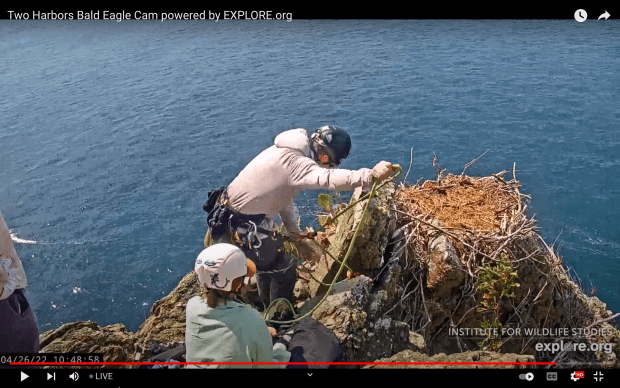
At 10:46 Pacific Time, Dr Sharpe and his two member team prepared to lower Dr Sharpe to retrieve the eaglet. Here are the images from the rescue.

The team prepares to lower Dr Sharpe with a carrier to retrieve the eaglet. Notice the condition of the railings on the nest pre-rescue.

Dr Sharpe descends to remove the tiny eaglet from the cliff edge. You can see the small grey ball above the letter ‘W’ in Wildlife below.

Dr Sharpe goes below the eaglet with the carrier bag.

Dr Sharpe gently removes the little one from the cliff. He will place it in the carrier bag he has over his shoulder.

The precious cargo is lifted back up to the top of the cliff.

The team have brought up twigs to create railings on the Two Harbours nest.

Dr Sharpe is cradling the eaglet in his left arm.

TH1 is home!!!!!!!

People and news stations from around the world were watching this rescue. In less than two weeks, Dr Sharpe has rescued two eaglets this season – one of Thunder and Akecheta’s eaglets fell out of the nest and now Chase and Cholyn’s baby. The world needed a happy ending and we need a hero and Dr Sharpe you and your team are it!

TH1 you are now an international celebrity!

When you consider making donations, think about the Institute for Wildlife Studies and others who actively assist and rescue these amazing raptors when others turn a blind eye.

Thank you to Explore.org and the Institute for Wildlife Studies for their streaming cam where I took my screen captures.

Update from Two Harbours

25 April 2022

The only eaglet of Chase and Cholyn attached itself to Cholyn’s feet/talons this afternoon when she flew off the nest on the cliff at Two Harbours. The chick fell off and is on a ledge down about 10 feet from the nest. That happened around 14:35 nest time.

The eaglet has eaten and is fine but probably frightened. It needs to hang on and stay on that ledge til Dr Sharpe can get there tomorrow!

This is the latest update from Dr Sharpe:

“I’m trying to find someone to help me in the morning (my crew has left the island already). It is too late to try to go out today.”

This is the link to the Two Harbours camera:

Thank you to Explore.org for their streaming cam and to all the staff and Dr Sharpe and the chat mods who have had to keep all of us calm this afternoon. Send your most positive wishes to this wee one. I am so grateful that cliff ledge caught it!

Take care all.

Late Friday in Bird World

08 April 2022

Just when I introduce you to Teo and Vita, a new cute female shows up on the nest the minute Teo arrives with a fish! This is the only Osprey nest in Latvia but it looks like there are floaters looking for mates. Maybe another nest is in the making???

I have not seen an image Of Karl II at the nest in the Karula National Forest but, Looduskalender says that Karl II is now in Estonia and could be arriving anytime. I hope the camera gets to working!

If you have not suggested a name for Annie’s ‘New Guy’, Cal Falcons is accepting suggestions on their FB page. On Monday, they will select the finalists from that list for voting. Give the ‘New Guy’ a great name associated with UC-Berkeley. I hope he continues to be a loving, kind, and supportive mate for our Annie.

Annie in the scrape 08 April 2022. 11:47. Incubating three eggs – 2 Grinnell’s and 1 of New Guys.

Speaking of Peregrine Falcons, did I mention that the couple in Manchester, New Hampshire have five —— yes, 5 – eggs?! They were laid on March 21, 23, 25, 28, and 30th. How in the world do they fit them underneath? So grateful that the scrape box is covered! Don’t want to see anyone cold and sick. This is going to be a great nest to watch!

Here is the link to that streaming camera:

After posting that WBSE 27 was released from rehab in Sydney, Australia, ‘B’ wrote and asked if there had been any sightings of Daisy the Duck and ducklings. I checked with my source and they said no sightings of Daisy. Boy did that little duck win over our hearts. Won’t ever forget her! If I ever do hear anything, I will be sure to let you know. This is precisely why my friend there has not sent us any images. We do hope that Daisy hatched some eggs and that her and the ducklings are safe and sound.

Staying in the Sydney Olympic Forest and Discovery Centre area. My source believes that the WBSE eaglet juvenile that landed on the WBSE a few weeks ago could possibly be WBSE 27’s younger sibling, WBSE28. 28 fludged and has not been seen after being chased out of the forest by the Curra. Oh, I loved the spunk of that eaglet. Well, that would simply be wonderful if this is 28. Of course the bird looks quite skinny and hungry to me – which makes me ultra sad. I hope it gets some fish and is safe and well. Life is so difficult for the first year birds. 28 was a sweetheart. Of course, this is just conjecture and wishful thinking on the part of my source and me. We know it wasn’t 27 because she was in care and 26 was euthanized. The plumage and the attitude make my source believe that this beautiful bird is 28.

I really appreciate it when you write and ask questions, send links to nests, or news worthy articles. There are so many and it is hard to keep up. As we all know, the Bald Eagle and Osprey populations – the Apex Predators at the top of the food chain – were almost completely wiped out due to DDT use. The numbers have been climbing back up and populations are healthy but, the regular counts are starting to see a drop in the number of eagles. As you know, I want to see positive change in hunting and fishing equipment including the ban of all lead. ‘S’ sent me this great article on the impact that lead ammunition is having on population declines and I wanted to share it with you. Each person that ceases to use lead when they hunt and fish ultimately help. One person at a time can make a huge difference! Believe it.

It is unclear how long the YouTube station will be broadcasting the nest of Eastern Imperial Eagles, Altyn and Altynai. This is only the second year that the Imperial Eagle cam has been streaming.

Last year, the couple laid their eggs on 13 April and 16 April. The first eaglet, a male, named Aydar hatched on 24 May. He was found dead under a power line on 6 September after fledging. The second eaglet, a female, named Aygul, hatched on the 26th of May. She fledged on 12 August. She is ringed and her numbers are black on silver АВ-0423-2Е on the right leg and a silver and green ring В-423 on the left leg.

Eastern Imperial Eagles were persecuted for years by humans and are one of Europe’s most endangered species. There are approximately 10,000 breeding pairs left in the world. They breed in northern European forests – from Central and Eastern Europe all the way to Asia. They live all over southern Europe and southern Russia. Some winter in Africa, India, and southeastern PRC. They do not like to live around humans and are vulnerable to deaths by unprotected power lines and, of course, habitation loss. Their plumage is a dark brown with a rufous tinge on their shoulders. The head and neck are often lighter in colour often casting a golden glow. They are extremely beautiful birds. The eagles lay 1-4 eggs and live on small mammals, reptiles, snakes, and carrion (found dead animals). They are large predators measuring from 72-84 cm or 28.3-33.1 inches weighing an average of 5.5 lbs for the male or 2.65 kilos and females being larger weigh from 8.1 lbs or 4 kilos.

You can see that beautiful plumage that differentiates these eagles from others such as the Bald Eagle. Gorgeous!

“Eastern Imperial Eagle” by Koshyk is marked with CC BY 2.0.

It wouldn’t be Friday without stopping in and checking on Thunder and Akecheta and the triplets. Seriously, how could you not smile every time you see this wonderful eagle family in the Channel Islands. Two years without eaglets and then triplets – no fighting, just great civilized kids and wonderful parenting!

This is a great nest. The land is owned by the US Navy. The Institute for Wildlife Studies and Explore.org have a permit to run the camera. That permit specifies when they can go and do maintenance, etc. The US Navy could, based on the agreement, stop the camera from operating. They are the controlling authority. — Do not worry. Dr Sharpe and his crew are fine. I am using this nest as an example of who ultimately has control over what happens at this nest – the landowner, the US Navy. If it were on my property, like Lori Coverts at the Captiva Osprey nest, then she has control. Lori withdrew her agreement with the AEF and gave Windows on Wildlife an opportunity to run a camera and chat. Lori called in CROW when Big died of unknown causes. — Sometimes it is good to know the hierarchy at the nests.

The other nests seem to be doing fine. Both eaglets are eating at US Steel – fantastic. Still waiting for Aran to get to the Glaslyn Osprey nest in Wales and for the camera to up and running at the Karula National Forest for Karl II and mate, Kaia.

Thank you for joining me. I hope you have a lovely evening. Take care everyone. See you soon!

Thank you to the following for their streaming cams or their FB pages where I took my screen captures: The Institute of Wildlife Studies and Explore.org, Sydney Sea Eagle at Birdlife Discovery Centre Sydney Olympic Park Peregrine Falcons Live, and Cal Falcons.

Wednesday Morning in Bird World

06 April 2022

First up. The children at the school in Big Bear Valley have picked the name for Jackie and Shadow’s eaglet. It is ‘Spirit’. What a wonderful name! Fly high, Spirit!

NBC – along with dozens of other news outlets – carried the announcement.

I get really excited about the return of the Ospreys to the UK in the spring. There are many reasons for this but the one that stands out the most is the respect and care given to these beautiful fish hawks. Did you know that most of the lochs are off limits to human use of any kind during the breeding season from 1 April to September? Most of the wildlife centres operate on grants and donations and have specially constructed ‘hides’ and monitors inside the buildings so that you can see the birds. Rutland Water and Poole Harbour have ‘osprey tours’ that are guided.

There are currently Ospreys on the following nests:

  • Rutland Water Manton Bay: Blue 33 (11) and Maya currently have 1 egg waiting for the 2nd any moment.
  • Loch of the Lowes: LM12 Laddie and Blue NC0. No eggs yet. Some intruders about.
  • Llyn Clywedog: Dylan is now home with Blue 5F Seren as of yesterday. This couple raised the largest male Osprey chick ever recorded last year.
  • Dyfi: Idris returned to Telyn yesterday and has been Sky Dancing and mating.
  • Foulshaw Moss: White YW and Blue 35 both at home working on the nest.
  • Poole Harbour: CJ7 the resident female hoping for a mate circled the town and has just arrived not long ago.

We are anxiously waiting for the arrival of Mrs G’s partner, Aran. Aran was injured and left late in September for migration. I do hope he returns safe and sound! If not, Mrs G will have lots of suitors. Perhaps even Monty’s boys have some idea that they would like to have nests close to one another. Tegid Z1 (love the guy) and Aeron (Z2) over at Pont Cresor. In the US, all eyes are on the nest in the parking lot in Missoula, Montana that belongs to Iris, the oldest Osprey in the world. Return safe, Iris!

PA Farms has announced that the 4th eaglet on the nest died during the night probably from hypothermia. What a little scraper he was climbing over those big siblings to get to the food.

The weather has been miserable in many areas this spring. It can cause all manner of diseases – the wet damp nests – for our birds.

Some are wondering if Big at the Dale Hollow nest is actually suffering from something. I had an inbox full of notes saying Big is being ‘too nice’ to Little Middle for the second day. Indeed, Little Middle got up first with no intimidation and ate the fish that came in at 08:54. Nice fish andd still scraps on the nest. Little Middle is ready for breakfast!

Little Middle gets up and does a stretch. It is so nice to see chubby legs. Big does nothing.

Little Middle is truly enjoying that fish!

Big moves up later.

Big is ahead in getting its feathers despite the fact that the two hatched on the same day. Notice the tail feathers on Big. You can see them growing out of the calamus or the quill. Some people refer to these structures as the shaft. They are properly known as ‘blood’ feathers. In baby birds, these are the feathers that are growing (not molting). They have a large supply of blood inside them while they grow. This will regress when the eaglet is older. Some of you might well remember that the Captiva Eaglets last year, Hope and Peace, were fed a rat that had died because of rodenticide. In the case of the last eaglet to die, it actually broke off a blood feather and bled to death because the rodenticide caused the blood not to coagulate.

Feathers are so important. They keep our feathered friends warm and dry while giving them the ability to fly as well as their distinct plumage of each species.

Little Middle proudly shows off his large crop at 09:26.

It is official. The chick has hatched at Two Harbours this morning for Chase an Cholyn! Congratulations!

Want to catch the action at Two Harbours? Here is the link:

If you move around the Channel Islands to check on Thunder and Akecheta at the West End, get out your worry beads! Those eaglets are right up to the edge with curiousity!

At the Utica Peregrine Falcon nest, Astrid just laid her 4th egg! Congratulations!

Yesterday I posted the name of the FB group for this streaming cam incorrectly. The correct name if you are searching is Falcon Watch Utica. Thanks ‘MR’ for catching that and letting me know!

Interested in Peregrine Falcons? Cal Falcons just posted information for a free virtual falcon conference for 19 May. There is always something wonderful to learn. Here is that posting:

The ‘New Guy’ continues to impress me. More bedtime snacks for Annie last night who, in her excitement, pulled the NG off the ledge with the prey!!!!!

I have news from many readers of nests opening up. I hope to report on those tomorrow including that of the Imperial Eagles. Karl II, the Black Stork from Estonia, has transmitted from Belarus. Hopefully he will be in his nest in the Karula National Forest in Estonia shortly!

Thank you for joining me this morning. There are so many nests! Will continue to monitor to see if Iris gets home to Missoula Montana and if Aran appears at Glaslyn. Take care all. See you soon.

Thank you to the following for their streaming cams or their FB pages where I took my screen captures: Friends of Big Bear Valley, Explore.org, and Dale Hollow Eagle Cam.