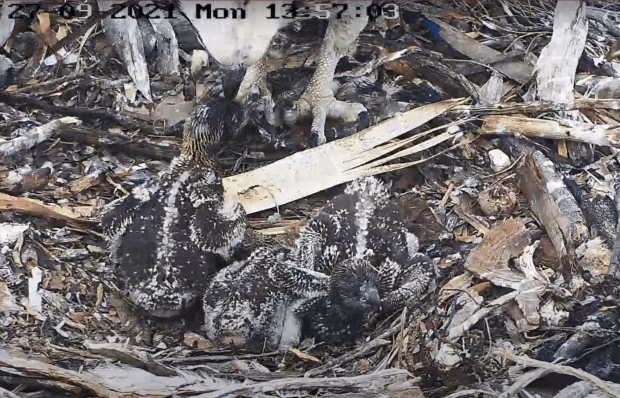
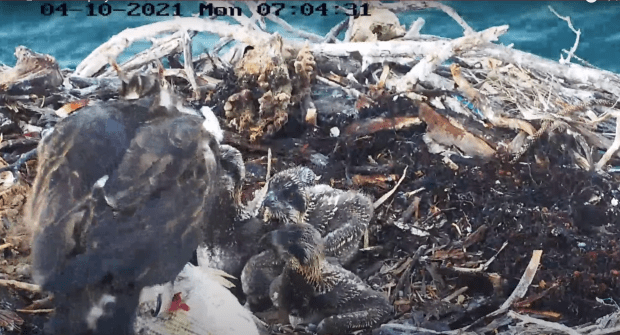
At 15:40 Jackie reluctantly gave up incubating their egg and just about to hatch chick for a much needed break.
That strong little chick is now making its way into the world as proud Papa, Shadow, oversees the action!
You can watch this amazing moment – when Jackie returns – to see her baby along with 8, 165 other souls by going to this streaming cam:
Tears. This chick is not fully hatched but nearly there. So happy for Shadow and Jackie and thankful to the Friends of Big Bear Valley for their streaming cam.
UPDATE: Jackie and Shadow’s chick hatched at 16:14 Pacific Time 4 March. Shadow was on the nest!!!
Jackie sees her baby for the first time as Shadow reluctantly gives up brooding. Congratulations, Jackie and Shadow.
It is -10 C on the Canadian Prairies on a day that can only be described as white. There is no colour in the sky and while I had anticipated including images of a different landscape due to melting, well, that hasn’t happened. The snow appears to be melting from the inside of the snow banks and tunnels slowly – which is a good thing! Today and for several days this week, we will continue having yet more of the white fluffy flakes. It has – weather wise – been a winter we will not forget for a long time.
I have been reading Mark Avery’s blog. Avery spent his life working with the RSPB in the UK and is an outspoken defender of ‘nature’. He was their Conservation Director for 13 of the 25 years he worked for them. I will include the link to his blog at the end. The current topic is ‘Alternatives to grouse shooting’.
Avery also includes a short list of books he has read and their reviews at the bottom. One of those was The Consolation of Nature. Spring in the Time of the Coronavirus. Three nature writers – Michael McCarthy, Jeremy Mynott, and Peter Marren – keep a ‘nature’ diary running parallel with happenings with the pandemic for the period of spring 2020. They begin with the astronomical beginning of spring on the 21 March running through 31 May when summer begins. (Meteorological beginning of spring is 1 March). My interest in this book is the emphasis on the healing aspects of nature and how, during the beginning of this horrific virus, people turned to nature for solace. All of us watch bird cams. Did you know that in the UK from the period 23 March to 31 May 2019, there were 20,407 page views of bird cams. During the early period of the pandemic this increased to 433,632 views! It was a similar situation at Loch Arkaig where 400,000 people watched Louis and Aila raise their three osplets. Indeed, it was an amazing year for nature as we isolated ourselves. Few if any planes, few if any cars. When we stopped, nature thrived. “Fish returned to the canals of Venice, no longer churned up by tourist boats. In parts of northern India, the Himalayas became visible for the first time in thirty years as air pollution fell. Baby sea turtles made it safely to the water on Brazilian beaches empty of sunbathers, joggers, and dogs. Wild boar and deer came back into car-free European cities.” As the authors demonstrate, some of those events were significant including “a colossal fall in the carbon dioxide emissions” driving climate change. While the coronavirus spring brought many human losses and great stress, nature gave each of us hope and comfort.
It is a remarkable little book. I highly recommend it but, even more so, I recommend that you begin keeping your own diary of how much joy our beloved birds bring to your life – or it could be the animals or the plants in your garden or a green area you visit. In years to come, it will be a treasure, I promise.
Many of us have never looked back after first watching our bird families on the streaming cams. By watching the daily lives of these families struggling to survive sometimes, we have learned much and it is hoped become more empathetic and prone to fight for a better environment for all of us.
Our first family up this morning are the Captiva Osprey family of Andy and Lena and the three Bobs. Lena was up at day break calling Andy to bring in a fish. She is incredibly loud and Andy could have heard her if he had been in Fort Myers!
I picked the image below not for its compositional beauty but because this morning for the first time, we can clearly see the difference in development between Big Bob and Little Bob. Look at the top of their heads. Little Bob, on the left, still has his soft light grey down. Big Bob has lost his. Soon his head will look like it has been dipped in a pot of black oil with a few copper flecks at the bottom. Big Bob is entering the ‘Reptilian Phase’.
While Lena wanted that fish before 07:00, it was, in fact, delivered at 08:14:39. It was a live Sheepshead.
Lena had a bit of a time with that fish – getting it opened and not flipping about on the kids. Big and Middle Bobs are right up there when she begins feeding. You will see that Middle Bob also has a greasy black Reptilian head like Big Bob. Little Bob is just waking up. Get up there Little Bob!
Little Bob is definitely our ‘Captiva Ervie’. It didn’t take him long to get the sleep out of his eyes and get up under Lena’s beak. Look at him stare at the fish. At least for today, we can easily tell Little from the other two if the trio are in a clump.
Lena was really hungry. She fed the kids for more than an hour and then finished off the fish and ate the tail at 09:49. All of the chicks were passed out in a food coma.
Andy returned hoping there would be some fish left just as Lena swallowed the fish tail! The chicks woke up and were thinking about a second feed. Too late! Big Bob did root around in the nest for scraps eating them as he found them. Wow. That is fantastic.
Lena is currently busy keeping the osplets cool by shading them. She is also hoping that Andy will ring another fish in!
Cornell Bird Lab put together a 15 minute video of Big Red and Arthur frantically working on their nest on the Cornell Campus this morning. It is much better than any still captures I could show you!
Squeezing some of the somber in with the joy, HH3, one of the Hilton Head Island Trust eaglets has died. HH4 is fighting for its life and hanging on by a thread. The test results to determine the cause are not ready yet. The adults are being monitored closely and the Birds of Prey Centre has brought in the Clemson University Vet School to help with the determinations as to cause.
There was a lovely kerfuffle at the NEFlorida Nest of Samson and Gabby this morning. It was fantastic, actually. Jasper (NE26) was eating all of the food. This has been the typical pattern for these two. This morning it was the same- NE27 is on the left with its head down and Jasper is at the beak getting all the food.
NE27 moves closer and does the old snatch and grab and horks all of the remaining prey! He was hungry and was tired of waiting. Way to go 27!
Jasper has been doing a lot of standing and wingersizing. She is definitely getting much more stable on those legs.
Gabby and Samson sure make beautiful babies. I just love the pantaloons on Jasper.
The more I watch the Dale Hollow nest the more I am loving this family. Obey comes in to check on River and feeds her. That reminds me of Blue 33 feeding Maya at the Rutland Osprey nest. Then River and Obey feed the chicks in tandem. The life experience of these two eagles, well into their 20s in age, really shows when dealing with the health and welfare of their chicks. Just wonderful. The third egg is 36 days old today and it is almost hatched!
Another tandem feeding this morning.
Continual aeration of the nest cup to keep it soft and bring oxygen in.
River feeding the twins.
Oh, just look at them. They are so cute, fluffy, and a little chubby. Perfect!
There are currently more than 3,044 persons watching and waiting for a pip at the nest of Jackie and Shadow in Big Bear Lake, California. The eggs were laid on January 22 and 25. That makes them 34 and 37 days old. The average time for pip is between 34 and 40 days so we are still right in the sweet spot for hatching. Good luck Jackie and Shadow! Your fans are cheering.
It is difficult to avoid the news. My heart goes out to any person caught in a conflict zone. It is difficult to avoid the war zones in Africa where our birds migrate to for the winter and now, as they begin to return to their homes in Latvia and Estonia, many have historically spent time eating and resting in the Ukraine. This is the map of Karl II’s family migration this past summer. Many of the other birds that migrate to Africa follow a similar route. Wildlife suffers irreparable harm, like ordinary citizens, in times of war.
Here is a detailed study of wildlife in conflict zones and the need for conservation. It is a good first read to understand the challenges that nature and wildlife undergo when there is war. I hope that you are able to open it.
I will close as we wait for a pip at Big Bear and the final hatching at Dale Hollow with a closeup of Dad at the Port Lincoln Osprey barge. Dad spent considerable time on the ropes yesterday. I cannot help but imagine that he was hoping to catch up with Ervie and see how he is doing. You can certainly tell where Ervie gets his good looks from!
It has warmed up to a balmy -8 C. Serious spring weather and I am off to get more bird seed and go for a much needed walk. Please take care everyone. Thank you so much for joining me today.
Thank you to the following for their streaming cams or FB pages where I took my screen captures: Port Lincoln Osprey Project, Dale Hollow Bald Eagles, Captiva Ospreys and Window on Wildlife, NEFlorida Bald Eagles and the AEF, Cornell Bird Lab, Friends of Big Bear Valley, Bald Eagles 101 FB, and the Latvian Fund for Nature Forum.
The Captiva trio are in food coma after their second big feed for the day. It is 16:56 nest time. Little Bob got his tiny but chubby bottom up to that table just like our dear Ervie. This little one loves to eat that fish! Little and Middle Bobs fell asleep at the table. Big Bob had left earlier and passed out on the other side of the nest.
That fish delivery came at 16:00:35. This time Andy ate the head so he had some nourishment, too.
One of my friends, ‘B’ suggested that it is the recreational vehicles at the weekend causing fishing difficulty for Andy. ‘B’ commented that it was the same issue at the Redding nest last season. Tomorrow is Monday. I hope Andy’s fishing returns to 3 or 4 fish. The adults need to eat as well too. It is like the oxygen instructions in a plane. The responsible party needs to put theirs on first and then take care of the others. Same for eating with Ospreys.
We will not worry about these three until tomorrow. Thanks Andy and Lena!
Window to Wildlife, the group affiliated with the cam and the chat, posted a short video of Little Bob hatching today.
I am just so impressed with the tenderness of some of the males. At the Dale Hollow nest today, Obey was clearing out some of the pantry items to see what he needs to bring in. All the while he was feeding River who was brooding the twins and keeping their pipping egg 3 nice and warm.
At the same time, River and Obey do another tandem feeding for the twins this afternoon.
I am so glad that I found this nest! They are an incredible family that is working so well together. Experience can do that!
The Port Lincoln Osprey nest is really lonely this morning in Australia. The pigeons are still doing clean up. I wish I could import them to clean up around my bird feeders! They look very thorough.
This is the latest tracking for Ervie posted yesterday on the Port Lincoln Osprey Project’s FB page. While he really did explore Port Boston to the right of the airport, Ervie continues to return to the area of the green pin to roost at night. The barge is the point right above the ‘t’ in Port at the bottom of the tracking image.
The juveniles, Jasper and NE27 on the Northeast Florida Bald Eagle nest are doing well. Here is a great image of NE27 standing tall this afternoon. Remember that this beautiful Bald Eagle will get a name based on the votes that the American Eagle Foundation receives of the five finalists. Jasper got her name because she was born when the named storm, Jasper, hit the area.
Message me through comments if you would like the information on voting.
The juveniles at the SWFlorida Bald Eagle nest in Fort Myers are several weeks older than those at NEFlorida. Harriet and M15’s E19 and E20 are really good at self feeding and they stand on the edge of nest rim and look about. Next stage is branching!
Big Red and Arthur have been working on their nest on the light stand. It looks so forlorn today with some snow and ice remaining.
I have not heard about a pip at the nest of Jackie and Shadow at Big Bear. When the pipping begins, the parent will hear the cheeping of the chick and can feel it moving about. You should notice the one on incubation duties looking down and listening.
I always hate to close with bad news. This are the two most recent postings for the Hilton Head eaglets. You will note that HH3 and HH4 are in critical condition. There is also information about the spread of avian flu and the deaths of other eagles. Anyone feeding birds needs to be vigilant in cleaning the feeders. If you were to find dead birds at the feeders and it is not the result of a cat or raptor, you might want to contact your local wildlife rehabber for advice. Do not handle the dead birds with your bare hands. You might want to do a major clean up as the lab results can take several days. Prepare for the worst and hope for the best.
Our thoughts go out to all of the bird families that have been impacted by this lethal disease. It is sobering to consider that an entire generation of eaglets (and other birds) could be wiped out.
I note that rodenticide poisoning also causes nestlings to literally fall out of the nest. One of my favourite wildlife rehabbers, A Place Called Hope, has admitted a Barred Owlet who fell out of the nest and is suffering from this poison. This is entirely avoidable. Everyone reading my blog knows rodenticide. Work hard to educate people so these beautiful raptors do not have to suffer.
Are you a falcon lover? The Peregrine Falcons are getting busy in Utica, New York. I am looking to find their streaming cam link and will post it tomorrow for everyone.
Thank you so much for joining me today as I did a hop, skip, and a jump checking on some of our nests. Take care everyone. See you soon.
Thank you to the following for their streaming cams or FB pages where I took my screen captures: Bald Eagles 101 FB, Dale Hollow Lake Bald Eagles, Captiva Ospreys and Window on the World, NEFlorida Bald Eagles and the AEF, SWFlorida Bald Eagles and D Pritchett, Port Lincoln Osprey Project, Cornell Bird Labs RTH camera, and Friends of Big Bear Valley.
Good afternoon Everyone! The sun is shining bright on the Manitoba prairies this morning. Even 2 metres of snow looks beautiful! It is a balmy -8 C and it feels like summer. It is too hot for winter coats today. Now if all of this snow will melt slowly…ever so slowly so we do not have floods. The soil needs the moisture!
If you missed it yesterday, there is real cause for celebration at the American Osprey nests. Rosie has returned form her migration to be reunited with Richmond on the Whirley Crane in San Francisco Bay yesterday. Richmond had been hanging around the nest for three weeks. Some of us were beginning to worry a little and then…Rosie showed up right at dawn 06:43 on 25 February! If you are new to watching Osprey nests in the US, this is a rock solid nest. I am a huge fan of the UK nests and this is my number 1 for stability and the occasional humorous moment in the US. Richmond is great at fishing at night amongst other antics.
As you can see this is the couple’s sixth season on the Whirley Crane. Last year they fledged three fine Juveniles! Here is that great reunion video again.
Here is the link to their camera for those who do not have it. It is not on YouTube. The camera is, as I write this, currently off line.
Ervie did not come to the nest yesterday as far as I could tell from having eyes glued on the screen and doing a lot of rewinds. The barge was visited by a number of the pigeon clean up crew and a lovely Cormorant. There was also another bird that landing on the moorings but I cannot accurately identify it. In the image below, the Cormorant is on the perch and the other bird is on the perch.
Port Lincoln has not updated Ervie’s sat-pak tracking yet. So, it remains a mystery where he captures his delicacies – those puffers!
There is sad news coming out of the Hilton Head Island Bald Eagle nest of Harriet and Mitch. I report on this nest occasionally. Two eaglets hatched and the last time I checked on them they had their juvenile feathers and were self-feeding. Yesterday one of them was found on the ground below the nest. It has been taken to Corvian Avian Conservation, a wildlife rehab clinic. It is unclear the state of the eaglet at the time it was rescued. This morning food has been brought to the nest. The remaining eagle did mantle the prey and is seen eating but not enthusiastically. The nest is being monitored. There is some concern that the bird prey brought might have avian flu, the highly pathogenic H5N1 strain that is spreading. I assume the remaining eaglet might also be removed from the nest for testing if authorities are concerned. Will monitor and post.
I will do a post just on Avian flu early nest week. There are other nests where the eaglets have fallen over the edge of the nest and they are being tested. Do not discount it. This is very, very serious. There are virologists looking at these deaths to try and understand the spread and the remedies. It could impact much of the nests other than the Ospreys who seem to be less prone because they eat fish almost entirely.
We all worry when these things happen and it is easy in small nests where there is prey competition, parental neglect, and a lot of wingersizing. I want you to watch, when you have time, this lovely video of a rescue of two eaglets in Sweden so you will understand that wildlife rehabbers can do amazing things. This is a heart warming story of individuals who really wanted a success.
The number of people watching the nest of Jackie and Shadow at Big Bear, California continues to grow. It was 2131 not long ago. Today is pip watch and you can join in, too.
While we were focused on the Captiva Osplets, Ervie, or Jackie and Shadow, something wonderful was happening over at the nest of River and Obey at Dale Hollow Lake. Twins hatched at 11:16 and 11:51 yesterday. There is a pip in the third egg. Wow.
If you are wondering where Dale Valley Lake is, it is in Kentucky. It is one of the oldest human made lakes in the region, created out of the Obey River, in 1943. Now you know how these two eagles who have used this nest for six years came by their names. The lake has 27,700-acres of water and is well stocked with fish for the Baldies.
Just when I praise the nest for being located right above the lake, I see Dad has brought in a rabbit for the eaglets lunch! Too funny.
Here is a link to the streaming cam so you can join this nest with the two grey little bobbles and another on the way:
I suggest you put this nest on your watch list. I am really hoping that the parents will not bring in any birds to this nest due to H5N1’s potential spread.
Kincaid is doing really well at the Kisatchie Forest Bald Eagle Nest near Alexandria, Louisiana. Louis brought in another big fish and Kincaid is really enjoying this late morning feed. Like many nests located near a stocked body of water, Louis mostly brings in fish but he also brings in Coots and other waterfowl. If you are new to watching Bald Eagles and want to add a nest to your long list, I highly recommend the KNF nest. It is on YouTube. Cody and Steve have made sure the image is great and the sound is awesome. Next year they will have the two nests on Kincaid Lake on camera. Great moderators on chat. Cody and Steve are often on there to answer your questions along with Tonya.
Normally I start with the Captiva Osprey Nest but, today, I will almost close with it. Lena was hollering at Andy to get a fish on the nest at dawn. I could not see a delivery. Please correct me if I am wrong. By 09:34:03 Big Bob was getting agitated and did some beaking.
Little Bob was smart. He moved far to the right out of harm’s way. You can barely see him. He has his neck stuck down in the twigs. Smart.
Their last feeding was in the afternoon yesterday and the trio were very hungry by the time Andy landed that fish on the nest at 10:30:42.
It was a large fish and Lena moved around the nest making sure that each of the babies was full.
They are all lined up nicely to eat. Big Bob’s slight aggression ended as soon as food arrived. Please note that if you are reading the chat, the moderator calls this ‘playtime’. They are all a week old and some aggression is typical at this age but more so now that the early regular and very stable feeding routine has been thwarted.
I hope that Little Bob gets up in the front despite the fact that he has one of the longest necks I have seen on an osplet!
Lena will continue to fed until the fish is gone if that is what it takes to fill her and the babies to the brim.
Nice crop!
It is now 12:43 nest time in Florida and Lena is yelling at Andy for fish.
It is 13:32. Lena is calling Andy again and you can hear him in the distance along with the cheeping Bobs.
There are so many recreational vehicles on the water today. I wonder if this is hampering Andy’s fishing. It is also quite warm in Florida today. Lena is doing a good job of shading the babies who cannot yet regulate their own temperature.
Til later…
We all need a giggle and today’s laugh is brought to you by a Raven in Poole Harbour, England at the nest of Osprey CJ7 (Rutland fledge 2015). The Raven is leaving two lovely chocolates that it will bury in the nest. How romantic a gesture this could be. I hope that this is for the arrival of CJ7 and the male, Blue 022, that we hope will also return and have their first successful breeding season together. If you want to see the whole video posted the Poole Harbour Osprey Project, please head over to their FB page. You do not need to be a member.
Here is the link to this streaming cam. Last year it was too late for this potential couple who delighted observers with their mating antics all over the town. If we get a hatch and a fledge, it will be the first time in over 180 years since their extinction! That is something to cheer about.
And on that happy note, I will say goodbye. Keep your eyes out for Ervie and a pip at Big Bear and a successful hatch for Dale Hollow. Things are really gearing up. Take care everyone. See you soon.
Thank you to the following for their streaming cams or FB pages where I took my screen captures: Poole Harbour Osprey Project, KNF Bald Eagles, Captiva Ospreys and Window on Wildlife, Port Lincoln Ospreys, Dale Hollow and Golden Gate Audubon and SF Bay Ospreys.
As a pigeon cleans the nest and a Cormorant dries itself on the perch of the Port Lincoln Osprey barge, Ervie, we are all missing you! You hatched on 16 September at 00:51. You are five months and three days and you have been away from the barge for 48 hours. Are you gone for good? We all wondered until you surprised us returning to the nest at 12:42 and you stayed until 13:30. How wonderful. When you left a couple of days ago, we all worried that we would not see you again. What a real treat, Ervie. Thank you. You are looking really well.
You did your fish calling right before you flew off. Did you see Dad? Will you return later today?
Here the pigeon is looking for scraps and the Cormorant has returned to the perch after you left.
You hatched on 16 September were 51 hours younger than Bazza, the oldest sibling in the nest. As late as 27 September, when you were 9 days old, Bazza was trying to take over dominance in the nest. Yes, he pecked at your head and tried to stand tall to intimidate you but, you never gave in, Ervie. Never.
None of us will ever be able to be precise about what it was that made your melt our hearts but, you did – in spades. Is it the cheering for the under dog? You never felt like an under dog to me, Ervie. You were spirited, you knew what you wanted. You learned early to get where Mum could see you and close to her beak in the sweet spot in order to get the fish. You were a survivor. You never cowered in submission to Bazza or Falky. OK. Maybe one or two times when you were very little, close to hatch, but by the 27th of September, you had the drive and the determination to get what you wanted.
There you are with that fish bladder. All of you were curious about it.
Look how much you have changed in just a few days. In the image above you are still sporting you soft grey down and in the one below, four days later, almost full reptilian.
Look how tiny you are in thee middle of Falky and Bazza.
Ervie, you loved your fish!
All lined up like children in a choir behaving. That was the tone of this wonderful nest at Port Lincoln. No one could believe it. The early angst was gone and each of you just lined up and ate your fish. Dad made sure there was plenty on hand even when it was storm and the winds were blowing at 37 kph. Mum made sure each was fed. You could not have chosen a better family in which to hatch than this one at this time and place.
You are 20 days old Ervie, looking and wanting that fish standing behind the others. Adorable.
You wiggle around and come to the side and you will get fed.
There you are, already sporting a big crop, up at Mum’s beak wanting more fish!
You are 34 days old in the following image. you are the one closest to Mum’s beak. Look at the beautiful juvenile feathering that each of you is getting.
It is 27 October and you are the one getting the fish bites in the image below. Look at how well you are standing. All of you are growing up.
Your eyes never move away from the fish that Mum is feeding. There you are n the back ready to grab a bite!
There you are with your sat-pak, Ervie. You were all banded and given official names. They even put some nice fish on the nest so all of you could eat. There was enough for Mum and Dad, too.
Big Bob, first hatch, has a red band, weighed the least at 1280 grams and is named Bazza. The name celebrates Take 2 Photography’s husband, Barry Hockaday, who did so much to bring the Osprey Barge to a reality.
Middle Bob, second hatch, has a yellow band, weighed 1330 grams and is named Falky after Ian Falkenberg, the bander.
Little Bob, third hatch, has a dark green almost black band, weighed 1380 grams and is named Ervie. It is the name of the Scottish town where Australia’s current Minister of the Environment grew up. This choice focused on the fact that the growth in the Eastern Osprey population and this project would not be possible without the Minister’s support.
And that is how ‘never miss a meal Little Bob’ became the biggest Bob! And got the sat-pak! Well done, Ervie.
Your bling is beautiful and we hope that sat-pak does work for 7 or more years so we know how you are doing.
It seemed that all of you grew up after you were banded. You were feeding yourselves and hovering and then fledging. Once everyone got their bling it was so much easier to identify who was right up at Mum’s beak – as she often chose to feed her boys even though they could easily feed themselves. That is you, Ervie, getting fed with your beak almost touching Mum’s head!
When Mum was not there and Dad delivered a fish, Ervie, you were often the one to get that fish first and mantle it.
On 14 November, you fledged, Ervie.
First to get the fish again.
Falky really wanted the fish Ervie had. Ervie, you were fast as lightning to get those fish deliveries – not always, but often and normally the first one of the day.
As all of you got older and more independent, the dust ups began. There was never any love lost between you and Bazza.
No one will ever forget the dog fight that you had with Falky!
Or your first puffer catch. Did you actually develop a taste for the Puffer, Ervie? You would bring in another one to the nest a few days before you departed.
You are four months old on 16 January and what a handsome fellow you are. You are now the king of the nest.
Super handsome Ervie.
You could hear your loud cry for fish across the cove. We will all miss it. Wonder if anyone tried to make a ring tone for their phone?
Oh, Ervie. You brought such joy to our lives. Every day we waited to see what you would be up to from the moment that you hatched. Thank you for staying with us for five months and for returning today to the barge. We never know when you fly off if you will return.
This is your latest tracking. Port Lincoln confirms that you are enjoying the Boston Bay area and the fishing is good by the National Park. We will look forward to more adventures.
If you do not return, Ervie, each of us wishes you the best life. Fly high. Live well and safe. Never be hungry. Come back to see us! And if for some reason you decide to use the barge as ‘home base’, I am sure no one will mind! At least not until Mum and Dad decide to take over the nest in the late summer.
Thank you to Port Lincoln Osprey Project for their streaming cam and FB pages where I took these screen captures and video clips. Thank you for letting us share in the lives of this beautiful Osprey family.
There are two cute little Osplets at the Captiva Osprey nest on Santibel Island this morning. If the third egg hatches, there will be three late Friday or Saturday. The first chick hatched at 21:40:12. I am not clear when the second hatched. They look almost like twins!
Eggs were laid on 8, 11, and 14 of January.
Oh, how wonderful to see that soft light fuzzy down and that dark stripe down the back of the nestlings. Oh, I have missed baby Ospreys! No doubt these two will bop one another and tumble on the nest. Here are a group of images from this morning.
You might notice that Andy and Lena do not keep a pile of fish on the nest. That would attract predators. Andy will, no doubt, have places where he stashes a little fish for the family elsewhere.
That little one wants some fish. Just look at the cute little tails already!
The oldest one has had at least one meal.
Andy is really on alert protecting his beautiful family.
In other news:
Bonnie and Clyde have one egg in the nest that stole last season from the Bald Eagles on the property of Farmer Derek near Newton, Kansas. That egg was laid when ice pellets were coming down about 00:47:00 on the 17th. Perhaps Farmer Derek will post an official time.
That icy sleet has turned to snow. Do not worry. You can just see those distinguishing ear tufts of the Great Horned Owl but Bonnie has thousands of feathers and her and the egg are absolutely safe.
Ervie is on the nest and Dad is on the perch. Everything is fine at the Port Lincoln Osprey Nest!
Send out warm wishes and positive thoughts to Andy and Lena. They will need to be so alert. We all hope that they will raise successful chicks to fledge this year!
Thank you for joining me this morning. Take care everyone. See you soon.
Thank you to Window on Wildlife, Farmer Derek and Port Lincoln Ospreys for their streaming cams where I took my screen captures.
\\\\\\\\
Oh, how I have missed seeing that lovely stripe and the fuzzy light down of the tiny little ospreys. Congratulations Lena and Andy!
Here is a variety of images from the morning. You will notice that there is not a pile of fish kept on the nest. That would attract predators.
Oh, just look. Little tails!!!!! And one of them wanting some fish.
Absolutely adorable.
There is our beautiful Osprey family. Andy is on high alert.
Oh, send out your most positive wishes to this Osprey family as Lena and Andy try to keep their babies safe.
Here is a link to the Captiva Osprey Cam:
Other quick news:
The Great Horned Owl couple that stole the Bald Eagle nest, Bonnie and Clyde, have one egg now. It was laid around 00:47:00 last evening it is thought. I have not seen an official time. There were ice pellets falling at the time and now Bonnie is covered in snow.
Bonnie will be fine and so will her egg. She is very insulated! If you want to watch this GHOW nest on Farmer Derek’s property near Newton, Kansas, here is the link:
Our favourite juvenile fledgling osprey is fine. Ervie is on the nest and Dad is on the perch. Everything is alright with the world in Port Lincoln.
Thank you for joining me today. Congratulations to Captiva and Bonnie and Clyde. Take care everyone. See you soon.
Thank you to Window on Wildlife and Port Lincoln Osprey Project for their streaming cam where I took my screen captures.
Andy and Lena laid their eggs in the Captiva Osprey nest on Santibel Island one month earlier than previous years. It is hoped that this will help in the survival of the chicks. The nest has been plagued in the past with predation by Crows.
The Osprey couple at Captiva are Lena on the left and Andy on the right.
Egg one was laid on 8 January with the second egg following on the 11th and the third and final egg on the 14th.
The first hatch came at 21:24:12 on 16 February 2022.
You can just see the little one behind the two eggs. Oh, so tiny.
There you go! What a darling. It appears that another chick is in the process of hatching. It would be wonderful if the three were close together.
It is very exciting when a little Osplet is born.
Lori posted a picture of the landscape with the Osprey nest on Santibel Island.
Let us send the warmest of wishes and congratulations to Andy and Lena. We hope that the Covids will stay away from the nest and that your family will thrive. Congratulations to Captiva!
Thank you to Lori for her Instagram feed and Window to Wildlife for their streaming cam where I took my screen captures.
It’s cold and there was more snow yesterday and some blowing wind last night!
There is good news today.
Pittsburgh-Hayes Bald Eagles have two eggs as of today at 16:07. The reveal came at 16:34. Congratulations Pittsburgh!!!!!!!!
Eagle Country had its second hatch today. My goodness these nests are going to keep everyone busy! Two precious bobble heads – a complete Eagle family for Valentine’s Day!
Dad’s got a bunny on the nest in celebration. Congratulations Eagle Country!
Mum isn’t even in the picture. I think Ervie hollers so loud she wanted some peace and quiet. There is Ervie and Dad just hanging out in the shed together. They look perfectly at home!
Ervie, we still love you. You are everyone’s Valentine.
Sadly the competition on the NEFlorida Bald Eagle nest has continued today. In addition, I am not seeing a lot of food in the pantry on this nest like there was earlier. Certainly the Eagles begin to slow down on deliveries but it seems a little early at this nest. NE26 is certainly not treating NE27 nicely.
Those images of that feeding were at 11:14 this morning. Thirty minutes later they are a cuddle puddle.
Neither chick has a big crop. NE26 is clearly much larger than 27. If you were going by size now you would say Big sister and Little Brother.
A fish was fed at 16:00. NE26 ate. I could not see any evidence of 27 eating. It was in submission on the side all the while. I am certainly not liking what I am seeing in this nest. I wish that Samson would get on the nest and feed 27 while Gabby feeds 26 just like Harriet and M15 do in situations like this.
NE26 passes out in a food coma. Little Bit is up looking to see if there is any scrapes on the nest.
27 found a few flakes and then aroused 26 to look up to see what 27 was doing. Note the very nice crop on 26. If there had been enough fish, I am certain that 27 could have had its share once 26 was asleep.
A few minutes later an adult lands on the nest. NE27 opens its beak at 26. It is Samson and there is no good. The adults have been on alert for several days because of intruders.
There has been no more food brought to the nest or feedings since 16:00. NE26 is also hungry. I sure hope there is a whopper of a fish brought in late. As I mentioned, Gabby and Samson have been on high alert because of intruders and that will account for less food on the nest. Protecting their territory is their first priority. The eaglets are last. NE27 had a full crop last night and it will be fine – just hungry. Let us hope that 26 gets full and passes out so 27 can have a meal. I have to say that I am more than disappointed – and I hope that the intrusions stop so this nest can get back to normal. As I often say, the fortunes of the birds can turn on a dime. It can be intruders or bad weather or the heat of summer. Send all good wishes out to them.
This is the video of that great dinner yesterday when both Gabby and Samson were on the nest with the two chicks. Samson fed NE27 til he was super full. Tears.
Come on guys – let’s do that again tonight!
There is great news up in Minnesota. The first egg of the 2022 season was laid by Nancy on 12 February. This is the nest of Nancy and Harry. It is one of my favourites. Last year Harry was only 4 years old when he fledged two super eaglets! Congratulations Nancy and Harry.
Here is the link to their streaming cam:
And here is the video of that first egg of the season laid on 12 February. We will be on egg watch for #2 tomorrow.
Send all your warm wishes to the NEFlorida Nest. I really hope that 27 gets a good feed tonight. Make no mistake, this eaglet is not starving to death. But regular and sufficient feedings really help keep the babies healthy and stress-free.
Thank you for joining me. Take care everyone. See you soon.
Thank you to the following for their streaming cams where I took my screen captures: MN DNR Eagle Nest, NEFlorida and the AEF, Port Lincoln Osprey Cam, Eagle Country, and Pix Cams.
I have spent the morning sorting books and clearing out paper and all that gets accumulated before you realize it. In the midst of all of that I found a really nice letter from the Director of the 1000 Islands Environmental Centre in Kaukauna, Wisconsin. I think that each of you will be interested in the contents of this letter – indeed, I know you will.
“Bald eagles typically have a clutch of 1-3 eggs laid in late February or early March and hatch approximately 34-36 days later…Observations on the nest of the 1000 Islands Conservancy Zone confirmed a successful hatching with video and photo evidence of eaglets. Over the weekend, additional video of the nest was able to show that the adult pair have successfully hatched four eaglets.”
This is an extremely rare occasion. Nowak continues, “Successfully hatching four chicks in one nest is a very rare occurrence for bald eagles and it is an event to celebrate and safeguard. There have been very few documented cases of nests with four eaglets, and despite the success the eagles have had to this point, the adults face a significant challenge to provide enough food to sustain the young eaglets until they are independent this summer.”
There are the four nestlings being fed by Mum. Can you imagine how busy those parents were providing food?!
Here is a video of one of those feedings:
And guess what? The four eaglets fledged!!!!!!!! So if anyone ever asks you if you know of a Bald Eagle nest fledging four, you can now say ‘yes’ with confidence. This is one of those really feel good stories.
Today, I have spent more time cleaning than checking on the birds. Ferris Akel has his tour going on behind me and he has made me really miss the ducks in our City. I am just counting the weeks until April when they return.
In other Bird World news, we are still eggspecting Liberty to lay her second egg today. Lots of people watching and waiting. I continue to check.
UPDATE: Liberty laid that second egg today, as expected, at 14:42. I have to say I even felt for her as she was in labour! Congratulations Liberty and Guardian.
Andy is giving Lena a bit of a break at the Captiva Osprey nest. We are now on pip watch for this couple. It remains unclear to me if the owner still intends to shut off the camera after a hatch. The Ospreys have had bad luck in the past with the Crows taking the chicks. My understanding is that the camera is to be shut down until such time the chicks would be too big for the Crows. We wait to see.
And sadly, the camera at Port Lincoln is off line again. This is the last available image of Ervie and Dad on the barge. I always keep these. You never know if this will be our last sighting of Ervie for some time.
UPDATE: The Port Lincoln Osprey Barge camera is now up and streaming again. Ervie is watching the water! That is a good sign. Oh, wouldn’t we love to see him catch a fish off that barge! And not a Puffer or a Toadfish, please, Ervie.
It is a beautiful blue sky with sun here creating deep shadows on the snow. It is -19. Today’s garden adventure is brought to you by Little Red. A week ago I put a suet bell on a hanger for Little Woodpecker. Someone has been working very hard because they got the heavy suet off the holder, took it across the snow and got it on top of the small wood shed in the back. At that point the suet got stuck on a branch. (I lay them on top of one another on the top so the birds can get inside and hide if Sharpie comes!). That someone is Little Red! What a surprise. He deserves every bite of that suet. What a character! And a hard worker.
There is the object of desire. That little squirrel really managed to get it quite far.
Little Red got big bites of the suet. He would then run up to Sharpie’s post and eat it in the sun and then run back and get some more.
Isn’t this squirrel adorable?
Oh, the joy and the giggles these garden animals bring!
Thank you so much for joining me today. Little Red says to remember to leave some food for the squirrels, too! Take care. See you soon.
Thank you to the following for their streaming cams or FB page where I took my screen captures: Redding Bald Eagles, Explore.org, Captiva Osprey Cam, and 1000 Islands Conservation Zone FB page.
Good night from Thunder and Aceta at the West End Bald Eagle Cam on Catalina Island. Looks hot.
YRK and OGK laid their egg at the Quarry Track nest, created by OGK, on 9 November 2021. Yellow-Red-Black (YRK) and Orange-Green-Black (OGK) are no stranger to the Royal Cam spotlight. They are the parents of the very popular Miss Pippa Atawhai, Royal Cam Chick at Top Flat in 2020. The moments viewing Atawhai with her dad, OGK, melted people’s hearts. Those who watched these very gentle birds will never forget the pair of them together.
YRK is 28 years old and OGK is 26 years old. They have been a bonded pair since 2006. This year is their 8th breeding attempt. They are also grandparents. This year their son RLK (Red-Lime-Black) successfully fledged SSTrig, the chick in the nest close to Royal Cam chick, Tiaki.
It took five days for the little one to hatch. The rangers say that the reason it takes the seabirds so long to get out of their shells is that they are such long lived birds. The Royal Cam chick is the 11th to hatch this season.
Ranger Sharyn returned the new hatchling to its mother, YRK, at 19:40 on 26 January. Before placing the chick under the mother, the area of the nest is sprayed with a bird-friendly insecticide in order that there is no fly strike on the youngster.
Ranger Sharyn carefully removes the chick from the insulated container.
She has already removed the dummy egg and sprayed the nest area before placing the chick under YRK.
Ranger Sharyn watches with delight as YRK accepts her little one.
YRK gives a shimmy and settles down to brood.
Once Ranger Sharyn is away, YRK raises up and looks down with the most gentle love to the new bundle.
It is extremely windy today. I wonder when OGK will fly in to relieve YRK and have his first look at the baby?????
Southern Royal Albatross are endemic to New Zealand. After the chick hatches, it will fledge in mid-September, spending 4-6 years at sea foraging for food in the waters off the coast of western Chile. Then the juvenile will return to Tairoa Head to find a mate. This choosing and bonding could take years. These seabirds are known for their socializing and elaborate dancing as well as the beautiful sky calls.
Once a couple have bonded, they will lay one egg every two years. Why not every year? It is too physically difficult to raise chicks that close together. The adults have to travel many hundreds if not thousands of miles to forage to feed their chick. They each take turns incubating. Once the chick has hatched they will take turns flying in and out of the headland to forage and feed their chick. They will do this until the chick fledges and begins its life on the sea. Imagine flying for the first time and not landing back on ground for another 4-6 years. I often cannot get my head around that!
The Albatross has the largest wingspan of any living bird at 3 metres or 9.8 feet. They stand 115-123 cm or 45-48 inches and weight 8.5 kg or 19 lbs. The males are larger than the females.
The population of the Southern Royal Albatross is vulnerable and stable at the moment. The challenges they face are longline and trawl fisheries, oil and plastic waste in the sea waters, natural disasters, and warming seas as part of climate change. The New Zealand Department of Conservation makes every effort to ensure that all of the Royal Albatross on Taiaroa Head are healthy. They provide supplemental feedings to both chicks and adults as well as elaborate sprinkler systems to cool the birds and medical care.
Here is the video of Ranger Sharyn returning the chick to YRK:
Here is a very short video by Liz of YRK revealing the chick three times.
You can watch the streaming cam for YRK and OGK here:
What wonderful news! I have peeked at all of the other nests and everyone is fine.
Ervie looked like a wet rat Wednesday afternoon late in Australia.
Ervie was alone on the barge last night while the rain is caught by the camera pelting down.
Thankfully the rain has stopped!
Gabby has been giving Samson time to brood the babies and feed them. Both 26 and 27 are doing very well! Gabby is much more relaxed this year with her third clutch.
Aren’t they so cute??
Thank you so much for joining me today. Take care everyone. See you soon.
Thank you to the following for their streaming cams where I took my screen captures: the Cornell Bird Lab and the NZ DOC, Port Lincoln Osprey Project, and the NEBald Eagle Nest and the AEF.