Ivory-billed Woodpeckers, Hampshire Falcons and more in Monday Bird World News

9 May 2022

Oh, it is pouring down rain and, as such, is a great day to drink hot tea and read. A friend sent me an article from the New York Times. [ Thank you ‘WW’ for that]. I do have a subscription but, as of late, I just haven’t had the time to forage through the paper or, for that matter, read it at all, sometimes. I like Margaret Renkl’s writing style. Her book Late Migrations looks down at me from the bookcase and like her, I have stacks of books all around, some read, some waiting. Today, she has written an opinion piece on the Ivory-billed Woodpecker. It is a good – it is a hopeful read. That is something we can all use on a cold wet dreary day.

So apparently I can gift the article to you to read. I don’t know about you but good news is uplifting and I will take all of it that I can find including the discovery of a bird living in quiet isolation that was believed to be extinct. I just hope that thousands of humans don’t converge on Louisiana with their long lenses and ruin it! Seriously, it is important not to give away the locations of some nests and these would be one of those instances to stay quiet!

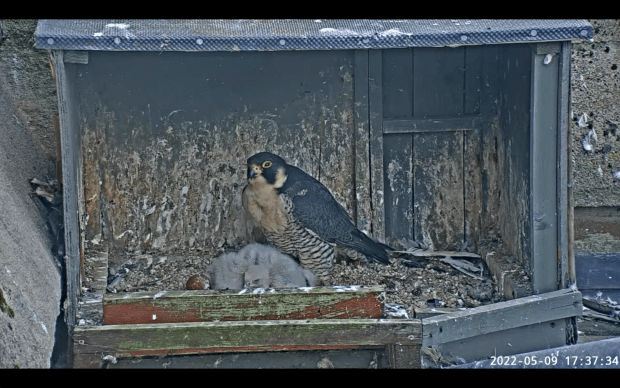
Did you know about the Peregrine Falcon scrape in St Mary’s Church in Hampshire in the UK? I didn’t! This nest has been here for a number of years. Listen to the discussion at the end to find out how the nesting birds were discovered.

The chicks are just slightly older -but not much – than Big Red’s. They are getting their itchy blood feathers. The scrape looks successful. Why do I say that? Look at all the ps on the walls!!!!!!!!!!

This is a great 51 minute talk about Peregrine Falcons by Ornithologist Keith Betton who is also the Country Bird Recorder for Hampshire. It is interesting.

There was a bit of a prey tease the other day at the Cromer scrape. They made a short video of it. Cute.

It is dinner time at one of Poland’s Peregrine Falcon nests – and it wasn’t a tease. Also notice – it is a nest! Just like the other one in the Polish forest, Dolina Baryczy.

It is evening – 20:21 – at the LRWT Manton Bay nest of Blue 33 (11) and Maya. We are definitely on pip watch but, if there is one, our Mum is not revealing it. Maya has been extremely restless since late last evening. Is she hearing her chicks? I feel like a very restless expectant parent!

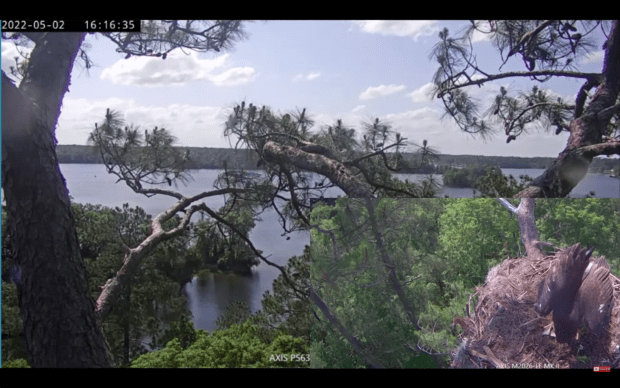
I am not familiar with the Osprey nests in Finland but, last year, a lovely young woman wrote to me to tell me that they have ten nests. That is fantastic. This is the link to one of those. Last year the couple laid three eggs. All three hatched. The youngest died at the age of 2 days for an unknown reason according to the streaming cam information. There was not a threat from the goshawks so I want to continue to check on this nest. The location is splendid. Just look at the water with all the fish for the babies and parents.

The female is Manta and the male is Manu.

The eldest eaglet at the Pittsburgh-Hayes nest is getting closer to branching. She was up on the top of the nest rim called ‘The Baby Gate’ today. The others are just too curious and they will be up there soon!!!!!!! Just don’t go crowding one another knocking someone off!!!!!!!!!

Anyone still worried about L4 at the Red-tail Hawk nest of Big Red and Arthur? I sure hope not. There is the tiny one right up front having lunch! If he isn’t on the edge, he will climb over the others to get up to Mum’s beak. Partially this is because he eats less food but needs to eat more frequently than the older siblings. But oh, what a little cutie pie.

Oh, those wings look like soft cashmere. Wee one is tucked in under them keeping warm. Every chick has a big crop!

The weather in Scotland around Loch Arkaig has not been good. The winds have been very very gusty with rain. One of those gusts almost completely blew dear Louis’s mate, Dorcha, off the Loch Arkaig nest around 16:00 today. Unbelievable. It always frightens me when this happens. Last year and the year before, Big Red was almost blown off once with a chick holding on to her.

Dorcha recovered but gosh, golly.

Nancy is on high alert at the MN-DNR nest after a juvenile eagle stayed on the perch tree and another flew overhead. Oh, I wish they would leave her alone. She cannot go and hunt for her and E1 with these interlopers about. It is pretty clear that the success of the reintroduction of the Bald Eagles (and Ospreys) in the US has caused a lack of good territories and nests causing much of the disruption and harm we have seen lately. I would also include the Peregrine Falcon population in the California area. What is the answer? More artificial nests? the stocking of ponds for fish for the birds?

Alden may be shy of the chicks but he is keeping the pantry full for Annie and the two wee babes. Don’t they just melt your heart?

Seriously sweet.

Some much bigger birds in the Dale Hollow Eagle nest were both enjoying a nice fish today for lunch. Both of them are perching up on the nest rim and each is doing very well. Looking forward to their successful fledge!
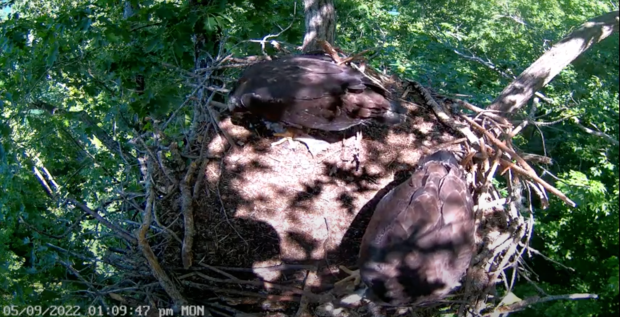
The UFlorida-Gainesville Osprey nest cam is back up and running. Excellent news.

I continue to hope that there will be a new wee babe on the Manton Bay nest by the time I wake up tomorrow. All of the nests I have checked are doing fine except for the continuing intrusion at the MN-DNR nest of Nancy and E1.

Thank you for joining me today. Take care everyone!

Thank you to the following for their streaming cams where I took my screen captures: UFlorida-Gainesville, Ospreys, DHEC, Andover Peregrines, LRWT, Cal Falcons, MN-DNR, Woodland Trust, Cornell RTH, and Pix Cams.

Friday Morning in Bird World

6 May 2022

The five peregrine falcon eyases at the Manchester, New Hampshire scrape have been fed four times before 0930. Meal times were 0531, 0627, 0712, 0917. Mum doesn’t get finished quick. She will wait til there are no beaks open wanting food. Just look at the youngest right up there!

There are five eyases in the scrape at the Walburga Tower in Oudenaarde, Belgium, too.

Here is the link to the camera in Belgium:

There is still one eyas at the scrape box on The Campanile on the grounds of UCalifornia-Berkeley. The wee one hatched on 5 May. There are two more eggs. One appeared to have some cracking of the egg but that could have been light or debris.

Bingo!

A really nice fish arrived for the two soggy eaglets at the Dale Hollow Nest at 0813.

It is not clear to me which of the eaglets claimed the fish. Note: the cam is flickering (or was) in and out of IR mode).

There was some headway made on the self-feeding and later both decided to sit it out on the rim of the nest.

Lessons are still being taught at the WRDC Bald Eagle nest in the Miami Zoo. Rita arrived with a nice fish at 0926.

She waited eating morsels. It was not until 1024 that a fledgling arrived on the nest.

Mum left them empty taloned. Wonder what lesson she was giving out today????

Both R1 and R2 seem to be hanging around the nest. Hi there.

The three eyases at the Weissenburg scrape in Bayern are really growing. Look at the change in their plumage. The soft dow gives way to a rather matty looking cotton that reveals feathers!!!!!! Pink beaks begin to change colour.

Louis is an amazing partner. I adored him with Alia and so sorry she did not return last year. He has settled in with Dorcha and despite the pelting rain in Scotland landed a nice fish for her. Well done, Louis.

Dorcha is so dark. She reminds me of Mrs G at the Glaslyn nest.

We might be checking in on the Osprey nests scattered about the UK but all eyes are on one nest – that nest belongs to Blue 33 (11) and Maya at Manton Bay. They should be having a pip and a hatch today or tomorrow.

Maya is not giving anything away! Gosh she is beautiful.

If you are looking for a solid Osprey nest to watch, one that fledges all their hatches then this is the nest to watch. Here is the link to the streaming cam.

It is raining a lot of places in the US and much of that rain is really welcome especially up in the Pacific Northwest. You will notice that I do not list any of the Osprey nests in that region. The ones I know have suffered from the extreme heat.

It is also raining on Long Island at the PSEG Oyster Bay Osprey platform. Did you know that there are over 2000 Osprey nests on Long Island? Most are located on the eastern end. PSEG has two platforms. The one at Oyster Bay in Nassau County and the other at Patchogue. The Ospreys return each year with the arrival of the Menhaden. It is a species of fish in the herring family. They travel south in the fall and winter and north in the spring in slow moving tight schools. Sadly they have been over fished.
Brevoortia patronus Goode, 1878 – Gulf Menhaden” by Crabby Taxonomist is marked with CC BY-NC-SA 2.0.

There are two falcons and two eggs at the Indiana and Michigan Power Company scrape. You can help them name the chicks. Information below.

Here is the link to this camera.

The Boys & Girls Club of Fort Wayne, Indiana provided a list of ten names for a Survey Monkey. You can vote here once before May 16.

https://www.surveymonkey.com/r/LN776TF

We are waiting for hatch at the new scrape box mounted on the top of the Spartan Stadium at the University of Michigan. It is raining there today, too.

Dad has come to relieve Mum but she isn’t budging. Will we have a hatch today? Maybe. Here is the link to this new streaming cam and scrape.

These falcons made the news!

Some images from this morning at the nest of Big Red and Arthur on the grounds of Cornell University in Ithaca.

Nancy has fed E1 and a cherry picker has gone up to the nest. It is banding day!

E1 properly defended the nest he shares with Mum. Sadly, Dad Harry has not returned to the nest. He disappeared on the evening of 26 April. Once Nancy realized what was happening, she started bringing food to the nest. As we know, it was too late for E2.

Despite early worries by some watchers when there were four eggs, Big Red has shown that this is not a problem. Indeed while it might be one extra to her norm, you can see by some of the peregrine falcon nests that it is possible for five to do well. Life is so different on the hawk and falcon nests than it is for the eagles and the ospreys.

It is going to be a gorgeous 21 degree C day in Manitoba. It is a good day to get outside – before the next rains come – and go and see some of the new arrivals in the City while I wait for the second hatch at Cal Falcons and for their Q & A at 5pm Pacific Time.

The Dark-eyed Juncos that arrived in mass during the horrible storm a few weeks ago seem to have departed. The numbers of birds at the feeders are returning to the norm. Even Mr Blue Jay dropped by this morning.

Take care everyone. Thank you for joining me. See you soon.

Thank you to the following for their streaming cam where I took my screen captures: Cal Falcons, WRDC, Woodland Trust and People’s Post Code Lottery, LRWT, Cornell Bird Lab RTH, Spartan Stadium Falcon Cam, I & M Falcon Cam, PSEG Oyster Bay, Weissenburg Falcons, DHEC, Oudenaarde Falcons, MN-DNR, and Peregrine Falcon Networks.

Monday in Bird World

2 May 2022

Oh, I cannot tell you the level of elation when – just stopping in to check on a fledging that it is there on the nest, yelling at the parent it sees in the distance bringing in a headless fish. Oh, Kincaid, it was so very nice to see you. Thank you Louis for that great meal! The time on the Kistachie National Forest streaming cam was 15:48:36.

There is Kincaid on the branch. Oh, how lovely. I have not checked in on you enough but, it so reassuring that you are still at the nest with your parents, getting food and getting stronger at flying. That is how you will survive! Maybe you won’t ever leave. There is plenty of lake, lots of fish, and an empty eagle’s nest.

Kincaid saw Louis flying towards the nest way in the distance and she rushes down to get her dinner.

Kincaid was sure ‘wheeing’ very loud as the adult approached the tree and landed. Kincaid mantled the nice headless fish perfectly.

Kincaid did a great job feeding. She was still on the nest eating an hour later.

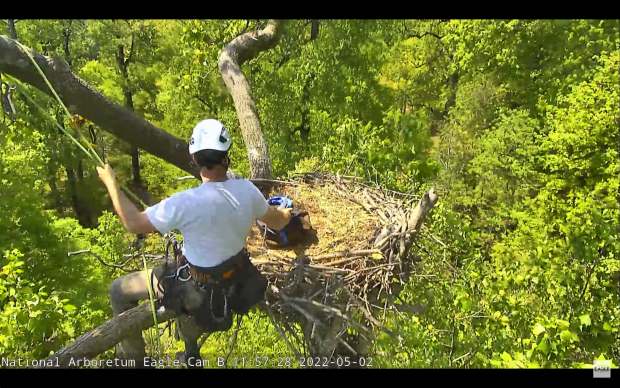
This morning DC9 at the National Arboretum Nest was banded. The eaglet was taken in a pouch down from the tree and returned. It was a very hot day in Washington, DC. 27 degrees C or 80.6. It is hotter on the top of the nest. DC9 was panting. The immediate reaction of the bander was that DC9 was a male. If I hear differently, I will let you know. Here are some images of that event.

DC 9 valiantly defended its nest. It is 10:52. DC9 is 35 years old. The perfect age for banding.

The bander sat very quiet talking gently to the little eaglet and slowly, ever so slowly got him to where he could place him in the sack.

In you go.

Down they go.

Done and dusted. The bander stayed to see that DC9 was alright. Watched his breathing etc.

DC9 is panting due to the heat and probably some of the stress. He is not going to show us his bling either.

Mr President was on a branch of the nest tree called the ‘balcony’ at 15:43. He flew down to the nest and fed DC9 at 16:22. I wonder if DC9 told Dad what a day he had had!

The cuteness factor at the nest of Big Red and Arthur is way up there. L4 is quite the ‘corker’ as my Mum would have said. Yesterday evening he was trying to eat the same piece of rabbit as its older sibling, L1. The wee one isn’t afraid of anything – even attempting to eat a bird leg this morning. It was quite hilarious. At least once Big Red had to rescue the poor darling from choking. Did I say she was a great Mum?

L4 is on the far right with that big piece of meat. Right now it is the only eyas that does not have the grey down coming in. The others are preening and itchy! Soon enough, little one. Don’t grow too quickly.

Everyone is getting a nice crop.

Then it started raining. Poor Big Red. She is getting soaked.

Then the rain stopped. All of the babies are completely dry and kept nicely warm.

It often seems like Big Red never stops feeding them! Adding one extra sure changes things on a nest!

Iris came to visit her nest today at Hellgate Canyon in Missoula. No eggs yet.

Someone commented that they thought raptors bonded for life (meaning if the mate disappears they do not take another mate) today in a short discussion about Nancy and Harry at the MN-DNR nest. Harry has been missing since Tuesday evening. He is Nancy’s second mate. Should Harry not return to the nest, Nancy will have her choice of suitors. She is an experienced female with a beautiful nest and according to the statistics there are too many single male eagles. II really hope that Harry is off healing and will return. Nancy is taking good care of E1. (E2 was shoved off the nest by E1 and subsequently euthanized due to its injuries both from the fall and from the beaking from E1 on the nest).

The oldest eaglet on the Dale Hollow nest branched today. A parent was in with a chunk of fish for Big and was feeding some fish to Middle.

The eaglets are big! Just look at the size of them.

Wow. That big beautiful wing. The eaglets are (counting hatch day) 64 days old today. They hatched on the 28th of February.

Louis and Dorcha at the Loch Arkaig Osprey nest in Scotland now have three eggs. Congratulations.

Male Ospreys are quite funny. Some bring toys and bright objects to the nest. Others land on their mates and use them as a pillow hoping to get some incubation time. At the Dyfi Nest in Wales, Idris pulls Telyn’s feathers when he wants a turn! Telyn is incubating three eggs!

Idris is also known for being ‘Daddy Longlegs’ and for his fantastic fishing abilities!

This is a reminder that Annie and Alden, the Peregrine Falcons at the Campanile on the grounds of the University of California at Berkeley are incubating three eggs which are set to hatch in four days – 6 of May (possibly the 5th). Two eggs are believed to belong to Annie’s former long term mate, Grinnell, and one is thought to belong to Alden. Everyone is very excited. When the chicks are banded, snips of feathers will be taken and a DNA test will happen. We will know the genders and hopefully which chick belongs to which Dad.

Don’t know what to expect from a Peregrine Falcon nest? or need a refresher? or just want 15 minutes of cute? Have a look at a season compilation from Glasgow.

I have not had a chance to check all of the nests! Adding the falcons and ospreys in with the eagles has been running – which is a good thing! Those nests I have checked appear to be just fine.

It is sunny and dry in Manitoba! American White Pelicans are on the river near to where I live. The floodway seems to be regulating the water inside the city the way it was designed. Thankful.

Thank you for joining me this afternoon. Take care. See you soon.

Thank you to the following for their streaming cams where I took my screen captures: Dfyi Osprey Project, Cal Falcons, Cornell Bird Lab RTH, DHEC, Scottish Woodland Trust, NADC-AEF, MN-DNR, KNF, and the Montana Osprey Project.

For the love of Ospreys

14 April 2022

The first time I watched an Osprey nest I swore I would never watch another one. Here I am years later. My book shelves are full of information on Ospreys, I dream about Ospreys, I do research on third hatches. My mind is filled with ‘Osprey’. These birds can take you to the lowest depths and send you to the highest heights of joy. Together many of us cheered on Ervie – the third hatch at Port Lincoln, Australia in 2021 – who was clever and survived winning our hearts and the sat-pak over Bazza and Falky. Since then he has had at least one talon pulled out – it is growing ever so slowly. As a result, Ervie has stayed around Port Lincoln. Ervie has entertained us by returning to the nest barge over and over with his puffers. It is the best! We get to enjoy him longer.

The camera at the Achieva Osprey Cam in St Petersburg, Florida is now on line. It looks terrific. While the camera was out of order, Diane laid three more eggs – a second clutch. The first fell in a hole in the nest (or so it was believed). Normally, the eggs would be hatching at the end of February or beginning of March. The hot Florida weather may pose a problem. I found it very endearing when I discovered, this morning, that David Hancock is adding a shade canopy to all of the Bald Eagle nests he is building in British Columbia. That is something that may become very necessary at the Florida nests!

Jack and Diane fledged three last year. It was not an easy nest to watch as Tiny Tot Tumbles struggled. More than three times we thought TTT would die but she was clever and persistent. She learned to eat old dried fish and she lived to become the most dominant – and beautiful. In the end, Diane went and caught cat fish to supplement what Jack brought to the nest. This is what turned the corner for Tiny Tot.

After fledging, Tiny Tot remained at the nest for some time. She even defended it against adult intruders on her own and with Jack. Oh, how I wish she was banded!

But, I will warn you. With the late hatch and the heat, there is no telling what will happen at this nest.

I have no idea how the three will be doing in a week at the U of Florida Gainesville nest. It is hot! The chicks are enjoying the shade under Mum.

These are also three of the most active little ones I have ever seen!!!!!!

At least two are up out of the egg cup. If Little Bit isn’t yet, he will be out of there soon clamouring around on the Spanish Moss.

Lena and Andy were one month ahead of the normal egg laying time in Florida. Their two osplets are just about ready to fledge. They are beginning to get a little air under their wings and it won’t be long til they are hovering about. Andy and Lena did a great job this year.

By laying the eggs a month early at Captiva, Andy and Lena might have saved their chicks from the Crows and other predators that predated their nest for two years.

The two are yelling at Andy to get the breakfast fish on the nest pronto! Lena can sit back and let them take care of it – if she chooses. They can be pretty loud.

You can still watch this nest and enjoy seeing these two beautiful birds fledge! Here is the link:

Idris has brought a large Mullet onto the Dfyi nest in Wales today but Telyn wants more fish and she is really telling him!

I am not sure what is happening in Loch Arkaig. Louis and Dorcha seem to be playing musical nests. Yesterday it felt certain that Louis and his new mate of last year would go back to the old nest but, today, Dorcha has been on the one that they used as a couple last year. It doesn’t matter for watchers – cam 1 or in this case, cam 2 – we can see them at either one!

Mrs G and Aran on the Glaslyn nest – now that everything is sorted and the females are where they should be – everyone can settle. Aran brought in five fish so far today – 3 yellow-bellied trout, 1 sea trout, and 1 flounder. He is an incredible fisher.

Mrs G, the oldest UK Osprey.

Aran! And he is very handsome.

While we wait for Mrs G to lay her first egg, Blue NC0 at the Loch of the Lowes nest laid her first a day ago and we will be watching for egg 2 shortly.

Seren and Dylan have their first egg yesterday at the Llyn Clywedog Nest in Cumbria.

One of my favourite nests is the Foulshaw Moss nest of White YW and Blue 35 in Cumbria. This nest fledged three last year. It was the home of a third osplet that no one thought would survive – the others were monstrous when the third hatched. It was to the keen parenting and the tenaciousness of Tiny Little Bob. She fledged as Blue 463 and she was queen of this nest! It was incredible to watch her figure out how to get around the big ones.

They are not on YouTube and there is no rewind on the two cameras. You can access them here:

https://www.cumbriawildlifetrust.org.uk/wildlife/cams/osprey-cam

That is a very quick run through some of the nests. I wanted you to know about Achieva in case it was a nest that you watch. Take care everyone. Thank you for joining me today!

Thank you to the following for their streaming cams where I took my screen captures: UFlorida Ospreys at Gainesville, Captiva Osprey and Window on Wildlife, Achieva Credit Union, Woodland Trust and Friends of Loch Arkaig, Dyfi Ospreys, Brywd Gwyllt Glaslyn, Cumbrian Wildlife Trust, and CarnyxWild.

Late Wednesday in Bird World

13 April 2022

The snow on the Canadian Prairies arrived later than expected – around 07:45 in my garden this morning. The wind roared and the snow blew and then, around 15:30 it calmed. We have been told that there will be several calm periods with rain and snow arriving again later tonight. The 27 European Starlings came. The woodpecker arrived for suet. Tens of dozens of Sparrows and seriously, I am not exaggerating, 350 Dark eyed-Juncos. We continued to clear paths on the deck and pour a line of millet and sunflower seeds – about 30 feet long – several times today. Everyone ate there or at the seed and suet cylinders and feeders. It felt good to help them. Many are arriving or returning to eat now that the snow has stopped. We received about 55 cm of snow. Thankfully the old snow had all melted. The whole of western Canada can use the moisture. We have had droughts for 4-5 summers. I hope that this lessens the wildfires during the summer.

The UFlorida Gainesville Osprey Nest was on ‘S’s list of top ten osprey nests to watch. I must find out more about this family from her. My interest is, of course, the fact that there are three little ones and how well this wee osplet can manage against the older siblings.

Little Bob at the UFlorida Gainesville campus Osprey nest is doing fine. He is growing. They all scramble about in the nest bowl and I really dislike the camera they are using but…all that matters is that he is doing well.

There is Little Bob on the far left.

The chicks at the Captiva Osprey nest are almost ready to fledge. They love to self-feed but, Lena being the great Mum that she is prefers to do it so that both get fish. Keeping it fair. I love it. Here are some images from today.

Chicks watching, totally focused. Such beautiful birds.

Lots of flapping. Look at those long legs! This osplet wants to compete with Idris at the Dyfi Nest for the nickname, ‘Daddy Longlegs’.

Those legs of Middle sure look a lot longer than Mum’s! Little continues to love looking out over the side of the nest rim.

Another nest on ‘S’s list is the osprey nest on the Narrow (Pettaquamscutt) River. Here is a view of the nest. No occupants yet! And a link to their camera in case you want to check later.

The Ferris State University Ospreys are also on ‘S’s list and there is an osprey on the nest but no eggs yet! The couple have been working on getting the nest in good shape.

Here is another view of the nest at Ferris State University in Michigan.

This is the link to their camera: https://osprey.ferris.edu/

In the UK, Louis has decided that he likes the nest that he shared with Aila better than the nest he had with Dorcha last year. As a result, Louis has convinced Dorcha to change nests. This is very interesting behaviour. It is such a gorgeous nest. Louis seems, by the move, to have accepted that Aila will not be returning. This will be her second season not to return from migration. Louis and Aila were an incredible pair. I am looking forward to watching Louis with his new mate this season.

The couple are settling in doing what Ospreys do when breeding season hits!

Dorcha is very dark and quite stunning. She reminds me of Mrs G at the Glaslyn nest.

Beautiful Iris has been on the perch and sitting in the nest today. It is a good place to get out of the wind. Gosh, she is gorgeous. Louis has, of course. been around doing what Louis does.

There always seems to be a train going through Missoula, Montana behind Iris!

Iris has a fantastic nest. In her time with Stanley she was a magnificent mother. No doubt, as I often say, she has earned the right to let Louis do his thing, lay the eggs, let the Crows get them, and then relax for the rest of the summer.

They are not friends to the Ospreys but, Northern Goshawks are incredibly beautiful medium to large-sized hawks. There are rare in my province. Those that live or breed head to the dense northern forests in the north. The adults have red eyes with a dark crown (the eye colour changes as they age). Their plumage is a gorgeous blue-grey slate colour with streaks on their pale breast and belly. They are known for grabbing chickens in farmer’s enclosures, rabbits, squirrels of all varieties, grouse, and Rock Doves. They have been known to lure Ospreys into the forest to kill them and to take their chicks- a sadddness which happened at the nest in Finland last year.

The numbers of nesting pairs has dropped considerably when there were 1000 couples to today when there are only between 400-600 pairs.

The images below are from a nest near Riga in Estonia.

This is some very interesting information about this nest and the hawk couple from Looduskalender:

“The nest of goshawks in this location in Riga has been known since 2016 – it is believed that the breeding couple moved here from another nest about 600 metres away. In the immediate vicinity of the nest there are both industrial objects, the sounds of which can often be heard, and private houses. The tree of the nest is located in a small wet area overgrown with weeds and shrubs. The nest is built in a black alder, which grows on the edge of a ditch. The goshawk has built his dwelling on the remains of a crow’s nest. The metal wires twisted in the nest still evidence that the crow was a supporter of durable building materials.

The nest was controlled during this time and the nestlings were ringed in it. This couple, and especially the female, is known among the ornithologists for their special character – she tends to behave particularly aggressively and attack people when they are just approaching the nest. On the other hand, birds are accustomed to people and equipment operating behind the fence in the nearby industrial facility and do not pay attention to them. Interestingly, at the time the female laid her first egg, very close, about 50 m from the nest, a crow couple were building their own nest. Crows are a common food item for Goshawks, but it happens that hawks do not touch other nesting birds near their nest, and they make use of this safety zone.”

This is the link to this Goshawk nest:

Mum is on the ropes at the Port Lincoln Osprey barge this morning in Australia. I wonder if Ervie will come and visit again today making it three days in a row? It is always reassuring and such joy when he visits.

Please help select the name for Annie’s new mate. He deserves a super name and Cal Falcons have narrowed the field down for you to select the finalist. (Go to the link for the names and their associations with UC-Berkeley)

This is just a quick glance at some new nests and a check in on the UFlorida triplets. Both of the eaglets, Jasper and Rocket, have now branched at the NEFlorida Bald Eagle nest. Avian flu continues to be a concern in many areas in the US and Canada.

Take care everyone. Thank you so much for joining me today.

Thank you to the following for their streaming cams and/or FB pages where I took my screen captures: Cal Falcons, UFlorida Ospreys, Captiva Ospreys an Window on Wildlife, Angel, Twitch, Woodland Trust, Montana Osprey Project, RMC, Narrow River Ospreys, Ferris State University, and Port Lincoln Osprey Project.

Monday in Bird World

11 April 2022

The tributes continue to come in for Grinnell! It is more than heart-warming to know that this little falcon touched the hearts and lives of so many in such a positive way.

https://www.theguardian.com/environment/2022/apr/11/peregrine-falcons-grinnell-annie-captivated-audience

I have not seen the list of names chosen by Cal Falcons in the naming contest. Will keep you posted.

A soap opera saga is playing out in the Glaslyn Valley in Wales. The four players are Mrs G, the oldest UK Osprey; her mate, Aran, Monty’s son Aeron Z2 at Pont Cresor, and Blue 014. With the late arrival of Aran and Blue 014, Aeron Z2 and Mrs G got a little too comfortable over at Aeron’s Pont Cresor nest. When both Aran and Blue 014 returned yesterday things got a little sticky. It looks like the guys are going to leave the girls to fight it out. I am just not clear which Aran or Aeron Mrs G wants!!!!!!!!

Aran is really handsome and looks in tip top shape. It is interesting, in terms of bird behaviour, what happens to a couple after there has been a loss of chicks on a nest and, to add to that, an injury to the male. That is precisely what happened at Glaslyn last year. We will wait to see how this sorts itself out.

Handsome Aran. 10 April 2022

Aran is enjoying his fish and keeping watch over his nest while the ladies fight it out.

While the drama continues to unfold in Glaslyn, the folks down in Poole Harbour are rejoicing at the reuniting of CJ7 and Blue 022. These two are totally committed to one another. What is at stake? The first Osprey to hatch in Poole Harbour in over 200 years! It is really exciting. CJ7 waited a couple of years for a mate and Blue 022, a youngster, showed up last year very keen – very keen, indeed.

The list of Ospreys left to return to the UK is growing shorter by the hour. Both Louis and Dorcha returned to the Loch Arkaig Nest safe and sound. So happy!

Some of you will remember the 2020 Osprey season at Loch Arkaig with Louis and his mate, Aila. They raised three amazing fledglings. Sadly, Aila did not return last year. Louis moved to a different nest and bonded with the female that is now called Dorcha.

I adore Louis. He is a great provider and a fabulous father. Here he is bringing Dorcha a fish. Louis knows how to take good care of his family.

It is very windy at Loch Arkaig today. It is hard to get a good image of Louis and Dorcha. Louis is on the left and Dorcha is on the right. Notice Louis’s beautiful necklace. I saw someone on one of the chats the other day comment that they thought only females have necklaces. That is not correct; there are quite a few male Ospreys with exquisite necklaces – the envy of many females!

Here is a link to camera 2 at Loch Arkaig:

I started the other day, with my friend ‘S’s list of favourite Osprey nests. So I want to go back to that list because Chesapeake Bay is on that list of great Osprey nests to live stream. The nest is on Kent Island just off the coast of Maryland. It is on the property of ‘The Crazy Osprey Family’. This family has been sponsoring a streaming cam for the Ospreys since 2012.

The Chesapeake Conservancy Osprey nest is the home to Tom and Audrey. Last year, after a couple of eggs broke in the nest, the couple fledged one chick, CJ.

Some viewers have been concerned about what appears to be a cut on Audrey’s chest. I say ‘cut’ because it does not appear to be blood from bringing in a fish. It is amazing how quickly wildlife heal and the water around the nest is 50% salt which is excellent to help cuts heal (Thanks ‘L’ for checking on that amount of salt here). Audrey should be fine.

The couple who returned to the nest from their winter migration to South America – Audrey on the 18th of March and Tom on the 25th – have been caught on camera mating today. If mating is successful, it takes three days to produce an egg. Keep watching!

Here is the link to Tom and Audrey’s camera:

The Osprey family on the light stand at the University of Florida at Gainesville survived the ball game yesterday. All three chicks were wide awake and ready for fish this morning! It is too early to tell how this nest is going to turn out. Middle and Little Bob still do not control their head as well as Big Bob who is right up front for food.

Here is a link to this cam:

https://wec.ifas.ufl.edu/extension/ospreycam/

Richmond and Rosie, the bonded pair of Ospreys whose nest is on a World War II crane at the Richmond Shipping Yards in SF Bay are hilarious. I highly recommend this nest – yes, absolutely. Solid Ospreys.

However, Richmond got a little carried away and decided to bring a small tree to the nest. In the process, he almost broke all the eggs! Richmond!!!!!

Then later Richmond decided he wanted to incubate the two eggs and was tired of waiting so he sat on Rosie! Richmond, maybe Rosie is thinking of laying a third egg??? What do you think?

Doing a quick check on Middle Little at Dale Hollow shows both eaglets ate well, both parents on the nest and a couple of nice hunks of fish. No sign of any monofilament line. All is well.

Middle Little is growing really well and eating good! Look at that big hunk of fish.

Sitting on the Canadian Prairies you would not know that a super storm is set to hit the area tomorrow. Most people are being extremely cautious. Our rivers are full to overflowing and they are predicting ‘the storm of the century’. Is it weatherman hype? In this case I hope they are entirely wrong! Thousands of Dark-eyed Juncos have just descended on our City, the Geese are nesting, the Snowy Owls are migrating north, and more song birds are moving in by the day.

This was Sunday in a rural area. The water is now up over the banks there.

There are tens of thousands of Canada Geese in Manitoba and more arriving daily.

Normally the geese leave you alone unless you get too close to their nest. Then watch out!

This little red squirrel had a stash of corn kernels at the base of the tree in the park.

He was such a cutie.

Oh, he looks like my Dyson with part of the fur on his tail missing. Poor thing.

Speaking of Dyson, I need to go and make sure that there are plenty of solid seed cylinders placed in various locations so that the squirrels can get to them during the storm. It should not be arriving until tomorrow evening – plenty of time to restock wood for the Jotul stove in case the electricity goes out, find candles, and generally get ready to sit back and read for several days. Can’t wait!

I hope that all of you are well. Thank you so much for joining me today. It is a pleasure to have you with us.

Thank you to the following for their streaming cams where I took my screen captures: Cal Falcons, Woodland Trust and Friends of Loch Arkaig, Explore.org, SF Ospreys and Golden Gate Audubon, UFL Ospreys at Gainesville, DHEC, Bywyd Gwyllt Glaslyn Wildlife, and Poole Harbour Ospreys.

Hawks definitely do not like children

By 18:30, the smoke and the temperatures were cooperating and it seemed like a good time to go and check on the Cooper’s Hawk family in Assiniboine Park. When I arrived at the Park, there were several cricket games going on, families were meeting and sharing a pot luck outside – many for the first time since spring 2020, there were birthday parties and children running around.

When I found the spot and knew where the hawks had their nest and were hunting for bugs and chipmunks the other day, there were children running around. I could see the hawks in the sky circling. They never went to the nest tree or came to the ground. It is the life of a birder. It would be wonderful to see them a few more times before migration. The Canada Geese do not usually begin leaving until the middle of September through to the end of October. I have seen some miss the group and wind up walking about on an early snow. Weather is such a significant factor in the challenges our birds face.

For those who are not sure what migration actually is. Our feathered friends Move from one area for breeding during the spring and summer to another area for winter. They have adapted to the pattern of coming and going in order to survive. It is based on food supplies.

Different species travel different routes to their winter homes. These are long journeys. For example, the Ospreys in the United Kingdom will travel some 8,000 kilometres or 5,000 miles to places in Africa. The birds will fly over land, sea, and desert to reach their destinations. People wonder why the birds just don’t live in Africa all the time. The answer is rather simplistic: there would not be enough nesting sites or food for all of them plus their chicks. There are also a lot of very hungry predators ready to take those lovely fluffy little ones. So they disperse from Africa to sites in the United Kingdom and Europe.

The birds decide when it is time for them to migrate. The hormones in their body begin to change. Unlike spring when this hormone change leads to breeding, the autumn sees the birds restless until they know that it is time to depart. These hormones trigger a lot of eating. Fat begins to gather under their skin. They gain weight. It is that fat that will see them through their migration. Still, they stop and feed along the way. Normally they hunt for food in the early mornings and late afternoons. High pressure systems are good for flying but low pressure systems bring winds and rain. When the birds get into a low pressure system, they will normally stop flying, if they can, and wait til another high pressure system comes through. Migration times vary because of the winds and the weather. Birds that soar and ride the thermals can travel as much as 465 km or 300 miles in a stretch. Some gather in flocks like the storks in Latvia and Estonia. Sometimes birds pair up to migrate. For the Ospreys, the female leaves and the male stays behind until there are no fledglings crying for food.

Not all birds migrate. Even I have a sedentary Sharp-shinned Hawk that defies all logic to stay on the Canadian prairies for the winter. The Osprey in Australia do not migrate. The birds in the Amazon Rainforest do not migrate. There is plenty of food and nesting sites for them year round. This past spring and early summer there was much discussion over the migration of birds from Florida. In Jacksonville, Samson, the father of Legacy, stays in the area of the nest year round. Gabrielle, on the other hand, migrates north – yes north – to cooler summer climates. This year she might have discovered it is hotter up north! Even some of the Ospreys in Florida do not migrate; they stay year round. There are plenty of fish for them as well as nests.

Birds take different routes. The White Storks from Latvia either taken a western route or an eastern route. Dr Erick Greene and his team in Montana study the migratory movements of the Ospreys from the Clark Fork River area with satellite transmitters. In the United States, some fly over Hawk Mountain where there is an annual count. In fact, you can go to this site to see the number of birds traveling over this marvellous area with its thermals. Here is the link for you for their autumn migration count that will being in about a week!

https://www.hawkmountain.org/conservation-science/hawk-count

Migration is extremely challenging and we hope that all of the adults will return to their nests the following spring and that we will see the juveniles who take their first flight to Africa in a couple of years.

And now for some birding and nest news

Poole Harbour: Blue 022 and CJ7 who were so visible until a few weeks ago sky dancing, mating, and working on the nest with the streaming cam are now working on another nest in the area. There is no camera. They are still doing everything together and everyone is looking forward to the first hatches in Poole Harbour for 200 years.

Dahlgren: A large part of the nest in King George, Virginia, collapsed today. It will be fixed in the fall well after Jack and Harriet’s migration.

Kielder Forest: All 16 of the 2021 juveniles have fledged successfully. Everyone is elated. This is 6 more fledglings than their previous best year. Congratulations everyone!

Mlade Buky: Bucachek and his new love spent the night on the nest in Mlade Buky, Czechoslovakia. Oh, how sweet! Just as the dawn is beginning to appear, they are both preening.

Balloons, something that impacts all birds: Virginia, Maine, Maryland, and Delaware have or are going to pass shortly the release of balloons. Hawaii has already passed a law on helium balloons.

Port Lincoln Ospreys, Australia: Dad and Mom have been taking turns incubating the eggs. Here is dad on the nest. A little earlier he had been pestering Mom. He kept pulling on that turquoise rope wanting his turn. It was too funny. The Port Lincoln Ospreys are an example of sedentary birds. They do not migrate. There is no need.

Loch Arkaig: The two juveniles of Louis and Dorcha have now fledged. I have not heard anything about the chosen names yet.

Collins Marsh: Malin was a little wet off and on during Saturday. S/he is sleeping on the nest alone tonight. There is no perch – let us hope that the parent or both parents are in a nearby tree in case there are any owls about. It seems like a pattern. Does mom always spend Saturday night off the nest?

WBSE, Sydney Olympic Forest: 27 and 28 continue to eat until their crops almost burst and sleep. Meanwhile there has been an intruder today and Lady and Dad were honking in alert.

And last but very special, A Place Called Hope. Along with other wildlife centres, they are receiving quite a number of starving Great Blue Herons and other herons. Why would they be starving? It has been raining in the Connecticut area and all the herbicides and pesticides that people put on their lawns and gardens makes its way into the environment, into the water table, into the ponds. It is poison. If your gardening centre or lawn care person tells you that the chemicals they use are ‘Green’ – well, think again. Whatever they are using kills. So sad. It is OK if your lawn doesn’t look emerald green.

Thank you so much for joining me today. Have a lovely Sunday. Take care of yourselves. I look forward to seeing you soon.

Thank you to the following for their streaming cams and their FB pages where I grab my screen shots: A Place Called Hope, Mlade Buky White Stork Cam, Collins Marsh Osprey Nest, Port Lincoln Osprey Project, and Sea Eagles, Birdlife Australia and the Discovery Centre.

The featured image is Dad at the Port Lincoln Osprey Barge taking his turn incubating his two eggs.