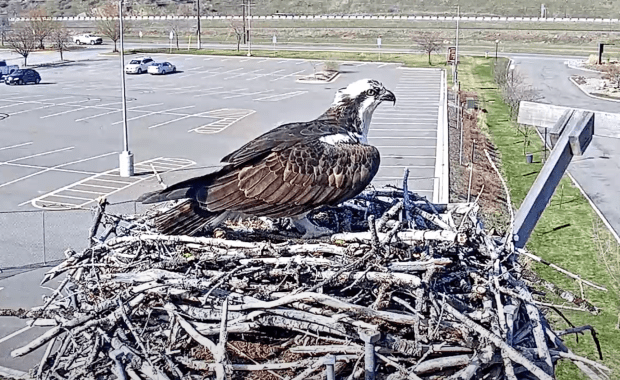
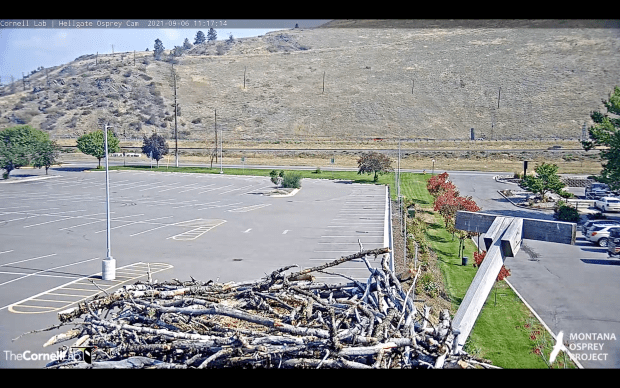
Iris is the Queen of American Ospreys. Believed to be the oldest Osprey in the world, Iris began breeding in Missoula, Montana on a hydro pole with her mate Stanley. The Montana Raptor Project built her a nest on what was the parking lot of the Riverside Clinic in Missoula near Hellgate Canyon. She is thought to be 28 or 29 years old.
Each year everyone waits holding their breath. April 7 is a special day because it is the day that Iris seems to pick to arrive more often than not! I will have a full report on this grand dame but for now, just celebrate! Iris made it through the winter and is back in Hellgate for the spring and summer!
Welcome home Queen Iris.
Thank you to ‘L’ for alerting me and to the Montana Osprey Project for their streaming cam where I took these images.
It is raining snow and snowing rain on the Canadian Prairies on Wednesday afternoon, 6 April. The huge mounds of snow that have covered every space available have melted from the inside out and are disappearing causing fears for a spring flood. Grey squirrels, Dyson and Scraggles, have come out only in the last light of the day to find food. Little Red must be tucked in nicely in his penthouse. So far only one of the Blue Jays has returned. I hope the others are just delayed. For years it has been the three of them – of course, birds do not live forever but when I look out and see my friends in the garden you want to believe that they will always arrive to say hello. Wildlife in an urban setting has many challenges. I am happy to report that my little corner of the world has four new families feeding the birds which, by the act of seeds falling, also feeds the rabbits and the squirrels. Individuals are now showing their toddlers the birds outside eating out of their feeders and together, we are building a bigger and bigger corridor for the wildlife. Our City no longer takes care of the boulevards in front of our homes and this year I want to encourage, where possible, the planting of bird friendly shrubs or trees on these sites. Wonder if I can get a grant from the City to help pay for the trees for everyone? It’s a thought! Will keep you posted.
You have asked me about Osprey nests with streaming cams now that the US birds are returning – some already have eggs in the nest. My friend ‘S’ loves Ospreys because they only eat fish. She knows the US nests; I tend to watch the ones in the UK and now Europe also. I asked her for her top list of nests to watch and she sent me quite a few. I am going to start with one or two a day. These nests are known to be successful. First up is the Dunrovin Nest in LoLo, Montana, home to Harriet and Swoop. Harriet is home; Swoop has not returned yet.
Here is Harriet on her nest looking out to the Montana hills.
Do you want to learn more about Ospreys? Then there is a special programme for citizen scientists run by a graduate student in Conservation Biology from William & Mary College. You observe a different nest, take notes, and meet up in a virtual world every Thursday at 14:30. The programme for this year has not started. Check out this link for more information!
One of the biggest challenges on the Dale Hollow nest for Middle Little is Big and her previous intimidation. When food comes to the nest, Little Middle is frightened and becomes defensive. Little Middle is self feeding but there needs to be food on the nest so that it can do this. Wednesday evening at 18:23:23 River brought in a 2 bite teaser. Big shot up immediately, grabbed the tiny minnow, if you like, and horked it down. Little Middle did not, of course, have a chance.
It is Thursday morning and both of the eaglets have eaten well. The nest appears to be drying out, too. Now that Little Middle is nice and full, it is time to go elsewhere and check on all those other nests including Karl II’s movements over night.
While Dale Hollow is drying out, the National Arboretum Nest in Washington DC is getting a bit wet. That little fuzzy ball is sure changing!
Big Red is getting some of that rain in Ithaca, too!
tors
Need another Peregrine Falcon nest? Here is another with four eggs like Utica, like the Red-tail Hawks in Ithaca and Syracuse…Some think that the increase in the number of eggs is to compensate for the loss of birds due to Avian Flu this year.
There is a pip in egg #2 at the US Steel Eagles!
A beautiful image of Jackie and her fast growing baby, Spirit, from yesterday afternoon. It really is a lovely name the children chose.
If you are a fan of the oldest female Osprey in the UK, Mrs G at the Glaslyn nest you might be wondering why – since you know she has returned from migration – she is not on her nest. She is over visiting with Aeron Z2, one of Monty’s boys. She is waiting for Aran and he is waiting for Blue 014. If neither return will these two get together and what nest will they choose, we wait! Aeron Z2 and his brother Tegid, Z1 who has a nest in Snowdonia have been very interested in that Glaslyn nest. Oh, the soap operas of the birds.
I am extremely fond of Idris and Telyn at the Dyfi nest in Wales. If you want to watch an Osprey cam this is one of the good ones in the UK.
Here is the link:
Karl II was near Minsk last night. There is hope that he might be near the Latvian border later today. As well as Karl, his mate and all the other storks in Latvia and Estonia should be on their way and hopefully safe and away from the war. Waiting is hard. Champagne corks will be popping when he lands on his nest!
The Indiana Department of Natural Resources posted an image with a saying yesterday: “Rescuing Wildlife is Legal”. If you see injured wildlife, please notify your local wildlife rehabber. Don’t know who that is? Find out! Because of the spread of the highly pathogenic Avian Flu,, special protocols might be in place. So ask before you help.
The New Guy at the Cal Falcons nest is still doing what he does best — support Annie! Yippeeeee. The romance continues.
Have a wonderful day everyone. Thank you so much for joining me. See you soon!
Thank you to the following for their streaming cams and/or FB or pages where I took my screen captures: Google Maps, Friends of Big Bear Valley, Dale Hollow Eagle Cam, Audubon Society of Rhode Island, Pix Cams, Cornell Bird Lab and RTH, and Dunrovin Ospreys.
Please pardon any spelling or grammar issues today. I have not had time to proof this report, unfortunately. Thank you!
So far it is a pretty good morning even at Dale Hollow Lake Bald Eagle nest on the border of Tennessee and Kentucky in the US. I turned on my computer just as a small fish was brought in my River, with its head, at 08:11:14.
Big goes to intimidate Middle at 08:23:49 but it is not the level of frenzy that Middle experienced late on the 23rd. Big ate all of the fish that came in. It was finished at 08:35:16. Then River moved over to the piece of Sucker that was still on the nest at 08:36:29.
I was encouraged by River’s actions as she clearly seemed to have feeding Middle in her mind. Middle turned to River to eat at 08:37:23 and then Big entered the picture pushing herself between River and Middle after she had a PS.
It was evident that both Big and Middle had eaten earlier as Middle had a nice crop.
River began feeding Middle at 08:38:25.
Eight minutes later, at 08:46:15, Big decides it wants to eat and starts intimidation. It ate a few bites.
River tries again to feed Middle at 08:47:33. River stops feeding at 08:47:25. There is still a piece of the sucker left. The nest is quiet of any animosity. At 09:03:38 Big turns and towers over Middle and does nothing! River returns to the nest. She is aerating the area by the small piece of remaining sucker. Big moves down at 10:01:20 and River feeds Big all the Sucker.
By 10:11:40 Middle is up at the top of the nest on the left being fed the rest of the old fish tail (not much on it). Big ignores the whole thing! Both eaglets are full. It is just after 10:15 on the nest.
Despite the modest attempts of intimidation, Middle ate this morning and has a nice crop when I stop watching. Big also has a crop. Hopefully more larger fish will come on the nest. Indeed, I hope that obey knows where to find more suckers! We can be joyful. This morning has been good for Middle!
River returns to the nest later to aerate. It is now 11:35. No more food items but not expected. Both Middle and Big have big crops still!
Middle had a really healthy PS at 11:32:41.
There is Big’s Crop. Because Big is such a large bird – no doubt she is a she – her food requirements are probably twice that of Middl now. Continue to send positive wishes for this nest. We are not out of the woods yet but I sure hope we are in a week. Both chicks cast pellets this morning and both had at least one PS. Enjoy this morning. It has been a good one at Dale Hollow.
Here is the first view of the newly hatched chick at Harry and Nancy’s MN DNR (hatched yesterday).
I have received word from ‘S’ in Latvia that a female interloper White-tailed eagle has destroyed the two eggs that Milda had laid on her nest in Durbe County. This is what ‘S’ conveyed: “Just a quick update. Yesterday evening a ringed strange female came to the nest and destroyed/ate Milda’s eggs while Milda was away feeding. Voldis did not stop her. It’s clear Voldis is not in any nesting mode yet, since his incubation skills also did not improve significantly. The intruder female is a Latvian WTE who was ringed in Latvia, near Jaunpils in 2016.”
Here is a video summary of the events:
As ‘S’ points out, many of the experienced watchers of Milda’s nest believe this to be better as it is clear that the situation could have gotten worse – no care for hatchlings, lack of prey to nest, etc.
‘S’ also included a message sent out by the Ornithologist, Jan Kuze:
“Today we have witnessed a very interesting turn of events – at least I am not aware of any other such cases. The role was played by the fact that the male is young and inexperienced, its connection with the territory and this partner is not sufficiently strong yet. The female continues to incubate due to inertia, but it cannot be ruled out that another egg will be laid in this nest, the next week or two will show.
I ringed the egg-eating female bird in the vicinity of Jaunpils on 25.05.2016. It is a young female who has reached the nesting age and is looking for a nesting area, it cannot be ruled out that we will continue to see her here and that some conflicts will continue.”
In Montana, members of the Raptor Resource Project are installing some ‘goose exclusion’ mechanisms to the Osprey nests. Here is the message from Dr Ericke Green:
It is not an Osprey nest but an unused Bald Eagle nest at Decorah, Iowa. The Canada Goose that has been checking out this nest has now laid her first egg. This is going to be a terrific nest to watch as long as there are is no predation. Imagine all those little goslings jumping off the sides.
The goose laid the egg and then covers it. Did you watch Daisy on the WBSE nest? If so, you might remember that the goose or duck will lay their eggs and then begin to add down from their breast to make the soft nest. After 24 hours, the goslings will all jump down! They have quite a ways to go but video has been taken of goslings jumping 106 m or 350 feet. They bounce! It is really exciting. They will then follow their Mother to water where they will begin eating. Ducklings and goslings are precocial – covered in feathers and able to eat on their own after hatch. Amazing.
On the Cornell Campus yesterday, 19 year old Big Red surprised everyone when she laid a 4th egg! Perhaps most surprised was her 6 year old mate, Arthur. Cornell called it “unprecedented” on Twitter. Red tail Hawks can lay up to 5 eggs. Since the camera became operative in 2012, Big Red has consistently laid 3 eggs. It is not know how many she laid in years prior.
I will alert all of you as pip approaches for Big Red and Arthur as well as for the Peregrine Falcon couple, Annie and Grinnell. If you are used to watching eagles, it is very educational to observe the smaller raptors and how they manage larger clutches.
Speaking of Falcons, it is not time for any egg laying by the Australian falcons at CBD 367 Collins Street or Xavier and Diamond at Orange. That will come in late summer. For now, there are several nests. That said, I am playing close attention to Annie and Grinnell (as much as Dale Hollow allows for). This morning Grinnell was in the scrape at 06:44:05 calling Annie. I sure hope he had her breakfast! In terms of hunting, Peregrine Falcons, the fastest birds in the world flying up to 370 kph, capture their prey when flying. That prey can range from parrots, doves, pigeons, Starlings, to geese and herons depending on the falcons location.
For those just starting/thinking about observing this scrape, there is one quick difference between Grinnell and Annie. Grinnell has a black ID on his left leg and a standard silver band on the right. I would also like to draw your attention to the hue of Grinnell’s legs, cere (the yellow part above the beak), and the yellow around his eyes. Notice how the colour appears to be an orange-yellow. This deep colour indicates that Grinnell is extremely healthy.
At 08:48 Annie returns to the scrape. Peregrine Falcons may have first laid their eggs in twig nests but, if they did, they evolved to using cliffs with sand or pebbles. It is believed that this allows for few, if any, diseases unlike Eagle nests that constantly have to be aerated.
The eggs that Annie will lay are some of the most beautiful in the avian world with their rich red-brown colour. Indeed, because of their beauty and size they became the target of egg collectors. Once Annie begins hard incubation, her and Grinnell will take turns for 33-35 days. On occasion, as at the CBD Collins Street Nest in 2021, all three of their eggs hatched within a few hours. It helps to avoid the issues that we have seen at Dale Hollow and with Eagles and Ospreys in general. Once hatched, it is 5 to 6 weeks til fledge. The parents will then train the eyases to hunt and feed them for about another month. On occasion, the fledglings return to the nest area.
I sure hope Grinnell had a good breakfast for her. Annie appears to be ‘thinking’ about laying eggs. We wait.
Here is a recap by CalFalcons of the 2021 year. You might want to turn the sound down a little – the music is quite loud (or maybe not). It compresses the season from mating to banding to fledge.
At the Berry College nest of Pa Berry and Missy, B15 is one sweet and energetic eaglet! The nest has become a launch pad for ever higher jumping. B15 loves the wind between its wings. This morning he was up checking out the DVR. Fledge could come any day now. It has been a terrific year for this nest.
About four hours ago, Harriet at the Dahlgren Osprey nest laid her second egg. Jack continues to bring in toys. Oh, dear. Last year an egg got lost in all the items on this nest. Poor Harriet.
As we wait for Richmond and Rosie to finish their nest and the arrival of Iris in Montana, the Ospreys heading to Europe are on the move. A couple of days ago there were 51 on a site in Senegal and today only 10.
I want to check on Karl II, the male at the Karula National Forest Black Stork nest who is making his way home for the spring and summer breeding season in Estonia. Yesterday, 23 March, Karl was making good progress and was feeding at Lake Beysehir in Isparta Province in Turkey.
Image courtesy of Wikimedia Commons
Karl II would normally be heading for an area around Odessa in the Ukraine on the Black Sea. Is it possible that he might revert and fly slightly West? We wait.
The day is half over on the Dale Hollow nest and I would suggest that it was a good start. River is currently on the nest shading the eaglets.
Thank you so much for joining me. I have skipped around checking on other Bird news this morning. All of the other nests are doing well and there is a lot going on. A storm is heading to Captiva that might put fishing off for Andy because the air pressure drives the fish deeper in the Water. Jackie and Shadow have been dealing with intruders. I may not get to all of those today. It could be a very late report. Take care everyone!
Thank you to the following for their streaming cams and/or FB pages where I took my screen captures: Cornell Bird Lab and the Montana Osprey Project, Cornell Bird Lab and RTH, Dale Hollow Eagle Cam, Cal Falcons, Berry College Eagles, Looduskalender, Google Maps, Dahlgren Ospreys, and Explore.Org. I know that there are more pressing concerns in the Balkans but I am extremely grateful to ‘S’ who took the time to alert me about Milda’s eggs being predated. Thank you ‘S’, I know the birds are your solace right now.
It is a grey and windy day. As the weather channel promised, our summer heat wave in October seems to have come to an end (for the moment) with the arrival of single digit temperatures. The recent rains have caused the ground and old tree stumps to come alive and the sparrows and thrashers are thumping the ground having a good old time. It reminds me – continues to remind me – why we should not be raking our leaves or mowing the grass. Gently rake them into a corner if you have to. The birds really will thank you!
It is also nearing Halloween and all around me I can see the windows and doors decorated – many have elaborate displays outside.
I believe Halloween was the favourite holiday of my children – you got to dress up, get candy, and have parties at School. I recall pulling the two oldest in a sled one year as the snowflakes fell faster and faster. We did not need to go more than a block. Their pillowcases were full because they were the only ones out on such an incredible wintery night. The grandchildren enjoyed decorating the trees and, sadly, I remember using some of that web material with little black plastic spiders. That was a long time ago when I did not know better – but I do now. As a reminder to everyone, please be careful if you decorate. It will be a tragedy if animals get caught and have to be euthanized just for a bit of fun.
Oh, gosh, golly. Xavier and Diamond’s little chick just took its first steps!
Meanwhile, the Collins Street Four – which are a week older – are now standing up. They are also getting curious about the outside world and one nearly gave several streaming cam viewers a heart attack when it walked up to the edge of the ledge.
The Collins Four having some fun. Look at the size of the wings!
In case you are wondering why the scrape box is so messy this year, it is because the wind does not blow through it like it did at the other end. On a positive note, the chicks have been supplied with some shade and neither them or Mum have been as hot and panting as much as last year.
At the Port Lincoln Osprey Nest, the osplets had, at least, five fish yesterday – probably a couple more. I could not rewind the camera prior to 16:00 and all had big crops at that time. One of the most interesting interactions was between Little Bob and Mum. They had a tug-o-war with the fish tail. Mum won!!! It was very cute. that fish tail was from the 18:02:17 fish Dad brought in.
The osplets are doing really well walking around in that twig lined nest, too. They are covered more and more with feathers each day. Those feathers seem to be pushing out of those quills right before our eyes.
Dad brought in a bedtime fish for the family at 19:39:16. It is difficult to tell one from the other but there is Little Bob in its usual spot, right up by Mum’s beak.
Where is Solly, the first hatch of the Port Lincoln Osprey Barge in 2020? She seems to have decided to take a quick trip to Streaky Bay before heading back to her special tree in Eba Anchorage. It is such a relief to see the movements of the birds – to know they are safe, living their lives well.
If you were following some of the Montana Ospreys, a map of their locations has been released on the Montana Osprey FB page this morning. It shows that all of the Ospreys arrived in Mexico or Central America. Such good news. Their satellite trackers are working splendidly.
Both of the little sea eagles, WBSE 27 and 28, were still on the nest early this morning. That doesn’t mean that they will be there in a couple of hours.
I am a huge fan of Gabby and Samson’s at the Northeast Florida Bald Eagle nest near Jacksonville. The morning was just starting. The couple spent the night on the branches and as the sun came up, Gabby could be seen working on the nest.
At various times during the day, Samson, Gabby, or both, can be seen preparing their nest for the new breeding season. Here is a link to the streaming cams (there are several but this one looks directly into the nest), so you can check on them.
Tiaki, the 2021 Royal Albatross Cam Chick, is making really good time on her way to Chile. She was well beyond the International Date Line this morning. So, with that news, everyone in Bird World is doing well today. Smile. It is all good!
The sun is out and the Slate-grey Juncos are on the deck and the sparrows are having a drink out of the bowls. I wonder what other garden critters will show up? No Halloween candy for them! But they are getting extra dry corn cobs.
Thank you for joining me. Take care each and every one of you. See you soon.
Thank you to the following for their streaming cams where I took my screen captures: Port Lincoln Osprey Project, NEFlorida Bald Eagle Cam and the AEF, Sea Eagle Cam@ Birdlife Australia Discovery Centre, and the Montana Osprey Project and the Port Lincoln Osprey Project FB Pages for the sat-pak maps showing the location of the migrating Montana Ospreys and Solly.
The poor mum at the Port Lincoln Osprey Barge nest has certainly been stared at! Chatters want a stick moved and Dad seems to continue, on occasion, to bring in some more nest materials.
At 02:06, many were certain there was a bump. By 05:33:13 there was a definite pip. The bump expanding for three hours certainly seems logical.
You can see it here – the back egg! The first egg was laid on 3 August. I think it makes it 40 days on the dot – but don’t trust me, do your own math, please. It looks like there will be a little Osprey by morning tomorrow. Lovely. I hope the weather is good for mum and chick.
Thanks to the two ‘Ss’ for alerting me. It seems that Iris was enjoying a fish yesterday on her favourite tree at Mt Sentinel. You will read later in this newsletter that Ospreys prefer trees without branches. This one is certainly perfect. She can see all around her. Oh, the survival skills the Ospreys have developed over millions of years.
Oh, these birds are so smart. If the weather is bad, maybe they know it. Certainly they anticipate local weather and act accordingly!
Hurricane season officially lasts from 1 June to the end of November. Last year several of us worried about Tiny Tot and we became curious about the impact of hurricanes on the Ospreys and other birds.
In his book, Soaring with Fidel, David Gessner talks about visiting Sanibel Island after Hurricane Charley hit the area in August of 2004. Santibel took a direct hit and it is home to many sea birds including lots of Ospreys. Some of you might have watched the Captiva Bald Eagle nest last year – Joe and Connie. That nest is on Santibel Island.
According to Gessner’s friend, Tim Gardner who lives on Santibel, the hurricane hit with 140 mph winds, a category 4. “The Ospreys, according to Tim, moved lower and lower in the trees, until they hunkered down near the ground in the brush.” “But no amount of hunkering could protect them.” Gardner revealed to Gessner that all of the nests were gone after the hurricane. Blown away. Gardner also added, “The remarkable thing was the birds’ resilience: those that had lived through the hurricane had come back to rebuild on the same spots”. He noted that the few trees that remained looked just like sticks pushed up out of the ground with no branches —– well, lo and behold, our Ospreys love trees without branches. Perfect. They can see all around them. As hurricane season continues for 2021, let us wish all the wildlife resilience and strength.
I have so enjoyed Gessner’s writing that I was able to find his first book at a used book shop. It is Return of the Osprey. A Season of Flight and Wonder. I hope that it is as informative as it is a good read. Certainly Soaring with Fidel fit that. I continue to return to that book. It is a delight.
After posting the article, “The Tears of the Albatross,” my friend, ‘L’ send me a link to this wonderful video, Albatross – A Love Story! It is excellent. Have a look. Thank you, ‘L’!
So many of you have sent me the most beautiful images of your the birds. Thank you! The care, love, and concern that each of you have for the wildlife visiting your gardens is so endearing. I wish we could spread that love and care like an aerosol.
Oh, the joy and laughter the birds and animals bring with their antics! This evening as the sun was setting, the three Blue Jays that visit my garden and two of the large grey squirrels had noticed the ears of dried corn that had been put in a bowl for them. My view was mostly blocked but oh, you could see the crest of the Blue Jay pop up and down and, on occasion, the cob would roll and you could see the Jays getting a kernel and eating it. One decided to have a bath. Of course, he will never use the bird bath. This fellow, the male, prefers the old gold water bowl.
I am also certain that he can hear when I take the cap off the lens since he absolutely refuses to pose! Seriously, he had been looking straight at me prior to this.
The Blue Jay couple are year round residents in the back garden. They always come out in the morning and late afternoon to almost sunset. They often arrive with a single juvenile every summer. To my amazement, they get along with the other regulars – the little Downy male woodpecker (and his juvenile in the summer), the lone Black-Capped chickadee, the three Grey Squirrels, Sharpie the Sharp-shinned Hawk, Hedwig the Rabbit, and ‘Little Red’, the Red Squirrel. OK. Red and the Grays dislike each other completely.
These characters that give us so many giggles are really a part of the family. It is always comforting, at the end of the day, to check off that each has been seen.
The link to the Port Lincoln Osprey cam is here:
My newsletter will be late tomorrow, very late. I am hopping to get a glimpse of some birds during the day if the weather cooperates. On the list are Sandhill Cranes. In fact, it might not arrive until Tuesday late morning so don’t worry.
Thank you so much for stopping by to check on our friends in Bird World. No doubt everything will happen at once – the chick at PLO will hatch the moment that Tiaki fledges and Iris arrives at her nest! The birds certainly keep us on our toes. Stay safe everyone.
Thank you to the following for their streaming cams or their FB pages where I took my images: Montana Osprey Project and Cornell Bird Lab, Sharon Leigh Miles from the Montana Osprey Project who allows me to use images from their FB Page she posts, and the Port Lincoln Ospreys.
Dr Tim Mackrill, the Osprey specialist that worked with Glaslyn on how to set up the fish table for Aran and Mrs G this past late spring and early summer when Aran injured his wing, gave a wonderful Webinar on Osprey migration. He has taped the entire talk and you can watch it on YouTube. It is free – and worth every minute. You can, of course, start and stop the presentation as needed. Here is that link to everything you wanted to learn about Osprey migration and more!
The wait continues for the female adult at Port Lincoln’s first hatch. Any time! It’s 12 August in Australia and that was the day I guessed on the FB page. Come on hatch!!!!!!
The nest at Port Lincoln is known for its siblicide. There will be no intervention of any kind – other than putting on the Darvic rings and maybe another satellite tracker this year (if they choose to do this). If you take the number of days different from the day egg 1 was laid and egg 3 and then add the number of days between when they hatched, you will get a real number that tells you the difference in age between 1 and 3 – sometimes ten days. Some of these little ones survive. Tiny Little Bob at the Foulshaw Moss had extraordinary parents. Tiny Tot at the Achieva Nest was simply an extraordinary bird. Many aren’t. So please keep this in mind. Here is the link to the streaming cam.
There is news coming out of Loch Arkaig. Louis might still be at the lake along with one of the juveniles. Louis is very devoted to his chicks and he will wait til one of them leaves – for certain – before he does. Stay tuned. People will be checking this to make sure.
There has been no confirmation about Iris, the grand dame of all Ospreys, having left for her migration. The last certain sighting was by Sharon Leigh Miles on 6 September.
Put a bookmark on the Osprey migration video if you can’t watch it soon. On one of those rainy days when you are wanting something to watch, it is a great resource.
Thank you for joining me this morning. Take care everyone. Stay safe.
The featured image is Iris. Iris is believed to be the oldest Osprey in the world. She summers in Montana but no one knows where she stays for the winter.
Thank you to the following for their streaming cams where I took my screen shots: Port Lincoln Osprey Project and Montana Osprey Project and the Cornell Bird Lab.
As the days of summer give way to thoughts of falling leaves and back to school, our beautiful Ospreys think of migration. Those in the United Kingdom have already already headed to the area around Poole Harbour to have a last good feed and sleep on land before heading south to Brittany and on to Africa. Those in the United States and Canada will take various routes. The male is still in Manitoba with one chick at the nest I watch.Some head to southern Texas and places in Mexico while those in the northeast fly over the cost, over the length of Cuba heading to South America. One of those leaving her summer breeding grounds in Missoula, Montana will be Iris.
Iris is not ringed. No one knows where she goes for the winter but, she turns up in tip top shape to her nest at Hellgate Canyon every spring.
Typically Iris spends more time at her nest before her departure. Last year she said goodbye on 8 September. Because of her age, many worry that she will not return. It is always an anxious wait until spring and she arrives again full of hope and hormones.
Sharon Leigh Miles shared this image of Iris taken on her favourite tree on Mt Sentinel on 6 September at 09:22.
She is there. Just squint.
Iris is the oldest osprey in the world – the grand dame of all of them. In her lifetime it is estimated that she has fledged between 30 and 40 chicks but no one knows for sure. It is possibly more. Iris is known around the world. Her arrival on 7 April 2021 to her Hellsgate nest made print and television news. Dr Ericke Green of the University of Montana believes Iris is at least 25 years old, perhaps more.
In the image below, Iris just landing from her winter migration. All the worrying about whether or not she survived another winter is put to rest.
Welcome home, Iris. 7 April 2021Landing with a nice big breakfast. 10:36 am. 11 April 2021
Iris’s nest, prior to the one she uses now, was on a hydro pole about 68 metres or 200 feet from this one. This artificial nest was built for Iris because of the high rate of electrocutions on power lines – all birds, not just Osprey. The power lines are high enough and have a clear view that they appear to be desirable. The new nest, erected in 2007, is all set up with a high resolution camera. Iris took to the new nest right away, thankfully. Iris mate, at the time was Stanley. Stanley did not return from migration in 2016. Her current mate, Louis, and her have had a very chequered relationship. Louis also has another nest with Star, his primary nest, near the baseball park. Iris and Louis fledged one chick, Le Le, in 2018.
Many of us are glad that Iris has been spending the summer of 2021 taking care of herself. Raising chicks is not an easy job – and everyone loves Iris and wants her to return year in and year out from her migration.
I have included some images taken at the nest this year.
Iris worked on building the best nest that she could. Every day she brought in more material. She eventually will lay three eggs – that we and she – seem to know are destined not to hatch. These were bittersweet moments for everyone.
She was fierce in her fishing and the protecting of her nest. Indeed, her and Louis protected the nest together several times. The video below is from 22 August.
Sharon Leigh Miles provided a chart of the departure dates for Iris for her migration. Today is 6 September so we are definitely in the range. These are the previous dates of her departure:
2012: 6 September
2013: 6 September
2014: 11 September
2015: 4 September
2016: 8 September
2017: 9 September
2018: 10 September
2019: ?
2020: 8 September
There is no one on the Hellgate Canyon nest this morning. Everyone is hoping that Iris will make several long appearances on the nest before she departs. This has been her MOD in the past. Fingers crossed!
If you would like to periodically check on the nest, here is the link to the streaming cam:
The Montana Osprey Project has had one fundraiser – the Iris pens – this year. If you would like information on how to order one of these, send me an e-mail and I will provide the details. They are lovely. There are also plans to commemorate Iris by a woodblock print. As information comes through I will post it.
Keep Iris in your heart. Migration is challenging. We wish her a safe journey, good winds, lots of fish, and a safe return to Montana in the spring.
Thanks for joining me. Take care everyone.
Thank you to the Montana Osprey Project for their streaming cam where I took my screen shots and their FB page. Thank you Sharon Leigh Miles for allowing me to use your images posted on the FB page.
It is pretty quiet at the nests these days – that lull if you like between the Ospreys leaving for their migrations in Europe and the US, the Bald Eagles slowly returning to their breeding areas, and the falcons and Ospreys incubating eggs in Australia. The biggest news in Bird World is that Diamond laid her second egg at 20:55 September 2nd.
Xavier taking a turn incubating and rolling the eggs for a bit this morning. Gosh, those are big eggs!
The Osprey was officially adopted in 1994 as the is the provincial bird of Nova Scotia, one of Canada’s ten provinces. Nova Scotia is a peninsula surrounded by the Atlantic Ocean, the Bay of Fundy, the Northhumberland Strait, and the Gulf of Maine. It is one of Canada’s Atlantic or Maritime Provinces. At its widest, 128 km, it is easy to reach any body of water easily. It is said that Nova Scotia has more Ospreys than the United Kingdom in its entirety. Many live on McNab’s Island at the mouth of Halifax Harbour.
@Wikimedia Commons
The lighthouse was built in 1809. In 1852, Dr. Abraham Gesner was given control of the lighthouse. In December, Gester used a fuel that he had just discovered – kerosene – to operate the light.
Ironically, there were hardly any Ospreys in Nova Scotia two decades ago. The use of DDT had weakened the eggs to the point that the birds were virtually going extinct. Since 1979, the Osprey Management Program, operated jointly between Nova Scotia Power and the environmentalists at the Department of Lands and Forestry to relocate nests that are on top of live utility poles to safer unused poles nearby. Each year they partner with the Museum of Natural History to live stream an osprey nest. The Osprey are in Nova Scotia from April to September. At the end of the summer, when the juveniles are old enough, they leave for their winter grounds in the Caribbean and South America.
The first little video is from 2014. Seven years ago, when streaming cams were not so HD. Here is a typical Osprey family of five in Nova Scotia on top of one of the partnership nests.
Here is another short video of 2020 showing the improvement in cameras. It shows the hatch of the second chick at this nest on 9 June.
Speaking of Osprey, Sharon Leigh Miles took this image today of an Osprey at Mt Sentinel in Missoula, Montana. It is Iris’s favourite tree and it is presumed to be Iris, the grand dame of North American Ospreys. Hopefully she will visit her nest before she leaves. She is the oldest Osprey in the world.
In other news, White YW, the male at the Foulshaw Moss Nest, dad of our one and only Tiny Little, Blue 463, is still in Cumbria. He was photographed there today. White YW hatched at Bassenthwaite in 2008. Gosh, he is a great dad. One of the unsung heroes. Chris Wood has received word that the estuaries that the UK Ospreys travel to for their winter season are filling up with water. Wonderful! Yesterday, I saw Cormorants here in Manitoba and today a couple seem to have taken over Maya and Blue 33’s nest at Rutland (at least for part of the day). The two little sea eagles are getting along fine. Food remains plentiful and they are growing, flapping, and learning to walk. Those clown feet are really growing. Just look, with food, 28’s feet are getting huge. Wow.
I am attaching the progress map of the Ospreys and Black Storks:
Pikne, in orange, is really travelling well. She has gone straight south almost beating Karl II in royal blue. You can follow them, too. Here is the link:
Thank you so much for joining me. Take care. Stay well. Look for egg number 3 on 4 September down in Orange.
Thank you to the following for their streaming cams where I took my screen shots: The Falcon Cam Project at Charles Sturt University in Orange, The Montana Osprey Project FB Page, Sea Eagle Cam @Birdlife Australia Discovery Centre, and BirdMap.
In my last post, Tiny Little Bob or Blue 463 from the Foulshaw Moss Osprey Nest was screaming at White YW (aka dad) for a fish. He could have flown to Wales and he would have still heard her.
What is that about the squeaky wheel always gets the oil first? Perhaps screaming daughters do, too. It is the last fish of the evening probably and Tiny Little is eating it. Blue 462, the other female on the nest, would like Tiny Little to share. Somehow I don’t think so ——- it was, after all, Blue 462 who was such a meanie to Tiny Little when she hatched. Birds have good memories.
These are the areas adjacent to Iris’s nest in Hellgate, Missoula, Montana. It is very beautiful. We always see the nest in the parking lot but just on the other side are trees, grass, and water.
Iris is the oldest living Osprey in the world. Her nest is at Hellgate in Missoula, Montana. After her mate Stanley died, she bonded with Louis. They had one chick survive, Lele, in 2018. Louis has another nest at the baseball park with Starr. They fledged two chicks this summer. When Stanley died, Louis also took over the territory that includes the two nests. Every year Iris returns, goes through the rituals of breeding, lays her eggs, and everything falls apart. People get upset. They think very little of Louis. I am of a divided mind. Right now I prefer Iris taking care of herself, eating well, and bulking up for migration than running around with a nest full of juvenile fledglings. She has done her bit for the DNA of the species. But that is just my opinion. Everyone is entitled to theirs, for sure. But the one solid thing that binds all of us together is our love for this most amazing of Ospreys.
Iris tends to spend more time at her nest before she leaves on migration. Last year she departed on 8 September. Everyone gets a little teary eyed right about now because there is no promise that Iris will return but, we live in hope that this strongest of female Ospreys graces the screens next spring. Along with that hope is that the rains come and there is plenty of food for all.
There have been a number of intruders, both male and female, this summer. Do they want to usurp Louis? take Iris for a mate? Certainly when Dunrovin’s Congo came on the scene everyone was hopeful! or are they just curious and checking out what nests are available? Perhaps all of those things. Today, Louis flew to the nest alarming and Iris flew in and joined him – showing off her big crop!
Erick Greene and his team in Montana are considering many ways in which to commemorate Iris. Stay tuned or check out the Montana Osprey FB page. If you wanted to order an Iris pen and forgot, if you will send me a note I will send you the details. They are gorgeous and made from those sticks she brought to the nest.
In the image below, Rosie, the female adult on the San Francisco Bay Osprey cam at the Richmond Yards, is bringing Poppy, one of two female hatches, a beautiful trout. Poppy is 110 days old today.
The average age for Richmond and Rosie’s female chicks to stop feeding at the nest is 105 days. The longest a female stayed was in 2018 and that was Kiskasit who was 124 days old. Lupine was last seen on Monday. She was 103 days old. Sage, the only male, was last seen on 28 July at the age of 86 days. The average for the males to stop feeding on this nest is 93 days so Sage left a little early. There is no reason to believe that Sage and Lupine have begun any type of migration. Richmond stays in the SF Bay area year round. Mom Rosie will migrate and the female adults normally leave before the fledglings. And whose to say they will migrate! If there is plenty of food and the weather is fine – well, it certainly agrees with Richmond – may be they will stay!
And, of course, just thinking about fledglings returning to the nest to be fed until they are 90-100 days old just makes me think about Malin. Susan, the wildlife rehabber that is over the area where Collins Marsh is located, was to get in touch me later today. She wrote me a long note yesterday and she is also firm in her knowledge that Malin was a forced fledge. As we have learned, normal fledges do not require our attention. The chicks return to the nest, take short flights, and are fed by the parents. Malin was not ready despite his age. He had suffered a lack of food. His forced fledge meant that he was in jeopardy and boots on the ground were needed immediately. This did not happen. As noted earlier, she found two chicks – one dead, one alive. I am hoping that ‘no news is good news’.
Suzanne Arnold Horning was on the Cornell Campus and she found the two Ks. No sightings of Big Red and Arthur but, guess what? Getting to see K1 and K3 on the 22nd of August is a bonus. Here they are hunting. That is K1 on the top. She looks so much like Big Red and has turned out to be such a fantastic hunter. Suzanne said they were not food calling – just being quiet and hunting. These two seem so much more independent this year.
Ah, the little cutie, K3 looking down and hoping to find a chippie.
What a nice treat to get to see the Ks. And, of course, theirs could be a migration dilemma. Big Red and Arthur stay in the area year round. Perhaps with the changes in weather so will the Ks. If someone could put the average date that birds leave for migration this year against last and create a global directory (surely someone does this already), tracking of changes related to climate could be measured. We have seen Poppy stay longer as are many others and now perhaps the Ks.
Thank you for joining me today. I will let you know as soon as I hear about Malin – it is heartwarming to hear from so many around the world who came to love that little nestling. If you are in line with any of the storms hitting the coast of the US, going over Hawaii, or elsewhere, take care of yourselves. Stay safe.
UPDATE: Aug 23 at 17:35:35 No2 (7182) fledged at the Estonian nest of Jan and Janika. Slept as an adult off nest.
Thank you to the following for their streaming cam where I took my screen shots and video clips: Montana Osprey Project, Cumbrian Wildlife Trust and the Foulshaw Moss Osprey Nest, SF Bay Ospreys and Golden Gate Audubon. I would also like to thank Suzanne Arnold Horning who allows me to download her images to share with you.
A lady in Manitoba is trying to figure out if anyone has ever seen what is happening at her house. Keely calls it a ‘strange domestic situation’. The nest has 3 robin chicks. The couple taking are of them are a Robin and a Sparrow. Both of the birds sit on the nest, feed the chicks, clean up the nestlings pop sacs, as well as standing guard. The couple often sit next to one another on the telephone line. Keely finds it fascinating. Have you ever seen such an adoption?
The little sparrow’s head almost fits into the mouth of the Robin nestling when he comes to feed it.
The proud couple!
In Montana, there has been a second life given to an Osprey chick. Ospreys are known to be very good foster parents. The researchers at the Montana Osprey Project have been busy. They are trying something very complicated called cross-fostering.
Yesterday they found a second chick that was found tangled in baling twine at the Steinbrenner’s House. It was an only chick. If they removed it to care the parents might leave for their migration. At the same time, the original chick that was taken to care for baling twine entanglement was ready to go back to its nest. That chick’s name was Kona. But its older sibling had fledged and the parents weren’t at the nest much.
So Kona was put in the nest at the Steinbrenner’s house. The plan is to keep the parent’s busy taking care of Kona until their chick is out of rehab in a week or so. Then they will have two chicks to look after.
So how did it work? Kona was placed in the Steinbrenner nest and she begin flapping and wingersizing. At the same time, the person with the Montana Osprey Project put two trout in the nest with her.
Kona with her two gift trout in the Steinbrenner House nest. @ Montana Osprey FB Page
The female landed on the nest and there was no aggression spotted. The female took one of the trout and flew to eat it. Kona began eating the other trout. Meanwhile, the male arrived with a fish which, when seeing everyone eating, he took off to eat himself. The female went back to the nest and both her and Kona are eating on the fish. Another great intervention to help the birds. Smile. It is fantastic! The latest news is that all is well.
Those stories just make you feel really good!
Other Nest News. If you are needing to see some Bald Eagles, Harriet and M15 are back hanging out at the SWFlorida Bald Eagle Nest on the Pritchett Property in Fort Myers. Samson was seen on the NE Florida Bald Eagle nest and that streaming cam is up and running after its annual maintenance. The Collins Marsh Osprey is looking good.
The Achieva Osprey nest has had an adult visitor today. Rumours have it that it could be Jack, the female, just checking on his territory. Blue 463 otherwise known as Tiny Little Tot on the Foulshaw Moss Nest has become the dominant bird on the nest – wow. A mighty third hatch. She was there today waiting for a fish delivery and looking good.
Zenit continues to grow and stay close to the nest for prey deliveries. This Golden Eagle juvenile has really grown! The Asociata Wild Bucovina that sponsors this nest have received enough donations to have two cameras operating next season. Congratulations to them.
It has been a really uplifting day in Bird World. Thank you so much for joining me. Take care.
Thank you to the following for their streaming cams where I took my screen shots: Asociata Wild Bucovina, Cumbria Wildlife Trust and Foulshaw Moss Osprey Cam, and the Collins Marsh Osprey Nest Cam. Thanks also to Keely on the Manitoba Birding & Photography FB Group for allowing us to share her story and to the Montana Osprey Project FB Page.