Fledge at Mlade Buky and other news in Bird World

We have a fledge at the White Stork nest in Mlade Buky!

Oh, this is just so wonderful. The people of this community can be so proud as these three beautiful birds leave their nest. It was their help that made it possible for these three to be alive today. Bravo.
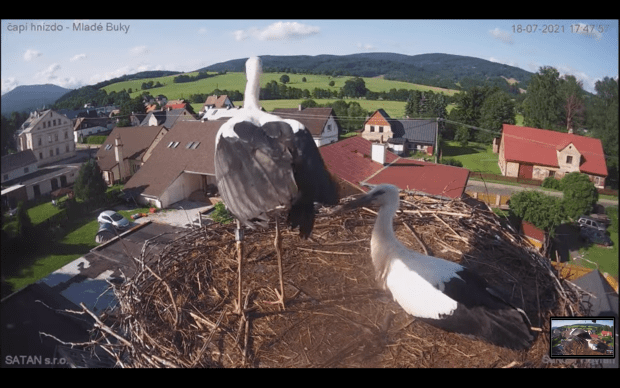
Here is the video so you can watch it.

The heat wave has taken more tolls on birds in the Pacific Northwest not just the Osprey chicks that literally roasted in the nests. Cooper’s Hawks have been jumping off the edge of the nests so they do not get cooked by the hot sun. This is a real tragedy in the making. Even the number of birds at my feeders is down. They spend the day in the myriad of vines in the shade of the house and the lilac bushes only coming out to drink and return to shade. The outside temperature near the water bowls reads 34 C. That is hotter than it is in the West Indies! So please put out water for the birds! Find old dishes and provide them with something. Thank you!

I hope that you are able to open this. If not you could Google ‘hawks jumping out of nests to avoid heat’. This is just so sad.

The streaming cams for many of the nests are being turned off as the season ends. Glaslyn will turn off the feed to Aran and Mrs G’s nest shortly as will Rutland Water on the Manton Bay Nest of Blue 33 and Maya. We will look forward to another season with them in the future. Blue 33 and Maya are a super Osprey couple – celebrities if you will allow me to call them that. They have been together since 2015 and have fledged 17 chicks. They raised a nest of four in 2019. That is almost unheard of and really takes a strong male to feed that many. I am impressed. I told someone if I came back as an Osprey in another life I wanted Blue 33 for my mate. He is incredible. They will return to the Rutland Manton nest in late March – usually within an hour of one another.

I expect many others will follow as it is costly to run the cameras. If you go to the camera and it is not functioning check the nest’s FB page. They have probably turned off the camera til the next season. But please remember that the breeding season is only beginning in Australia with the Peregrine Falcons, Port Lincoln Ospreys, and the WBSE.

NC0 up at the Loch of the Lowes nest is out fishing for her chicks. She is incredible. She spots the fish from the nest and dives down and gets it. Here is a very rough cut of a video of the two Loch of the Lowes chicks enjoying themselves.

I never thought I would say that a Golden Eagle nestling was cute but Zenit certainly is.

Zenit is really working on his wing flaps and from his crop it appears that he has had a feeding. That is good. I am just thinking how lucky Zenit is to be in a tree nest with shade.

Kindness is one of the cutest Bald Eagle nestlings I have ever seen! Here she is again trying to nibble around mom.

Oh, how beautiful. Kindness sitting next to Mom. Everyone thinks Kindness is a female because her Dad loves to feed her!

You are getting to be a big girl, Kindness. You are 52 days old today! More than halfway to fledge which will be around 89 days – the average for the Glacier Gardens nest. (The average in Alaska is 80 days).

Tiny Little has been in the nest every time I checked on her. A fish came in and 462 ate and ate. Then 464 came and couldn’t get the fish tail down. Tiny Little was playing with it when White YW brought in another fish. Tiny Little ignored it and dad left with the fish! Silly Tiny! Some dads will feed their chicks but White YW doesn’t seem to do this very often preferring that Blue 35 take on those duties almost exclusively. Tiny Little has yet to get confident in opening up a fish with a head.

White YW returned to the nest at 17:39 and Blue 35 flew in to feed Tiny Little. Tiny did not ignore that fish this time!!!!!!!

Oh, she just loves being fed by mum. Tiny Little eats for about forty minutes.

This kiddo should be stuffed.

At 21:00, Tiny Little and big sib 462 were cuddled up duckling style read to sleep.

It is not clear to me if Tiny Little ever did a second flight today. She was flapping those wings really hard and walking around the nest looking down for a long, long time. Often I had to leave only to return to find Tiny on the nest. Maybe someone saw her fly again?

Tiny tried everything but getting over on the middle left side of the nest and just going for it like she did when she fledged was something she did not do. There were a few good hovers. Fingers crossed for tomorrow. Need to get those wings strong and self-feeding down for migration.

The couple who saved the little osprey chick that fell into the river at the Putuxent Osprey Nest 2 were surprised that so many people from around the world watch their birds! I mentioned to them the need for an emergency number on the streaming cam. Fingers crossed! Thank you to everyone that sent them a thank you note. The chick is doing well.

Thank you for joining me for a quick look at a few nests on a Sunday evening. Take care. It is very hot in so many places or there are torrential rains and flooding. So where ever you are be careful.

Thank you to the following for their streaming cams where I took my screen shots: Glacier Gardens Park, Cumbrian Wildlife Trust and the Foulshaw Moss Osprey Nest, Mlade Buky White Stork Cam, Patuxent Park Osprey Cam 2, and Asociatia Wild Bucovino.

Saturday 17 July in Bird World

I promised some updates on Big Red, Arthur, and the Ks. Right up front I want to thank Suzanne Arnold Horning for allowing me to share her images of Cornell’s birds with all of you. She lives in Ithaca and once or twice a day she heads out with her family looking for the Ks. Thank you Suzanne!

This first series is from 16 July. Both of the Ks are on the corner of this unidentified building. K1 is on the left and K3 is on the right at the corner of the building.

Isn’ she gorgeous? This is K1, the mini-Big Red.

On the 15th, the Ks were hanging out on Weill.

K1 is doing the hawk walk! So cute.

She stops and looks for her brother, K3, who has just flown away.

K3 flew over to the middle of the hockey rink roof and landed! Good gracious.

Later, K3 rejoins his sister on Weill.

Meanwhile, where are Big Red and Arthur?

Big Red is on top of the Cornell Clock Tower.

Here’s a much closer look at Big Red.

And here is an image showing the position of Arthur and the Ks. The green arrow is where Arthur is on the light stands and the purple arrows points to the corner of the Weill Building where the two Ks are located.

Thanks Suzanne for the arrows and the images. It is reassuring to know that everyone is safe and sound.

There is some other news today. K1 caught her own prey. I know it happened but I do not have an image I can show you. Of course, no one knows if this is the first time or not but this is incredible. She is certainly related to Arthur who is like the stealth bomber of hunting! And Big Red is really good herself.

The Ks will be leaving their parents territory in August. They need to be able to fly well and hunt. As you can see Big Red and Arthur have now moved them around Weill and other areas farther from the nest. Soon they will have them hunting in the fields out by the Holey Cow Barns. Why holey and not holy you ask? The cows have clear tubes inserted in their sides so that the students in the Vet School can see what is happening inside the cow’s body. I have to admit the first time I heard this I was quite happy not to be there seeing it. But then wow – how would these students learn otherwise?

Suzanne Arnold Horning also went out to the Cornell Osprey nests and took some images. She believes that the nestlings are about to fledge!

There is only one Osprey nest on the Cornell Campus. It is located on the university athletic fields on a light tower at the soccer field. The adults there fish in Cayuga Lake, Beebee Lake, and Six Mile Creek. Those are within a few miles of the nest. The adults are Olin and Olive.

Off the Cornell Campus there were 38 Osprey nests around the Cayuga Lake Basin. While it isn’t a steadfast rule, most male Ospreys do return to the area of their natal nest. I am assuming then that when Olin showed up as a bachelor and began building a nest that he had hatched from one of the nests around Cayuga Lake several years earlier.

Olin would fly around the soccer field and people began to wonder if he was going to build a nest on one of the light towers. He made several attempts with sticks at the Game Farm Road soccer field. Olin did attract a female – Olive.

The nest you see in Suzanne Arnold Hornings’s images is the new nest that was built for Olive and Olin.

There are three little ospreys ready to fly in that nest this year.

Don’t you just hold your breath when they are hovering? I do! Wings everywhere. Looks like Olive needs to duck.

The Hornings and the Sedlaceks wrote a lovely article about the first year with Olin and Olive. There are some good images. I will attach it below this. Olin and Olive originally had a nest on a light and it was precarious. This is a wonderful nest that was constructed for this Osprey couple. Just look at it. They figured out the height, the measurements the nest should be and made sure that it was storm proof. Amazing.

Here is the link to the article. Please read it, it is lovely.

https://sites.google.com/site/cornellssurpriseospreys/

On the earlier part of the Ferris Akel Live Tour, there was a lovely juvenile Cooper’s Hawk. I think I have a couple of reasonable good screen shots to show you. What a lovely bird. We have Cooper’s Hawks that come to breed on the Canadian Prairies in the summer. They are protected under the Manitoba Wildlife Act of 1994.

Indeed, when I first encountered the hawk that comes to my garden, it was not clear if it was an adult Cooper’s or a Sharp-shinned. Turned out to be a Sharpie Adult, Northern. Like the Sharp-shinned, the Coopers are a medium sized Accipiter. These are the green-blue-grey (or celadon if you want to describe them like a pottery glaze) of a juvenile. The eyes of the adult male are red and they have a white breast/belly with ochre streaking, blue-grey hood and wings. You can see those red eyes in the image directly below.

“Cooper’s Hawk” by airboy123 is licensed under CC BY-NC-SA 2.0

This juvenile might look like a Red-tail Hawk if you only saw its back. Like my Sharpie and the Red-tails, the length of the wings attributes to the silent stealth manner in which they hunt. They live in forests and even in urban back gardens and they need to be able to turn quickly which they can also do with their wings and their medium size. You can see those celadon eyes of this juvenile in the image below.

Look at the image below. Do not peek at their blue Darvic rings! Which one of those birds is Tiny Little?

It might be a surprise to you. Tiny Little is the bigger chick at the back!

I watched Tiny Little for several hours. He is absolutely hilarious. For awhile I wondered if he had forgotten how to fly. He hovered, he flapped his wings and he really wanted to go but he couldn’t get it in forward gear. But never mind. White YW brought a fish on to the nest and thoughts of flying went right out the window. Tiny Little was up to his old tricks. What you are seeing in the image below is the second sibling that Tiny Little has tormented over the evening fish. BTW. Tiny Little had a huge breakfast! His MOD is to stare at the fish, then do some flapping, go back and stare and make the sibling nervous til they walk away and leave the fish. And guess what? He is really good at it.

Blue 464 gave up the fish! Because of his behaviour you will know which one is Tiny Little below but please look at the size and look at the other bird. This is the female, that big female that tormented Tiny Little, Blue 464. Unfortunately I took about 300 images of this nest today (maybe more). I have one of Tiny Little standing next to Blue 462, the male. 462 has the thinner longer legs of White YW. Tiny Little’s legs are stout like a female and she is a big bird.

Just like she wanted. Tiny Little gets a nice feeding by Blue 35. Indeed, I think the two of them shared almost half a fish after 464 and then 462 tried to self-feed.

Here is an earlier image of the Foulshaw Moss family minus Blue 464. White YW is on the front left. Then Blue 35 is next at the rim of the nest. Then don’t peek, which one is Tiny Little? If you said the one on the far right, you are correct. Now necklaces in themselves do not indicate a female but with those stout legs and her size. Well..

‘Silo’ chick on the Patuxent River Osprey Nest 2, the one who fell out of the nest into the water last evening, was up and moving about in the afternoon so everything seems alright there. Fabulous.

Thank you everyone for stopping in today to find out about the birds. It is great to have you with us.

Thank you to the following for their streaming cams where I took my screen shots or who gave me permission to use their images: Suzanne Arnold Horning for the images of Cornell’s Red tail Hawk family and the Osprey Nest of Olin and Olive, Ferris Akel Live Tour, Cumbrian Wildlife Trust and Foulshaw Moss Osprey Cam, and Patuxent River Osprey Cam 2.

Osprey chick falls off nest at Patuxent River Nest 2

Every Osprey Streaming Cam (or, for that matter, any wildlife streaming cam) should be required to post an emergency number. There should be one for normal daytime hours and an emergency number. Why?

This evening at 7:15 Eastern time, one of the three chicks at the Patuxent River Park Osprey Nest 2 fell into the water! These chicks cannot fly, and it is unclear to me how they are to float or swim after dropping from the height of the nest. This is the nest where an additional foster chick was placed just yesterday.

I was approached by a friend. ‘S,’ trying to find a number to call because the regular park office had just closed. So, here is the emergency Wildlife number for Maryland, everyone. 1-410-8888. This is actually a fish and game issue, but the nice young man on that emergency number put the calls through to them. Thank you! So this is a shout-out to all these streaming cams – many, many times, your citizen birders see an incident first. Put an emergency number there so they can call without wasting time and perhaps the animal’s life.

There is another issue at hand. What is the regulation for the size of an Osprey nest over water? We all know that nest sizes vary, but what should the size accommodate three growing, almost fledging chicks and two parents?

I urge you to write, e-mail, or phone the steaming cams that you watch and encourage them to include an emergency 24-hour number on their YouTube channel.

So very sorry to be bringing this news to you. I hope that there is a good ending to what well could be another horrible tragedy in this year’s ospreys. Thank you for caring.

Thank you to the Patuxent River Park Osprey Cam 2, where I took my screenshot, and to the young man at the Wildlife Emergency Services in Maryland who took my phone call seriously and acted.

Wednesday in Ospreyland

The camera at the Foulshaw Moss Osprey nest has been down or going on and off today so it has been hard to follow what has been happening on the nest. I was able to get some shots for you with two different fish. We know some of Tiny Little’s behaviour and this might help us predict what will happen. When Tiny Little is hungry he is going to be a pest until he gets some fish. In the afternoon on the nest, around 15:40, Tiny Little was on the nest with White YW and Blue 462.

Blue 462 has the fish in its beak. White YW is to the right of 462. Tiny Little is behind 462. You cannot see her.

Ah, there is 463 looking out off the nest maybe day dreaming of fledging? White YW is cleaning his beak and 462 is tucked into the fish. Tiny Little doesn’t seem interested.

Dad has left and Tiny Little continues to look off to the hills and mountains. Tiny Little is acting peculiar. At times he appears to be preening and at other times you might think he is hiding a small piece of fish. At any rate, whatever is going on, he does not seem hungry or interested at all in the fish that Blue 462 is eating.

Once he turned around and looked.

Then Tiny Little goes back to preening.

A fish was delivered for the late snack around 20:00. All three of the chicks are on the nest. It is so nice to see them together and to know they are all safe. 464 has the first go at the fish while 462 looks on anxiously.

Tiny Little is laying down duckling style just watching what is going on. Tiny Little learned a long time ago to let 464 finish before moving in. 462 is standing there, head down watching and waiting for their turn. Tiny Little has no problem getting up to try and eat or take the fish from 462 — but not 464!

462 could not have been that hungry. It ate and if you look carefully you will see that most of the fish is left on the nest to the left of the chick at the rear. 462 does a couple of beak swipes and flies off.

462 moves in to have some fish before Tiny Little can get there. Tiny is still playing duckling.

Tiny gets up and does the usual trying to distract the older sibling. He is now working on nest renovations and moving twigs about.

Then Tiny Little goes and stands by 462 next to the object of desire – that fish! They are both busy watching something. Maybe it is 462 flying about. I bet Tiny Little is hoping it is Blue 35 coming to take that fish and feed her like yesterday.

They both follow whoever is flying for a long time their heads and eyes moving in unison for the most part.

Tiny does a pretty fantastic ‘ps’ at 20:18.

And then he moves right back over by Blue 462 eyeing that fish.

Sadly, I cannot confirm what happened. But if yesterday was any indication, Tiny Little is eventually going to get some of that fish. Maybe Blue 35 will fly in and take over and feed Tiny Little or will Tiny Little get the fish herself? Fingers crossed the camera comes on again to solve the mystery.

At the Dyfi Osprey Nest, Idris was on his perch while Telyn was feeding Ystwyth on the nest.

Later both Dysynni and Ystwyth were on the nest together. Aren’t they adorable? Ystwyth should be fledging soon.

LM 2 was on the nest alone at Loch of the Lowes earlier. Is she watching her mother or Laddie or NC0? That is truly a gorgeous place to have an Osprey nest.

My Scottish friends can correct me but I am thinking that there is not a lot of fishing equipment debris to get into the Osprey nest making the nests in the UK safer than most in North America where the lakes and rivers have many power boats and weekend fishers.

Over at Clywedog, Only Bob loves to eat. Telyn and Only Bob are looking up to the skies at 17:13.

At 17:13:59 Dylan lands on the nest with dinner for the family.

Only Bob moves up so that he can watch how Dad eats the head of the fish.

Only Bob also knows that Dad loves to feed his chick! Dylan spends some time feeding Only Bob before turning it over to Seren who is waiting patiently in the wings. She would like some fish, too.

Only Bob waits for mom to have a few bites before she feeds the rest to him. You are really a very ‘big’ boy, Only Bob.

If you have been watching the nest of Iiris and Ivo in Estonia, their first hatch fledged. Here is that moment:

And with all the attention on Tiny Little, these three beauties of Richmond and Rosie, have all fledged. Aren’t they gorgeous. Richmond could probably handle a nest of four. Very few Osprey males can.

Many of you will have read that when the three chicks were banded, the measurements indicated that they were all boys. But…for the very first time in the history of the nest, the measurements were wrong. DNA testing shows that Poppy ZP and VZ Lupine are females and WR Sage is the only boy. Goodness they were wrong.

Rosie migrates but Richmond doesn’t. He stays around the San Francisco Bay area all year round. He will take very good care of these babies once Rosie leaves and he will be waiting for Rosie to return around Valentine’s Day!

Here is a really cute video of the two girls doing a tug of war with a fish. This was yesterday.

Ah, Legacy at the Fortis Red Deer Nest is snuggling up with mom to keep cool as she serves as a mombrella from the sun. That sky is so hazy from all of the fires. It travels all the way – the smoke – to Manitoba and can make breathing difficult. I wonder what impact the smoke has on these chicks?

It looks like the smoke from the wild fires is also making it hazy at the Fortis Exshaw Nest. Little ones are also trying to get in some of the shade provided by mom.

It is such a contrast to see the Osprey nests in Alberta, Montana, Florida, and California with those in the United Kingdom. It has given me a lot of pause to think about the trash that makes its way into the Osprey nests such as the baling twine that has been killing the chicks up in Montana.

I could not get back on the Cumbria Wildlife Osprey cam but Blue 35 will not let Tiny Little go to bed without some fish. He was so full in the middle of the afternoon that he wasn’t wanting any so maybe he really has had enough already. Either way he will be fine. Growing like a bad weed that one – and surely with those big sturdy legs he is a she.

Thank you for joining me. I am in the midst of planning a trip to Overflowing River in Manitoba to go and see the Ospreys that come to our province to breed during the summer. There will be lots of images for you I hope – but this is not happening for a couple of weeks. Take care everyone. See you soon.

Thank you to the following for their streaming cams where I took my screen shots: SF Bay Ospreys and Golden Gate Audubon, Scottish Wildlife Trust and Friends of Loch of the Lowes, Dyfi Osprey Project, CarnyX Wild and the Clywedog Osprey Nest, Cumbria Wildlife Trust and the Foulshaw Moss Osprey Nest, Fortis Alberta Red Deer Osprey Cam, and Fortis Alberta Exshaw Osprey Cam.

Late Friday and early Saturday in Ospreyland

There is news in Ospreyland, some good and some not so good. I am going to start with all of the good news.

Those who follow and read about Ospreys know that there are certain ‘truths’ that are held dear. These ‘truths’ get passed down through books, Websites, and conversations. One of those is that a male fledgling will ‘always’ return to its natal nest area on its first migration ‘home’. The question is how true is that statement? Is it 90% true or 80% or with all of the unringed birds is it even 50% true? There are always exceptions! It was reported today that Rutland’s Maya and Blue 33’s 2015 male chick S2 has been breeding in the Biesborch National Park in The Netherlands for the past two years. In 2020 S2 and his mate fledged three chicks and in 2021 they have two in the nest. Fabulous news.

Male 022 has been courting CJ7 since he first returned as a two year old from his first migration. Initially, this young male wasn’t quite sure of the ‘process’. What he didn’t know he made up for in enthusiasm. Could he hear everyone shouting “Bring her a fish!” Sometimes he would bring a fish but he would not share. Sometimes he shared. Meanwhile they were mating all over Poole Harbour – seriously, they were. 022 has certainly grown into understanding his role. He has been working on the nest with CJ7 and today he brought her a fish and gave it to her to enjoy – a gift. How sweet. He has done a sky dance for her and now we watch and then we will wait for next spring when everyone hopes that these two will be a couple and raise some chicks. 022’s sky dance was the first seen in 200 years in Poole Harbour. Oh, please let this couple have a nest of healthy chicks next year that fledge! Poole Harbour might announce a holiday in their honour.

The eldest chick has fledged at Foulshaw Moss, Blue 464. The others look surprised! Who will be next? That special moment was caught here on a short video:

Tiny Little has been doing a lot of wingersizing. Will he be next? He is doing a great job and I know that he is going to grow up and be as strong and fierce as Z1, Tegin.

And Tiny Little is clever, like Tiny Tot in the Achieva Nest. Today, he sniffed about and found a piece of leftover fish that the other siblings had forgotten. Tiny Little had a nice little self-feed over in that front corner. He is a survivor.

You can see that he is still Tiny but not as tiny as he once was! What a little cutie. In addition, his eyes are fine. There were some early issues, perhaps from one of the older siblings pecking him about but all seems fine now. Tiny Little is in the clown feet stage!

White YW brought in a nice fish for Blue 35 for breakfast. Guess who was first in line? You got that right – Tiny Little! Go Tiny Little, Go!

Everyone ate and had nice crops and Mom even got the fish tail.

At Loch Arkaig, there appears to be a new couple working on bonding. YP and Blue 152 have been bringing in moss and sticks to add to what Louis did in the early spring while he waited for Aila. It will be grand to have a couple in this nest next year although I have to admit that I wish it were Louis and the new Mrs Louis.

After the heat and the storms the two Osprey nests in Albert, Exshaw at Canmore and the nest at Red Deer appear to be doing well.

This is Exshaw this morning. It is a sunny dry day and the chicks are sleeping after a 5:35 am breakfast.

Legacy is doing fine, growing like a bad garden weed, down in Red Deer:

Good news coming in from Loch of the Lowes is that the first fledgling has returned to the nest and taken its second flight with mom, NC0. The first fledgling at Foulshaw Moss, has also returned to the nest. Well done!

Now for some of the sadness. The concern in Canada’s West is the growing number of wild fires active in the province of British Columbia. Last week 330 were added to a growing list of over 780 fires. The impact on wildlife now and in the future is alarming not counting, of course, the human and property cost. The province desperately needs rain and lots of it.

News has come to me from my friend, ‘T’ that goshawks have taken the lives of two banded Osprey chicks in a single Latvian nest and another chick at a nest in Spain. This is so very, very sad. The chicks were big – already ringed – in earshot of fledging.

“Goshawk” by Andy Morffew is licensed under CC BY 2.0

‘L’ has reported that a fledgling Bald Eagle was killed when it landed on a power line in Dayton, Ohio. This is so very sad because we have known for decades the problems with power lines. There could be a silver lining to this story – the community has spoken to the local power company and they seem willing to do something to their poles so that these tragedies will not happen again. Let us hope that they work fast. There are other fledglings in that nest! Indeed, every power line needs to be ‘bird friendly’. This should be standard practice.

Thank you for joining me on a sunny and going to be crispy hot Sunday on the Canadian Prairies. The news in my garden is curious. After the extreme heat wave, the number of birds at the feeders seems to be less. Strange, however, is the now regular appearance of a dozen or more Blue Jays. We always had 3. Mr Crow and family are not happy about the Blue Jays but they won’t enter the yard to try and escort them away. Perhaps the number of Blue Jays has driven the other birds away — except for Mr Woodpecker and baby. The tiny Downy fledgling was here yesterday! They are always so quick and gone by the time I have grabbed my camera.

Take care everyone. I hope to have news of Big Red, Arthur and the Ks this evening. Stay safe, stay cool. See you soon.

Thank you to the following for their streaming cams where I get my screen shots: Fortis Albert Red Deer Osprey Nest, Fortis Albert Exshaw Osprey Nest, Cumbria Wildlife Trust and Foulshaw Moss Osprey Nest, and the Scottish Wildlife Trust and Friends of Loch of the Lowes.

What is gorgeous in Ospreyland?

This entire day has been ‘weird’. It started with only four hours sleep after checking on Tiny Tot’s nest all night. I have no idea what I was thinking. Tiny wouldn’t have flown from wherever she was just to be bounced about, would she?

And then there was the intruder on the nest. This intruder is just giving me a headache. I think I want Tiny Tot to show up on that nest so bad that I forget that there have been a number of visitors to the nest, several that Tiny Tot fought off valiantly. Still there is some kind of family resemblance.

This bird is still bugging me. It is nearly 4:30 pm. I know that I took a screen shot similar to the top one where you could see the white ‘V’ and the scalloped white of the crest making the heart. Tiny Tot had that. This bird has the thick short legs of Tiny and the sweep of the feathers is long BUT it is not elegant like Tiny Tot. The eyes are not the same. But then who knows what your eyes would look like after a hurricane.

This picture of Tiny was taken on 4 July the day before she ‘seemingly’ left the nest permanently for broader horizons. You will notice the white line above the wing is the same. Each of the birds have some dark on their legs, a little strip like a band but not a band.

And this is Tiny mantling her fish on 4 July.

Sadly, these birds are not banded and we only have images to compare that aren’t always sharp and from the same angle. What do you think?

Now, I think every bird is extraordinarily beautiful, but some more so than others. Today, the Dyfi Osprey Project posted an image taken by the individual who ringed two Ospreys in a nest in the Lake District in Cumbria England. They are females, Blue 460 and Blue 461. I took a deep breath and knew that I had to redefine what ‘gorgeous’ means when looking at an Osprey chick.

These are Monty and Glesni’s grandchildren. Their father is Merin. He hatched at Dyfi in 2015. They have Monty’s piercing orange eyes! Gosh I hope they do not lose them to become yellow. Look at the crest with the peach, the soft little white beards. I will be staring at these two beauties for days.

There are reams of files, both analog and digital, tracking UK Ospreys. And this again shows why it is important to get these birds banded. It is now known that at least four of Monty and Glesni’s chicks have returned to successfully breed. Of course, there could well be others. There is Aeron (Z2) who has been chasing intruders away from his PC nest at Glaslyn, then there is Tegid (Z1), one of my third hatch wonder children, who has a nest in Snowdonia, and Clarach in Aberfoyle, Scotland. Gosh, I would love to get a close look at the chicks of Tegid and Aeron!

Mama and Legacy were both asleep when I checked in at the Fortis Red Deer Osprey Nest.

There are both parents on the nest with Legacy yesterday. She is really growing now that the hot weather is gone.

There has been a lot of bad weather going around Alberta and there are dark clouds still around the Fortis Osprey nest at Canmore today. You can just see the two Bobs if you squint. Everything in the nests seems stabilized after a turbulent period of heat and storms. Warm wishes that it stays this way.

Here is a quick check in of a few of the nests. The Two Bobs at Rutland Manton Bay continue to perfect their flying skills after fledging. The Only Bob in the Clywedog Nest in Wales has been doing some wingersizes and the Two Bobs up at Loch of the Lowes are starting to think they might like to hover and fly. There could be a number of fledges coming up in the nest week. Mrs G has been catching fish and so has Aran. The overzealous two year old, Blue 022 has been bonding some more with CJ7 at the Poole Harbour Nest. If they both return from migration it will be great to see some chicks on that nest – the first chicks in 200 years born in Poole Harbour. Will that be the headline? The eldest fledgling of Big Red and Arthur, K1, the Red tail hawks at Cornell, probably caught her first prey item today – a little vole – witnessed by the Hornings. K3 enjoyed observing! Those two are excellent fliers. Can’t wait to take another tour with Ferris Akel to see how they are doing. Will be sure to let you know.

My friend, ‘R’ knows more about Albatross and Petrels than I will ever know. She is curious about the Goony Albatross that ended up in Bempton Cliffs in the UK. He should be in the South Atlantic. Maybe he thinks he is a yellow headed Short-tailed Albatross of the North Pacific? or a gannet? ‘R’ and I will try and put our heads around this one over the coming week. Here is the story on the BBC:

https://www.bbc.com/news/uk-england-humber-57683184

And what is this about the fish being addicted to meth? What happens to the birds that eat the fish? I will be following up on that along with a tribute to Tiny Tot and a story of a Sulphur-Crested Cockatoo in a Renaissance painting. Those are coming up this week.

Thank you for joining me today. Have a really enjoyable rest of the day no matter where you are.

Thank you to the following for their streaming cams where I grabbed my screen shots: Fortis Alberta Red Deer, Fortis Alberta Exshaw, and the Achieva Credit Union. I also want to thank the Dyfi Osprey FB Page where I took the screen shot of Merin’s chicks.

A hurricane, two nests, and falcons

Elsa was a category 1 hurricane when she bore down on the Southwest Florida coast last evening. The two chicks on the Sarasota Bay Osprey Nest had their talons anchored, riding out the gusts and the rain. This was the pair of them at 23:08 Tuesday, 6 July.

Whew! No chicks blown off the nest just a good soaking.

As the gusts calmed some in Sarasota, they were picking up at the Achieva Osprey Nest in St Petersburg. It is nearly midnight. What is surprising are the number of cars on the streets and even people walking. The nest perch weaves back and forth. Oh, I am ever so glad that Tiny Tot is not on this nest! Indeed, I can see why the birds might choose to migrate north for the summer to get away from hurricane season.

All of this made all of the aunties and uncles relatively nervous. We can’t do anything but watch which is precisely the problem! And none of us knows what kind of damage the storm will do.

Instead of drinking coffee and eating way too much chocolate, I turned my mind to Peregrine Falcons.

“Peregrine Falcon” by Bill Gracey 26 Million Views is licensed under CC BY-NC-ND 2.0

Peregrine Falcons. The fastest animal on the planet. Speeds up to 390 kph or 243 mph. They are flying killing machines attacking their prey in the air instead of on land. They are magnificent creatures who appear in art, literature, culture, and sport.

“Peregrine Falcon” by DaveInman is licensed under CC BY-NC-ND 2.0

Falcons appear on the shoulders of the terracotta figures, the haniwa, on the Kofun (mound tombs) in Japan from 300-555 CE. These were royal tombs. The haniwa were not placed on the inside of the tomb but, rather, on the top of the mound as if in a ceremonial parade. They served many functions. One of those was utilitarian – they kept the soil from eroding as they would have their bottom portion pushed into the the ground.

Using Google Earth, satellite images show you the distinctive ‘keyhole’ design of these ancient burial sites. Forests now cover the sites but originally, they would have been cleared. These hollow clay figures covered the surface. Were they there to protect the deceased? did they tell about the status of their life on earth? No written records exist but we know that over time simple clay cylinders developed into very elaborate human and animal shapes like the falconer, above.

Falconry was known to be practised by the aristocracy in Japan. Taka is the Japanese word for falcon. Taka means strength and bravery. It is no wonder that the art of falconry, takagari, was adopted by the warrior class, the samurai.

The military class ruled Japan during the Edo era. During the Tokugawa Shogunate, 1603-1858, local war lords (daimyo) and the Shogun hired painters to depict the falcons on crests, screens, textiles such as boy’s kimono, in hangings as well as in single sheets or albums.

The image below is one of many woodblock prints depicting falcons. This one is Falcons with nestlings in a pine tree at sunrise by Utagawa Kuniyoshi.

Falconry is still practiced in Japan today. Here is a lovely short video about a woman who desired to take up the sport.

As it happens, I have just finished reading Queen of the Sky. That is probably why falcons are on my mind. In fact, this beautiful little book is sitting next to me. The illustrations are gorgeous.

What a marvellous little book written and illustrated by Jackie Morris. It is the story of Ffion Rees’s rescue of a Peregrine Falcon off the coast of Ramsay Island. It might be easy for someone to think, on the surface, that it is a condensed version of H is for Hawk by Helen MacDonald. If so, they would be missing the book’s heart. It is about love. “Come and see what is in my kitchen” Ffion urges Jackie. It is a story that weaves the lives of the women and the bird – love, loss, and friendship – together in a book that you will not wish to set down. Morris draws you in – you can smell the sea and the land, you can hear the gulls and you want to escape into the wild that is Ramsay Island. Required with the book are at least half a dozen tissues.

Morris tells us that the Peregrine Falcons hatched on Ramsay’s Islands are believed to be the fastest and most fierce in all of the United Kingdom. The kings of England kept many birds from Ramsay.

As a child do you recall the nursery rhyme about the Four and Twenty Blackbirds baked in a pie? Can you conjure that image? Like the one in the old coloured drawing below?

“King William IV sits with knife and fork at the ready before a pie containing blackbirds served to him by Lord Melbourne. Coloured lithograph by H.B. (John Doyle), 1836.” is licensed under CC BY 4.0

But did you know that King Henry II (1133-1189), known as Henry the Falconer, allowed his noblemen to bring their falcons with them whenever there was a feast? And adding to that, did you know that Henry’s chefs made special pies full of live songbirds (they could not have baked them!) and when they were opened the birds flew out as fast as they could while the owners took the hoods off the falcons?

Hoods protect the eyes of the falcon and help to keep it calm. They can very elaborate. This one is in the collection of the Victoria & Albert Museum in London, England. It dates from the early 17th century and is made of leather which has been incised and gilded. There is silk velvet embroidery with silver thread along with silver breads and a tuft. It is typical of the type of hoods used in Europe at the time. Isn’t it gorgeous?

@Victoria and Albert Museum, London

Can you see it in those cold stone castles with their long wooden tables, pies full of birds flying and thrashing about being chased by stealth fliers? Plucked feathers flying all about and landing in the food?

Falcons raise their eyases in scrape boxes or on the sides of cliffs or in caves. The scrape are shallow and contain gravel. It is believed that the falcons developed this method of raising their chicks to keep away the pests and diseases associated with twig nests.

There are several falcon scrapes that have streaming cams. One of the most famous couples in the United States is Annie and Grinnell who have their scrape box in the Campanile of the University of California at Berkeley. They have just fledged three boys – Fauci, Kaknu, and Wek-Wek. At this time of year, if you want to watch falcons hatch and fledge, you have to go to the falcon streaming cams in the Southern Hemisphere. Two are the CBD Peregrine Falcons otherwise known as the Collins Street Falcons in Melbourne, Australia and the scrape box of Xavier and Diamond on top of the water tower on the campus of Charles Sturt University in Orange, Australia. The CBD Peregrine Falcon Cam is not up and running yet. I will let you know when it is.

Here is the link to the live streaming cam with Diamond, Xavier, and their nine-month old son, Izzi, who refuses to leave home!

I am very happy to say that the two chicks on the Sarasota Bay Osprey Nest survived their very first hurricane. Here they are at 10 am, Wednesday, 7 July.

Tiny Tot’s nest held up perfectly well, too. No one was on it but one of the adult visitors this morning for a bit. We all assume that the impact of the storm had no harmful effects on our beloved Osprey family in St. Petersburg.

The question of who this bird is has driven me a little nuts. The bird has the white ‘V’ and the rounded white heart shape that Tiny Tot has. It has the black patch on the rear of the head that Tiny has. It has Tiny’s short thick legs. But, this is an adult!

Thank you for joining me today. Many of us are quite tired having stayed up to ride the hurricane out. It is such a relief that it has passed. If today’s blog is a little disconnected – that was the state of my mind last night. It will all pass (we hope). Take care all!

Thank you to the following for their streaming cams where I took my screen images: The Bay Sarasota Osprey Cam and the Achieva Credit Union in St Petersburg, Florida.

A quick look at Osprey chicks in care — and is it really goodbye, Tiny?

You may have heard that osprey chicks do not do well if they are taken from the nest and placed into care. But is this true? Last year, anyone watching the Port Lincoln Osprey Nest knew that Little Tapps was not going to survive. Solly was too big and too aggressive and when the middle chick, DEW, began to turn on the little one and keep it from eating it was not ‘if’ but ‘when’ would Tapps die. It was emotionally devastating. How many wanted to toss a cloth cover over the camera and at least try and rescue that baby?

In less than a week, news of two interventions came to my desk and thanks to my friend, “T”, two others last evening. Wonder how many more there were? There was at least one Osprey chick taken into care due to the extreme heat in the British Columbia interior. It had fallen out of its nest and bystanders notified SORCO, the only raptor rehabilitation centre in the area at Oliver. They retrieved the three week old chick immediately hydrating it. The staff said that Ospreys can become stressed when in care but, this one is so young they anticipate that it will adapt.

On 3 July an Osprey nest caught on fire when the transformer next to the nest blew. The parents were able to escape, one chick perished, and the other chick was taken into care. The chick was suffering from severe smoke inhalation and some burns from the fire. That precious little one is on oxygen and pain relief therapy. It was initially given high levels of oxygen using a mask but now it is an oxygen incubator. The chick is resting comfortably at the Raptor Tales Rescue in Wareham, MA. Its condition is ‘guarded’.

Sweet little baby. That had to be extremely scary with all the smoke, fire, and noise.

Many other Osprey chicks have been orphaned and placed in nests with foster parents. It is surprising how often this occurs with no ill effects. We saw this recently in Finland and near St Petersburg when another Osprey nest fell down on 29 April. The parents left and all of the chicks died but one. Baby Foster was placed in a nest where there was only one other baby. The parents accepted the new chick immediately. Baby Foster fledged on 13 June. The events with Baby Foster and his new family were caught on video by one of St Petersburg’s local photographers, Kathleen Finnerty.

It is midnight in St Petersburg, Florida. All eyes are on the nest of Tiny Tot and right now, it is calm but Tiny Tot is not there. She came in during the early morning of 5 July. Was she scared by fireworks?

It has been 100 years since a major storm hit the Tampa area. If you look carefully, you will see that St Petersburg is right at the entrance to Tampa Bay.

Tiny Tot has not been on the nest since 9am on the 5th of July. She has not come for a fish and to my knowledge, Jack has not brought any fish to the nest for her since 4 July when there were at least two fish brought in during the early evening. Jack knows where Tiny is or he would be on the nest checking for her. Did the fireworks scare her on her way? did she get tired of chasing off intruders? or did her instincts kick in and tell her it was time to leave the nest?

Here are some images of Tiny over the last few months. They are in no particular order and I have left all the lines and date stamps for you. I will, one day this week, put together a comprehensive album of this miraculous little one – a third hatch that was tough, that survived, and who will do well. What a privilege it was to watch this clever little one become a big strong juvenile.

Tiny, thank you for staying around as long as you did! Stay safe out there. Enjoy the fishing. Have an extraordinary life. You deserve it.

Thank you for joining me today. Here is the model of the storm that is set to hit the Tampa area today. We will be watching and sending warm thoughts to all the nests in that area. Be safe little ones! The recent revised forecast is for Elsa to be a cat 1 hurricane hitting the Tampa area around 11pm tonight. Prayers for all the birds.

Thank you to the Achieva Credit Union for the streaming cam where I took my screen shots of Tiny Tot and her family. Many thanks also to Raptor Tales Rescue for the images on their FB page that I used to show osprey chicks in care.

Monday Nest Hopping – to keep my mind off Elsa

There were some lovely letters in my inbox today – articles and quesions – to keep me busy and to try and curtail me from checking on Tropical Storm Elsa every half hour. My friend Wicky – lover of books and hawks as long as they leave her songbirds alone – pointed my noise to an article in The New York Times by Margaret Renkl. Renkl is the author of Late Migrations, a fabulous book that I pick up often to simply read a single entry. Today in “Hawk. Lizard. Mole. Human”, Renkl speaks to the garden that she can see out her windows. She says, “How lucky I am to live in a home with windows. Against all odds – the encroachments of construction companies and lawn services and exterminators – those windows still open onto a world that stubbornly insists on remaining wild”.

Here is the link. I hope that you can open it. Renkl is a wonderful writer always leaving me appreciative of her love of our feathered friends and – others. Thank you, Wicky.

Like Renkl, I am grateful for my windows and astonished at what happens in a tiny bit of paradise inside the heat and concrete of a big and growing city. The birds have returned to the garden after the extreme heat. It is simply glorious seeing them splash around in the baths, having drinks, and sneaking off with some birdseed that looks like trail mix. The Blue Jays love the cashews and the berries and have gone through the large berry-insect-suet cylinder in a few days. There seem to be fewer insects every year. Is it the spraying of the caterpillars who eat the leaves off the trees? the greening of the lawns so that they look like they came out of a magazine, or the opposite where concrete is replacing grass? What are the birds to eat? Thankfully a growing number of people are willing to put the time and effort into helping them survive.

A lovely note came in from Finland, also, telling me about the ten Osprey nests. Thank you Tiny Toefan! I admit to not knowing enough about the Finnish nests but tonight while that storm is churning through the Gulf of Mexico towards Florida I am going to begin my education on these Ospreys. I want to learn more about them so I am just not an occasional observer. Tiny Toefan says that their Ospreys had a bit of a sad year. The attack of the Raven at the Satakunta Nest and the death of Alma spread quickly within the community of Osprey Lovers around the world. Our hearts broke for that dear family. Intruders, lack of food, and weather-related events have wrecked havoc with all the Ospreys this year.

Speaking of intruders, the UK nests are having issues with the returning two year old juveniles. They are all excited and flying about while the adults are trying to take care of their chicks that will soon be fledging. Today there were three intruders at the Glaslyn nest. All hatched at the Dyfi Nest. Z2 (Aeron, 2017) has chicks on the PC nest with 01 at Glaslyn. He quickly moved Hesgyn KA3 (2019) and Dinas KS6 (2018) along before they could do any lasting damage. Here is a video clip of all that action:

There were intruders at Foulshaw Moss Nest also. While watching Tiny Little get ready to stand up, in a quarter of a blink he was flat down like a pancake. For a moment I thought he had broken his leg – but, no – somewhere there were unwanted guests.

Did the adults teach them to do this? or is this 65 million year old instinct at work?

My friend, “R” also wrote today to tell me of another bird in the wrong place. It begs to ask how many instances of birds being where they shouldn’t are there? There is a Stellar’s Eagle in New Brunswick, Canada that should be in Russia and there were definitely birds out of location in Toronto earlier in the season.

The bird in England is a beautiful Black-browned Albatross. It should not be in the Northern Hemisphere! Imagine what a sight it was for those in Britain. I will follow up later on this story with more information. Thank you, “R”.

Here is the article. If it won’t open, try to copy and paste the URL in your browser. What in the world is this bird doing in England!?

https://www.thisisthecoast.co.uk/news/local-news/rare-albatross-sighting-on-yorkshire-coast/?fbclid=IwAR2lu8erfI5wv_J-I0gGdUvcJ2YM35wipWkXornJDTVtlAdiUgMs372NWRQ

In a swing through the Osprey nests, Tiny Tot is not on the Achieva Osprey Nest. She came in during the night and then left. The fireworks for the 4th must have been really disturbing to all the Osprey in that area. I am going to hope that Tiny Tot is down by the water catching fish to hold her until Elsa passes. She might also be looking for a place to hunker down til the storm passes. Again, because she is a fish eater and not an insect or nectar eater, Tiny Tot should be alright. It is the wind and flying debris if it gets bad. Well, it is worrisome. We can all image a hundred scenarios. I continue to run Laura Culley’s advice in my head – “worrying is nothing more than establishing an outcome in your mind before it happens. Don’t do it!” Need to put that mantra on repeat. Culley would tell me that these birds are much smarter than we are.

Electra has a huge fish that she is eating on the Cowlitz PUD Nest. It is good to see her eating well. She needs to regain her strength. On the other hand, it also makes me very sad. It would have been grand if that size of a fish came on that nest when the little tykes were alive. It might have made all the difference.

Give a shout out to the linemen of Fortis Alberta and to the streaming cam watchers who notified them that Legacy was tangled in monofilament line. They got there in time and saved her life. Legacy was so wound up in the line that she could not even lift her head to eat – and this was during the heat wave. She needed that hydration! The linemen responded to the call quickly. They removed the fishing line as well as the two dead chicks from the nest. Today, just look at her. Legacy is chowing down on a nice fish on the Fortis Red Deer Nest. There are still dark clouds but the rain has stopped and the nest seems to be drying out. That said the forecast is calling for rain tomorrow. The temperatures are in the 17 degree C range, a far cry from the extreme 40s C.

The two chicks on the Fortis Exshaw Nest at Canmore, Alberta seem to be doing alright, also. They are both being fed by mom. The skies are the same as those at Red Deer but they are calling for a thunderstorm tonight and rain tomorrow at the nest. Oh, stay dry little ones!

There seems to be a constant stream of intruders on the Hellgate Osprey Nest of Iris. It is prime real estate right next to the river and the fishing continues, despite the heat and low water, to be good for Iris. Louis has come and helped ward off the Dunrovin juveniles looking for a nest but sometimes, Iris has had to fend for herself The indignity of it all!

There are not enough good trees for the Ospreys and the placement of platforms has to be carefully evaluated because of all the territorial issues. It is confusing. On the one hand old timers tell me that Ospreys do not have territories but if you watch, Louis certainly claims this nest and the one at the baseball park as his even if he fishes in the same river as the other Ospreys. As more male chicks survive and return, careful planning will need to be undertaken for nests – if the water in the rivers and the fish stay sufficient to support a growing population of these fish eagles.

The predictions for Elsa are becoming more worrisome. Each change in the model sees it bearing down more heavily along that Southwest coast of Florida including Fort Myers up to St Petersburg. Please send any warm wishes you have that the system pulls more to the West as it heads towards Florida after Cuba.

Thank you for joining me today. Stay safe wherever you are and thank you to everyone who writes to me. I do try and get to answer your letters as quickly as I can and please know that I appreciate them. I learn something new every day from you! And thank you to all of you for simply loving the birds and doing what you can to make their lives better.

Thank you to the following for their streaming cams where I grab my screen shots: Fortis Exshaw, Fortis Alberta, and the Cumbria Wildlife Trust and the Foulshaw Moss Osprey Cam.

Late Sunday and early Monday in Bird World

It is raining this morning. The three juvenile Ospreys at the Foulshaw Moss Nest are drenched this morning. Blue 35 left a piece of fish on the nest. Wonder if she is watching for self-feeding action? And will she make certain that Little Tiny Bob is fed?

This amazing and uplifting story of how an entire village intervened when Mama Stork was electrocuted. They fed the chicks and Father Stork three times a day until Father Stork could look after the storklings on his own. Now just look at them! Just puts a smile on your face – it always does when help is allowed! At the Mlade Buky White Stork nest, fledging will occur in 1-2 weeks.

There is also good news coming out of the Fortis Alberta Red Deer Osprey Nest. It was originally feared that all three chicks would perish during the recent extreme heatwave hitting the area, along with a series of thunderstorms and torrential rain. But there is one surviving chick! It just feels like a miracle.

As we know, it can be tricky at this point in a chick’s life. Wet weather can also cause hypothermia. That is what was seen at the Urdaibai Biosphere Park Osprey’s nest that took the lives of the two seemingly healthy chicks. Keep sending warm wishes toward Red Deer for this sweet little one.

And poor Tiny Tot. She returned to the nest after dark, probably from all the loud fireworks! Wonder when the celebrations will shift to fireworks that do not make noise? Seriously, all of the animals suffer, not just the birds. Family pets are susceptible to loud booms. Tiny isn’t on the nest as I write this, been and gone. Tiny, I hope you are eating some fish where we can’t see you.

We continue to watch Elsa. Already the local weather reports for St Petersburg, Florida, are calling for rain most of the beginning of the week. I knew that Tiny Tot had one feeding, but one of my readers, ‘S,’ notes that he actually had two fish fairly close together late in the evening. That is fantastic! Thanks, Jack! Keep it up. The news this morning is that Elsa wants to make landfall in the Tampa Bay Area. A state of emergency has been declared in South Florida, and they are saying that it is the heavy rain that is the problem. Tiny Tot, Harriet, and M15 in Fort Myers, the Captiva Nest are all within the area that this storm seems intent on landing. Send warm, positive energy their way.

https://www.cbsnews.com/news/tropical-storm-elsa-nears-cuba-worries-florida

Thanks for joining me this morning. This is a concise report. I will be checking on the storm throughout the day and any other news in Bird World. Take care all.

Thank you to the following for their streaming cams where I took my screenshots: Achieva Osprey, Fortis Alberta, Mlady Burky, and Cumbria Wildlife.