Early Friday in Bird World

7 October 2022

Good Morning Everyone,

Two Juncos, 1 Grey Squirrel – one of Dyson’s little ones – and a single Blue Jay are up and feeding this morning. It is -2 degrees C. It is now time to seriously begin finding the puffer coat, the Alpaca boot socks and scarf! The Anorak is no longer enough for a walk at the nature centre! Burrrrrrr.

This is also the beginning of the Thanksgiving long weekend in Canada. The second Monday in October marks the end of the harvest and it is the fields with the grain left from the Combine Harvesters and Reapers that feed all the Canada and Cackling geese, Sandhill Cranes, and all the other birds landing in them during migration.

Making News:

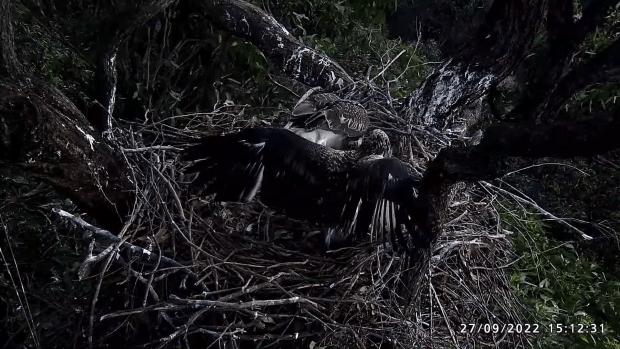
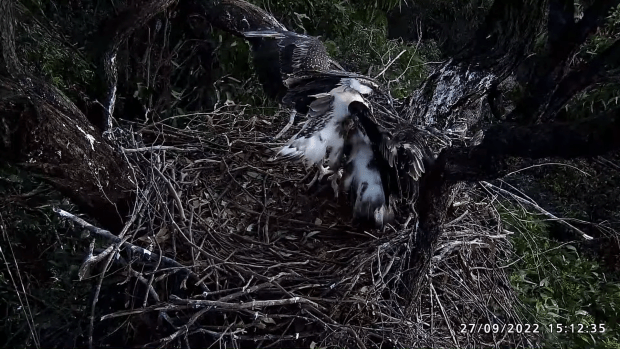
Lori Covert, the owner of the property where the Captiva Osprey platform and Bald Eagle nest are put out an announcement for everyone today.

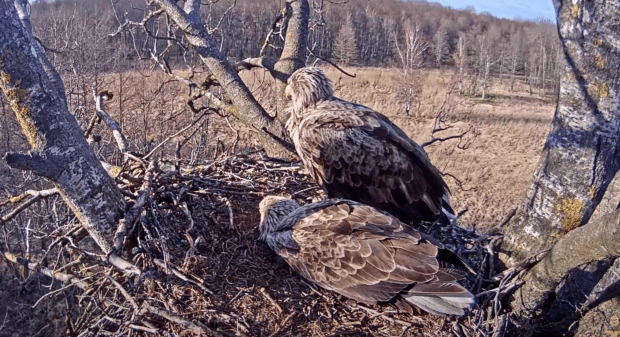
Harriet and M15’s rebuilding efforts continue to make the news in Fort Myers. The eagles are busy and they are inspiring everyone to move forward! I love how all of the raptors live in the moment. It is truly special to see them surviving the hurricane, checking the nest, deciding what to do, and then gathering up the materials to rebuild.

The correlation between factory farming and bird flu is being discussed more openly.

https://www.theguardian.com/environment/2022/oct/06/bird-flu-an-urgent-warning-to-move-away-from-factory-farming

The article above comes from the most recent publication by Thijs Kuiken in Science.

https://www.science.org/doi/10.1126/science.adf0956

We need to really examine our relationship with these industrial farming methods and what this means.

Nest News:

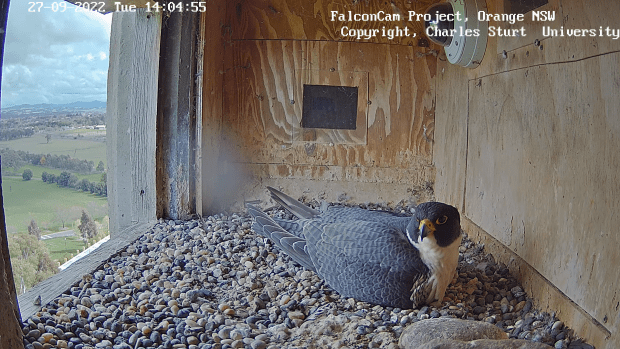
Oh, it is difficult to feed a much smaller eyas that cannot yet focus than it is an older one. That said, the wee one at Orange did get some nice bites around 18:34 at Orange. Soon its eyes will focus better and then, s/he should be able to position themselves better for Xavier and Diamond’s beaks.

There is a video of this feeding overlaid with a super interview with Dr Cilla Kinross, leader of the research project at Charles Sturt University at Orange. It is 10 minutes long and if you don’t have the time to sit and watch. Cilla Kinross has a great sense of humour – the water tower being dubbed the ‘Concrete Hilton’.

Cilla does mention how late the little one hatched and that it will be fed after the first one. Most of us are used to the falcons and hawks hatching close together and all of them making a circle of beaks reaching up for food with no prey competition. The issue is the height of the smaller one. Kinross says that Diamond and Xavier will feed the ‘strongest’ chick in this instance first. She also discusses the ability of Xavier to hunt in the horrific weather that Orange is having. She also discusses why it is important to study the falcons (and animals). Really, it is a good interview. Have a listen!

One single note. At the nest of Big Red and Arthur, L4 was tiny. That little one scrambled to the front of the line to get food with no fear of the others. In the end, L4 was the first fledgling to catch prey and, it is L4 that continues to reside on the territory of its parents on Cornell University. L4 turned out to be, perhaps, the strongest of the four eyases.

The weather in the Sydney Olympic Forest is dreary. The rain will continue until Sunday, and it is not such a great time for SE30 to decide to fly. SE29 and the adults continue to encourage SE30 higher on the branches. Not a lot of large prey is coming on the nest. SE30 got a small fish. There was no quibbling…is SE29 eating off nest? That is my question of the morning.

‘A’ wrote and mentioned that the Currawongs have become a problem around the nest of late. That is another good reason for SE30 to just sit and wait for the nice weather to come before venturing out into the forest with its first flight.

Oh, if Cilla Kinross wishes the falcons would eat more Noisy Miners, I wish the sea eagles would go after those Currawong! Have a banquet!!

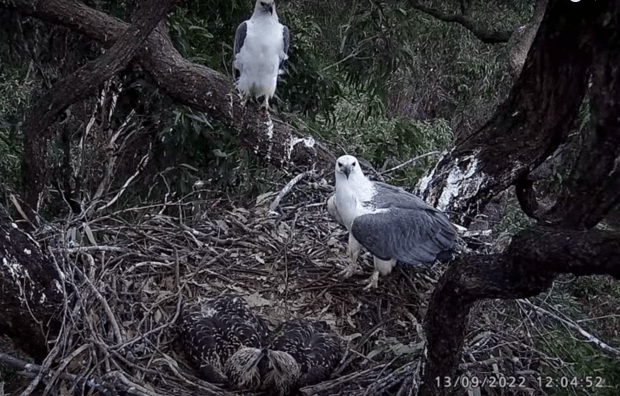
SE29 is sleeping on the branch. Every once in a while, it moves, and you can see it – again above 30 as if the sibling is looking after and protecting the other sibling. What a pair these two have been this year. So fantastic to watch.

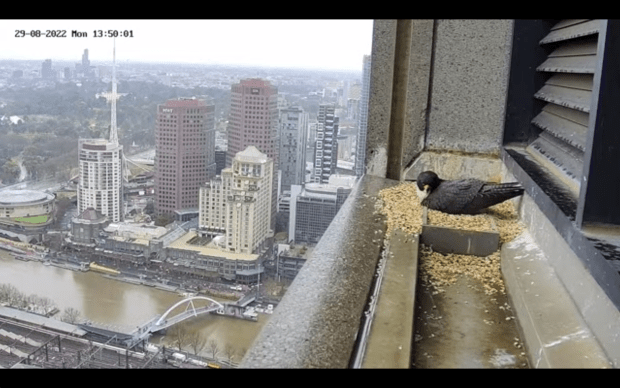
The parents at the Melbourne scrape are doing fabulous. I simply cannot say enough about how these two have come together as first-time parents (OK. parent and stepparent but I will call them parents) and are doing one fantastic job. The weather is not good in Melbourne either. You can always hear the faint call of the male telling the female of a fresh prey drop. (They also have a stash somewhere, like Xavier and Diamond, for the days when hunting is not good. Mum rushes off, has a break and a meal. Sometimes Dad feeds the four, sometimes Mum. Dad is pretty good at getting those bites in those beaks – and now, it seems the wee one is seeing better and holding that wobbly head upright. They are called Bobs – not in reference to the male name Bob or Robert but, because their heads ‘bob’.

Yesterday there were three feedings at Melbourne before noon. Several before light’s out.

Mum has been notified of a prey delivery and off she goes.

Every chick will be fed.

Look at that wonderful rainbow!

The four eyases are too big for Dad to brood! And even Mum is now having some difficulty.

When the 16:42 fish arrives on the nest on the Port Lincoln barge, all three osplets still have crops from earlier feedings. Little Bob managed well with getting himself up in the line in a position where he could get bites including stealing a few from Big Bob like he has done the past couple of days. At bedtime, all three were full – and that is wonderful. Today it will be partly cloudy in Port Lincoln, no rain predicted with temperatures ranging from 14 to 8 degrees C. The windspeed will be 16kph.

Little Bob has the same problem as the wee one at Orange. His neck is not long enough so eating position is key right now.

A nice fish arrives – big enough to feed everyone including Mum.

Mum tries her best to cover her fast growing family.

Thank you so much for being with me this morning. Please take care. See you soon!

Thank you to the following for their posts and streaming cams where I took my screen captures: Lori Covert and Window to Wildlife, WINK News Fort Myers, Port Lincoln Ospreys, Charles Sturt University Falcon Cam and Cilla Kinross, Sea Eagles@Birdlife Australia Discovery Centre Sydney Olympic Park and 367 Collins Street by Mirvac.

Tuesday morning in Bird World

27 September 2022

Good Morning Everyone!

It is clear blue skies on the Canadian Prairies this morning. The temperature when I began this blog was 2 degrees C. There was frost on the roof for the first time this year. The remaining flowers and herbs were not bothered so hopefully the second wave of hummingbirds that will be coming through will have some nectar. The Crows and Blue Jays along with the squirrels are busy collecting corn and peanuts this morning. Little Red has a new suet cylinder so all is well in the garden.

Making News:

Hurricane Ian is beginning to impact the Florida coast. This is the view of one of the Captiva Ospreys earlier this morning. For all of our raptor nests and everyone in this region – as I know so many of my readers are – we are all sending you our warmest thoughts. Stay safe. I will be checking on the Captiva situation throughout the day and evening.

It is currently calm in St Petersburg at the Achieva Osprey nest.

Some wind, which seems to be picking up in gusts, and rain at the nest of Bald Eagles Ron and Rita in the Miami Zoo.

You can hear the wind gusts at the Southwest Florida nest in Fort Myers of M15 and Harriet.

The winds at the Northeast Florida nest of Samson and Gabby appear and sound to be as strong as those at Southwest Florida.

Just checked. The wind speeds at Fort Myers (Harriet and M15) are at 17kph with Jacksonville, home to Samson and Gabby at 18 kph, and Ron and Rita’s nest in Miami at 19 kph. All have rain. We should expect these winds to pick up considerably later in the day.

This is the latest view from the Osprey nest at Captiva. There is one bird on a perch. You will have a front row seat to watch the storm according to the moderator on the cam. Hang on Lena!

Here is the link to the this camera:

Arctic Terns travel 44,000 miles during migration and now, once in the UK, they are met with Avian Flu. A good article that continues to discuss the demise of so many sea birds this year due to this wide spread disease.

https://www.theguardian.com/environment/2022/sep/27/country-diary-a-cruel-end-to-an-arctic-terns-epic-travels

Dr Sharpe has boundless energy and his love for raptors is highly infectious. He is now looking to place streaming cam on Alcatraz for one of Grinnell and Annie’s daughters who has been nesting there and raising chicks for a couple of years. The Institute for Wildlife Studies posted this image of Dr Sharpe this morning checking out the situation.

Nest News:

We can all give ‘three cheers’ for Little Bob at the Port Lincoln Osprey nest. At the mid-day feeding, Little Bob had himself right up there in the front row! This does remind me of our dear Ervie and it did take Ervie a couple of days to figure out the ‘sweet spots’ so he could get the most food. This is fantastic. Just look at that little bit of an osplet up there by Middle Bob. Gosh, he is a darling. Big Bob has such a long neck he can reach over both of them but what a tidy trio. It is also nice to see Dad on the nest. What a fantastic family this is.

Little Bob looks so proud of himself.

Dad came in at 1307 with a small headless fish and there was another feeding extremely close to the last one. By the time this feeding was over, all of the chicks were right ready for a good sleep!

The Mum at Melbourne seems to be ‘sitting’ on the eggs differently. Reports out of Melbourne seem to indicate that she is being fed and at one male did stand above the eggs, as if listening, yesterday. A soap opera in Falcon World. We wait but it should not be too long now. There could be pips as I am writing.

The two below appear to be the reigning adults at the Melbourne scrape. The female called simply a falcon (or Mum) has higher horizontal bars on her chest than the male. It is the only way I can tell them apart. Juveniles have vertical bars. The feathers of the female are darker than those of the male or the tiercel and, of course, she is bigger but it is often difficult to tell the size differential unless the pair are close together. I have watched the old male for quite a number of years and this tiercel does not look like him to me.

Mum was doing a lot of ‘looking down’ as if listening to the eggs beginning right after noon yesterday. She is quite beautiful but sure seems to give her ‘most fierce’ look at the camera sometimes.

Now she is being sweet and not so fierce.

It looked as if an eel were brought into the nest in the Sydney Olympic Forest with a wee bit of discord between SE29 and SE30 – but, in the scheme of things – that discord lasted 3 seconds with no pecking. Just a little feisty shuffle. Of course, the adults are watching everything that these two are doing.

Beautiful Diamond. At Orange, the eggs of Xavier and Diamond tend to hatch between 36 and 39 days. That means that the first pip should come on 1 October. As many of you know, the falcon eggs can hatch almost all at once. So 2-3 days. I do hope that these two have a very healthy chick or chicks. ‘A’ and I noticed that both Diamond and Xavier tend to be looking very healthy this year. Fingers crossed.

Thank you so very much for joining me this morning. We are really watching for pips and hatches at Melbourne and keeping our eyes and ears on what Hurricane Ian is doing to the nests within its range. Take care everyone. See you soon.

Thank you to the following for their posts and streaming cams which form my screen captures: Captiva Ospreys and Window for Wildlife, Achieva Osprey Nest, WRDC, SWFL Eagle Cam and Pritchett Family, NEFL-AEF, NOAA, IWS, Port Lincoln Ospreys, 367 Collins Street by Mirvac, Sea Eagles@Birdlife Australia Discovery Centre Sydney Olympic Park, and Charles Sturt Falcon Cam.

Iris is still here and more news on Tuesday in Bird World

13 September 2022

Good Morning Everyone! It is 11 degrees C (51.8 F) and will only rise to 17 C (62.6) – a great day for a long walk! As the temperatures begin to fall and the summer clothes make way for sweaters, it is a reminder to enjoy every moment outside that we can – here on the prairies of Canada. Winnipeg has been known to actually be colder than Mars in the winter so every precious minute outside is a gift.

Oh, it was a nice day yesterday. The best treat was I found the little duck. It is the tiniest wild duck I have ever seen in my life. There is still a lot of down and its wings seem ‘small’.

5 September:

12 September. The head is larger and it appears that some more feathers on the back have grown in. The little one was so busy scooping up what looks like confetti made out of leaves. It is called Duck Weed and is not the best thing to have growing on the ponds but – the ducks love it!!!!!!! In fact, ducks will eat whatever food is in front of them including pondweed, sea weed, reeds and flowers as well as berries and seeds and we have seen them eat frogs, too.

The Canada Goose couple that had lost one another the other day and were honking up a storm had taken possession of the only island in the pond. It seems that the water level is rising due to the staff at the centre draining one area to move the water to another. The geese were sharing with some Mallards but they were not moving and giving up their lease!

Aren’t they a gorgeous couple?

In past years there seem not to have been as many juvenile American Coots. They are everywhere at the nature centre – hiding in the reeds, riding on pieces of branches, or just standing quietly around a corner this year and I have seen others at ponds around the city.

You can see how thick that duckweed is on the pond. Someone of it should be cleaned with a filter – and maybe that is what the staff are doing.

Over the years the Mallards have just gotten more beautiful to me. They are common and often over-looked because of it. So many sweet little females around the edge of the pond.

Most looked nice and full from their foraging. It was bottoms up everywhere!

Oh, look at those beautiful primary and secondary feathers. Let us all hope that our wee one will have as many by the end of October.

In the Mailbox:

No questions just outpourings of love for Izzi who was the subject of yesterday’s archival photo. Oh, what a character he was and each of us that watched Xavier and Diamond’s scrape and Izzi so intently has so many stories of his antics.

Making News:

A Bald Eagle death in Canada attributed to Avian Flu. This is very sad. It was believed that the H5N1 was slowing down. Now it might be spread again by migratory birds.

The EU is being heavily criticized for not protecting marine life from overfishing. Why is this in a bird blog? Well, the birds that eat fish need them so the setting up a moratorium for fishing for human consumption might help.

https://www.theguardian.com/environment/2022/sep/12/eu-slammed-over-failure-to-protect-marine-life-from-destructive-fishing

One of my favourite books, Goshawk Summer, has won the Wainwright Nature Writing prize. James Aldred spent the early part of the pandemic in the New Forest. His assignment was to document the life of a Goshawk family. Written like a daily diary, Alden captures the solitude of the forest and the magical experiences of the chicks. “The wood holds its breath, the only sound the begging of the chicks and the gentle breeze through trees. The forest hasn’t been this peaceful for a thousand years.” Despite Aldred being a wildlife photographer there is not a single image of the Goshawks in the book but, they are not necessary. Through his words their presence is evoked as clearly as a newly cleaned window.

https://www.theguardian.com/books/2022/sep/07/wainwright-nature-writing-prize-goes-to-inspirational-goshawk-summer

Two lucky Bald Eagles were helped in Maine when they were relieved from being entangled with one another. They were mid-air and crashed into the water. Both could have died with out the help of the kind couple.

Nest News:

I wasn’t quite sure where to put this wonderful news. Many of you will have already heard that Iris – thought, perhaps, to have migrated from her spring and summer home in Montana – was eating an enormous fish she had caught on the Owl Pole today in Missoula. The oldest Osprey in the world looks magnificent.

Here is a 4 minute video of this magical event.

12 September is a very special day. It is the day that Gabby normally returns to her nest near Jacksonville, Florida that she shares with her partner, Samson. Out of 4 years, 3 of the returns have been on the 12th of September. How incredible. Samson has been waiting and looking and bringing in some sticks. Gabby did not disappoint! She arrived today!!!!!!!!!!!!! The couple got busy working together getting ready for the wee eagles this year. Oh, it is so wonderful to see you home, Gabby.

Good night Samson and Gabby. All is well with the world. See you tomorrow.

Lady Hawk caught the reunion on video!

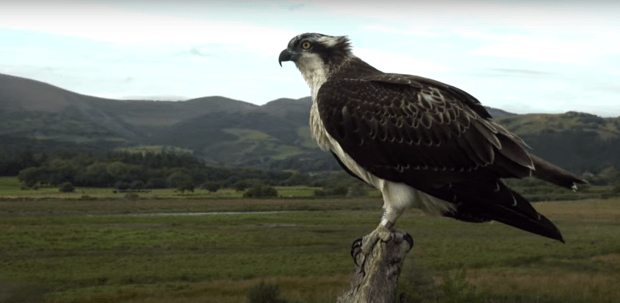
Padarn appears to still be with Idris at the Dyfi Osprey nest in Wales.

Blue 497 is still on the nest at Glaslyn and Aran delivered a really nice fish for tea time.

Did you know that both Padarn and Blue 497 hatched on the same day? It was 26 May. 497 is the oldest and Padarn is the middle chick. Both, as we can see, are still at home.

Idris brought a flat fish later and is looking around for Padarn. Is she gone?

Everything seems to be fine on the Sea Eagles nest in the Sydney Olympic Forest.

The eaglets had an early breakfast. Looks like one of the Silver Gull chicks from the old barge down the Parramatta River.

Even with a great big nest SE29 and 30 prefer to snuggle together. Lady keeps watch.

A lovely family portrait.

At the Port Lincoln Osprey barge, Mum has been rooting around in the nest and rolling those three precious eggs. It is the 14th of September in South Australia. Is it really possible that in 4 more days we could have a hatch? At times it felt like it has taken forever and on other days it seems like we just had the last egg laid. Does it feel that way to you?

At the 367 Collins Street scrape, Mum got up to stretch her legs. Gosh these birds must get stiff sitting on those eggs for so long —- yes, I am projecting human needs on them! If they had a little buzzer to remind them to stand up and get the circulation moving it might help. Oh, she made me ache as I watched her raise off those eggs. She was hardly gone…someone played a trick on this female. They told her that she had to do all the incubating herself. Hopefully she will give Dad some more time.

Oh, just when you say the birds eat off camera, someone brings a nice juicy pigeon and there you go – eaten on the nest! It is like having a sick child and taking it to the doctor and your little one is immediately well on arrival!

Migration News:

Just imagine 428 million birds making their migration flights tonight.

Remember it is time for lights out. If you want to check your own area of migration, go to this link and put in your postal code or the name of your city – sadly lower mainland US only.

Karl II’s family migration – Waba is still around the area of Manachyn and has flown a short distance south where he has discovered a little lake.

Bonus is still in the wetlands along the Prypjat River south of Makarichi.

Kaia is still around the Desna River. So all three appear to be doing well. What a glorious relief. No news from Karl II.

From the Archive:

Do you know my name? I was the only eaglet on an enormous nest. My parents names are Liberty and Freedom. When I branched and started jumping and flapping my wings, your got very worried.

I hope that your day is as lovely as ours on the Canadian Prairies. Thank you so very much for being with us today. Take care. See you soon!

Thank you to the following for their blogs, tweets, videos, and streaming cams that make up my screen captures: Charles Sturt Falcon Cam, Wreckhouse Weekly News, The Guardian, Bangor Daily News, Montana Ospreys and Cornell Bird Lab, NEFL-AEF, Lady Hawk, Dyfi Ospreys, Bywyd Gwyllt Glaslyn, Sea Eagles@Birdlife Australia Discovery Centre Sydney Olympic Park, Port Lincoln Ospreys, 367 Collins Street by Mirvac, BirdCast, Looduskalender, and Glacier Gardens.


The eaglet was Kindness who hatched in Glacier Gardens, a large botanical garden within the Tongass National Park, Juneau, Alaska. The year was 2021.

4 eggs for Melbourne, Victor is moved outside and other news in Bird World…Monday morning

30 August 2022

What happened to August? It seems as if we blinked and it flew by. Despite the heat there is a look about the leaves on the trees and the wilting of the tomato plants despite their being well watered that is alerting us to the end of summer, not just the calendar. There is another 9 or 10 days before the teachers and students are back to their classrooms in Manitoba. It is a reminder that it is time to get a small delivery of firewood. There is something so cosy about a wood fire on a crisp autumn morning and if August is any indication, autumn will be here in two blinks.

The colour of the light and the water of the pond seemed to be taking on the hues of autumn.

The rain started in the early morning hours of Monday and everything has turned green in the garden again…it is raining so hard! And for once, I am so glad to see it! Monday will be a good day for reading the small pile of books accumulating on my desk.

In the Mailbox:

‘N’ writes: “Do all falcons incubate the eggs the same no matter where they live? Do all ospreys?” Oh, what an interesting question! I am not a specialist on incubation, the term used for the behaviour whereby adult birds keep the eggs warm until they hatch. My experience watching the nests of different species is that birds are very individualistic and even within a single species, the attention that they give to their incubation duties varies. I found a paper that actually discusses the different approaches to this important task. It is not a recent one but it is quite interesting. The author covers some birds that are unknown to me but, I believe the findings and the data can enlighten us as to the full answer to your question, ‘N’.

In the News:

RSPB created an extremely short video about Avian Flu killing the White-tail Eagle chicks on the island of Mull. What is so intriguing is the landscape of the island and the beautiful chicks so alive in the nest. It is clearly not the be all- end all informative presentation but it was nice to see where these eagles live.

Just a couple of months before Avian Flu began killing the White-tailed Eagles on Mull, this beautiful 7 minute video was made showing them on their island setting. Have a watch:

The attempt to rid Gough Island of its House Mouse problem has hit a wall. The eradication of the mice that were biting and killing Tristan Albatross chicks and adults is now being viewed as a failure. Everyone had such high hopes that the island would be rid of these invasive mice but an unknown problem presented itself – the slug. Have a read:

https://www.acap.aq/latest-news/4427-alien-slugs-thought-to-be-the-cause-of-failure-of-the-house-mouse-eradication-on-gough-island

I found an excellent story dealing with the tragedy of the mice and the Tristan Albatross and why the eradication attempt is so important.

In his newsletter, David Hancock of Hancock Wildlife just posted the following information about the Delta 2 nest in British Columbia, Canada: “Firstly, both Ma and DM have gone on their migration. Ma was last seen at the Delta 2 nest/territory on July 25th. DM (taking his new role as Ma’s mate very seriously) hung around for another week keeping an eye on things. He was last seen there on August 1st. Thanks to all who donated to the GoFundMe campaign, as well we received a a few private donations which are greatly appreciated. These donations are going to cover the costs associated with the installation of a sturdy new nest pole and two (2) new cameras at Delta 2.”

Nest News:

It is egg 4 for the Melbourne Peregrine Falcon couple on the ledge of 367 Collins Street! Oh, my goodness. Dad you are going to so hope that the pigeon population of the city is very plentiful!

Here is a video of that last egg being laid:

It was a prey drop and a chance for Dad to get himself acquainted with how you have to wiggle around to get 4 big falcon eggs under so they can stay warm.

It is a lot easier for Mum to get those four eggs tucked in tight. Do you think there will be a 5th?

We have a ways to go before hatch for Melbourne and Diamond might not be finished laying eggs. Incubation is a time for the females to rest. It is going to be very hectic if all the hatch at Melbourne! And exciting.

The Sydney Sea Eagles are developing right to schedule. Their plumage continues to come in and they are picking up sticks in the nest and preening. SE29 is standing and walking better each step. They really are gorgeous. The Monday morning feeding saw both 29 and 30 with nice crops full of fish. I have seen no concerning aggressive behaviour on the part of 29 to 30 that would cause me to worry.

We are about 3 weeks away from hatch watch at Port Lincoln. Mum and Dad continue to take turns incubating. That said, Mum will always have night duty and Dad will provide Mum with her meals.

You would think that Mum would be very stiff incubating the eggs all night. Dad has arrived and is nudging her off so he can have a turn. Mum goes away for her breakfast and a break, returning in about half an hour.

You are doin’ good, Dad.

There has been an unknown male visit Annie in the tower.

There is a notable change in the behaviour of the female Ospreys in the UK this year. Normally they would depart the nest about 10-14 days prior to the fledglings leaving on their migration. This year it appears the majority are choosing to remain on the nest while some or all of the fledglings depart. While we will not know the specific reason, I wonder if it is, in part, due to the raising of these large female chicks and the Mums needing more time to get in top shape. Or could it be that prey is plentiful, the weather is nice in the UK, and they just want to be home for a little longer?

Idris, Telyn, Padarn and Paith are still at the Dyfi Osprey nest in Wales as of Sunday the 28th. Idris has stayed on the perch all night. Pedran was last seen on the 11th of August at 0905.

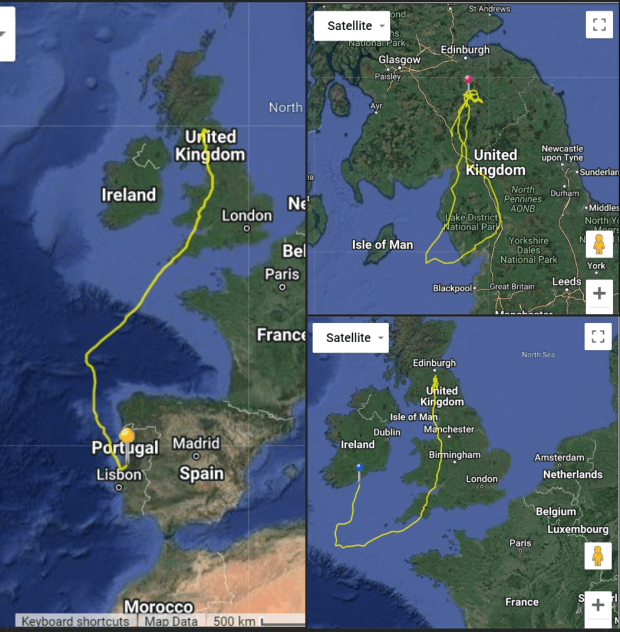
If you follow Tweed Valley, the three fledglings are going in very diverse directions including Glen who remains on the nest. Kirk is in Ireland having flown south and turning back to the land. Tweed is nearing land in Portugal.

Ruthland is updating us on their second hatch at Manton Bay, 1H2:

Tiger Mozone says that the fledglings need good DNA and luck. 1H2 certainly has great DNA. Let us all hope she has some awfully good luck, too.

1H2’s parents, Blue 33 and Maya, along with older sibling 1H1 were all still at the Manton Bay Nest at Rutland on the 27th and there is no news of either 1H1 or Maya departing since.

Seren was on the Llyn Clywedog nest early this morning and Dylan even popped in for a few minutes to join her later.

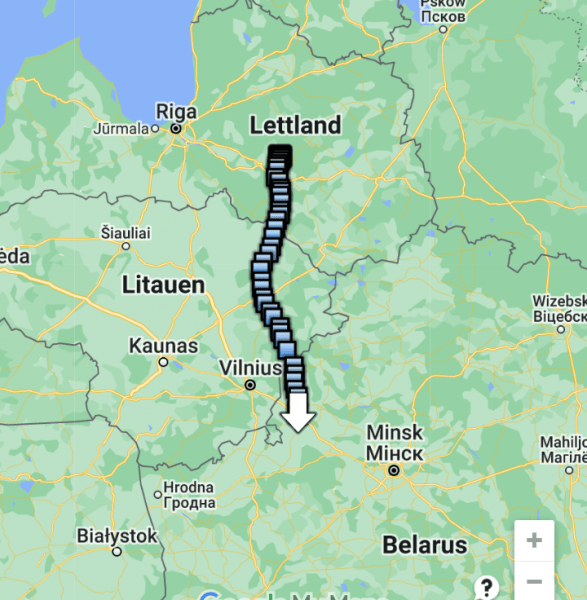
It is just incredible. Bonus continues to prove that he is a very special Black Stork! He flew from the nest in Estonia and spent the night in Latvia on the 27th. He has now flown through Lithuania and is in Belarus near Minsk. That was a total of 279 km.

Kaia, Bonus’s foster mother, remains in Belarus in the Prypjat Wetlands near Shestovicy.

So what intrigues me is this. If Kaia remains where she has been for the last several days since she flew north out of the Ukraine, is it possible that Bonus might also wind up in the same wetlands? Or will Bonus fly into the Ukraine? and remain there? or turn back north like Kaia? We should have our answer in a day or two.

Here is the distance shown by Google Maps:

Waba has begun the journey also and the tracker shows that he crossed into Latvia from Estonia on 28 August. He then flew a short distance.

I have received word that Karl II has left the nesting area in the Karula National Forest and has begun his migration. More on that to come tomorrow.

Victor has done so well since Dr Sharpe travelled to the Two Harbours nest on the Channel Islands to take him to be treated for zinc toxicity at the Ojai Raptor Centre. He has now been moved out to the big flight area! It just doesn’t get too much better than this until he is released. Wow. Victor. Way to go!

Looking forward to Lena and Andy at Captiva next year? or Connie and her mate? Window to Wildlife posted a 7 minute video about updates changes to the cameras, etc with some lovely pictures of Lena feeding the wee nestlings last year.

Thank you so much for joining me today. Please take care of yourselves. See you soon.

Thank you so much to the following for their streaming cams, their videos, and their posts that make up my screen captures: RSPB, 367 Collins Street Falcons and Mirvac, Charles Sturt Orange Falcon Cam, Sea Eagles@Birdlife Discovery Centre Sydney Olympic Park, Port Lincoln Ospreys, Cal Falcons, Dyfi Osprey Project, Tweed Valley Ospreys, Rutland Osprey Project, LWRT, CarnyxWild, Looduskalender, CIEL, and Window on Wildlife.

Monty’s last Bobby Bach has died and other brief news in Bird World

26 July 2022

While it was pouring down rain and thunder and lightning were rattling the skies on the Canadian Prairies, little Willow was being tossed off the side of the Loch Arkaig nest by a Tawny Owl. I caught it in a very very short video.

Willow returned to the nest and appears to be unharmed.

Tragic news has come out of the Dyfi Nature Centre this morning. Normally, if a fledgling survives its first migration to return at the age of two and then again at three, that Osprey will live a long and fruitful life. So the news today of the death of Hesgyn is particularly troubling.

Hesgyn was Bobby Bach, the third hatch of Monty and Telyn (now with Idris) in 2019. He and his sibling Berthyn had returned to the UK in 2021. It was the first time the Dyfi Osprey Project had two chicks from the same brood return after their first migration.

Hesgyn was three years old when his body was recovered from Criccieth Beach in north Wales yesterday. Emyr Evans wrote a lovely tribute to this promising son of Monty.

https://www.dyfiospreyproject.com/blog/emyr-mwt/hesgyn-has-died?fbclid=IwAR27ciHVWxDnXJLsIZLFMlCiIa-jzrkS9JQqVItjgJPGD91_6Pcjuns01Mw

When you read about Ospreys you will sometimes see that their diet is 99% fish. This mourning Asha at the Loch Garten Osprey nest brought in a young Grebe and fed part of it to the two chicks on the nest.

It is clearly an example of Ospreys eating something else although I suspect if the Grebe were under water Asha might have thought it a fish. What is so troubling about this – and I have yet to see anyone mention it – is the highly pathogenic Bird Flu that is across the area. It is a nest that will be monitored with the hope that the young waterfowl did not carry H5N1.

File:Little grebe Zwergtaucher.jpg” by Andreas Trepte is licensed under CC BY-SA 2.5.

Avian Flu continues to kill thousands and thousands of birds across the UK. It is wiping out bird populations on the islands and the mainland.

https://www.bbc.com/news/uk-england-tyne-62253049

At the Llyn Brenig Osprey platform in Wales, it was a very special afternoon. at 12:45 X6 Olwen fledged. Perhaps her brother Gelert KA9 will fly tomorrow. You might recall that this was the nest cut down with a chainsaw in 2021. Congratulations to everyone today!

There have been two fish deliveries so far at the Osoyoos Osprey nest (it is currently 0920). The first was a little fish at 0554 and the second was a fairly good size one at 0616. Keep sending all your good wishes their way – a heat warning is in effect and the temperatures will climb to 41 C or 105.8 for almost the entire week. This is a tragedy…look at those beautiful osplets standing so nicely. We want them to survive. Will someone supply them with a fish table or fish basket if it is necessary? Certainly Urmas, the state Ornithologist in Estonia would do this exact thing. These beautiful raptors certainly didn’t cause the planet to heat up catastrophically!

My heart just aches for this beautiful family who have struggled for weeks with low fish yields, a chick falling off the nest, and extreme temperatures. If they were in NZ, they just might have a mister and lots of supplementary fish like the Royal Albatross.

In comparison, the Fortis Exshaw Osprey platform at Canmore, Alberta will be hot but significantly cooler than at Osoyoos. Last year all of the chicks on the nest of Soo and Olsen died because of the heat wave that hit the area. They were considerably younger but this nest on the border of British Columbia and the US will need fish – it is the only hydration the Ospreys get.

The three osplets of Dory and Skiff at the Boathouse Platform – not on Hog Island but often called the Hog Island Ospreys (thanks ‘H’) – are doing fine today despite temperatures rising to 29 C or 84.2 degrees this week. Osoyoos would really welcome that weather – although I wish for all of them that it would be about 24 degrees C or 75.2 F.

At Mispillion one of the chicks was on the nest eating a fish alongside Mum’s little treasures – the yellow mat and the yellow grid metal ornament. Both could get tangled in the legs of the birds. But, on a good note, the chicks are being fed by the parents off the nest. This one lands with a small headless fish on the nest – a nice safe place to eat.

Dad is bringing in lots of fish to the Sydney Sea Eagles nest and Lady made sure that both had big crops before it was light’s out.

Lindsay is not quite as loud as Grinnell, Jr but she sure tries to be!

On the Notre Dame Eagles FB page, there is mention of all three eagles again being in the trees. The notes are confusing so I am not copying them here but I do join in with everyone hoping that the trio are learning to hunt and are eating. I wish for Little Bit to find a prey rich area to build up his strength before migration.

Thank you so very much for joining me this morning. I do not see any new news on Victor who continues his rehabilitation at the Ojai Raptor Centre. Take care everyone. See you soon.

Thank you to the following for their FB posts, web page announcements, and streaming cams where I took my screen captures: Friends of Loch Arkaig and the Woodland Trust, Dyfi Osprey Project, Loch Garden RSBP Ospreys, Llyn Brenig Ospreys, Osoyoos Ospreys, Fortis ExShaw Ospreys, Audubon Explore, Mispillion Harbour Ospreys and the DDNR, Sea Eagles @Birdlife Australia Discovery Centre, Sydney Olympic Park, and Cal Falcons.

Late Sunday in Bird World

22 May 2022

I can’t speak for all Canadians but, in Winnipeg when the sky is blue and no rain is falling and the temperature makes it feel like summer, we go outside. We will find anything to do to keep us outside. Today, amidst the roar of songbird vocalizations I planted the Vermillionaires that are going to make the summer hummingbirds very happy. Neighbours were on their bikes, walking up and down the alley in their summer attire being friendly. I did not check a lot of nests as a result.

I am, however, going to start with the bad news first. The highly pathogenic strain of Avian Flu is not in Sitka, Alaska. This is not good news. There is a huge population of Bald Eagles in Alaska that live off the salmon. Our dear Kindness that fledged off the Glacier Gardens nest last year is one of those. For more information go to the link that Terry Carman has posted on the Bald Eagles Live Nest Cams and News today.

How many of you fell in love with Louis and Aila at the Loch Arkaig Osprey nest? was it in 2020? when they fledged Vera, Doddie, and Captain? Captain, a third hatch, was my big celebration that year. Loving parents Louis and Aila made sure that that wee one was fed. Indeed, Louis often fished at night and tandem fed the chicks with Aila. We were devastated when she did not return from migration in 2021.

Doddie has been spotted, photographed and the band number has been confirmed – JJ6. He was diving for a fish on the Shetland Islands. This is absolutely fabulous news! We wait for news about Vera and JJ7 Captain.

That is quite the distance. The males tend to cause some bother around their natal nests. I must check on this. The distance is quite interesting.

The Manton Bay Three continue to thrive. Blue 33 stands guard while Maya feeds the chicks. This is a brilliant strategy on Blue’s part. He is prepared – either to help feed the chicks or to fight off any intruders that might want to take advantage of the situation of three chicks and a single adult on a nest.

I love fat little ospreys. Well, I love fat little chicks on a nest – period. This means they are well taken care of. These three are growing so fast it is hard to believe.

Yeap. No one is going to mess with Blue 33 (11)s family. He even has a better ‘snake eye’ than Iris sometimes!

A nice big fish came on the UFlorida-Gainesville nest around 1:39. Mum fed both of them and by the time she was finished, each had huge crops! I thought it was going to be another day where it was 10 bites for Big and 1 for Middle but, in the end, it seems to have worked out relatively even. These two are seriously gorgeous birds.

The four eyases of Big Red and Arthur are growing and growing. It was a nice day and then it rained and rained on the Cornell Campus. The only ones that seemed to fit under Mum were L3 and L4. Sometimes being the first hatch isn’t all that nice! That said L1 and L2 have some nice feathers coming in.

River and Obey continued to come to the Dale Hollow nest to try and lure their two fledglings, DH14 and DH15 back to the nest. So far it does not seem to have worked. A partial fish was left and one of the adults returned at 1609 to eat it and aerate the nest cup.

This was earlier. The adults have moved the large twig over to the side also.

It was hot in San Francisco today and Alden was working hard to keep the chicks shaded.

Alden helped Annie recover from Grinnell’s horrible death. These two very healthy chicks are a great testament to the hard work that both Alden and Annie have put in to make sure they not only hatched but that they thrived.

We were used to Annie and Alden feeding the chicks 10 or 12 times a day – little tiny meals. Now that they are older they will have fewer meals but will eat more and will have enormous crops. Just look below at the crops and how big their feet are!!!! Perhaps it is the angle but the Little one (nearest us) seems to have longer ‘toes’ talons than the oldest.

For those of you who love that ‘high spirited’ Spirit at the Big Bear Valley nest of Jackie and Shadow, you best be watching her closely! She is branching and flapping and looking out to the world away from the nest. She was their miracle chick this year and Jackie looks on knowing that Spirit will not be throwing her little fits for much longer – we will surely miss them as much as her parents.

I want to close with another wonderful day for ND17. A very large fish landed on the ND-LEEF nest at 1942. Little Bit 17 was in the right place at the right time – indeed, the parent actually oriented themselves so that 17 was on one side and, I believe, it was 15 on the other. Little Bit ate and ate and ate. Another huge crop at bedtime! Get the tissues. This is nothing short of fantastic. Perhaps this female has decided that she should feed her littlest one!!!!!!!

17 is on the nest under the left wing of the adult.

You can see where 17 is clearly now and see the size of that fish. Incredible. That will feed everyone.

17 got right up to the beak. Notice how well he is protected when Mum actually turns to the little ones benefit. The two older siblings are not going to plow through her to get to Little Bit 17. Perfect location.

Little Bit 17 knows how to put the food down. Look at that beach ball crop. Three days in a row. I hope I don’t jinx it. This little one will grow and grow over night. It isn’t going to catch up with the other two – it is six days younger – but it will help with the feather and muscle development – all this fine fish. Such a relief.

Thank you so very much for joining me. Little Bit 17 with a full crop is simply a perfect way to end this blog this evening. Take care everyone. Tomorrow we should have some more UK Osprey hatches!

Thank you to the following for their streaming cams and/or FB pages where I took my screen captures: ND-LEEF, UFlorida-Gainesville Ospreys, Cornell RTH Bird Cam, LRWT, DHEC, Bald Eagles Live Nest Cams and News, Friends of Big Bear Valley, and Cal Falcons.

Late Thursday in Bird World

5 May 2022

Tonight, the Audubon Society believes that 380 million birds will be on the move from the south where they wintered to the north to their breeding grounds. Manitoba is set for a huge number of birds flying in especially to the very north near Churchill and to the wetlands in the middle of the province. I draw your attention to the Wapusk area because I want you to see Churchill. Churchill is now as the ‘accessible Arctic’. Here beginning in June you can see many species including Ross’s Gull, the Northern Hawk Owl, Smith’s Longspur, Spruce Grouse. the Three-Toed Woodpecker, and Harris’s Sparrow. Of course, the list is endless for the ducks and geese that make Hudson’s Bay and the area around Churchill their summer home. Raptors include the Northern Harrier, Gyrafalcons, Merlins, Bald Eagles, and Golden Eagles. Lots of other wildlife abound in the area including Polar Bears.

North of Riding Mountain National Park, also in Green to the south and west of Wapusk is Winnipegosis. This is the place to see Osprey. Directly east and north of Gimli near Hecla Island is a large concentration of Bald Eagles. Canada Geese have arrived and the Trumpeter Swans are arriving now along with the American Pelicans and Red-winged Blackbirds. The shores of the two very large lakes, Lake Manitoba and Lake Winnipeg, are home to a huge variety of shorebirds that are beginning to arrive.

It felt like I watched Annie and the wee hatchling all day under a microscope. Alden got to see the chick and brood it and incubate the other two eggs. There is a dent in one of the two remaining eggs.

Alden checked earlier to see if Annie wanted a break and she wasn’t ready yet.

The baby was wanting food so Annie gave Alden a shift. I noticed how extremely careful he was with his lame leg not to stop on the chick. Well, done, Alden.

Annie arrives with a bird for the little one’s first meal. I could not possibly tell you what species this is. It is not familiar to me in Manitoba.

First hatch had a nice meal.

Annie catching some sleep. She is going to need all she can as the next eyas appears to be working on its shell. So happy for Annie. Things feel like they are going to turn out just fine.

Afterwards I went to check on the osplets at the UFlorida-Gainesville Osprey nest. I had been watching earlier in the day but not early enough to catch a morning feed. It was apparent that the chicks and Mum had eaten as all three had crops heading into the evening.

It is good to see the Mum on the nest and the osplets – and her – nicely fed. Middle is the one closest to Mum.

Middle is growing. A few days of good meals makes all the difference in the world.

Big Red has a nest full!!!!!!! She must be in her glory. Oh, I hope the weather holds.

L4, the smallest one, hatched a week after the first, likes to be at the front of the line. Gosh, sounds like another Ervie!

At 19:32, two Crows arrived at the Achieva Osprey nest in St Petersburg, Florida. This is the nest of Jack and Diane. Last year Jack and Diane fledged three – this is the home of Tiny Tot -. Those chicks hatched the beginning of March. Jack and Diane had a previous clutch of eggs that went down a hole in the nest. Diane laid three more eggs but the dates were unknown because the cam was offline. I know that the Achieva nest is a favourite of many but, perhaps this is a blessing in disguise. It is really late to have osprey chicks in Florida due to the extreme heat.

It is doubtful that any of the eggs made it. Crows watch and wait just like they did with Daisy Duck’s clutch. Eggs left alone even for a few minutes will be eaten if there are Covids around.

Bird flu continues to be in the news as 37 million factory farm birds are killed.

https://kdvr.com/news/bird-flu-not-just-affecting-colorado-bald-eagles-other-wild-birds-dying/?fbclid=IwAR21A8vcIZW0WgdOK4c4rYk9prFMvvUbxDm3u6BqNHLQkV4cEq-YYHkkG6k

We are one week away from pip watch for Richmond and Rosie at the SF Osprey nest on the Whirley Crane in SF Bay.

One of my favourite Osprey nests in the UK belongs to Idris and Telyn at the Dyfi in Wales. Idris is know as Daddy Long legs but he is also one of the best fishers amongst all the UK osprey. Look at this one he hauled in today!

Beautiful Maya at the Rutland Manton Bay nest she shares with her mate Blue 33 (11). We are on pip watch for this couple!

Another fantastic Osprey Mum, Blue NC0 at the Loch of the Lowes nest in Scotland that she shares with Laddie. We will be watching for her eggs to hatch after Maya’s. What a beautiful setting for a nest!

The oldest Osprey in the UK is Mrs G. She is believed to be 22 years old. She is incubating the three eggs of her and Aran’s. They will be hatching late as Aran was late returning from migration. Today Aran was busy keeping intruders away from the nest.

Of the nests I have checked, all seem to be doing just fine.

Thank you for joining me. Take care everyone. See you soon.

Thank you to the following for their streaming cams where I took my screen captures: Brywd Gwyllt Glaslyn, Dfyi Osprey Project, LRWT, Friends of Loch of the Lowes and Scottish Wildlife Trust, UFlorida-Gainesville Ospreys, Cal Falcons, Cornell Bird Lab RTH, SF Ospreys and Golden Gate Audubon, and Achieva Osprey.

Early Tuesday in Bird World

3 May 2022

News has come that the male at Denton Homes, Majestic Dad, has died. Avian Flu has been confirmed. The Denton Homes nest lost three eaglets and an adult male. The female, Majestic Mum, looks good on cam and is being monitored.

For those looking for information, here are two publications that have good solid information as well as some of the latest news on the spread.

https://www.who.int/news-room/fact-sheets/detail/influenza-(avian-and-other-zoonotic)?fbclid=IwAR2wNC51JO4V2JADpz_SGHQR_ovyiwyYpVmAVyxsMBt_rGxtzhROMqBSZEM

https://www.cdc.gov/flu/avianflu/wildbirds.htm?fbclid=IwAR03jx2Iw6YSAPQL9jJ4zvAzT58C9UcEgEAiAycbiOyALsOY1wEsLmjzJbA

This is one of the last images of E2, that sweet little eaglet off the MN-DNR nest that became a victim of siblicide at the age of 5 weeks. E2 hatched on 23 May and was shoved off the nest by E1 and subsequently euthanized on 30 April.

Dr Sharpe has been very busy. Another chick was to be banded on Santa Rosa Island and Dr Sharpe arrived just in time as the nest had collapsed and dropped. Here is that announcement

There are now five baby Peregrine Falcons in the Manchester, New Hampshire nest

Here is the link to that streaming camera (there are 2 of them).

There is an unease this morning on the UFlorida-Gainesville Osprey nest. I have observed fish being brought in but a bewildered adult and no feeding of the eaglets. An adult brought a fish on at 10:19 (or thereabouts). Both of the chicks began to scream for food. It was interesting watching what is happening. The adult eventually gave up and dropped the fish on the nest. Middle began to self-feed. You might have noticed him chewing on other bits of old fish and bones on the nest.

In the image below, the adult has brought in the fish. Middle is trying to get under here to be fed. (Big has the darker back plumage).

Middle anticipated that the adult would be feeding them and is trying to get to a point away from Big so that it gets some food.

The female places the fish in the middle of the nest leaving it. She did not feed the chicks when she brought in the piece of fish.

The chicks look on as the adult flies away. They do not understand what is going on – the same as me!

Middle begins to self-feed.

The chicks give up on the self-feeding. This picture was taken at 10:31.

At 10:47 an adult lands on the nest.

The adult, at first, appears to be a small piece of fish tail that they have brought in. Then the adult pulls part of a catfish – the head and part of the body – out of the nest. Both chicks are prey crying very loud. The adult appears confused as Middle tries to self feed. Is this Dad? and was it Dad earlier?

The adult looks completely bewildered.

Middle is attempting to self-feed. What is going on at this nest?

Middle had very little food yesterday and, if that were the case the day before, is not starving but getting there. It is clear that Big has no crop and is also hungry but not like Middle.

Middle may have gotten a little flesh off the open end.

While the dropping of the fish on the nest is a good strategy for both if there are two pieces and both chicks are self-feeding, it is clear that these two are not ready to feed themselves. Where is the female?

At 12 noon the adult returns, chicks crying desperately for food. The adult looks around. Is this Dad again? (From the behaviour I am assuming Dad). Where is Mum? If you observe the Mum feeding the chicks (or the dad) please send me a note. I cannot watch the nest all day today, unfortunately. I am quite concerned.

This has been posted on the UFlorida-Gainesville Osprey Nest page if you would like to help name the chicks, the adults, and the nest:

All I have to do is flip over to the Red-tail Hawk nest at Cornell and there is an instant smile. The four Ls do not have to worry about getting fed. Arthur is constantly bringing in food and Big Red feeds each beak until there is not one asking for food.

Larger clutch, direct feeding, lots of food on the nest, no history of siblicide – that is the difference at the Red-tail Hawk nest as compared with the UFlorida-Gainesville Osprey nest.

The West End nest of Thunder and Akecheta is an example of two parents working hard to make sure that each of their offspring survive —- and thrive! Both parents were active bringing in food. Several times they had tandem feedings. And look – Sky, Ahota, and Kanakini. They should all fledge and we hope return and raise their own families in the Channel Islands.

The Mum and Dad at Pittsburgh-Hayes consistently raise triplets to fledge. They hatched on 21, 22, and 25th of March making them 43, 42, and 39 days old.

These are Bald Eagle nests. Examples of siblicide that I listed yesterday include both Bald Eagles and Ospreys. It will be enlightening, at the end of the season, to compare data on species in terms of survival rates. It is also complicated and might not reveal a true picture in terms of prey availability, parenting, genetic predisposition to siblicide, etc. unfortunately. Another interesting comparison will be the rate of success of 3 clutch Ospreys in the UK with those in North America.

At the Hellgate Canyon nest of Iris in Missoula, Montana, the oldest osprey in the world laid her first egg of the 2022 season at 08:13.

Louis arrived a little later – fishless – to see the egg and do what Louis does.

I want to repost Dr Erick Greene’s letter about Iris’s relationship with Louis and why I should not be – nor you – upset with the fact that he has two nests. There is a huge change in the Osprey population that use the Clark Fork River for their food supply. Much of what Dr Greene says can also be applied to other species who are under pressure.

The Anacapa Falcons are doing well.

Things seem to have settled for now so that Bukachek and Betty can take care of their five eggs in the Mlade Buky White Stork nest in The Czech Republic. They have had disturbances – as recent as two days ago- from intruders like so many other nests this year.

It is a soaking morning on the Bald Eagle nest at Notre Dame University. There has been some strife at the nest with regard to the third hatch getting feed. It seems that there are good days and not so good. The weather might well impact feeding and behaviour today.

This is the history of this nest back to 2015: One chick, ND1 in 2015; ND2 in 2016; ND 3 and 4 in 2017; ND 5 and 6 in 2018, ND 7, 8, and 9 in 2019; ND 10, 11, and chick 12 who died on May 14 in 2020); ND 13 and 14 with a non-viable egg also in 2021. The hatches this year (2022) are ND 15, 16, and 17. Hopefully all three will make it.

Notice the turtle shells. James Broley commented that the Bald Eagles love turtle and he always found turtle shells in their nests when he went to band the chicks.

Beautiful female with her two eggs in the Barlinka Forest nest in Poland.

Wow! I just came across this Osprey nest at the US Steelworks Plant in Washington State.

It really helps to have metal workers when you need an upgrade. The original nest was on top of a light pole. Look carefully. In 2012, when a lighting upgrade was required, it was felt that a new nest platform should be constructed. The workers incorporated the old nest with the new metal one in hopes of attracting the birds to use it.

I do not know anything about the history of this Osprey nest. It is in Kalamana, Washington State and the Pacific Northwest had tremendous problems with the extreme summer heat causing many nests to fail. Chicks were leaping to their death to get away from the heat. So this is a warning if you start to watch this nest – there could be issues related to weather at this nest.

Eyases have hatched at the Cromer Peregrine Falcon scrape in the UK. The adults are Poppy and Henry.

The nest is on top of the Cromer Church Tower. In 2020, the resident pair fledged three chicks. In 2021, no viable eggs were laid. Now look at the little ones this year. Fantastic.

Here is a short video of their feeding. Notice how the female holds the prey.

Here is a link to the Cromer Peregrine Falcon page that has a link to the camera as well as lots of images and information.

https://www.cromerperegrineproject.co.uk/

And here is a link to the YouTube streaming cam for Cromer.

I am very interested in the White-tail Eagle nest at the Matsalu National Park in Estonia. Last year the couple hatched two chicks that perished from Avian Flu. It was the first recognized instance of H5N1 during spring breeding and marked a shift from the Avian Flu being prevalent in the fall and winter when it did not impact the breeding season. The two eagles have returned to the nest where WTE have been raised since the 1870s.

Will they lay eggs this season? If so, they are very, very late. In a normal season the eggs would be laid around the third week in March with hatching in late April. We are now 3 March.

This is the link to this nest in Estonia.

If you are watching the UFlorida-Gainesville Osprey nest today and see a feeding, if you do not mind sending me your observations I would be very grateful and would, of course, credit you for those! I am very worried about this nest. The female has to eat and it is possible that she is as ‘starving’ as Middle. Two fish on a nest is not enough to support the female plus two growing and demanding chicks. Thank you so much!

So many nests and so much happening – lots of good and much sadness recently. Thank you for joining me today. It is so nice having you here. Please take good care.

Thank you to the following for their streaming cams and/or FB pages where I took my screen captures: The Eagle Club of Estonia, Cromer Peregrine Falcons, U-Florida-Gainesville Ospreys, Cornell RTH, Montana Osprey Project, Steelscape Osprey Cam, Peregrine Falcon Networks, Institute for Wildlife Studies, Explore.org, Pix Cams, ND-LEEF, Barlinka Ospreys, Mlade Buky Storks, and Anacapa Falcons.

Monday Morning in Bird World

27 April 2022

Good Morning Everyone. I hope that all of you are well and that the sun is shining bright where you are.

Middle or LittleO at the Captiva Osprey nest roosted on the rim of the nest box. He spotted Andy and started fish crying. You could have heard him all the way to Fort Myers! At 07:30:05 Andy delivered his middle child and oldest surviving of the 2022 season a really nice catfish for his efforts!

Here comes Andy! Good one, Dad. Middle (LittleO) is really hungry.

Andy gets his talon nipped again.

Catfish are really bony and a challenge to eat. I wonder if Lena will come and help?

No. Middle (LittleO) had to work on that bony fish all by himself. He flew off of the nest at 09:02.

The clean up gang came up to the nest to see what was left of that nice fish.

To my knowledge, there has been no sighting of Little (or MiniO) since she fledged.

There was an early morning fish delivery at the UFlorida-Gainesville Osprey nest. Civility continues. The time was 08:13.

Both siblings have nice crops and there will be fish left for Mum.

Chase has two big fish on the Two Harbours nest for Cholyn and TH1 this morning. After all the activity with the eaglet falling out of the nest and being rescued yesterday, it is hoped that nothing eventful happens until banding day!

Big Red is not giving much away but that 4th egg still has a lively pip happening. Cornell says that part of the shell is crashing so that is a good sign.

These three have been having a banquet of critters.

Arthur – isn’t he a darling? – got a chance not only to deliver prey to the pantry but also to brood his chicks! Fantastic.

The goslings are hatching at the old Bald Eagle nest in Decorah, Iowa. Mother Goose is really protecting them. So cute! It looks like four so far. Two more to go. There will be six in total if all hatch.

Here is a video of the hatching:

Here is the link to the camera for Mother Goose! Don’t be fooled by the Bald Eagle – this is Decorah’s old unused nest leased to Mother and Father Goose. When will the goslings jump? When they are all hatched, are dry, and have developed their protective fuzz. Probably tomorrow morning.

DN15 and DN16 are having a lovely morning with their Mum, Mrs DNF (Decorah North Female) looking over them. Because of the recent Avian Flu deaths in the Midwest, I will continue to check in to make sure everything is alright on this nest. They are looking good this morning.

All three of Thunder and Akecheta’s eaglets are up on the nest this morning! It looks grey and dreary there.

Rosa and Martin’s Only Eaglet at the Dulles-Greenaway Nest has certainly grown. It is waiting and hoping that someone is going to bring breakfast!

I am very concerned about the MN-DNR and have written to find out the status of the two eaglets. I hope that they are both just very very sound sleepers and this is not another two eaglets taken by H5N1.

At 06:03 both were tucked up under Nancy.

At 08:09 a parent was on the nest checking on them.

One ate at 08:00.

I will report later if anything is confirmed at this nest. This would be such a loss.

I hate to leave on a what could be a sad note. The number of cases of Avian Flu in the Midwest are growing. If you would like to see the spread of this deadly virus, here is a link to the USDA data:

https://www.aphis.usda.gov/aphis/ourfocus/animalhealth/animal-disease-information/avian/avian-influenza/hpai-2022/2022-hpai-wild-birds

Thank you for joining me. Please take care everyone. See you soon.

Thank you to the following for their streaming cams where I took my screen captures: MN-DNR, Cornell Bird Lab RTH, Explore.Org, Institute of Wildlife Studies, Dulles-Greenaway Bald Eagles, UFlorida-Gainesville Osprey Nest, and Captiva Ospreys and Window for Wildlife.

Early Tuesday in Bird World

26 April 2022

Monday the 25th: It is going to be a long nite for the eaglet, TH1, of Chase and Cholyn. The eaglet attached itself to Cholyn’s talons around 14:35 on Monday and fell – thankfully not directly into the sea but, luckily onto a tiny ledge on the cliff face. Dr. Sharpe of the Institute for Wildlife Studies is looking for someone to help him rescue the eaglet in the morning. It just needs to hold on. How easy this is to do is unknown to me. The ledge is not wide. It will also be a long night for all those worried for the eaglet. It is, however, in the best hands that any eaglet could have. Dr Sharpe will do anything for the birds that is in his power.

The wee one lasted through the night. Let us all send positive energy to help it hang on and not tire out until Dr Sharpe and his volunteer can reach it and do the rescue.

The eaglet is on the ledge directly above the word ‘Institute’.

The three at the West End nest of Thunder and Akecheta are fine. The chick that is clinging to the cliff is Chase and Cholyn’s at Two Harbours.

It has, indeed, been a long three weeks that awakens us to all of the perils that our feathered friends face. Grinnell, the male at The Campanile scrape and mate of Annie, was killed within a mile of home probably chasing an intruder, a juvenile female. The three Denton Homes eaglets most likely died of H5N1 on the 23rd.

iThe male adult has returned to the nest and is roosting on a branch above the remains of two of the nestlings. He looks to be in good health. The female consumed one of the carcasses. It is hoped that it has done her no harm.

Little Bit at the UFlorida-Gainesville Osprey nest died from starvation induced by siblicide sometime between 18:32 on the 24th and the morning of the 25th. Little or MiniO fledged or was fludged by wind gusts at Captiva on the 23rd and has not been seen since. The biological chick at the Pink Shell Osprey nest died from siblicide brought on by the addition of a larger foster chick to the nest. The third hatch at the ND-LEEF Bald Eagle nest is small with two big siblings and is being (sometimes) kept from eating even when food remains on the nest (I have not included this nest in my blog). Siblicide is perhaps more widespread than is recognized. The list goes on and on with many, many more eagles, geese, ducks, hawks, and falcons dying daily of H5N1. It is easy to feel completely helpless.

We cannot, however, become complacent. First, we have to savour the good moments and appreciate the birds that are alive and we owe it to them and their children to create a better place. Each of us in our way can help. Perhaps you can help by getting barbless hooks mandated or if you know a fishing friend or family member, ask them to cut the barbs off. When I lived in England no one used barbed hooks. It really does help the fish from enduring pain and suffering. Organize a clean up – get some gloves or a picker and set out to clean up all the pandemic masks that have been tossed at a local park or in your neighbourhood. Remember we should cut the ear loops. Lobby in any way you can the use of lead in hunting and fishing equipment. Make it known how dangerous rodenticide is to domestic pets and raptors – get it banned. Find accurate information about the Avian Flu and how it is spreading. Consider eating less meat or eating locally raised chickens, etc as opposed to factory farmed ones. If you can afford it, drink certified bird friendly coffee. Feed the birds. Plant bird and insect friendly plants in your garden. Keep the cats indoors. The list is endless.

I have not brought recent news from some of the European nests so I want to do a hop and skip through many of them while I am waiting for tomorrow.

The White Storks at the nest in Armenia have at least four little storklets so far.

Here is the link to the camera:

Two things about this nest. There is some plastic sheeting that has been brought in that makes it difficult to see the storklets. Secondly, if it turns out that 7 or 8 storklets hatch or even 4 or 5 and the parents do not feel that they can adequately feed them based on the current availability of food, they do not let them have a prolonged starvation on the nest like Little Bit had to endure (along with the physical trauma that little osplet went through). No, the adult storks will pick out the weakest and drop them off the side of the nest. Death is instant. It often traumatizes viewers but, what is more traumatic? a chick being physically beaked, plucked, thrown about and starved for days? or this? I pick the stork method.

The RSPB has its first Goshaw streaming cam in Scotland. Hatch watch is the 23rd of May. Today, while the female was incubating her eggs, a Buzzard attacked the nest. It lasted less than 17 seconds.

Goshawks are beautiful creatures that live a rather solitary life in the forest. They are large hawks with rounded wings and a banded tail. The eyes of the adults are red. Their bluish slate coloured plumage is gorgeous; they have a dark crown. There is a bit of a white band and then a dark band extending from the beak through the eye to the back of the neck. No doubt this helps with glare when hunting. The raptors are quick often luring their prey into the forest.

The Goshawk returned to its nest after ridding its territory of the Buzzard.

Here is the link to this new RSPB nest.

Are you fans of Idris and Telyn at the Dyfi nest? Telyn has just broke the nest record for the laying of eggs! I adore this couple. In the past five years she has laid three eggs each season for a total of 15 eggs from 2018-2022. The previous record holder was Glesni who laid 13 eggs in a five year period.

At the Glaslyn nest of Aran and Mrs G, Mrs G has now laid her 60th egg. That is going to be a record very hard to beat. Mrs G is incubating and Aran is on the perch.

Mum and Dad have been coming and going to the barge at Port Lincoln.

I have not seen any mention of any Ervie visits lately. His tracking from the 25th of April shows him traveling to the marina and to an area known as Delamere.

It would seem that Ervie has found a very good area to fish and roost. So nice to know that he is alive and doing well.

There has been no more discussion at the Cornell Bird Lab about the pip in the 4th egg. Perhaps it did not make it. The three Ls are doing great and Big Red will not have to deal with trying to get four wee ones under her if the weather gets poorly.

These three are utterly adorable.

Send all good energy over to Two Harbours for strength for the little one and a quick rescue! Here is a link to that camera in case you do not have it.

One last thing before I go. If you go where there are ducks and geese – as at a park – please understand that the Avian Flu can be spread by both footwear and car tires. While this might pertain to factory farming of chicks where delivery trucks and workers go in and out, it is very appropriate to try and help. H5N1 is spread through feces and mouth droolings (or so I am told). It is now in the far western province of Canada where free range chickens have been dying off.

Take care everyone. I hope to be able to bring wonderful news about the West End nest soon. It is nice to have you here with us – with the good news as well as the challenging.

Please excuse any typos or grammatical errors this morning. I have had to write this in a bit of a rush this morning.

Thank you to the following for their streaming cams and/or FB pages where I took my screen captures and video clip: RSPB Goshaw Nest, Cornell Bird Lab RTH, Explore.org, Denton Homes, Port Lincoln Osprey Project, Brywd Gwyllt Glaslyn, Dyfi Osprey Project, and NABU.