Zenit fledges and Tiny Little protects fish!

It is really, really hot on the Canadian prairies today. There are dire warnings of water shortages in small towns southwest of Winnipeg. And there are birds in the wrong locations. I wonder if they are scouts sent to check out new locations? Like the Spoonbill on the river near Highway 89 around Montezuma or the Wood Stork? Ferris has his Saturday tour and there will be some images from that tour on Sunday. But, in Bird World, there are some exciting things happening.

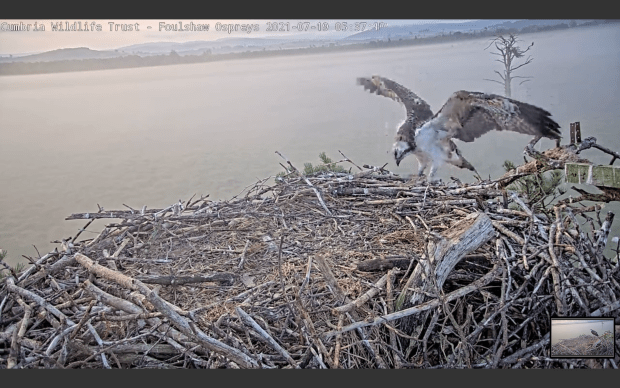
First up, Tiny Little on the Foulshaw Moss Osprey Nest successfully defended its fish twice against big sibling 462. I was shocked when Tiny Little used its wings to great effect to keep her from getting its late night meal. You would have thought it was the ‘Rumble in the Jungle’ Heavyweight Boxing match between George Foreman and Muhammad Ali. I say that because it was the strategy of Tiny Little. He put the fish (finally) in a place where it was secure. He could eat and 362 could not take it off the back by pulling. Then he fixed it so that he could eat fast and watch 362 out of his right eye. When 462 started coming close, Tiny Little just opened those great big wings of hers and started flapping. 462 backed off. This is a ‘big win’ for Tiny Little. She took a fish off dad to have it stolen but today she successfully defended her food until she was finished and walked away leaving a nice piece and tail for sibling 462. Tiny Little is getting the street smarts that Tiny Tot had earlier. Give her a round of applause. It is what is going to work in her favour and keep her alive. Well done, Tiny Little. So proud of you. Those big siblings will no longer intimidate you!

Sibling 462 staring down Tiny Little’s fish.

462 using some of Tiny Little’s early strategies: stare down the sibling, move in closer, create a distraction.

“Ah come on and let me just have a little bit. Oh, please. I am sorry for all the horrible things I did to you when you were a wee babe, Tiny Little.”

No!

I told you to get away! This is MY fish!

462 gives up and heads towards the perch.

Peace and quiet.

Tiny Little was able to eat comfortably after keeping sibling 362 at bay twice.

After eating for about forty minutes or longer, Tiny Little cleans her beak. 462 is watching and wondering if there is any fish left. Tiny Little did a great job self-feeding under that pressure. She left her big sibling a good portion of fish by the tail and the tail. It worked out well for both and both went to bed with fish in their crop.

At 20:12:26, 462 flies away with the piece of fish towards the parent tree. You can see her dark wings heading toward the tree between the nest and the tree. Looks like a black line on the fields. That took Tiny by surprise but no matter. You can see his crop is nicely full. You will have sweet dreams tonight Tiny Little. Congratulations. Every day you show us that you are learning to take care of yourself.

The second big event is that Zenit, the little Golden Eaglet, now a Big Golden Eaglet, has branched and fledged on the same day. This is so fantastic. I hope that its life is long and that it has a great nest to raise its own family near Bucovina. My concern is the prey and the spread of Avian Flu H5 N7. The Golden Eagles are opportunistic hunters and when prey is low they eat what is available to them including a domestic cat – which Zenit did on the 23rd of July. He has had fox, roe deer, buzzards, a kestrel, and other small birds along with a host of mammals and parts of other mammals.

Lady Hawk caught the branching and the fledge for us.

Now just to have you know how many fish a great Osprey dad brings in, Richmond had, as of yesterday, brought in 600 fish to the Whirley Crane Osprey Nest in San Francisco Bay. Rosie brought in a Halibut so big that it took the three 4.5 hours to finish it off! Today Richmond brought in a Golden Trout and one of the fledglings was on the nest and grabbed it and dad at the same time. This happened around 3:05 nest time.

Poor Richmond! My goodness. I never thought I would see a chick jump into the air to grab a fish out of the talons. Look at Richmond, how strong he is to hold the fish and the chick. Incredible. Richmond is holding them up with a couple of talons!

I understand from my virtual friend and reader ‘S’ that there have been two fledges at the Patuxent 2 nest – and she believes she got to see one of those happening live. Congratulations! Those chicks did really well. The rangers that decided to put two fosters on a nest with only one chick made a great decision. Everyone is thriving.

It is hot and smoky in Alberta. Mom is shading the two Bobs. Birds need clean air, too. I wonder just how much this impacts their lungs — the smoke from all those wildfires? We have some smoke in our city today but not nearly what it was a couple of days ago but it is hot. And the birds have been emptying the bowls that have been left in the shade and are just now coming to the ones on the deck. It is 5:30 and the shade is covering them now.

It is really hot down in Red Deer and Legacy has a hard time getting in the shade and being cool at all. She had a nice fish meal at 3pm nest time.

It is so nice to see fish on these nests on a hot, hot afternoon!

I am not so impressed with the Collins Marsh Nest. The little one has been on its own trying to find shade for what seems like most of the day. If there was a feeding earlier I have missed it. Sadly, over and over again, these nests remind me of Cowlitz. Now with the extreme heat and the drought and the height of this nest. Well, I wish for a good outcome.

The mother has shaded it a bit. I wonder if she is out fishing – that was what took the life of the last chick on the Cowlitz nest – heat stroke. It had a full crop. This chick, unfortunately, doesn’t have that.

Thank you so much for joining me. It is a hot day out in Bird World. I feel for these beautiful Ospreys as droughts set in areas where they have their nests. Let us hope that cool air will come! And rain.

Take care everyone!

Thank you to the following for their streaming cams where I take my screen shots: Collins Marsh Osprey Nest, Fortis Alberta Red Deer Osprey Nest, Fortis Alberta Exshaw Osprey Nest, SF Bay Ospreys and Golden Gate Audubon, Cumbrian Wildlife Trust and the Foulshaw Moss Osprey Nest.

An evening with Big Red, Arthur and the Ks

If you hear the name Ferris Akel, you might recognize the individual that gives a regular Saturday afternoon virtual birding tour of the area around Montezuma National Park, Wildlife Drive, Sapsucker Lake, and the Cornell Campus at Ithaca. Ferris also surprises us with ‘pop up’ tours of the Cornell Campus at other times so that he can see what is going on with Big Red and her family and share it with us. Tonight, we got a special tour and were able to see all four members of the Big Red family.

For those of you unaware, Big Red is a Red-tail Hawk. Red tail hawks are easily identified by their bright orange-red tail feathers once they are adults. The females are larger by approximately 30% than the males. This is called reverse sex size diamorphism. Red tail hawks have amazing eye sight. They will scan for food while they are soaring or are know to sit quietly on a perch for long periods of time watching for their prey. They will immediately fly to get it. Unlike the Peregrine Falcons who take their prey in the air, Red tail hawks normally fly down and get their prey on the ground. They do not normally eat carrion (dead animals) unless they are really starving. Their wing span is 1.2-1.5 metres for both males and females or 3.9 feet to 4.9 feet.

Big Red is a huge celebrity within the birding community. Big Red is now 18+ years old. She was banded near Ithaca, at Brooktondale, on 20 October 2003. Her current mate, Arthur, hatched in a territory next to the Cornell Campus in 2016. He has been Big Red’s mate since her mate, Ezra, died in March 2017. Arthur was first spotted visiting the nest in April of 2017. Big Red and Arthur were an ‘item’ by the fall. Their nest is on one of the light boxes across Tower Road from the Fernow Building. This year they hatched three chicks, the Ks. Two of the three fledged – this is the only time that Big Red did not have all of her chicks that hatched fledge. K2 sustained an injury to her right cheek and beak in the nest and had to be euthanized. She would never have been able to live in the wild nor would she have been able to have any quality of life in captivity. The two surviving chicks, K1 and K3, have already proven themselves to be excellent flyers and it looks like K1 has already had some successful hunts.

K3 on the nest. 21 June 2021. She was taken into care the following day.

Big Red was named after the territory she dominates, the Cornell Campus. She is also a large Red-tail Hawk with a lot of the beautiful rusty brown colour and bring orange-red tail feathers. In the image below she is beginning to become ‘Big Blond’ as she is moulting.

She is the matriarch. It is estimated that she has probably hatched chicks for fifteen years. Ezra was probably her first mate. If she hatched three chicks per year, that means that she has fledged 44. That is an incredible record! Sadly none of the chicks were banded so there is no knowledge of their whereabouts or status. A small number are known to have died after fledging. One was injured and is an ambassador bird for Cornell, E3.

Big Red is noted for her very dark plumage and that amazing red feathered apron.

Ferris first spotted one of the Ks on a light tower.

Big Red was spotted on the Water Cooling Plant.

You can see that her feathers look a little ruffled, untidy. This is the moulting.

Those piercing dark eyes just make you melt.

Can you spot the hawk? Seriously I believe that Ferris Akel has ‘hawk eyes’!

Oh, look it is Arthur! He is Big Red’s mate and is one of the most amazing hunters I have ever seen. He is also moulting!

This is K1 looking out. She is a really good flier and is also believed to have already made a couple of ‘prey kills’. Yesterday she had a little chipmunk and was doing a war cry when K3 came around hoping to get some of it. Normally if the bird is war crying they are the ones that caught the prey and will not share! Even if it is their cute little brother.

At first Ferris and the gang were not sure but once we saw the stripes on the tail, we knew it was K1. K3 has a muddy tail almost verging on red – a first for all of Big Red’s chicks.

K1 is gorgeous and very dark. These images are soft not because Ferris could not focus but because of the heat shimmer off the buildings.

And here is cutie pie, K3. All those little third hatches just soften my heart.

Oh, you wanted your sister to share her chippie and she told you to go and catch your own! Poor little thing.

And that was a wrap. Ferris persisted in finding all of the Ks and trying to get some good images of them despite the heat shimmer and the fact that it was getting dark.

Good night Big Red, good night Arthur, good night K1 and K3.

Big Red and Arthur are moving the Ks around the buildings on the Cornell Campus. They can now be found around the Water cooling buildings, Bartels, and across the ravine. It will not be long til they have them out by the buildings with the cows and the open fields. It is part of their training – enlarging their territory bit by bit. How do they do thus? Food is a great motivator and the adults will carry prey to different areas of the campus and the Ks will follow! It is that easy.

If you see the hawks coughing and shaking their heads and necks and something gets ‘thrown’ out of their mouth, this is called a ‘cast’. It is the bits and bobs of the prey that cannot be digested that is sort of compressed into a small pellet. The raptors cannot digest this and so they throw it up. This is properly called ‘casting a pellet’. This is with the exception of the owls that have a gizzard for digesting these parts of the prey.

It is now getting towards the last week of July. The Ks will be with us for a bit longer. I remember last year. Once J2 and J3 had been catching their own prey around the barns they began soaring. It was not long after that that J3 went poof and was gone with the winds to be followed by J2 the following day.

The last bit of news this morning is that Tiny Little and siblings were fed by White YW (dad) this morning. 462 was first followed by Tiny Little.

It is now around tea time, late afternoon, and Tiny Little has been like a ducking food crying in the nest for a bit.

Thanks so much for joining me. It was a great evening with Big Red and the Ks. They are progressing so well towards their own independence. Sadly, they do not get bands and we will not know where they go or what they do. Lucky for us Tiny Little is Blue 463! Take care all.

Thank you to the following for their streaming cams where I took my screen shots: Ferris Akel’s Livestream and Cumbrian Wildlife Trust and the Foulshaw Moss Osprey Nest.

Sadness on Channel Islands Bald Eagle nest and other news from Bird World

There is sad news coming out of the Channel Islands Bald Eagle community. The male eagle, A64, Spirit, devoted mate to Cruz, was found floating in the ocean near Fraser Point on 21 July. The report stated that there appeared to be no traumatic injuries. Spirit’s mate, Cruz, has been seen at their nest. Condolences to all.

Deb Stecyk made a great video of this wonderful couple in 2018. Here it is:

The gusts have really been whipping the Fortis Alberta Exshaw Nest around this afternoon. For awhile it looked like the two chicks might get blown off. Mum was food calling and looking in the sky and you sure had a lot of sympathy for dad trying to fish and feed his family this afternoon. The weather station reports that the winds are blowing at 21 km/h. The gusts appear to be more than that. Hang on everyone!

Of course, you can’t even tell there is a breeze in a still photo!

The chicks are doing well on this nest. There seem to be no worries.

The wind was not blowing at the Fortis Alberta Red Deer Osprey Nest. Just look at how big and pretty Only Bob is getting! It really does help to be an only chick.

As the day heats up, Mum is making sure that this little one is good and shaded from the pounding heat of the sun.

The Only surviving Bob at the Collins Marsh Nest had a nice crop this morning. It is really, really hot on the top of that old wildfire tower. Both Mum and chick are really panting.

It was really nice to see a nice big crop on this little one today especially with the heat.

Tiny Little had breakfast and had an evening meal. Mom flew in to help but looks like Tiny Little did a pretty good job cleaning up. Our little one decided to sleep duckling style on the nest tonight. I like to think that all those lines are golden rays shining down and protecting this wee babe.

Other news coming out of Welsh Osprey nests is from Llyn Clywedog, the nest of Dylan and Seren. Only Bob, Blue 496, today flew from the nest with a good sized fish attached to its talons to eat it elsewhere. It is not clear if this is a first for Only Bob but it sure could be. Well done! Another milestone.

This is so fantastic. Dylan and Seren can be very proud of their 2021 fledgling Blue 396. He is doing so well in all aspects – flying, self-feeding, and now flying with a fish in talon. All good prep for migration.

As you probably know, the mothers leave before the fledglings and dad. They normally take off for Africa (or Spain or Portugal) two weeks before everyone else. Seren has been photographed in The Gambia. Dad will stay behind and feed the fledglings. When they take off and are all on their way it is only then that the male will leave. Everyone knows what a treacherous undertaking migration is. This year only 80% of the Ospreys expected to return did so in the UK (according to Tiger Mozone’s data). That is low. Normally it is 90%. We will begin to look for their return the third week in March. Normally Blue 33 and Maya are one of the first couples to get back to their nests. I can’t wait. There is something adorable about these little fuzzy bobble heads turning into reptiles and then getting their juvenile plumage that warms your soul.

My last report comes from Dr Ericke Green at the Montana Osprey Project. Him and his team have now visited 200 Osprey nests along the Clark Fork River. They note that the water in places is less than half the normal amount. The heat has persisted for more than a month, the water is hot, and the fish are dying. This is bad news for the Ospreys. Green noted that the chicks that they ringed were in good shape, regardless. He said that when they were on the Flathead Indian Reserve north of Missoula they found some nice healthy chicks living in nests lined with Bison hair! The nest is close to the Bison Wildlife Refuge. Wouldn’t that be soft and cosy?

Do any of you know what has happened in the Barlinecka Forest’s Osprey Nest in Poland? I have written to the Polish Committee for the Protection of Eagles that ran the camera. It has gone off line. There were two chicks on the nest – chick 1 hatched on 25 May and chick 4 hatched 31 May. Eggs 2 and 3 did not hatch. That is a massive difference in age! If you know anything about the status of these birds please let me know. I haven’t had a response yet from Poland. I will share it if I hear.

I want to thank all of you for joining me today. It is always a pleasure to have you with me. It was helpful to hear Dr Green say that this year’s osprey chicks in Montana have done well despite the drought that is encompassing so much of that area and ours in Canada. Take care everyone. Tomorrow loads of images of Big Red and the Ks.

Thank you to the following for their streaming cams where I get my screen shots: CarnyX Wild and the Llyn Clywedog Osprey Nest, Cumbrian Wildlife Trust and the Foulshaw Moss Osprey Nest, the Collins Marsh Osprey Nest, Fortis Albert Exshaw Osprey Nest, and the Fortis Alberta Red Deer Osprey Nest. I also want to thank the Montana Ospreys at Hellgate FB Page where I grabbed the image of the Osprey chicks in the nest lined with Bison hair. They hold the copyright.

Late Thursday and early Friday in Bird World 22-23 July 2021

The Royal Albatross ‘Cam Princess’ for 2021, Taiki, was banded on Taiaroa Head, New Zealand on 22 July. Taiki is Maori and means ‘protector of the land and sea’. She now has a permanent metal band with a unique number to her and a white plastic band with the number 60 on it on the other leg. The white designates the chicks that were born this year. All 34 of them will get a white band. When they return to land, after being at sea from 4-6 years, they will receive the adult colour bands. For example, Taiki’s mother is Lime-Green-Lime (LGL). Can you imagine being at sea and only returning to walk on the ground after being away for all that time?

Here is an image of Ranger Sharyn putting on the bands.

And here is the video that the Cornell Labs did of the entire banding session.

It is unclear how many fish came up to the Collins Marsh Osprey Nest today. ‘S’ noted one medium fish. I did check in on the nest and caught the chick standing. That is very good. It is getting its juvenile feathers and it is beginning to get strength in its legs to walk and stand up. Excellent.

One of the most beautiful times of day at the White-Bellied Sea Eagle nest in the Old Ironbark Tree in Sydney is early morning. The forest is waking up. You can hear all the birds singing including the Sulphur-Crested Cockatoo, the Noisy Miners, and the Currawongs. We are just getting a trade off on incubation duty (I believe) when I checked the nest. We should be on hatch alert in a couple of days!

It is so calm and peaceful in the forest. No one is allowed inside this restricted area other than the Rangers and specific staff of the Discovery Centre.

Here is another hand off around 13:30 this afternoon.

The adult plumage is this beautiful slate blue grey with a white head and underbelly. The juveniles are the most gorgeous rusty-espresso.

I want to give you the link to the Sea Eagle camera so that you can start watching. It is very exciting. The little ones are fuzzy white when they hatch. So cute.

It is 4:59 and Tiny Little has already flown off the Foulshaw Moss Osprey Nest.

Just looking at that nest reminds me how grateful everyone was when Tiny Tot stayed around the Achieva Osprey nest for so long. In fact, for four months we got to enjoy seeing that wee one grow up. We saw her change from the beaten, pecked, and starved little one to a ferocious independent fledgling. What a gift we were given! We never know how long we are given with these ‘special survivors’ so we have to savour every minute. Tiny Little will, no doubt, return to the nest when there is a fish drop unless the parents begin to feed the fledglings off nest.

Ah, and before I stopped writing it seemed like a good time just to check on that Foulshaw Moss Nest again and guess what? Tiny Little is there with another sibling waiting for the breakfish drop!

Tiny Little, 463 on the left and 462 on the right.

And they both got their wish!

Some good news was posted today. Seventy eggs of the Black Foot Albatross from Midway Island were transported to Guadalope Island, Mexico. I mentioned this in an earlier blog last week. It has now been confirmed that all 70 of the eggs hatched and all 70 of the chicks have fledged. You can’t get any better than 100%.

One of my friends and readers lives on the Hawaiian Islands. She mentioned the colony of Albatross Hawaii they have. That reminded me to introduce you to a very special person who founded the Kauai Albatross Network.

Her name is Hob Osterlun. In this short clip, she is doing a one person play on her life as a nurse for nurses and doctors and she talks about how the albatross changed her life.

That short video, Kapuna Life, mentions Hob’s book, Holi Moli. I recall the first time I read it. I devoured the pages reading from late in the evening to the wee hours of the morning.

So many of you reading my blog have been moved by ‘the birds’. Whether it was during the pandemic or before, a two legged creature with feathers – that fly or not (we can’t forget about the Kakapo) – touched you in a way that is probably hard to describe. For Hob Osterlund, having that Laysan Albatross touch her foot was extremely powerful.

Here is a beautiful video about Hawaii and the Albatross. It is an hour long. Watch pieces of it or the whole thing when you have time. These are such beautiful birds. Hob never gets tired of talking about them!

It is a scorcher in southern Manitoba and Winnipeg today. Yesterday my daughter and her sons got to see an Osprey dive for its fish at Lake Winnipeg. She saw the nest using binoculars with its two chicks, too. We have a number of Osprey platforms placed by Manitoba Hydro around Victoria Beach, Grand Beach, Grand Marais and on the way to our Iceland city, Gimli. How lucky they were!

Thank you for joining me. Stay safe everyone! Stay cool. Remember to leave water out for the birds.

Thank you to the following whose streaming cams I use to get my screen shots: Cumbrian Wildlife Trust and the Foulshaw Moss Osprey Nest, Collins Marsh Reservoir Osprey Cam, Cornell Bird Lab and NZ DOC, Sydney Sea Eagles, Australian Bird Life, and the Discovery Centre.

Thursday Morning in Bird World

Living on the Canadian prairies, we know that spring is coming when the Canada Geese return from their winter migration. Indeed, Canada Geese are usually one of the first birds to arrive. You can hear them honking flying overhead in their large ‘V’ shape formations. They arrive in late March and stay with us until late October or November.

Like other bird species, Canada geese bond for life. They also return to the same nesting site year after year. That is the sad part. Our City is growing so fast that to see these beautiful creatures laying their eggs on dirt in the midst of broken up pieces of concrete on a building site is a tragedy.

It is spring and these geese have arrived at one of our nature centres, Fort Whyte.

You can easily tell a Canada Goose from other geese with its long black neck, its white chinny chin chin, its black legs, and light grey-brown underparts and wings.

I had gone to the park near me to put up signs not to feed the birds bread. A group of the geese came over to see what was on offer and, when they saw corn and peas, they grumped at me. These geese are so used to eating bread that they will shun the food that is good for them! That is sad. The bread makes its way into the water and decomposes creating horrible algae.

This guy was particularly offended by an offer of peas! Geese will hiss and if you get close to their nests or goslings they can bite really hard. Be forewarned!

In the fall, there are several places where you can go – including the Fort Whyte Nature Centre – to see them fly in and land on the pond. There are thousands of them. The sky fills up with the silhouettes against the orange and pink at dusk. It is beautiful.

Our nature centre had – until the pandemic – an annual Goose Flight Dinner. It was a charity event with a great meal and an opportunity to see the geese up close flying in. I had my phone. There are geese in the apricot background but they are too difficult to see. So close your eyes and imagine a black blur honking.

Have you been following the love geese? Their names are Arnold and Amelia.

On 13 July the staff at the Cape Wildlife Centre in Barnstable, Massachusetts noticed that one of the geese that lives on a pond behind their centre had a limp. The staff knew the wild bird and wanted to help. The goose was caught and it was determined that he had two open fractures in his leg. The staff explained that an open fracture means that the tissue and skin are pulled away from the bone. You can see this in the top right photo. Their best guess was that a snapping turtle had harmed Arnold. Arnold had surgery and while he was recovering, there was a tap tap at the door. It was Arnold’s mate, Amelia. Amelia waited for the surgery to be complete watching Arnold from the glass window.

@ Cape Wildlife Centre

The couple became instant celebrities. Who doesn’t need a warm fuzzy story these days?

Arnold is healing nicely. His bandages get changed and he is getting stronger. Amelia comes to visit him every day, looking in the glass door of the porch. The staff were so moved by the devotion of the geese to each other that they fixed up a pen so that Arnold and Amelia can share a meal. The good news is that Arnold will be moved to an outdoor pen once he has finished his medications. He will be returned to Amelia and the wild once his foot has completely healed.

Wow. That puts a smile on your face! Everyone loves a love story – especially if it is two birds – ‘love birds’ or is it ‘love geese?’

@ Cape Wildlife Centre

Some quick Osprey news. At the Foulshaw Moss Osprey Nest, Tiny Little slept like an adult on the perch. White YW (dad) brought in three fish so that everyone could have a nice meal during the day. That is fantastic.

After calls for emergency numbers, I received an e-mail from Katherine at the Patuxent Osprey Nest 2. They have now included the park e-mail at the top of the streaming cam. This is fantastic. There is no phone at the park that is operable 24/7.

I still recommend that everyone who watches particular nests make their own list of emergency numbers so that if you see something happening you can act quickly.

Here is a better look at that Patuxent Osprey nest as it sits in the water. Thanks ‘S’ for sending me the time stamp! Gosh, that is a really nice place for a nest.

When I checked the Foulshaw Moss nest last, no one was home! Tiny Little is out working those wings. That is fantastic.

Thank you for stopping in today to check on the birds. Everything appears to be fine on a Thursday morning in Bird World. The Osprey fledges are working their wings and getting stronger in the UK. There are still chicks to fledge there and in the US. No doubt there will be a flurry in the next couple of weeks. Take care everyone. Stay safe. I will be checking on Tiny Little throughout the day!

Thank you to the following for their streaming cams where I grabbed my screen shots: Cumbrian Wildlife Trust and the Foulshaw Moss Osprey Nest and the Patuxent Park Osprey Nest 2. Thank you to the Cape Wildlife Centre where I grabbed the images of Arnold and Amelia from their FB Page.

Good Morning Ospreyland

I have a friend who lives in the Northeastern United States. She has a beautiful garden and loves her songbirds. She also adores Big Red, Arthur, and their chicks. Wicky and I often get really down in the dumps over the direction that environmental policies are going. Then we see something and begin to believe that there is hope that all this heat, drought, flooding, birds falling from the sky, etc will pass. We need one another – for on the day I am down, she is up and vice versa!

Today Wicky sent me a quote from Jane Goodall that I would like to share with you. I am including the interview in the New York Times that she sent as well. I hope you can open it.

“Traveling the world I’d see so many projects of restoration, people tackling what seemed impossible and not giving up.”

I am always impressed with how New Zealand develops positive policies for their wildlife. Another area that is doing that is Scotland. Here is a short early morning BBC programme on the restoring of the landscape at the Cairngorms National Park. I am including some images of the park for you so that you get a glimpse of the type of landscape being restored.

“Cairngorms” by wwarby is licensed under CC BY 2.0
“Cairngorms” by chuckrock123 is licensed under CC BY-ND 2.0

Of course, my interest is the Ospreys and this is the home to the Loch Garten Ospreys. It was the first place that the Ospreys returned to in the UK in the 1950s. It was the home of the Lady of the Loch, that female, often called the Norwegian by Tiger Mozone whose DNA, according to Tiger, is in every UK Osprey except for CJ7. Lady was the foundation stone.

The image below is of that historic Osprey nest that is still used.

Sadly this year there were no Ospreys breeding at the nest. I might be remembering this wrong but it seems to me that two birds arrived at the nest and people in a canoe or kayak got too close trying to take photographs and the birds left not to return. (I hope that I am not remembering another nest – I could be so feel free to correct me, please!). Fingers crossed for next year! Here are some images of the loch. It is freshwater and is full of trout. We know that Ospreys love their trout. Dylan flew 13 km to get trout for the Clywedog Nest with Seren and Only Bob a week or so ago.

What an incredible sunset.

“Sunset at Loch Garten” by chuckrock123 is licensed under CC BY-ND 2.0
“Loch Garten” by Cairngorms National Park is licensed under CC BY 2.0

This is that short programme with Ade Adepitan, MBE on the restoration of the natural environment in the Cairngorms:

It is now approaching 11pm on the Canadian Prairies. The Osprey nests in the United Kingdom are just waking up.

Good Morning Tiny Little! I wonder if you dreamed about flying?

Totally serene image of Loch of the Lowes. No one sleeping on the nest. On occasion NC0 or one of the fledglings will appear on the nest but for the most part the camera remains fantastic because sometimes you can see the Ospreys fishing in the loch.

Aila did not return from her migration. Louis waited and waited refurbishing their nest. When he could wait no longer he paired with a new female. They raised two chicks on another nest off camera. The new Mrs Louis is Dorcha. When the two chicks were ringed on 15 July it was believed that they were 4-5 weeks old and are both are believed to be male.

Beautiful Manton Bay Nest of Blue 33 and Maya. The camera will be shut off soon and we will have to wait til the Ospreys return in March. Normally Blue 33 and Maya arrive within an hour of one another. Just think – they travel 4000 miles and arrive in that close of time. It is unclear if they winter together in the same place.

The beautiful morning turned into a day of defending their nest for Blue 33 and Maya. Poor birds.

What a beautiful morning – just look at that pink sky and the green of the landscape – at the Dyfi Nest of Idris and Telyn. I can’t see a fledgling but it sounds like one of them is scratching on the microphone of the camera!

The cameras have not come on at the nest of Dylan and Seren but, wow. I found an 11 minute video shot by a photographer of Llyn Clywedog. We can get a really good look at the loch where their nest is located. It is like you are going for a walk around the water. Very restful.

It is now a sunny afternoon at Llyn Clywedog and no one is home! It is quite understandable why the owners of these streaming cams will be turning them off in the future!

Tiny Little made a short flight from one side of the nest to the other. She spends a lot of time looking down over the edge. Did someone tell me that birds are afraid of heights? Yes, they did. It was someone at the Cornell Bird Lab years ago. It is one of the reasons the little ones don’t often fall off the edge of the ledge nests.

Tiny has spent a lot of time sitting on the edge of the nest looking down.

It’s tea time at the Foulshaw Moss Nest. 463 has joined Tiny Little who is food begging. His crop is pretty flat. Good luck Tiny!

At 16:32 Dylan flew in with a live fish which 464 promptly mantled. Let’s hope mom is around to feed some of that fish to Tiny Little!

White YW is out of there as 462 flies in for the fish. This is going to get interesting. It is still alive! Good lessons.

Oh, we had a little rain and a thunderstorm during the night. It is still really cloudy and, despite the 27 degree heat, one can imagine it is cooler!

Thank you so much for joining me. It seems that everything is going along as it should with the UK Ospreys – save for our little darling Tiny Little who needs some confidence. It will come. They are all individuals. Have a wonderful start to your week. Take care. See you soon.

Thank you to the following for their streaming cams where I took my screen shots: Cumbrian Wildlife Trust and the Foulshaw Moss Osprey Nest, Scottish Wildlife Trust and Friends of Loch of the Lowes, Scottish Woodland Trust, LRWT, Rutland Water and the Manton Bay Osprey Nest, Carnyx Wild and Llyn Clywedog Osprey Nest, the Dyfi Osprey Project, and Bywyd Gwyllt Glaslyn. A big shout out to Wicky for sending me the Jane Goodall interview!

Late Saturday and early Sunday 17-18 July in Bird World

If you have watched Kindness, the Bald Eagle nestling at Glacier Gardens, then you might have caught her nipping at her mum’s beak. It looks like she is trying to kiss mum. A couple of days ago a video was made showing Kindness interacting with her mum. My goodness, Kindness, you are lucky your mum is so patient! Have a look.

At the Port Lincoln Osprey barge, it looks like the final touches have gone on the nest renovations. The egg cup is now lined with very soft pieces of bark. Mom decides to try it out!

Dad flies in with something else on his mind! No eggs yet but mating is taking place. Season will begin soon!

As we approach fledging at all of the Northern Hemisphere Osprey nests and migration in a month to six weeks, if you fear Osprey withdrawal, here is the link to this nest. Just a warning. This nest has had instances of siblicide in the past.

The Port Lincoln’s eldest chick from the 2020 season, a female named Solly, was fitted with a satellite tracker. Solly is 301 days old and she is still hanging out at Eba Anchorage and Kiffin Island. It sure seems that Solly has found her forever home at Eba Anchorage. For those of you unfamiliar, the movements of Solly changed what everyone understood about Ospreys in Australia. It was believed that ospreys stayed near to where their natal nest was located. Solly travelled over 200 km to Eba Anchorage and Perlubie giving the researchers fresh insights to the behaviour of these ospreys.

To my knowledge there has been no sighting of DEW, her younger brother. He did not receive a tracker but he did get a metal ring and a Darvic colour band.

Suzanne Arnold Horning was on the Cornell Campus again this evening. How lucky she was to get some great images of Big Red with a squirrel down on the ground – and it wasn’t raining. (Send the rain to the Canadian Prairies when you get tired of it, Suzanne!).

It was wonderful to see Big Red with prey that she was going to eat herself. She needs to build up her strength after laying eggs, incubating those eggs, and feeding and caring for the three Ks until fledge. Even now she is doing some prey drops and is busy training the Ks to hunt.

Big Red with Squirrel. @ Suzanne Arnold Horning

The Robins were giving Big Red a lot of grief. Could it be because Arthur has been up at their nest eating their babies? Or the fact that K1 caught a bird today and it was rumoured to be a young Robin?

Robins being rather assertive around Big Red. @ Suzanne Arnold Horning

Big Red and her squirrel also attracted another visitor – a Turkey Vulture!

Would you mind sharing asks the Turkey Vulture. @ Suzanne Arnold Horning

The pair also attracted a human who was said to have tried to interfere with the situation. Both of the birds were fine. Big Red was eating and the Turkey Vulture appeared to be waiting to see if she left anything.

One of the things that I have learned is that hunting is difficult and prey is not abundant always. Raptors can wait for hours, half a day, or even a day to catch prey to eat. It is estimated that only 1 out of 3 juveniles live to the age of two years – mostly due to starvation. Humans should not interfere when a raptor is eating. As a result of the human intrusion, Big Red chose to fly away from the human who was interfering. This also caused her to leave part of her meal. The vulture did eat the rest – so in the end everyone ate- but it was a situation that should never have happened. Remember if you see a hawk hunting or eating, please leave them alone. Finding their meal is not that easy.

Turkey Vulture at Cornell. @Suzanne Arnold Horning

The scientific name for the Turkey Vulture – Carthartes Aura – means ‘cleansing breeze’. They are scavengers, eating mainly carrion. They have dark espresso coloured feathers, red legs and head, with a white beak. Like the condor, there are no feathers on their head. This is a great evolutionary trait so that pieces of the dead do not stick to them causing disease or parasites. The Turkey Vulture’s sense of smell is so great that they can find a fresh killed animal a mile away! The only raptors larger than the Turkey Vultures are the Eagles and the Condors. What I find interesting is that they are the only raptor that cannot kill their own prey. They simply do not have the right talons to do this – their feet are more like that of a chicken. That said they can tear through really tough hides with their beak. In other words, the Turkey Vulture was never a threat to Big Red.

As I prepare to settle in for the night, Tiny Little is waking up. The early morning fog over the marsh is just starting to clear. You can see the parents, or siblings, or both back on the parent tree. Tiny Little is still sleeping like a duckling on the nest. Good Morning Tiny Little! Let’s get that gear box into forward today.

Tiny Little is also checking the nest for any little tidbits of leftover fish. And just like Tiny Tot he has found some lurking under those sticks.

Tiny Little was doing some prey calling and looking up in the sky. The morning fog doesn’t seem to be clearing. What a beautiful colour it is – that sort of golden pink gradually fading into the grey-blue-green. Lovely.

Update: Tiny Little had a huge breakfast. It is now mid-afternoon and Blue 462 is working on a fish that arrived. 464 is standing next to that fish and Tiny Little, 463, is ignoring it right now. She is probably still full enough from the morning not to bother. Unclear if Tiny Little has taken a second flight today. I stayed up waiting! But had to give in to being tired.

This is the image of the afternoon line up for a fish! 462 is eating, 464 is pretending to be Tiny Little and bugging his big sibling. Tiny Little is over at the side duckling style. Tiny Little is full from breakfast and knows that Mum will come to the rescue later if she gets hungry.

There is a beautiful peachy almost coral sky as the morning begins at the Poole Harbour Osprey nest. CJ7 and Blue 022 are roosting elsewhere.

Golden diamonds are falling on the nest of Blue 33 and Maya at Rutland Manton Bay. No one is home. They are all perched elsewhere. Blue 33 does make food drops at the nest for the two Bobs.

A little later, Blue 095 flies into the nest and settles down and then flies out again.

Blue 095

Oh, wow. Just look at that sun coming up over the Dyfi nest of Idris and Telyn in Wales. It is so bright you cannot see the perch!

A very short video of Ystwyth fledging at 7:59 am on 17 July is here:

It is serene up at The Loch of the Lowes. No one is home but it sounds like there is a fledgling on the camera perch.

What you don’t see here is that later, NC0 is on the nest, spots a fish, goes out and gets it, and gives it to LM2.

Early Morning at Loch of the Lowes. 18 July 2021

The only thing you can hear at Glaslyn are either bees or wasps on the microphone! Oh, it is so beautiful and green. It has been hot at this nest, 26-29 degrees C – and the birds are staying cool in the shade of the trees. Even with the heat the landscape looks so lush. What a gorgeous way to begin the day.

Early morning at Glaslyn. 18 July 2021

Thank you so much for joining me today. I so enjoy hearing from all of you. Stay safe! See you soon.

Thank you to the following for their streaming cams where I took my screen shots: Byrwd Gwyllt Glaslyn, Dyfi Osprey Project, Scottish Wildlife Trust and Friends of the Loch of the Lowes, Cumbrian Wildlife Trust and the Foulshaw Moss Osprey Nest, Poole Harbour Osprey Project, LRWT and the Manton Bay Ospreys. I would also like to thank the Port Lincoln Osprey Research Project and the PLO FB page where I took a screen shot of Solly’s recent tracking. And last but never least, I would like to say a huge thank you to Suzanne Arnold Horning for allowing me to use her images on my blog. She holds the copyright on them so please do not use elsewhere. Thank you.

Saturday 17 July in Bird World

I promised some updates on Big Red, Arthur, and the Ks. Right up front I want to thank Suzanne Arnold Horning for allowing me to share her images of Cornell’s birds with all of you. She lives in Ithaca and once or twice a day she heads out with her family looking for the Ks. Thank you Suzanne!

This first series is from 16 July. Both of the Ks are on the corner of this unidentified building. K1 is on the left and K3 is on the right at the corner of the building.

Isn’ she gorgeous? This is K1, the mini-Big Red.

On the 15th, the Ks were hanging out on Weill.

K1 is doing the hawk walk! So cute.

She stops and looks for her brother, K3, who has just flown away.

K3 flew over to the middle of the hockey rink roof and landed! Good gracious.

Later, K3 rejoins his sister on Weill.

Meanwhile, where are Big Red and Arthur?

Big Red is on top of the Cornell Clock Tower.

Here’s a much closer look at Big Red.

And here is an image showing the position of Arthur and the Ks. The green arrow is where Arthur is on the light stands and the purple arrows points to the corner of the Weill Building where the two Ks are located.

Thanks Suzanne for the arrows and the images. It is reassuring to know that everyone is safe and sound.

There is some other news today. K1 caught her own prey. I know it happened but I do not have an image I can show you. Of course, no one knows if this is the first time or not but this is incredible. She is certainly related to Arthur who is like the stealth bomber of hunting! And Big Red is really good herself.

The Ks will be leaving their parents territory in August. They need to be able to fly well and hunt. As you can see Big Red and Arthur have now moved them around Weill and other areas farther from the nest. Soon they will have them hunting in the fields out by the Holey Cow Barns. Why holey and not holy you ask? The cows have clear tubes inserted in their sides so that the students in the Vet School can see what is happening inside the cow’s body. I have to admit the first time I heard this I was quite happy not to be there seeing it. But then wow – how would these students learn otherwise?

Suzanne Arnold Horning also went out to the Cornell Osprey nests and took some images. She believes that the nestlings are about to fledge!

There is only one Osprey nest on the Cornell Campus. It is located on the university athletic fields on a light tower at the soccer field. The adults there fish in Cayuga Lake, Beebee Lake, and Six Mile Creek. Those are within a few miles of the nest. The adults are Olin and Olive.

Off the Cornell Campus there were 38 Osprey nests around the Cayuga Lake Basin. While it isn’t a steadfast rule, most male Ospreys do return to the area of their natal nest. I am assuming then that when Olin showed up as a bachelor and began building a nest that he had hatched from one of the nests around Cayuga Lake several years earlier.

Olin would fly around the soccer field and people began to wonder if he was going to build a nest on one of the light towers. He made several attempts with sticks at the Game Farm Road soccer field. Olin did attract a female – Olive.

The nest you see in Suzanne Arnold Hornings’s images is the new nest that was built for Olive and Olin.

There are three little ospreys ready to fly in that nest this year.

Don’t you just hold your breath when they are hovering? I do! Wings everywhere. Looks like Olive needs to duck.

The Hornings and the Sedlaceks wrote a lovely article about the first year with Olin and Olive. There are some good images. I will attach it below this. Olin and Olive originally had a nest on a light and it was precarious. This is a wonderful nest that was constructed for this Osprey couple. Just look at it. They figured out the height, the measurements the nest should be and made sure that it was storm proof. Amazing.

Here is the link to the article. Please read it, it is lovely.

https://sites.google.com/site/cornellssurpriseospreys/

On the earlier part of the Ferris Akel Live Tour, there was a lovely juvenile Cooper’s Hawk. I think I have a couple of reasonable good screen shots to show you. What a lovely bird. We have Cooper’s Hawks that come to breed on the Canadian Prairies in the summer. They are protected under the Manitoba Wildlife Act of 1994.

Indeed, when I first encountered the hawk that comes to my garden, it was not clear if it was an adult Cooper’s or a Sharp-shinned. Turned out to be a Sharpie Adult, Northern. Like the Sharp-shinned, the Coopers are a medium sized Accipiter. These are the green-blue-grey (or celadon if you want to describe them like a pottery glaze) of a juvenile. The eyes of the adult male are red and they have a white breast/belly with ochre streaking, blue-grey hood and wings. You can see those red eyes in the image directly below.

“Cooper’s Hawk” by airboy123 is licensed under CC BY-NC-SA 2.0

This juvenile might look like a Red-tail Hawk if you only saw its back. Like my Sharpie and the Red-tails, the length of the wings attributes to the silent stealth manner in which they hunt. They live in forests and even in urban back gardens and they need to be able to turn quickly which they can also do with their wings and their medium size. You can see those celadon eyes of this juvenile in the image below.

Look at the image below. Do not peek at their blue Darvic rings! Which one of those birds is Tiny Little?

It might be a surprise to you. Tiny Little is the bigger chick at the back!

I watched Tiny Little for several hours. He is absolutely hilarious. For awhile I wondered if he had forgotten how to fly. He hovered, he flapped his wings and he really wanted to go but he couldn’t get it in forward gear. But never mind. White YW brought a fish on to the nest and thoughts of flying went right out the window. Tiny Little was up to his old tricks. What you are seeing in the image below is the second sibling that Tiny Little has tormented over the evening fish. BTW. Tiny Little had a huge breakfast! His MOD is to stare at the fish, then do some flapping, go back and stare and make the sibling nervous til they walk away and leave the fish. And guess what? He is really good at it.

Blue 464 gave up the fish! Because of his behaviour you will know which one is Tiny Little below but please look at the size and look at the other bird. This is the female, that big female that tormented Tiny Little, Blue 464. Unfortunately I took about 300 images of this nest today (maybe more). I have one of Tiny Little standing next to Blue 462, the male. 462 has the thinner longer legs of White YW. Tiny Little’s legs are stout like a female and she is a big bird.

Just like she wanted. Tiny Little gets a nice feeding by Blue 35. Indeed, I think the two of them shared almost half a fish after 464 and then 462 tried to self-feed.

Here is an earlier image of the Foulshaw Moss family minus Blue 464. White YW is on the front left. Then Blue 35 is next at the rim of the nest. Then don’t peek, which one is Tiny Little? If you said the one on the far right, you are correct. Now necklaces in themselves do not indicate a female but with those stout legs and her size. Well..

‘Silo’ chick on the Patuxent River Osprey Nest 2, the one who fell out of the nest into the water last evening, was up and moving about in the afternoon so everything seems alright there. Fabulous.

Thank you everyone for stopping in today to find out about the birds. It is great to have you with us.

Thank you to the following for their streaming cams where I took my screen shots or who gave me permission to use their images: Suzanne Arnold Horning for the images of Cornell’s Red tail Hawk family and the Osprey Nest of Olin and Olive, Ferris Akel Live Tour, Cumbrian Wildlife Trust and Foulshaw Moss Osprey Cam, and Patuxent River Osprey Cam 2.

Ystwyth Fledges and a shout out to those who helped the Patuxent Osprey chick

Yesterday was quite an anxious day with people all over the world staying up to see if the little osprey chick was saved at the Patuxent River Nest 2. In the flurry of the moment, a few people were not thanked who need to be. The first is Burky4 from the Achieva Osprey chat group. Indeed, Burky4 was the first person to mention that there were only two chicks in the nest in the nest in the Patuxent chat room. So this is a huge shout out to Burky4. Thank you! I will not know the names of everyone and I apologize – but another shout out to S Shen who then in her own words, “found the number of Tom O’Connell, director of the USGS Eastern Ecological Science Center (EESC). His business number went to voice mail which INCLUDED his cell!! Yay. I was able to text him and he gave the phone numbers for the 24 hour a day Natural Resources Emergency or Assistance.” S Shen says that another individual to be credited is Barnegat Light. I also want to thank Linda Kontol who got busy phoning numbers as well to try and get anyone’s attention after hours. I also want to thank the young man on the Wildlife Emergency Services Line again who got in touch with the Fish & Game people. It was a grand team effort and this chick might not be alive this morning were it not for the efforts of these wonderful citizen birders and government officials who worked to save this little one. And to everyone that was inadvertently missed, thank you! Tom O’Connell will be posting information on the actual individuals who went to the site this coming week.

The ‘silo’ chick is the one that went into the water, the last foster chick to be put in this nest. It is the one in duckling mode. The chick has moved but has not moved a lot. It has had a lot of excitement. Let us hope that there is no damage from either of its falls.

Every day people watching nest cams move into action when they see an animal in distress.

S Shen reminds me again how important it is to have emergency numbers readily available. She said that several years ago she noticed a chick in a Lake Barkley, Kentucky nest entangled in fishing line. There was no chat room so she went to the nest’s FB page and remembered the name of one of the chatters who said they lived close to the nest. She tracked down their phone number and called them. That person, ER, managed to get someone up to the nest and the chick was saved.

I remember that my mother had a list of emergency phone numbers for everyone helping her just in case it was needed. It was on her fridge. Here are three suggestions and I am certain everyone reading this will have more. The first is if there is a chat room associated with a nest that it have a moderator 24/7 (these are volunteers) who have emergency numbers to call the instant something happens. The second is for anyone administering a streaming cam that the local emergency wildlife numbers appear right under the name of the nest so people can locate them quickly. And the third is for everyone who watches a nest to begin to gather their own emergency numbers to call for each nest and make their emergency list for their fridge, phone, etc.

In other Osprey news, if you missed it Tiny Little of the Foulshaw Moss fledged yesterday at 20:19:57. He slept alone on the nest duckling style last night and was up early looking around. It is just a beautiful morning in Cumbria as the sun slowly rises the mist gives way to a pink hue over the landscape.

Tiny Little was doing a lot of flapping and looking. I wonder if he realizes that he actually flew yesterday?

Monty and Glesni have a grandchick. Oh, they would be so proud. Four of their chicks are now breeding. Yesterday on the Pont Croesor Nest in the Glaslyn Valley, the Only Bob of Monty and Glesni’s son, Z2 Aeron, and Blue 014 was ringed!

Blue 494 is also the first chick to hatch in this nest so there are a lot of congratulations and happiness going around. The PC nest was controversial when it was positioned where it is. Many thought it too close to the Glaslyn Nest of Aran and Mrs G. Only time will tell how this works out. For 2021, Blue 494 is also the only chick to hatch at Glaslyn with the three little ones of Aran and Mrs G dying due to the circumstances surround the storm at the end of May and Aran’s injury.

And congratulations to Idris and Telyn on Ystwyth’s fledge today! Both of their 2021 chicks have now fledged. Well done.

Doesn’t that empty nest look nice? Ystwyth is 54 days old.

She is investigating the area around the cameras.

I have some great pictures of the Ks to share with you. I will get them organized this evening. For now there is a lot of happiness to go around. Once again thank you to all of those individuals who helped save the ‘silo chick’ at Patuxent.

Thank you for joining me this morning. It is another scorcher on the Canadian prairies. There is rumour of some showers but like everywhere else in Canada we could use some rain and the birds in my garden are probably wanting their bowls and baths to be filled.

Thank you to the following streaming cams where I took my screen shots: Bywyd Gwyllt Glaslyn Wildlife video on the ringing on their FB page, Dyfi Osprey Cam, Cumbrian Wildlife Trust and the Foulshaw Moss Osprey Cam, and the Patuxent River Park Osprey Cam Nest 2.

Tiny Little fledges at Foulshaw Moss!

Oh, my. No one was expecting it. 496 people were watching the streaming cam at Dyfi expecting Ystwyth to fledge and it was Tiny Little who beat her!

It had all been over a fish. Imagine a big fish on a nest and three juveniles. The fish came in around 19:00. 464 ate some of the fish at the beginning. Then 462 flew in and decided it was their turn. In the middle of all of this was Tiny Little trying to eat the tail, dig at the middle, twist the fish and gently unbalance his siblings.

For awhile they all give up. The fish just sits in the middle of the nest.

464 pulled it over to the edge of the nest and began self-feeding. 464 is a pro at this!

At 20:22 Tiny Little is watching 464. He moves over to the rim and food calls to mum.

At 8:19:57 Tiny Little lifts his wings and flies to the parent tree. I think he was tired of calling for mom to come and feed him! And then he proceeded to safely return to the nest at 20:22:07. Tiny Little flew like a pro. Tears of joy today.

Tiny Little returned to the nest and got curious about the fish and tried pulling it out. Hopefully mum will reward him…gosh, that was a smooth flight.

What a glorious day. Everything pales in comparison.

Thanks for stopping by and thank you to the wonderful folks at the Cumbria Wildlife Trust and Foulshaw Moss Osprey cam where I took these screen shots.