The following announcement was posted by the Ojai Raptor Centre. Our dear Victor is quite the trooper. He had a full body CT Scan – it must be stressful for him but the vets are going to try and find out why he cannot stand.
Thank you to ‘C’ for alerting me. Victor was with Lillibet on the nest. She flew up the branch. Victor has been much perkier this morning and he decided to fly up to the branch. Sadly, he has fallen. The time was 11:09:08. Thank you ‘C’ for your diligence.
Victor is alive! His wings helped him! He is in the top left corner in the image below.
Thank goodness for small miracles.
This is the link to the Fraser Point Eagle Cam and the chat where you can stay informed about how things are going. Dr Sharpe will be out there tomorrow. Hang in there Victor.
I want to start by putting a smile on everyone’s face. Ervie. The photo was taken yesterday around the North Shore where you will see that Ervie has caught a really nice sized fish – not a puffer! Thank you ‘B’ – I have been so preoccupied with Victor and a couple of osprey nests that I missed checking on Ervie since they posted his last tracking. — Good things happen to talons. They grow!
That is a beautiful fish and good form, Ervie! Does everyone realize that Ervie could be the best thing that happened to Port Lincoln tourism? Maybe, as a male, he will just hang around til he can take over the barge from Dad. Why not? There is lots of fish and he will not bother Mum and Dad – house rules.
Update on Victor, Sunday morning: Victor was active around 0619. He was doing some wing flapping and some hopping. He stood for a short while. He appeared to sleep better during the night.
This is the latest posting from Dr Sharpe about 42 minutes ago- 9am PST.
These are the images from this morning.
Andor and Mama Cruz are bringing in bedding for Victor. He was more alert. I understand that Dr Sharpe has approved a banner with a link for donations. If you have been wanting to donate, this is a great chance to support the wonderful work that Dr Sharpe does for these eagles on the Channel Islands. as ‘B’ and I were discussing, the only person we know that would work so hard to save this eaglet is Dr Sharpe. — I will also add that donations are tax deductible and you can give $100 and have it spread out over 12 months at $8.96 a month. You will get a beautiful thank you and a gift. Mine was an embroidered T-shirt and a super digital image of the nestlings of Thunder and Akecheta.
The information below on Victor comes from late Saturday.
Some close up images of Victor’s left leg and talons and a reminder of the many challenges and obstacles that need to be cleared away before Dr Sharpe can get the fledgling help.
Lillibet stayed with her brother – these two have always been close. They remind me of E17/18 and E19/20. It would be comforting for Victor to have his sister beside him. It has been a hard day to watch Victor. He has clearly appeared to be in pain. Hoping that Andor or Mama Cruz will feed him tomorrow.
Dr Sharpe is not the only person that is having trouble getting volunteers. Around the world it is the same – fewer and fewer people are stepping up to assist in the rescue of our wildlife. The high rise in the cost for everything has placed many who have helped in a situation where they cannot – fuel is one of those issues. I do not know a wildlife rehabilitation centre that is not overwhelmed in the middle of the summer. Every one relies on donations. It has been mentioned twice that Victor will need a place to go to get the care and treatment he requires. Will there be someone answer Dr Sharpe’s call for help if he gets permission to retrieve the eaglet. Will someone provide a boat? Is there a motel that will allow Victor in its rooms? Each leg of the rescue of eaglets in the Channel Islands has its many challenges and its costs.
I am actually starting Sunday’s blog Saturday night. It has been a roller coaster day in Bird World. The Osprey expert who is my go to -if I do not know the answer about an issue or who fills me in on the back story to everything happening in Osprey Land -sent me a letter. It said: “Isn’t it amazing how people are in denial about what is happening to juvenile ospreys?” It was ‘just the other day’ that ‘A’ wrote and said she will never look at an adult raptor the same – she now appreciates the struggle that they went through to live beyond their first year never mind to 8 or 10 years! As everyone reading my blog knows, ‘that list’ grows but, at the same time, I told my friend that there is a silent army out there working for the betterment of our birds and I meant all of you! Thank you for what you do for the birds – the smallest gesture can have the most impact.
Case in point. Just look at the Osprey nest below. The original one kept being destroyed in high winds. It was decided to consult some experts on design in order to shore up the nest and make it safer for the Ospreys on the Sunshine Coast in Australia. There is information in the posting below the image – but everyone there deserves a huge shout out. Well done.
Iris is, of course, a miracle. At the age of 28 or 29 she is as fit as they come. She is an excellent fisher and she continues to work on her nest in Missoula, Montana. and what a nest that is! Iris is an example that we should all follow – she eats well, has lots of exercise, and keeps herself busy. Iris is truly amazing and we are so glad that she is spending so much time this summer on this ever growing penthouse of hers because we get to watch. Beautiful wings, fabulous legs. By every measure she is a real senior but she looks like a fit youngster.
Mr President and Lotus teach Takoda life lessons since he is an ‘only’. They are doing a great job showing him how easy it is to steal his fish!
The four storklets are waiting for either Kaia or Karl II (or both) to bring some nice fish for breakfast. Frogs would be OK, too.
Bonus is squatted down on the left, facing right. He is fully transitioned into the family. The intervention appears to have been very successful – a rare Black Storklets life is saved by two people taking a chance on an idea – Urmas and Dr Madis V.
The climate is changing and it is having an impact on our feathered friends around the world. Warming seas, a shortage of fish, high day time temperatures. You name it. It is harming the bird’s ability to thrive. They are not birds but those cute little penguins that visit the Royal Cam chick on occasion are not the only New Zealand wildlife that could be having trouble.
‘H’ has reported that all three have fledged from the Carthage Tennessee Osprey nest. Congratulations everyone! That is fantastic news. ‘H’ also reports that there is really good hovering going on at the Mispillion Harbour Osprey nest. The kids are 52 days old and they were doing some super hovering as well as being nice to one another and trying self-feeding. Thanks, ‘H’. Like Ervie these two got forgotten with Victor’s injury.
All eyes are on that egg in the Chesapeake Conservancy nest of Tom and Audrey. The first hatch is doing fab…
So far it looks like at least 2 fish have come to the Osoyoos Osprey nest this morning. 07:28 and 08:11.
Dory and Skiff’s trio are doing fine as well. Lots of fish come to this nest. I would like to give one of them to Osoyoos sometimes. The chicks at both Osoyoos and Hog Island are getting feathers coming out of those shafts. Lovely.
That is a hop skip and a jump through the nests. Great news on Ervie. Always makes my heart stop – that Osprey! Thank you Dr Sharpe for all you do – this man needs to be given an award with a huge prize for all he does. Everyone else seems to be holding and doing good.
Thank you for joining me today. Take care everyone. See you soon.
Thank you to the following for their streaming cams and or F/B or web sites where I took my screen captures: Port Lincoln Osprey FB, Institute for Wildlife Studies, Explore.org and The Institute for Wildlife Studies, Bald Eagles Live Nest and News, Sunshine Coast Council, Montana Osprey Project, NADC-AEF, Eagle Club of Estonia, Mispillion Harbour Ospreys, Chesapeake Bay Conservancy, Osoyoos Ospreys, and Audubon Explore.
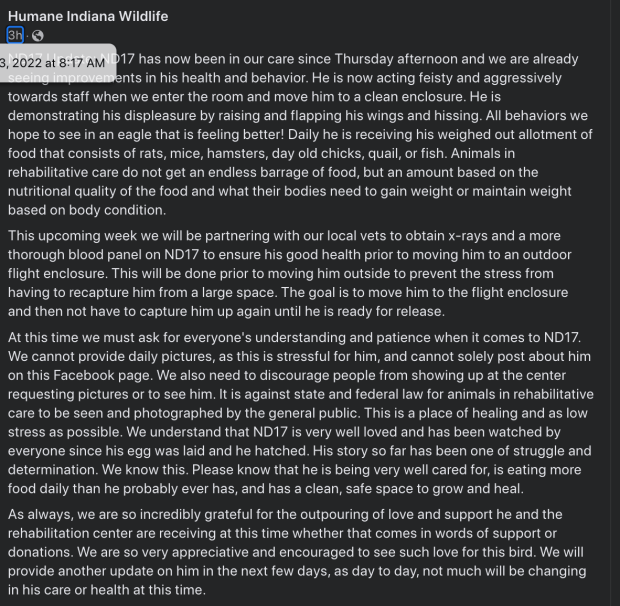
Humane Wildlife Indiana provided an update on Little Bit 17 this morning. Two things they note: Little Bit has stress lines in his feathers. I have mentioned this before. It is common in birds that have gone without food for the amount of time Little Bit did and also perhaps, the lack of nice fish and having to eat fur. Of course, then there is the stress from the siblings. Little Bit has each of you knows did not have an easy life on that nest. That is why we are all cheering him on and surprised that he lived. It is unfortunate that the clinic has to put up with people interrupting the important work they are doing to try and see him. I note that US Steel did not give the name of the rehab clinic that picked up USS5. Perhaps that is a protocol that all should adopt.
Yesterday I posted an image of WBSE 27 who spent more than 6 months in care – for a second time. Most rehabbers will say it takes a long time to train an eagle to fly and to hunt prey. It is very important that the last part of the training is undertaken. If the bird cannot hunt, he cannot feed himself. Other eaglets have also been released in prey rich areas away from the natal nest when their siblings are free flying with the parents.
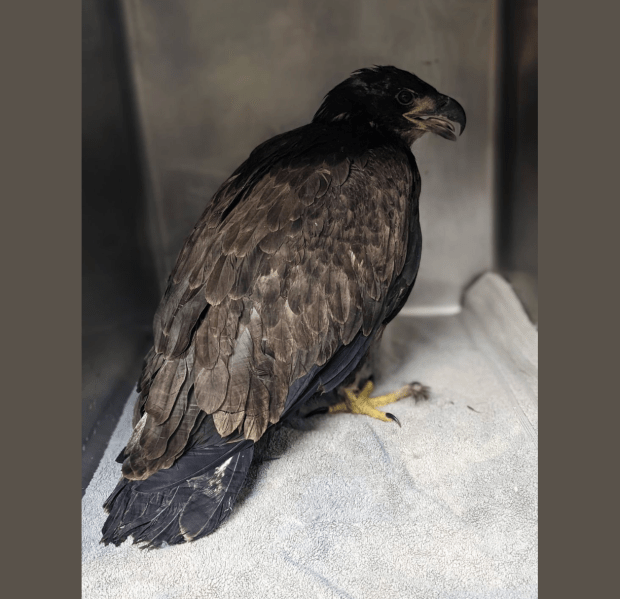
Oh, Little Bit. Do you know how much you are loved? Wishing you lots of quail and fish, a long and productive stay in rehab, and…if you can’t fly, a wonderful place where you can be an ambassador bird.
Little Bit 17 has extensive stress lines. You can see them easily. Was it from lack of food? lack of nutrition in the food? psychological stress? or all of the above and more?
I found a a short article and video on stress bars that go into a little more detail. For those of you that own parrots, you might have looked for these when you were either purchasing or adopting your bird.
The nest at ND-LEEF is disintegrating despite the fact that the adults continue to use it to deliver fish. This is a clear demonstration of how important the natal nest is for the fledglings. Most parents prefer to feed the fledglings on the nest. It is absolutely clear that Little Bit 17 could never have made it to the nest.
It is a very cute first hatch and Audrey is an old hand at taking care of osplets. So sweet. Here is Tom and Audrey’s first hatch of their second clutch enjoying a nice fish lunch around 1230. Holding that head up nice and strong.
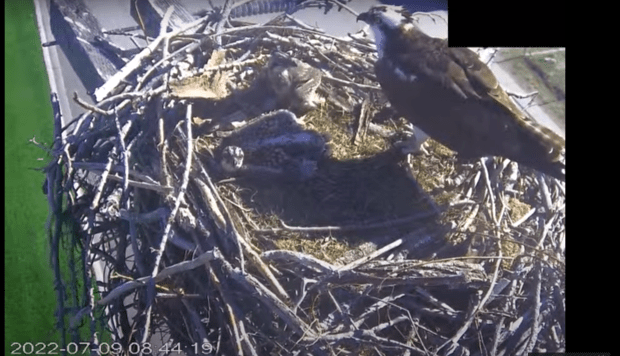
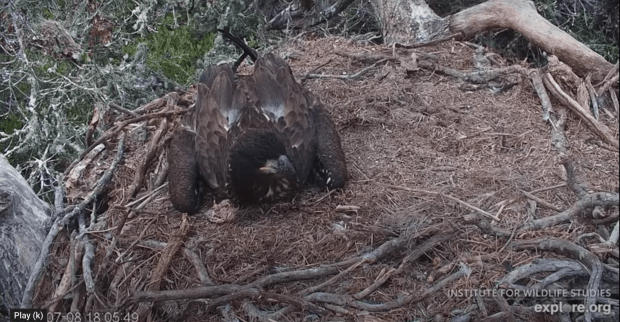
It is not clear what is ‘wrong’ with Victor on the Fraser Point Bald Eagle nest. He has definitely injured himself. He is not just tired.
There is chatter about a missing talon on the left foot. It is very hard to see in this image because of the angle but that looks like a possibility. However, I am reminded that Ervie had a missing talon and he was still flying, standing, and catching puffers.
There is a small fish under Victor. He cannot stand to self-feed. He is really, really struggling and it would appear that he is not able to stand – at the moment – for any period of time. Mama Cruz we need you to feed Victor his lunch!
Continue to send positive wishes to Victor.
Oh, oh. Mama Cruz is in but she is feeding Lillibet. It is a tiny fish. Will there be any left for Victor?
Last year at Osoyoos it was hot and the chicks died. This year there has been so much rain in the area and flooding that it might have impacted the fish. Hoping for some nice big meals on the nest for the two chicks and Mum today.
Dory and Skiff’s trio are doing great at the Boathouse on Hog Island. The kids are growing like weeds and I am completely impressed with this first time Mum. Just like I am with CJ7 at Poole Harbour. Fantastic to see Little Bob getting bigger.
Here is CJ7 and Blue 022 with their two very healthy and very big offspring. Wow. I am so happy for CJ7 and Blue 022 – it was one of those romances that everyone wanted to blossom – and for all the people involved in the translocation programme. A big shout out to Roy Dennis.
This is a very brief look at some of the nests we are watching. Continue to send warm wishes to Osoyoos and Fraser Point. Thank you for joining me this morning. Take care. See you soon.
Thank you to the following for their streaming cams and/or FB pages: Humane Indiana Wildlife, Chesapeake Conservancy, Explore.org and The Institute for Wildlife Studies, Osoyoos Ospreys, Explore.org and Audubon, and Poole Harbour Ospreys.
You need to know about the presentation and we have all been waiting for an update on Little Bit 17. Of course, we do not need any more bad news in Bird World.
First. I have just been notified that Alan Poole’s excellent discussion about North American Ospreys will be taken off YouTube in 8 days. This is extremely informative – if you want to learn about Ospreys, please have a listen. Lots to learn! The original programme aired last year. You can start and stop…
Humane Indiana Wildlife posted this announcement today. You will see mention of Little Bit 17 at the bottom. — I am going to assume that Little Bit’s fan club have tried to see him. Please don’t. Every wildlife clinic is underfunded and overwhelmed especially in the middle of summer. We do not want the staff to get to the point that they cannot get Little Bit out the door quick enough. He needs to stay there as long as he can learning how to fly and being taught to hunt. If you know people who say they are going,, please have a gentle talk with them. It is in Little Bit’s best interest.
At the Fraser’s Point Eagle nest, Victor and Lillibet fledged on 30 June. Here is a short video – notice that Victor tried to land on a bush but it would not support him so he fell to the ground. Lillibet had a good flight.
Victor returned to the nest this morning around 1030. He cannot stand. Mama Cruz doesn’t understand what is wrong with him. She has tried to feed him. This is tragic.
The Fraser Point nest is part of Dr Sharpe’s research area – the Channel Islands eaglets. You can be sure that he is aware of the problem and will determine whether or not it is safe to intervene and extract Victor so that it can be determined what happened and what is the best help for this recent fledgling.
This is the link to the Fraser Point streaming cam:
Send all the positive wishes that you can to this wonderful Fraser Point nest! Rest assured that if anything can be done, Dr Sharpe will do it. It is one of his great missions – to give these eagles a chance at life.
Thank you for joining me for this very quick post. Take care. See you soon.
Thank you to Humane Wildlife Indiana for their FB post, and to Explore.org and The Institute for Wildlife Studies for their streaming cam where I took my screen captures.
For a couple of months now I have been hoping to give a brief shout out to the amazing wildlife rehabilitation centres that provide the raptors (and other species) with a second chance at life. One recent patient was our beloved Little Bit ND17 that was taken for care at Humane Wildlife Indiana. Each of us knows how important the individuals are that pick up, transport, and care for our raptors.
Today, however, I want to focus a moment on the Audubon Centre for Birds of Prey in Maitland, Florida. A quote used yesterday by Margaret Mead that came from the book Malena and Klepetan. A Love Story on Wings is once again appropriate.
“Never doubt that a small group of thoughtful, committed citizens can change the world. Indeed, it is the only thing that ever has.”
Before there was a Centre for Birds of Prey in Florida, there was the Audubon Society. The year was 1886 -136 years ago. George Bird Grinnell, editor of Field and Stream, decided it was time to try and unite all people interested in protecting birds. He made an appeal in the magazine and by 1887, he had received positive responses from 39,000 people who joined the new Audubon Society. Unfortunately, the adventure was so successful that he magazine staff could not keep up with the demand! In 1896, Mrs Augustus Hemenway from Boston founded the Massachusetts Audubon Society. What was it that made Mrs Hemenway so angry that she set about trying to fine ways to protect the birds? The wholesale slaughter of birds of prey for their plumage used in hats. Florida was the state that supplied the overwhelming majority of hat plumes and, as a result, the beautiful raptors became very scarce. The Audubon Society worked tirelessly to get state laws passed that would outlaw the killing of birds for plumage. Hand in hand with the lobbying for legislation to protect birds was education. It was deemed important to educate the public – young and old – on the value of birds to our lives and the need to do as much as we can to protect them.
A full history of the early decades of the Audubon Society can be found hre:
In 1900, fifteen wealthy and influential individuals met at the Maitland estate of Clara Dommerich to discuss how they could stop the wanton death Florida’s raptors. The fact that the killing of the birds so that their feathers could adorn hats of the rich and famous drove the small group to form the Florida Audubon Society. The Audubon Centre for Birds of Prey would evolve and become a driving force in the care and rehabilitation of injured raptors. Here is a wonderful article – and I would ask you to note that the portrait of Marie Antoinette shows her wearing a hat with plumes. The plumes also appeared on military hats and clothing.
The Rt. Reverend Henry B. Whipple, the first President of the Florida Audubon Society said, “Many of these beautiful creatures are no longer to be found, unless in the Everglades. The murderous work of extermination has been carried on by vandals, incited by the cupidity of traders who minister to the pride of thoughtless people.” The feather industry in 1900 employed 83,000 people with an income of 17 million US dollars. Taking into account 2.95 % inflation, “…$17000000 in 1900 is equivalent to $591551428.57 today.” That is hard to grapple with – 599 billion dollars. That is a huge industry and the fifteen people meeting to form the Florida Audubon Society must have known they had their work cut out for them if they were to succeed. People were murdered. The killing of all birds but game birds was outlawed in 1901 in Florida. It was a meagre beginning as so many birds were left off the list including “hawks, crows, owls, shorebirds, ducks, pigeons, butcherbirds, meadowlarks and robins.”
In 1903, US President Theodore (Teddy) Roosevelt stated, “I do not understand how any man or woman who really loves nature can fail to try to exert all influence in support of such objects as those of the Audubon Society.” Roosevelt was active in trying to create areas where the wildlife could be protected. This includes Pelican Island along with 230 million acres for wildlife refuges, forests, and parks.
The subject of this blog is the Audubon Centre for Birds of Prey that opened on the 19th of October 1979. Their mission is “the rescue, medical treatment, rehabilitation and release of Florida’s raptors.” Their statistics are enviable. Since their founding they have rehabilitated more than 600 Bald Eagles who were successfully released into the wild. they are also active in education and research.
Here is more information on the Centre and what they do to enrich, protect, and preserve birds of prey in Florida: https://cbop.audubon.org/
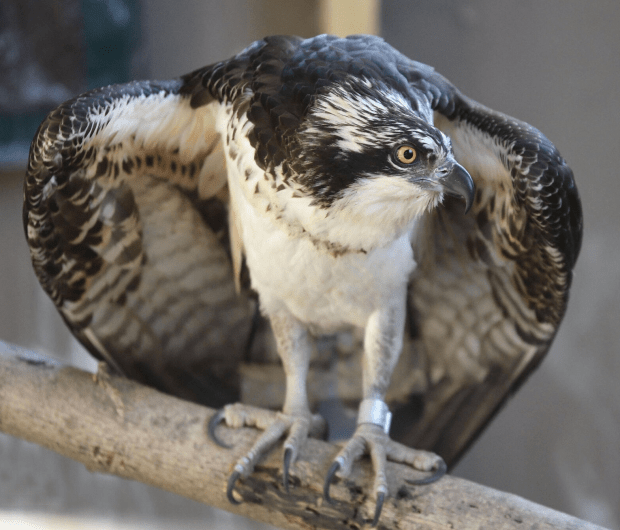
How many reading my blog today recognize the name ‘Smedley’? On 7 June 1998, Smedley, an Osprey nestling, was admitted to the Audubon Centre for Birds of Prey. Smedley had fallen out of his nest. As a result, his right wing was broken. The Audubon Centre gave Smedley a second chance by keeping him as one of the raptor ambassadors.
For those who love Ospreys you have probably heard that Ospreys do not do well in care. Smedley spent 24 years at the Audubon Centre from the time he was a nestling. He could not fly and the slumping of his right wing needed attention. In addition, he had imprinted on humans and could not live in the wild.
In May, Smedley’s wing began to droop more. The staff at the Audubon Centre for Birds of Prey designed and made a harness for him. The wing continued to get worse with the harness and then a sling working for awhile. Then Smedley began flipping on his back and he was not able to right himself without human help. His mouth and eyes would get full of sand (the material you can see in Smedley’s enclosure. The issues continued to worsen and the staff at the centre “decided as a group that we need to let Smedley go so he can fly free in a different life and end the hardship this life has become.” They did not, of course, take that decision lightly. It was also decided that the week prior, Smedley would enjoy the most delicious fish meals. On 24 May 2022, Smedley was released from his suffering so that his spirit could soar. I want to thank ‘L’ for this information and for the picture of Smedley above – the last image of this beautiful Osprey, Smedley.
Since 2017, Smedley had a companion named Bailey sharing his enclosure and being his friend. Bailey arrived at the Centre from Hog Island, Maine, where she had sustained a broken right wing due to a Great Horned Owl Attack (GHOW). She was then attacked by wasps and eagles. Poor thing. She is the only surviving osplet of Rachel and Steve at Hog Island in 2017. Her other siblings were taken by a GHOW. Bailey thwarted the attack of the owl only to be stung so badly by wasps that she leapt out of her nest prematurely. A platform was built for Bailey and then she was attacked by Bald Eagles. She did eventually fledge on her own but she sustained wounds and did her own migration in style (via jet airplane) to Florida to the Audubon Centre in November 2017.
Hank is a ‘glove trained’ Osprey at the Centre. Oh, isn’t he gorgeous. Hank came to the Centre from Biscayne Bay as a nestling in 2017. Several attempts were made to return him to his nest but, they always failed because the adults did not return to care for their chick.
The goal of every wildlife rehabilitation centre is to release the birds back into the wild so they can live their lives. If for any reason they cannot be released, then the focus is to provide the best life the Centre can provide or at another place around the country – full of quality care, interaction, and enrichment.
Other ambassadors include Frank (Francis), the Bald Eagle, named after St Francis of Assisi, the Patron Saint and Protector of all Animals. Frank came to the Centre for Birds of Prey in 1991. He has continual issues with his eyes and his respiration. As a glove trained eagle, Francis is a great ambassador for the centre and his species.
A beautiful hawk mantling its food. ‘L’ says that this Cooper’s Hawk has a svelte body until he puffs up to protect his food.” The army of people that help the raptors at the Centre for Birds of prey work very hard making sure that the birds get the food and calories required so that they stay in top form even though they cannot be released. Such a cutie. Check out their website for the stories of the other 37 ambassador birds.
The staff and volunteers also observe the non-releasable birds, the ambassadors, closely making sure that they have the type of enclosure that is best for them. Here is a great short article on how they do this:
The Centre and the staff educate people on the damage that humans have done to the environment of the raptors. ‘L’ said, “We irrigate/drain land for cultivation and crops which is the death knoll for black storks and other wildlife that relay on the water flooded areas in Europe. Living in Florida, I am so fortunate to see Swallow Tailed Kites as they migrate here for breeding….but we’ve removed their nesting sites for development too. You used to be able to see them as far north as North Carolina. Not anymore….they struggle in Florida for nesting sites.” As ‘L’ mentioned I am well-versed on the destruction and outright extinction of birds of prey in the United Kingdom and the great effort now made to restore those species.
The clinics rely on the love and hard work of an army of volunteers along with donations for vital supplies, medicines, and buildings to teach the raptors how to fly and hunt prey. No one is getting rich! It is, indeed, done for the love of raptors.
I want to thank ‘L’ who provided me with the last image of Smedley and some of the other raptors that she cares for at the Audubon Centre for Birds of Prey. ‘L’ is dedicated to making their lives enriched and to helping us understand how important raptors are – how we are destroying their environment by the hour and what we might do to mitigate that destruction. Thank you ‘L’ for all you and the team do at the Audubon Centre for Birds of Prey do for our beautiful birds.
Thank you so much for joining me today. I will have a round up of nest activity this evening. Take care. See you soon!
Good Morning Everyone. I hope that you had a marvellous weekend and for those celebrating independence day in many countries around the world, have a fun and safe time.
With all the talk about storks, ‘L’ asked a question in the comments. Did I know what happened to the White Stork couple, Malena and Klepetan? Thank you ‘L’ – that is a great question and I bet many are wondering too.
Klepetan and Malena are the best romance story in all of Bird World. The intervention to save Malena’s life after she was shot by a man in Croatia is a testament to what love can move us to do for our wildlife friends.
If you do not know the story, before you read further, please watch at least the first one of these videos so you know the background to this truly remarkable story.
Perhaps the most famous stork couple in the world were Klepetan and Malena. Malena stayed year round with Stjepan Vokic in Croatia. As you will know from the video, Malena was shot and it was only through the gentle care of Vokic that her life was spared. What devotion to keep her, clean her, feed her, prepare the nest and fish for both adults and chicks so that Klepatan and Malena could spend all their time together.
For 20 years, Klepetan migrated back and forth from South Africa to Brodski Varos, Croatia. Malena died peacefully on 7 July 2021 of old age. She was 28 years old. Klepetan was by her side when she died along with her other faithful companion, Vokic. Malena was buried in one of her favourite places. Klepetan continued to come every day wondering where his mate was. They had been together for 20 years and had raised 66 storklets. Klepetan was fitted with a transmitter. He did not return to the nest he shared with Melana in 2022. Did he also die? or find a different nest with a new mate? I am hoping to be able to find the time and help to see if Klepatan’s transmitter is still working.
Want to help out Humane Wildlife Indiana? They have an extensive wish list on Amazon including a xylophone for chickens. I have learned through one of our readers, ‘L’ how important it is to have creative stimulation or enrichment for all of the animals in care. Who would want to live strapped to a perch with nothing to do? There are lots of things on the list from a few dollars to $30 or $40. Here is the link. It is good to see what the wildlife clinics are asking for. You can always help out your local clinic too – they always need laundry detergent, bleach, hand sanitizer, wipes, and those old clean towels I keep repeating…Even if you do not intend purchasing anything for the clinic, have a look. It is possible that you intend to get rid of items that could be used at your local clinic.
So busy with Little Bit and the JJ storklets that some others get forgotten so I am also playing catch up this morning. The only surviving eaglet at the Fort St Vrain nest in Colorado, 46, fledged on the 1st of July. Congratulations everyone!
It is not just Annie and Alden bonding in the scrape! As breeding season in Australia gets closer, Diamond and Xavier are doing a lot of bonding rituals in the scrape – some short, some long. Oh, you are going to fall in love with little Xavier if you don’t know him already. Here is that video clip.
‘B’ sent me a newspaper article on the rescue of the US Steel Eaglet. It is a good read with one troubling bit – they state that he eaglet will learn to fly and be released in an area away from the natal nest. My concern is that they must teach that eaglet to hunt – just like Little Bit needs that training. In order to do that the eagles need a little of time, trained professionals, and specialized structures. It is expensive and time consuming and well worth it if neither wind up back in care. Thanks ‘B’.
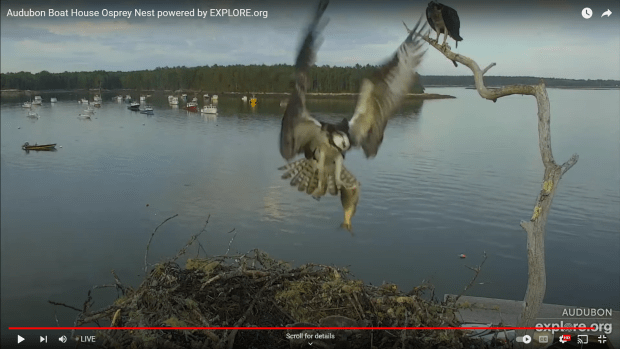
I want to include a screen capture that ‘H’ sent me on Sunday. It is just a beautiful sunrise at the Boathouse Osprey nest on Hog Island, Maine. How stunning. Thanks ‘H’ for sharing this beautiful image with all of us!
The boathouse osprey cam on Hog Island is currently offline and is only showing highlights.
Two chicks on the Osoyoos Osprey nest on a misty wet morning. Let’s hope that dad gets a pile of fish on the nest today since the weekend festivities have passed.
There is a severe thunderstorm watch in the area of the Canmore Fortis Exshaw Osprey nest…send positive wishes to all!
There was also beautiful sunrise in Mlade Buky, The Czech Republic. Betty has flown in and is feeding those four great big storklings.
It is early morning in the Karula National Forest in Estonia. The four chicks of Karl II and Kaia are sound asleep. It is so good that Bonus, one of JJ’s chicks, has integrated so well into this family. It is Day 5 for Bonus.
‘T’ sent me an image of Karl II. Last year he discovered the fish basket that Urmas provided. It is about 9-10km from the nest and this year Karl II has been visiting the fish basket and bringing lots of fish to the four storklets on the nest. They are hoping that the herons do not find the basket as it will limit the fish Karl II will find.
This is the other nest where Janus, the middle chick of Jan and Janika, in Urmas and Dr Madis V’s experiment has been placed. It is doing well. Thank you ‘T’.
Takoda decided to come and visit the National Arboretum nest on Sunday. He has found his reflection in the camera. There are some great ‘selfies’ that Takoda is taking! Have a peek.
Some of you became very interested in what your country is doing to help stop avian electrocutions. Knowing what is being undertaken to help the birds is a good way to begin understanding what you can do to spread the word about the dangers and solutions. ‘A’ wanted to find out what Japan was doing and she discovered that there is a special institute working on this problem on the northern most island of Japan, Hokkaido.
“Birds of prey have the habit of perching on high places with a good view and will use tall trees as well as man-made structures such as streetlights and utility poles as perches. When raptors perch on utility poles or pylons, or when they are about to take off from a perch, they are electrocuted when their wings or other body parts come in contact with parts of the body that conduct electricity.
In Hokkaido, accidents involving electrocution of Blakiston’s fish owls, hawk eagles, white-tailed eagles, and Steller’s sea eagles have occurred to date. Electrocuted birds of prey may show severe burns and blackened feathers. Red spots called electric current spots may also be seen on the skin where the electric current was applied.
To prevent electric shock accidents, electric power companies install insulators on current-carrying parts and devices to prevent birds of prey from perching on utility poles. They also install safe perches on top of utility poles to prevent electrocution. The Institute for Birds of Prey Medicine is working to prevent electric shock accidents by analyzing electric shock accidents and consulting with electric power companies and other parties in order to develop more effective countermeasures in areas where electric shock accidents have occurred or are likely to occur.”
Thank you, ‘A’.
I wanted to see what work the Institute for Birds of Prey Medicine is doing and came across something very interesting. Fifteen years ago the use of lead (Pb) ammunition was outlawed in Japan. Today, lead poisoning remains a serious problem for raptors who accidentally consume lead pellets from illegal hunting in various places in Japan but the overall testing of raptors and discovery of those who have ingested lead has dropped significantly (lower than 25%). In comparison, the US Geological Survey discovered that between 2010-2018 (the end of the study) more than 50% of all raptors in the US had been poisoned by lead either in hunting or fishing equipment. The soft lead bullets that break into fragments have the worst impact on the raptors. Other lead fishing equipment can be mistaken by birds such as Loons who think these lead weighs are pebbles and eat them!
There is no nationwide ban in the US for the use of lead. California is the only state to ban the use of lead entirely. New Hampshire, New York, Vermont, and Maine have partial bans in fishing gear. In 1987, Minnesota banned the use of lead shot for waterfowl hunting. In 1991, a federal law in the US also banned lead shot for waterfowl hunting. The problem rests with the DNR who has lobbied against imposing any other lead restrictions on hunters. In April of 2021, three states – Maine, Minnesota, and New York introduced bills that would ban lead completely in all hunting and fishing gear. I am checking to see if HF2556 has been signed into law in Minnesota in 2022.
Do you remember the ‘Old Warrior’? He was taken into care after being found on the side of the road lethargic. He went to A Place Called Hope, another great wildlife rehabber. His lead levels were measured at 49. Very extensive lead removal treatments resulted in the old eagle with the broken leg and beak being able to go into an outside enclosure. A Place Called Hope applied to the USFWS for a license to keep the Old Warrior as an educational bird. I reached out to A Place Called Hope and they said that sadly the lead issues had caused so much damage that the Old Warrior had died. He was a poster child of trying to beat the odds. There are other kinds of ammunition – stainless steel and copper. Lead is not the answer!
There has been some concern about Blue 022 at the Poole Harbour nest. He has now been caught on camera and all is well. The two chicks have been ringed and they are both girls! Well done Poole Harbour. Congratulations and relief.
At the Rutland Mantou Bay nest of Maya and Blue 33, 1H2 and 1H3 fledged this morning. All girls are flying about and there is definitely an empty nest! They will return to harass dad for fish, no worries.
Whew! You might need an extra cup of tea or coffee to make it through this today – sorry! Lots happening in Bird World. The kids up at Loch of the Lowes are starting to get the hover going, too. Thank you for joining me today. Please take care. Thanks to everyone who sent news, photos, or comments. They are always appreciated. See you soon!
Thank you to the following for their streaming cams and/or FB pages or videos where I took my screen captures: The Dodo, HRT, Ft St Vrain and Excel Energy, Falcon Cam, Audubon Explore.org, Osoyoos Osprey Cam, Fortis Exshaw, Mlade Buky, Eagle Club of Estonia, NADC-AEF, A Place Called Hope (APCH), Poole Harbour Ospreys, and LRWT.
I hope that you have had a really lovely weekend. Thank you for taking the time to join me this evening.
There are two important moments in a young Red-tail Hawks life. Their first flight marks them as a fledglings. They need to fly out and return to the nest for the proper definition to apply. They become juveniles only after they catch their first live prey item by themselves. So everyone give a big shout out and congratulations to Big Red and Arthur’s L4 (that little cracker) and L 2 who officially became juveniles today. Wow. Didn’t I say that L4 is amazing. No fear. I will never forget him climbing right over those big siblings to get at the front of the food line. No worries about siblicide on Big Red and Arthur’s watch.
Across the pond, Osprey parents are working hard to get their chicks in perfect condition for migrating. While Osprey chicks will fledge and fly and return to the nest for a feeding from Dad, they normally do not catch their own fish until after they have begun their migration. The parents do not teach them. Fishing is hard-wired into 60 million years of Osprey DNA and memory.
Blue NC0 flew out and brought in a whopper to her two – a big girl and a boy.
Idris is trying to beat every Welsh record that there is for fishing! This is an unbelievable catch! Three big girls and Seren to feed plus himself! Idris is up to the challenge!
Dylan took the approach that more deliveries are the best so he recorded 8 fish deliveries for Seren and the kids before 1700. Wow. It looks like a perch this time.
It was very sad news to learn of Pikne’s demise on the 6th of June on a hydro pole in Turkey. Searchers for her body and the transmitter could find nothing so she has been taken by humans or larger animals. My immediate concern after hearing this is where is Udu, the only surviving juvenile of Karl II and Kaia of 2021. Finally some indication of his transmitter on 16 June but questions lately. He was in the Central African Republic at the time. But this was April 2nd…with battery power at 0%. Since Urdu’s tracker tries to send data but the location is the same as April 2nd. Perhaps someone will be able to establish what is happening. My fear is that Udu’s transmitter is in the hands of a human playing with it and Urdu is no longer with us. Please let me be wrong.
I continue to watch the experiment of Urmas and Dr Madis V with the Black storklet chicks of Jan and Janika with much interest. Bonus was been placed in the nest of Karl II and Kaia and this morning Bonus was not defensive when Karl II brought food. It would appear that Bonus has now accepted he is part of Karl’s family. Amazing news. Bonus has been in the nest for 4 days.
As you know I believe in intervention when it is more likely to benefit the bird. This is the first time that anyone has tried to raise Black Storklets in a clinical setting and then foster them with other Black Stork families. Urmas and Dr Madis V went to great lengths to try and ensure the success including decoy parents, the feeding Toto and making certain that sounds of the forest was present. Urmas also distributed fish baskets to try and take the burden of feeding an extra storklet off the parents. We celebrate today that Eedie has found the fishing basket provided by Urmas. Jan and Janika’s storklet, Janus, is in Eedie’s nest. There is a picture of Eedie going to the fish basket to get food for the family. Thank you ‘T’ for sending us this confirming image. Tears! So many are learning about the behaviour of the Black Storks in these circumstances — this will prove important in the future should another nest lose a parent during the breeding season.
When there were statements about the Bald Eagles feeding ND17 it was important to have ‘proof’ in some form. There wasn’t any. In fact, ND17 was either fed little or nothing due to his condition when the rehabbers picked him up. To demonstrate that the intervention is working and what aspects are helpful to the storks, photos are being taken. This photo proves that Eedie found the fish and now will return to the nest to feed the four storklets.
At the nest of Karl II and Kaia, there were 5 feedings today – 3 by Karl and 2 by Kaia. Bonus has now been part of their family for 4 days. Is he eating enough? Yesterday his ‘ps’ was thin but today there is an image of a healthy ps by Bonus proving that he is eating well.
At 12:12:55 Akecheta flies to the nest with a fish. He looks around wondering which one of the fledglings was going to fly down and grab it.
It was Sky!!!!!!
That is a great mantling job!!!!!!
At 16:02 it is Ahote’s turn to get the fish drop! Oh, I so admire these parents who continually risk their legs and talons to feed their fledglings. It is amazing.
If you see an empty nest at Two Harbours, do not despair. Lancet has been seen eating on the overlook cam.
This is a very short report. It was warm on the prairies today with a beautiful blue sky and lots of happy people. I was out counting American White Pelicans and Double-Crested Cormorants. I will not bore you with the panorama of photos that I took to ensure the count was accurate but..they are such beautiful birds. It is an honour to see them fishing and raising their little ones in the summer. There are places where sport fishing is popular where the pelicans are not appreciated. Authorities can, even with the Migratory Bird Treaty, give permission for people to shoot them! Pelicans were fishing out of the rivers long before people were sport fishing. If people needed to fish for their survival that is one thing (and some do) but…I will let you finish the sentence. You know me well and what I would say.
If you are ever sent to help out with a bird count, it is much easier if you take various shots of the stationary birds and then try, as best you can, to count those flying about.
Take care everyone. Thank you for being with me this evening. See you soon.
Thank you so much to the following for their streaming cams and/or FB or forum pages: Looduskalender, ‘my friend T’, Explore.org and The Institute for Wildlife Services, Dyfi Osprey Project, CarnyXWild, Eagle Club of Estonia, Scottish Wildlife Trust, and Ferris Akel Tours.
Do you live in an area where farmer’s are baling hay or straw? and using baling twine? It was baling twine mixed in with some other nesting materials that caught on the male Ospreys talon at Osoyoos and pulled the chick off to fall to its death. Dr Erick Greene at the Montana Osprey Project finds literally tonnes of baling twine in the Osprey nests he studies. He also finds dead chicks and others nearly dead and tangled. If you live in a farming area help our Ospreys by spreading the word. Here is an information pamphlet that Dr Greene prepared – it is quick and to the point.
It is surprising that the nest at ND-LEEF is still holding. It looks like bits and pieces of it are falling away each day. Mum and Dad are still bringing fish to the nest for ND15 and 16.
15 was on the nest when the adult arrives with a nice fish. Soon 16 arrives.
I believe 15 kept the fish!
There is an update today on ND17 – and it is a good one. There is that sweet baby. It appears that individuals have been showing up at the clinic wanting to see 17. Please do not go there. The clinic staff has addressed this issue in their posting. ND17 is doing great and it is the clinic’s business to help him so that he can be returned to the wild. Everyone who works at a rehabilitation clinic is overworked and underpaid – it is a very sad situation in many instances where they do not get celebrity birds and good donations. Send them a thank you letter! Tell them you don’t expect a reply. Make a donation! Give to your local rehabber — I keep saying clean old towels but gosh, they are much needed. Give the towel a second life, too.
Isn’t he adorable?
Problems with nests and falling out of nests happens everywhere. It has been awhile since I checked on the two White-tail Eaglets in their nest in the Tucholskie Forest in Poland. Last time I remained somewhat cautious about the second chick surviving. Their names are Uno and Duo. (The third chick was a victim of siblicide). Uno fell off the nest and spent 4 days on the forest floor. He must have glided – as he flew back up to the nest. There are now some concerns that Duo has not been fed since 1 July and Uno is taking all the prey. They are big eaglets – just beautiful. Both will hopefully survive.
Sleeping and waiting for food.
Last year, Karl II and Kaia had three storklets. One of those Pikne who stayed with Karl II for a long time having him bring her food before fledging. She hatched on the 28th of May and fledged 4 August. She has a perfect flight to Ethiopia where she arrives on October 24, 2021. Pikne stayed in Africa and set off for her return flight to Estonia. She was in Israel on 1 June 2022 and everyone was so happy to see her transmitter working. Sadly, on 6 June, she on a power line and was killed in the middle of nowhere in Turkey. Such promise. A day does not go by without adding another one to ‘the list’.
Pikne is the storklet getting ready to stand up at the front.
As ‘S’ reminded me last year, countries can make laws that power companies must make their poles safe for wildlife but the companies must follow through in a timely manner. Last fall we lost Solly in South Australia and the individuals that make up Port Lincoln Osprey were on a mission to get the government to fix the power poles. Must check with them to see how they are doing. It is, sadly, a worldwide issue for our beautiful raptors and storks. In Pikne’s case, it is thought that she was tired and landed to rest as there was no place to feed near that pole — so it is not just poles near feeding areas but all poles that should have a protective cover.
This is the nest of Karl and Kaia this morning. Bonus made no reaction to Karl II which means that he has accepted him as his father, the male on the nest and is home with the three siblings. This is such good news for the success of the intervention by Urmas and Dr Madis V. Actually it is fantastic news.
What can you do to help so that our beautiful birds are not electrocuted? Here is a story of a Bald Eagle and an individual who got their power company to retrofit the power lines – 12 of them – in their neighbourhood. Remember! Each of us can make a difference by seeking solutions for the birds that live where we do.
Most everyone is following the story of Malala, the Red-tail hawklet meant for dinner but adopted by the Gabriola Island Bald Eagle family. This article covers this adventure from the beginning to the present. It is a really good read.
Every once in awhile I feel compelled to give a shout out to the New Zealand government and specifically their Department of Conservation (NZ DOC). I wonder how many of my readers follow the exploits of the Royal Cam chick on Taiaroa Head? There she is – QT (Quarry Track) chick doing her morning stretches. What a beauty.
This year has seen at least 10 supplementary feedings for QT and a few of the other chicks on the peninsula. Her parents are YRK and OGK. Just like Janika could not provide enough food for her storklets alone, neither can YRK. There is little talk on the Royal Cam FB group but the much beloved OGK was last seen on the 19th of May. Some believe he came in on June 10 but that is not confirmed and many believe it was not him but, rather, YRK. OGK doesn’t choose to not return to feed his chicks. He is one of the most devoted Royal Albatross I have ever seen. He is either injured or dead. Two years ago OGK suffered a leg injury and returned limping after 40 days. If the 19 of May date is correct – he is missing for 46 days now. Send all good wishes his way, please.
US Steel Eagle 4 (USS4) is in care from tumbling out of the tree with severe feather injuries but USS5 is doing great – learning how to fly and returning to the nest for prey from the parents. Congratulations 5 – you are doing very well, indeed.
‘H’ reports that Dory has really mastered the art of feeding her three osplets on the Boathouse Osprey nest – making sure that each and everyone has bites. Dory purposefully gave Little Bob several nice mouth fulls this morning. Fantastic. Thank you ‘H’.
Dad was in early with fish for Mum and the two osplets on the Osoyoos Osprey Platform. It was 0554. Fingers crossed!
That is a brief look at some of the news today. Everyone seems to be doing well.
It is not a good image – taken with my phone at a distance. But this is the tiny rabbit that comes to the garden now grown – 4x his size. Grass and birdseed!
In celebration of ND17s progress, I am sending each of you a virtual piece of that Yokohama Orange cake…Sorry to all food designers. Fall plate and spring flowers! But delicious cake…it was worth all the effort.
Thank you for joining me today. Take care everyone. See you soon!
Thank you to the following for their streaming cams and/or FB postings where I took my screen captures: Humane Wildlife Indiana, The Eagle Club of Estonia, Bieliki Online Bory Tucholskie, NZ DOC, ND-LEEF, Explore and Audubon, Pix Cams, Osoyoos Osprey Cam, and GROWLS.
What a busy day in Bird World and sadly, another entry on ‘that list’.
I want to start by thanking one of our readers, ‘AM’. She left her home and pushed through all kinds of Canada Celebrations and a parade for an hour to get to the Osoyoos Osprey Nest the minute she learned of the chick’s fall. Sadly, the little one did not survive. ‘AM’ found a quiet restful place for him near the nest. Thank you ‘AM’. I also want to add that she went prepared with all the things needed to drive him to a rehabber – gloves, towels, a box, etc. Fantastic.
It is always tragic to find a wee one dead or badly injured. It was a big fall and unlike goslings or ducklings, osplets just don’t have the bounce. Sadly, we cannot stop the ospreys from bringing material to the nest but, we can urge farmers to use best practices and different baling materials. Dr Ericke Green at Montana Raptors (Iris) has been studying this problem for a long time and has found a different material for baling that is less problematic for the Ospreys — if farmers would only use it.
I am very thrilled to see all of the donations and thank you’s to Humane Wildlife Indiana. For all of you that pushed the staff at St Patrick’s Park to get help – through your e-mails, phone calls, and in chat, thank you. It takes an army of people to get help and you are a great army.
If you want to send a direct thank you to Delilah Ruiz, here is the e-mail: druiz@humaneindiana.org
Our beautiful Little Bit in care, thankfully. Tears.
There is, however, some really super news in Bird World. It comes from Cal Falcons. Annie and Alden were doing a courtship ritual in the scrape box. Alden proved himself to us over and over again as being very capable of taking good care of Annie and any chicks but – Annie had to really make that decision. Alden passed – and Annie and Alden are a couple. Yes.
Alden figured out how to overcome a physical limitation and he now has Annie and the best territory in San Francisco. I hope that their lives together are long and productive.
Looks like we are going to see the chicks doing a lot of moth chasing and loafing just like Lindsay did today! Isn’t she gorgeous? Look at those eyes and those feathers. I hope that we see Little Bit 17 get his feathers into good condition now that he has regular food.
You know. Human animals should watch some bird cams before they have children so they learn that everything one does makes an impression on children.
Other good news is coming out of Cornell. Here is today’s update on L3 who was taken into care a week ago.
“We received a brief update from the Wildlife Hospital today, reaffirming that L3 continues to do very well. The veterinarians will be performing additional radiographs in another 1-2 weeks to check up on the fractured coracoid bone, at which point they should be able to better predict a future timeline for continued healing and rehabilitation. They also shared that, based on body weight, L3 is likely a female. We will plan to post another update following the next set of radiographs — thanks for sharing all of your concerns about L3’s continued healing!” Thank you ‘SAH’ for seeing that L3 was found and was in care quickly.
Dylan has just brought in the last fish for the day to Seren and the three Bobs.
The three at Llyn Clywedog have been ringed. They are 553 a big female weighing 1710 grams at 40 days, 554 a male weighing 1485 at 40 days and 555 another male weighing 1410 at 37 days old.
The parents lose weight when they are busy raising chicks. Just look at how small Maya looks compared to the three big gals that her and Blue 33 have been feeding. Maya lost about 33% of her body weight taking the great care she did of her chicks.
Idris brought in another whopper to the Dyfi nest despite the rainy weather. Him and Telyn (Maya’s daughter) are feeding three girls, too.
It hasn’t all been rosy with the four Black storklets in the nest of Karl II and Kaia. At first Bonus was hissing at Kaia. That got better. Then the biological storklets were biting Bonus’s legs. Karl II has brought in a meal a few hours ago and things look good. Urmas needs to observe the nest closely so that the biological osplets do not get in a position of not having enough fish due to the size of Bonus.
Fingers crossed that all of this gets worked out. The biological three are looking for more fish and there is Bonus busting his crop.
I intended to include more but a kestrel has a broken wing about an hour and a half away and needs to get to Wildlife Haven – so I am off!
Take care everyone. Thank you for joining me. Donate if you can – even $5 for Little Bit. Every $ helps. See you soon.
Thank you to the following for their streaming cams and FB pages: Eagle Club of Estonia, Humane Wildlife Indiana, CarnyXWild, LRWT, Dyfi Osprey Nest, Cornell Bird Lab and Cal Falcons.