So many fledge watches! How many of us wish we could fly about like the birds?
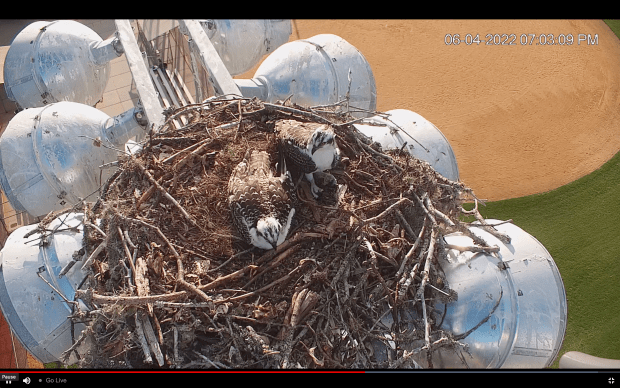
L1 and L2 have both returned to their natal nest on the Fernow light stand on the Cornell Campus. Big Red and Arthur have been bringing prey. Today when L2 flew back and wanted to take L3 and L4’s lunch, Big Red went and got it and fed the two smallest chicks. It was interesting. Someone asked if they return to the nest and the answer is ‘yes’ for the first several weeks you might catch them but once they fledge Big Red really does like to feed the fledglings ‘off nest’. She has been known to ‘get upset’ with Arthur for feeding the wee babes on the nest!
At 17:20 with all four on the nest, Big Red returns with another chipmunk for dinner.
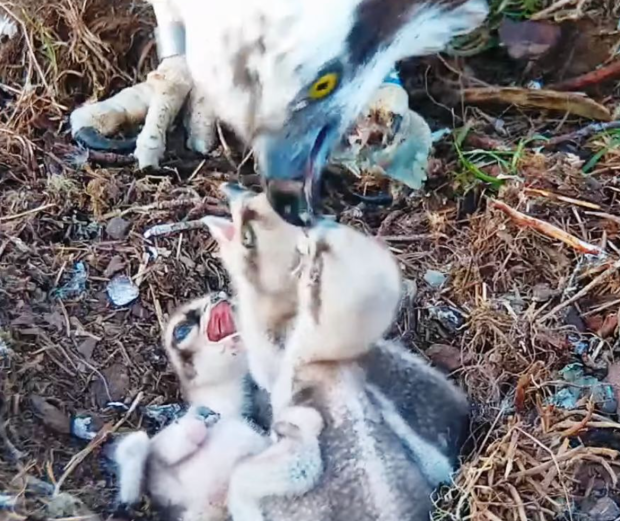
They are on fledge watch at Utica scrape as falcons Percy and Kara are spending time on the ledge! Little Ares is grateful – they are focused on flying and he gets a great meal!
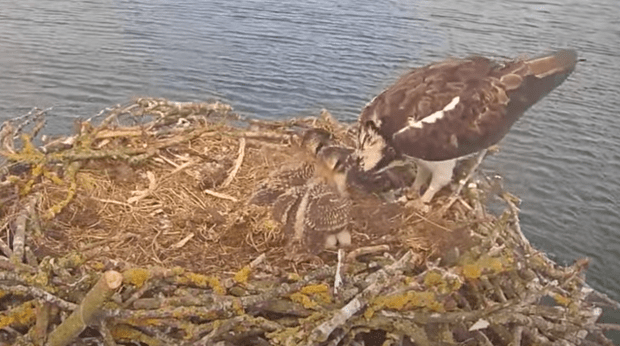
The Glaslyn osplets are thinking about food – not fledging – as they gobble down the fish that Aran brought to the nest for Mrs G to feed them!
Blue NC0 and the three are really benefiting from Laddie’s fishing lately at the Loch of the Lowes. He brought in 9 fish on the 7th! How wonderful!
Despite Idris being a remarkable fisher, that Big Bob is nothing but a handful. Emyr Evans describes it as ‘play aggression’ when the are beaking one another. It is true. Ospreys in the UK rarely die from siblicide – unlike their counterparts in the US where we have seen a number of cases in the large raptors this year. Normally Telyn gets it all sorted and all are fed.
Little Bit has been really good at the snatch and grab at the ND-LEEF nest. A raccoon came to the nest and it has been going back and forth switching from one sibling to the other. At 13:54 Little Bit 17 stole it from the beaking sibling 16 and he was working on it again later after 16 took it back. Little Bit has had a very large crop today so it is another good day for this hard working eaglet who doesn’t seem to be afraid and who is ever so quick!
Little Bit 17 is growing. Just look at the span of the wings and the tail feathers.
There has been a lot of speculation on the chat at the ND-LEEF nest that because Little Bit is a small male – is that true? – we don’t know – that it would not be able to find a mate. Perhaps we should step back from that statement. We do not know what happens to any unmonitored raptor. We can only hope that they survive their first year. Little Bit has some advantages – being small and quick is one of them. Reading the environment well is another. Willing to eat anything to survive is another but his quickness and his ability to manoeuvre will be key.
It has been miserable and rainy in Mlade Buky, The Czech Republic. Still Bukacek and Betty are feeding their wee storklets.
Both Lady and Dad spent the night at the WBSE nest in the old Ironbark tree in the Sydney Olympic Park. Friday morning Lady is rolling the first egg. Will there be a second? Stay tuned.
At the Redding nest, Sentry is at 15:20 nest time up on a very high branch! Will he fludge or fledge?
Here is the link to the Redding camera if you do not have it:
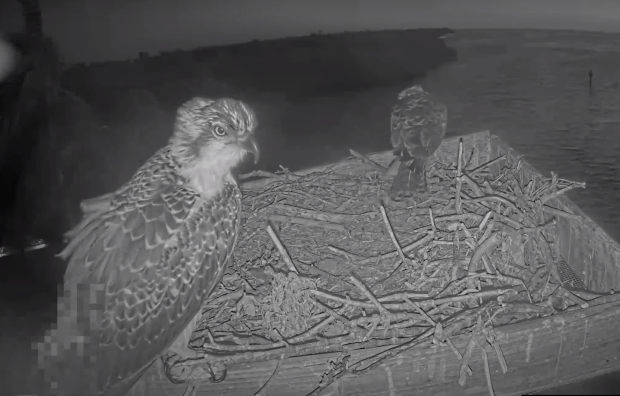
Both fledglings are back on the UFlorida-Gainesville Osprey nest hoping for a fish delivery!
All three are on the cliff nest of Thunder and Akecheta waiting for some prey drops, too! Sky has been getting ready – hovering and jumping.
So much going on! Most doing very well.
Thank you for joining me as I jumped around and checked on a few of our nests that we have been watching. Take care all. See you soon.
Thank you to the following for their streaming cams where I took my screen captures: Explore.org and The Institute for Wildlife Studies, Cornell RTH, Mlade Buky, Friends of Redding Eagles, UFlorida-Gainesville Ospreys, Sea Eagles@Birdlife Australia Discovery Centre, ND-LEEF, Dyfi Osprey Project, Friends of Loch of the Lowes and Woodland Trust, and Bywyd Gwyllt Glaslyn.
Liz has posted a video of Urmas and his team removing the Black Storklets from Janika’s nest in Jegova County, Estonia on 5 June. I reported earlier that a glove like a Black Stork shape had been used to place the storklets in the basket. That information is incorrect and my apologies. Bare hands were used. One storklet, sadly, died in the nest over night before the intervention. They need temperatures of 22-28 degrees C. They cannot thermoregulate their temperatures yet. In addition, it rained and well – I hope the remaining chicks survive and thrive. It will be a first for the Veterinary College to raise Black Storklets to fledging. Good luck to Urmas and his team!
Here is the video that Liz posted:
The White Storks Bukachek and Betty still have five storklets in their nest in Mlade Buky, The Czech Republic. You can see the difference in size from the oldest to the youngest known as ‘Little Finger’ by the chatters.
Bukachek (male) is making sure that the wee storklet gets food in the image below.
It has been raining on and off. The rich Red Iron in the clay makes all of the Storks look dirty. Maybe when it is not so rainy more straw will be brought to the nest! That would help.
Awhile ago I mentioned the Lesser Spotted Eagles. Andris and Anna, at their nest in Zemgale, Latvia. The camera was down for awhile but it is now back and running. In the meantime, a beautiful little Lesser Spotted eaglet has hatched!
It is so cute and fluffy! There was only one egg so this is the only chick. Had there been two eggs, the first hatch most always predates the second. So having only one is a good thing! The parents can focus on bringing food to this cutie pie.
Voldis came to the White-tailed Eagle nest that he shares with Milda near Durbe, Latvia. He arrived at 05:30 and stayed for well over an hour.
Milda has had a terrible time since her long time mate, Raimis disappeared two years ago. I hope that Milda and her mate if it is to be Voldis have a very successful next breeding season. This year the eggs were predated.
Margit hatched on 25 April and is growing by leaps and bounds with the tender care of the parents, Kalju and Helju. This Golden Eaglet’s nest is in Soomaa National Park in the southwest of Estonia.
Oh, such a beautiful eaglet. Margit is waking up. The black dot behind the eye is the ear. It will be covered over with feathers before the eaglet fledges.
Helju just brought breakfast for Margit. Liz caught it in a video:
This is the streaming cam for this nest:
What is happening with Ahote? Ahote, the youngest of the three eaglets at the West End nest of Thunder and Akecheta, fledged on June 2. He has spent the time since then on Transmission Rock and is getting hungry unless food was delivered. Working his way back to the nest, he got some wind on his wings and got to the nest but was blown off course. No doubt he will get there! Very determined.
In the image below you can see him directly below and slightly to the right of Kana’kini and Sky.
Checking on Osprey nests in the UK, the third chick hatched at Llyn Brenig but did not survive.
Aeron Z2 and Blue 014 have had their first hatch at the Pont Cresor nest in the Glaslyn Valley.
Laddie LM12 delivered nine – yes, 9 – to the nest for Blue NC0 to feed their three Bobs at the Loch of the Lowes.
All three Bobs seem to be doing fine at the Glaslyn nest of Aran and Mrs G. Just look at how dark Mrs G’s plumage is and that necklace.
Aran has been busy delivering fish. Little Bob is not always in the most perfect position!
I do have to admit that Idris and Telyn are my favourite Ospreys in the UK along with Blue 33 and Maya.
Telyn is feeding the two older Bobs while Bobbie Bach is asleep.
Food coma!
Oh, could that be comfortable?
There is Bobbi Bach ready for his meal while the others sleep. Poor Telyn. They are surely keeping her busy.
It looks like it is starting to dry out for Dylan and Seren at the Llyn Clywedog nest. Gosh, Seren was just so wet and hunkered down keeping the three Bobs warm and dry. Let us hope the sun comes out, too, to warm them up.
Both of the Ospreys were on the UFlorida-Gainesville nest sleeping during the night.
Both are back on the nest waiting for a breakfast delivery!
Good Morning Little Bit 17! Everyone is waiting for prey deliveries at the ND-LEEF nest. I hope that the adults will feed Little Bit like they did yesterday. That would be grand.
The scrape box at Manchester NH is getting to be quite the mess! A good wind will help clear it out. It is hard to believe but this scrape will be on fledge watch beginning on the 10th or 11th of June – this coming weekend!
Nancy is on the nest at 08:40 feeding E1. It looks like they will have a beautiful day at that Bald Eagle nest in Minnesota. Wonder when E1 is going to take to the skies? Nancy has done wonders taking care of E1 and fending off intruders.
Fledge watch is on for the three at the Pittsburgh-Hayes Bald Eagle nest. It looks like only two but 17 is up higher in the tree.
There are still two eaglets – Sentry and Star – on the Redding nest of Liberty and Guardian. We are on fledge watch for these two also! It could be a very busy week!!!!!!
We are definitely on fledge watch for the eyases on the nest of Big Red and Arthur on the Cornell campus. The chicks are restless and L1 is definitely ready!
Oh, the excitement of a nest of four hawks – each itching to fly including the youngest, L4. Wonder if L1 will be the first of the oldest to go? Stay tuned.
Thank you so much for joining me this morning. Take care. See you soon!
Thank you to the following for their streaming cams where I took my screen captures: the Eagle Club of Estonia, Mlade Buky White Storks, Latvian Fund for Nature, IWS and Explore.org, Friends of LOTL and the Scottish Wildlife Trust, Bywyd Gwyllt Glaslyn, Dyfi Osprey Project, CarnyXWild, UFlorida-Gainesville Ospreys, ND-LEEF, Peregrine Networks, MN-DNR, Pix Cams, Friends of Redding Eagles, and Cornell Bird Lab RTH.
It was a fantastic day on the Canadian prairies. Clear blue sky. Sun shining bright and everyone happy – even smiling and saying ‘hi’ on the trails. Sadly, the birds thought it was beautiful too and they must have all gone sight-seeing! There were some American White Pelicans – 7 to be exact – hanging out with 9 Double-Breasted Cormorant. A female Hooded Merganser. A family of Canada Geese! And many Red-wing Blackbirds protecting territories where there were obvious nests. It was still nice to be outside with the sun beating down even if there had been not a single bird in sight.
There were two females on nests and these three goslings with their parents. This place should be crawling with goslings – everywhere. The flood really did a lot of harm.
The Redwing Blackbirds appear to have sentinels that stand watch or follow humans trying to lure us to one spot or another away from the nests.
There has not been a lot of time to check on all the nests. I wanted to see if Little Bit 17 had any food. He had an entire fish to himself yesterday but he needs food every day! It won’t always get it, sadly. Not on this nest. At 19:02:47 a Bluegill at 19:02:47. Everyone sort of looked at Dad and the fish. Then at 19:04:57 Little Bit stole it! I cannot tell you if he got any fish to eat but he worked on it until 16 – the one who beaks him – stole it from him. Then 15 took it and Little Bit moved over by the porch and did the snatch and grab and got some fish. There could be another delivery later.
It is not a huge fish.
Little Bit was quick! And he took advantage of a good situation. It is too bad that Dad didn’t just block the other two!
16 has the fish and 15 is going to get it away. Little Bit is at the top left watching and listening. Little Bit knows if 15 gets the fish he will get some food.
There is a scab forming over the bad peck that 16 gave Little Bit the other day.
Little Bit is by the tree snatching and grabbing bites from 15 as 16 watches.
At 17:37 Little Bit gets the fish head and moves with it to the top railing where he feeds off it until 17:50! Well done Little Bit 17! You will clean that head of every bit of fish flake like no one else. So happy.
Janika has been regularly feeding the storklets. The last feeding was at 22:54:10. The four have eaten well today. I thought maybe she would stay with them during the night but she is off hunting for food. Urmas has not removed any of the chicks. Perhaps Janika can make this work! I hope so. I wish she would find the fish basket provided for her.
The last two eggs hatched for White Storks Bukacek and Betty at their Mlade Buky nest in The Czech Republic. I cannot help but think that the two smallest will become brood eliminations but, maybe not. That is a lot of mouths to feed.
At the Cal Falcons scrape, Annie and Alden have done the most amazing job raising these two eyases. They are huge – full of energy and life and absolutely healthy. We will be forever grateful that the Avian Flu did not manifest itself in the West so that these two can take flight. Their names could not be more perfect – Lindsay and Grinnell Jr.
Meals happen outside of the scrape now and the chicks run up and down flapping their huge wings. Seriously – look at that wing!
These two have great fun playing with one another. Have a look:
There is something so stunning about the plumage of juvenile Ospreys – the patterning, the beautiful black and white. I do think they are much more gorgeous than the adults. Don’t tell them! Middle has been working his wings since Big fledged.
These two have eaten well. Mum and Dad really filled them up yesterday after getting Big back on the nest for breakfast. And it is nice that the heavy rains forecast for Gainesville as part of the Tropical Storm did not materialize.
The five falcons at the Manchester NH scrape have almost lost all of their baby down. It is really something when food comes to the scrape. All are fed but oh, my what mayhem!
Aran and Mrs G are doing fine with the osplets. It is a wonderful streaming cam because you can hear rural Wales – the sheep bleating and the cows mooing. It is quite lovely if you live in a city like I do.
Despite the strong winds at the Dyfi nest, Idris and Telyn are keeping the osplets nicely fed and hunkered down. Bobbi Bach has really eaten well. He hatched on the 28th of May and is a week old today. Happy Week Birthday!
Poor Telyn. The wind has done a mess of her feathers.
When the third egg hatched at the Loch of the Lowes, I held my breath. It took Blue NC0 a few days to get it together to feed three. Now just look at them. Unbelievable. Lots of fish and this is what happens – fluffy little Osprey chicks with their soft grey down turn into Reptiles. Little Bob is not having any trouble. There he is in the middle of the pack at Mum’s beak.
All over England they are celebrating the Queen’s Platinum Jubilee but in Poole Harbour everyone continues to be delighted in the first three – yes, the third hatched – ospreys to hatch in Poole Harbour in more than 200 years!
In fact, of the birds translocated from Scotland to Poole Harbour over the course of a couple of years, three are now breeding. It has been an enormous success and a shout out should go to Roy Dennis Wildlife for his steadfast belief that you could re-introduce birds to a location by using hatches from another area (Scotland in this case).
You can read all about CJ7 and Blue 022 on Roy Dennis’s website here:
Roy Dennis writes extensively about this project in his book, Restoring the Wild.
Big Red took a break from parenting to sit on the lights in the sun today. It is quite crowded on that nest now!
The light was not so good to see the eyases but it was good to show the dark bands on the chick in front of the light box. There are five clear dark bands on that chick. From the length of that tail in comparison to the bird to its right, it has to be L1. I would suspect that there are actually 6 clear bands. She is ready to fledge!
What a year it has been for Big Red and Arthur with four eyases on the nest! Even at 19 Big Red continues to surprise us and keep us in awe. She is an incredible hawk and hawk Mum!
Thank you for joining me for this quick look at a few nests today. Take care. See you soon.
NOTE: My Sunday report will come in the late evening.
Thank you to the following for their streaming cams where I took my screen captures: Bywyd Gwyllt Glaslyn, Dyfi Osprey Project, Friends of Loch of the Lowes and the Woodland Trust, Cornell Bird Lab and RTH, ND-LEEF, UFlorida-Gainesville Ospreys, Poole Harbour Ospreys, Cal Falcons, Peregrine Networks, Mlade Buky Stork Cam, and the Eagle Club of Estonia.
Saturday was an incredible day for a long walk at the nature centre. Thankfully individuals have donated benches in their loved one’s names and they are scattered about the trails. Much of Ft Whyte has been covered with water and there are areas that are more wetlands than anything else. Those are the interesting places. The Red-winged Blackbirds and the Yellow-rumped Warblers seemed to love eating the seeds? of the bull rushes. It was a fascinating day. Way across the lake were two adult Double-breasted Cormorants and nine juveniles. The Cormorants make their nests on islands or in the tops of trees or platforms. Normally there are 5-7 eggs that are incubated for 25-59 days. This couple seems to have hatched 9!
They were at a great distance and the sky was getting very dark. Not touched up but a lovely scene.
The usuals were around – beautiful Yellow Warblers, American Goldfinches, the Yellow-rumped Warblers, and a Downy and a Hairy Woodpecker.
What a striking difference between the male Red-winged Blackbird and their female mates, below. She is having a wonderful time gleaning for insects and seeds on the ground.
This female American Redstart flitted around the Cattail branches. She was very difficult to photograph! She was hovering around the pools of water foraging for insects.
The Canada Geese are still incubating. No one seems to know when the eggs are due to hatch at Ft Whyte! (or not anyone that I could find).
You often see evidence of the woodpeckers presence but, most times, you do not actually see them. So to see both a Hairy and a Downy over by the songbird feeding station was quite a treat.
A female Hairy Woodpecker.
The female Downy Woodpecker.
In fact, today was a fun day because so many of the female birds were out feeding. What a joy!
I had hoped to head out today, Sunday, but right now it is raining. The birds in the garden are not happy! Hopefully the sun will come out later for them and they can dry off and I can go for my walk.
Sadly, Saturday was not a good day on the ND-LEEF nest. The lack of prey coming to this nest is becoming highly problematic. The two older siblings have figured out how to self-feed. Little Middle 17 had an advantage when they didn’t know how to do this! There was someone on chat that made a comment that Little Bit 17 had some food from Dad last evening – a heron?? I did not see it. Perhaps some of you did. My notes indicate 48 hours without substantial food. Let us hope that the fish get on the nest tomorrow and are plentiful. In fact, one of the older siblings – I do think it is the Middle one 16 – attacked Little Bit today and Mum flew down from the branch and intervened. We need fish on this nest quickly. Send all positive thoughts to Little Bit 17.
Two fish have so far come to the ND-LEEF nest on Sunday morning. The second one right before 10:58 when Mum flies down and feeds 17. Originally the fish was left on the nest but no takers and Little Bit seemed reluctant to eat it. He is staying back in the part beyond the camera. After a few minutes Mum comes down and takes the fish. Little Bit eats. Then in a few minutes 16 steals the fish. How much did Little Bit get? It isn’t clear but when 16 stole the fish, there was only about half of it left. I know Little Bit can eat fast – he has had to. Let us hope he got enough and that another fish comes and then another. We need to get out of this bad loop on this nest. 16 continues to attack Little Bit. 16 is one nasty bird.
If you are at all sensitive, I would not watch this nest for a few days. Let it sort itself out. I am very concerned about the level of hunger and the attacks by 16 on Little Bit.
The eyases on the Red-tail Hawk nest of Big Red and Arthur are changing by the day. Those juvenile feathers continue to grow and grow. Watch their tails. It is best if they have 5 or more dark tail bands for fledging.
That is little L4 showing off his beautiful wings. Big sister is in front. It is awhile til fledge from the look of the tails!
At the UFlorida-Gainesville Osprey nest, Middle was busy eating a really nice fish. And guess what? He did not share!
This nest is so civilized now. If you just tuned in you could never imagine that the third hatch died from siblicide or that the Middle chick had been beaked and stopped from eating. It is a lovely nest to watch.
Middle was making some headway 9 minutes later. It is hard for the osplets to figure out how to hold the fish down and unzip it at the same time. They need to watch Mum carefully when she digs her beak into the skin and pulls hard!
Both of the osplets have been eating on the UFlorida-Gainesville nest Sunday morning. Each has had a turn at a fish and there are fish on the nest if you look closely – well, pieces of them. These two are healthy and doing so well.
As the sun went down on a beautiful Saturday at the Loch of the Lowes, Blue NC0 was feeding the three nestlings. I am cautiously hopeful for this third hatch. It is a nice strong little one.
It was so windy earlier in the day that Blue NC0 was literally blown off the nest.
It is Sunday morning and Blue NC0 and the trio of Bobs are waiting for Laddie to deliver a fish!
Laddie came through – of course, he did! They have all eaten well and Little Bob felt like he wanted to start a fight. He is a little toughie. LOL. You can see the plumage changing on Big Bob.
Telyn had gone for a break at 0503 and Idris flew in with the breakfast fish two minutes later. He thought he was going to get to feed the Three Bobs but, no. Telyn had a different idea. Gosh, they are so cute…I wish they would stay this soft grey downy chick for awhile longer before becoming a Reptile-Dinosaur showing their DNA chick.
It is quite amazing how quickly they get stronger. Adorable. Nice dark bands around those eyes.
The Dyfi Osprey Project created a video log of the hatching.
Aran and Mrs G now have two Bobs at the Glaslyn Valley Osprey nest. One more egg to go!
These two look like they will be a hand full.
CJ7 and Blue 022 have already made history by laying the first osprey eggs in a nest at Poole Harbour in more than 200 years. The eggs were laid on 23, 26, and 29th of April. That means that the first egg is 36 days old now. I am thinking pip watch in a couple of days?? This morning CJ7 ate her fish off the nest so no hatch yet! Gosh this is going to be a difficult nest to see those historical hatches!
Oh, those three Bobs on the Manton Bay nest of Blue 22 and Maya are getting huge. It seems it was only yesterday that we were worrying that the flapping Perch had killed one or both of the nestlings. It was 13 days ago!
This is such a good nest. A fish is right there when Maya gets the chicks up in the morning. It must surely help to have a stocked lake that is free from leisure vehicles and people.
You can almost hear Maya saying, “Oh, please, just have one more bite.”
Maya looks like she is in shock as Blue 33 arrives with a fish.
And what a fish that was!!!!!!!!!! Oh, gosh, is it going to land on the chicks?
All lined up like the Osprey lads at Port Lincoln last season. No need to fight over food on this nest – everyone is fed regularly til they are full. Would love to send this fish to Little Bit 17.
Blue 33 also brought in some nesting materials this morning and dropped them over the chicks. The look on Maya’s face was priceless!
After Blue flies off, Maya turns and looks at the camera. My goodness she is a beauty.
I haven’t mentioned them for awhile – shame on me. There are three osplets in the Osprey platform at Cape Henlopen State Park in Lewes, Delaware. They are doing fine and from their heads you can see they are now moving into the Reptilian phase.
Bukachek and Betty have five White Storks this morning in their nest in Mlade Buky, The Czech Republic. Everyone is so excited. There is one more egg to hatch.
Here is an adorable video of the six storklets at the nest of Jan and Janika!
There are wee ones on the nest of Karl II and Kaia, too. With all the nesting material it is hard to see how many.
It is rainy and blowing at the MN-DNR nest. Nancy has gotten food on the nest and E1, Harriet, continues to do very well. Hopefully Nancy will have a new mate next year. So many of us still miss Harry. What a real shame to lose him – he was only 5 years old. Just starting his life really as an adult. And what a wonderful mate he was while he was with Nancy!
There are way too many nests! And too many things happening. There is Annie looking up at us at 05:53 this morning in San Francisco. She is asking you to pick ‘nice’ names for the two chicks that her and Alden have raised. Suggestions stop and then there will be a vote…it seems that there will not need to be a run off for the name of the male. Grinnell is running away with the numbers! How could it not be Grinnell, seriously?
To suggest a name go to https://calfalcons.berkeley.edu and click on the Facebook tag. Scroll down a few entries and put in your desire names. Suggestions end on the 30th with voting starting immediately for the finalists once they are listed. They are giving us a short time so do not delay choosing your favourites of the short listed. I will try and remind everyone, too.
Take care everyone. Have an absolutely fabulous Sunday. Thank you for joining me today. See you soon.
Thank you to the following for their streaming cams where I took my screen captures: Cal Falcons, MN-DNR, Eagle Club of Estonia, Mlade Buky White Storks, Osprey Webcam for Cape Henlopen State Park, LRWT, Poole Harbour Ospreys, Brwyd Gwyllt Glaslyn, Dyfi Osprey Project, Friends of Loch of the Lowes and the Scottish Wildlife Trust, UFlorida-Gainesville Ospreys, Cornell Bird Lab RTH cam, and ND-LEEF.
I have been away most of the afternoon and have not been able to check on all the nests on my return. It was raining on the two osplets on the UFlorida-Gainesville nest and it looks like they have been at the hair salon, too!
It has been terrible weather at the ND-LEEF Bald Eagle nest. As I understand it the last big feed for ND17, Little Bit was last evening at 21:25. Little Bit was quite full. Eagles do not have to eat every day but 17 would benefit from having more regular food. I saw a discussion about the feathers on Little 17s head. Chicks show stress in their feature development if they have not had regular feedings or as much food as they should be having. In addition, siblings can during beaking pull out feathers. For 17 it could be a combination of both. He will be fine when food comes in later – except that the big siblings will also be hungry. Fingers crossed for lots of fish once the storm passes and the waters clear for fishing.
Sean and Lynn have posted the banding and Q & A session for Cal Falcons. There is some really interesting information in there and if you are interested, please do take the time to listen. Make sure to start it back at the beginning.
Mrs G and Aran now have two chicks as of 20:42 at the Glaslyn nest in Wales! This is the 51st chick for Mrs G and the third egg is cracking!!!!!! These three will be very close together. Fantastic. I continue to worry about the third hatches at both Loch of the Lowes and Llyn Clywedog.
Idris and Telyn have two of the cutest little osplets on the planet at their Dyfi nest, also in Wales.
Idris has two fish on the nest for Telyn and the kids. He is eating some of the second fish before departing for security duty.
There are three chicks on the Llyn Clywedog nest of Dylan and Seren. Yesterday, Dylan had been missing and the weather was terrible. A fish finally came to the nest. Everything seems to have been fine since then. Things have dried out. The third chick is quite small. A nice fish was delivered at 20:51.
The chicks at Manton Bay are so big compared to these wee hatchlings. They no longer fit well to be brooded by Maya.
Blue 33 was acting like there were intruders around. He kept looking around with his snake eyes.
I can hardly believe it. The rain and wind are gone. Dorcha has been able to dry out. We should be on hatch watch by the 31st for her and Louis’s chicks.
I am very concerned about the third hatch at Loch of the Lowes. Blue NC0 has a tendency not to feed them if they are not right in her face and beak. The two oldest at Llyn Clywedog are a bit of a handful, too. This was the early morning feeding at Loch of the Lowes. The wee one did not get any food and I haven’t seen it get fed today – I hope I missed it and please tell me if I did.
So the worries are Llyn Clywedog and Loch of the Lowes. A great nest to watch, if you are looking for one with little drama is going to be Idris and Telyn at the Dyfi. They are as steady as you go, just like Blue 33 and Maya at Rutland. Mrs G and Aran are the favourites of many and I personally like Foulshaw Moss with White YW and Blue 35 but I do not like their camera – no rewind!
Take care everyone. It was great to know that Annie was in the scrape with the two eyases – a daughter and a son – five minutes after the banders left! That is fantastic. Thank you so much for being with me today. See you soon.
Thank you to the following for their streaming cams and/or FB pages: Cal Falcons, Friends of Loch of the Lowes and the Scottish Wildlife Trust, Dyfi Osprey Project, Brywd Gwyllt Glaslyn, Friends of Loch Arkaig and the People’s Post Code Lottery, UFlorida-Gainesville Ospreys, and LRWT.
The morning started off terrible in Bird World. Dylan was believed to be missing at Llyn Clywedog with three hungry chicks on the nest and Seren calling and calling — and another floppy fish covered the oldest Bob at the Dyfi Nest. Things turned out well and I thought it was a good idea to tell everyone immediately!
The weather is very bed at the site of the Llyn Clywedog Nest. The wind is blowing strong and it is raining. Dylan did manage to get a fish on the nest for Seren and the chicks. Fantastic. The babies were so hungry. You can see one of them at the left.
John Williams says the weather and fishing are set to improve tomorrow. Thank goodness. Most of you will recall the horrific storms, the damp and cold last season.
Telyn got up to eat the Flounder and there was Big Bob. There was also Middle Bob!!!!!!
What a relief.
Just look. Big Bob was so strong when it hatched and so is Middle Bob. Middle Bob is still a little wet from hatching. These two are going to be a handful and we have egg 3 to go.
A look at Aran and Mrs G’s first Bob at the Glaslyn Osprey nest. Cutie Pie. This is chick # 50 for Mrs G.
It seems that the Racoon event at the Fort St Vrain Bald Eagle nest is not a one off revenge attack. EJ searched and found a 2019 incident at a nest in Washington DC involving a Raccoon and an Eagle.
It doesn’t look like there has been a fish delivery at the UFlorida-Gainesville Osprey nest before 1430. These are such gorgeous chicks. That is Middle flapping his wings this afternoon.
Things are still going well at the Loch of the Lowes!
Here is a good look at that eye. Looks perfect to me.
There continue to be six storklets on the nest of Jan and Janika in Lativa. No elimination so far.
At the nest of Bukachek and Betty, there are three storklets and two eggs. So far everyone is doing well.
The eyases at the Manchester NH scrape are going in and out of the scrape to the ledge. If you go to the streaming camera and only see one or two chicks, do not panic!
Oh, Annie, Grinnell, and Alden’s chicks are getting their beautiful feathers too. Look at the eyes beginning to reveal those steel blue-grey feathers. Gorgeous. There is a reminder at the bottom that the banding is at 0800 tomorrow – Friday the 27th. Set your clocks!
Cal Falcons posted a great growth chart of these two chicks on their Twitter and FB feeds. I am certain that they do not mind if I share this with all of you. Everyone is here to learn!
Mum and chicks doing well at the Great Spirit Bluff Peregrine Falcon scrape.
If you do not have it, here is the link to the Spirit Bluff streaming cam:
Life on the Red-tail Hawk nest of Big Red and Arthur at Cornell is changing rapidly. Juvenile feathers are coming in. Indeed, with the sticks in the nest you can see how well camouflaged the eyases are compared to a couple of weeks ago.
Self-feeding is happening! Lots of little chippies on the nest for the Ls.
Gorgeous peach feathering coming in along with the belly bands!
Every time I go to the Big Bear nest, I fear that Spirit will have taken the leap. She spends a lot of time on the balcony and is now able to go back and forth from the front porch to the back. For viewers this means that she could be on the nest tree and just out of view of the camera.
Today is the last day for the Captiva Osprey cam and chat to be operational. If you would like to be notified of any videos posted by Windows for Wildlife be sure to go and subscribe – it is the bell under the streaming cam image on the right.
The streaming cam at the West End Bald Eagle nest of Thunder and Akecheta is running again! Fantastic. Many of us were afraid we would miss the trio – Kana’kini, Sky, and Ahota – fledging. Oh, how grand.
We are also able to watch Lancer on the Two Harbours Alternative Nest of Chase & Cholyn.
It feels like we can all go whew but the weather at Loch Arkaig is not good. Poor Dorcha. It is great to have the cameras running at West End and Two Harbours. Remember that the banding for the Cal Falcons is at 8am Pacific Time tomorrow morning. Thank you so much for joining me. Take care everyone!
Thank you to the following for their streaming cams where I took my screen captures: CarnyXWild, Dyfi Osprey Project, Brywd Gwyllt Glaslyn, UFlorida-Gainesville Ospreys, ND-LEEF, Friends of Loch of the Lowes and Scottish Wildlife Trust, FOBBV, Cornell RTH, Mlade Buky, Peregrine Networks, Cal Falcons, and Explore.org
Tonight, the Audubon Society believes that 380 million birds will be on the move from the south where they wintered to the north to their breeding grounds. Manitoba is set for a huge number of birds flying in especially to the very north near Churchill and to the wetlands in the middle of the province. I draw your attention to the Wapusk area because I want you to see Churchill. Churchill is now as the ‘accessible Arctic’. Here beginning in June you can see many species including Ross’s Gull, the Northern Hawk Owl, Smith’s Longspur, Spruce Grouse. the Three-Toed Woodpecker, and Harris’s Sparrow. Of course, the list is endless for the ducks and geese that make Hudson’s Bay and the area around Churchill their summer home. Raptors include the Northern Harrier, Gyrafalcons, Merlins, Bald Eagles, and Golden Eagles. Lots of other wildlife abound in the area including Polar Bears.
North of Riding Mountain National Park, also in Green to the south and west of Wapusk is Winnipegosis. This is the place to see Osprey. Directly east and north of Gimli near Hecla Island is a large concentration of Bald Eagles. Canada Geese have arrived and the Trumpeter Swans are arriving now along with the American Pelicans and Red-winged Blackbirds. The shores of the two very large lakes, Lake Manitoba and Lake Winnipeg, are home to a huge variety of shorebirds that are beginning to arrive.
It felt like I watched Annie and the wee hatchling all day under a microscope. Alden got to see the chick and brood it and incubate the other two eggs. There is a dent in one of the two remaining eggs.
Alden checked earlier to see if Annie wanted a break and she wasn’t ready yet.
The baby was wanting food so Annie gave Alden a shift. I noticed how extremely careful he was with his lame leg not to stop on the chick. Well, done, Alden.
Annie arrives with a bird for the little one’s first meal. I could not possibly tell you what species this is. It is not familiar to me in Manitoba.
First hatch had a nice meal.
Annie catching some sleep. She is going to need all she can as the next eyas appears to be working on its shell. So happy for Annie. Things feel like they are going to turn out just fine.
Afterwards I went to check on the osplets at the UFlorida-Gainesville Osprey nest. I had been watching earlier in the day but not early enough to catch a morning feed. It was apparent that the chicks and Mum had eaten as all three had crops heading into the evening.
It is good to see the Mum on the nest and the osplets – and her – nicely fed. Middle is the one closest to Mum.
Middle is growing. A few days of good meals makes all the difference in the world.
Big Red has a nest full!!!!!!! She must be in her glory. Oh, I hope the weather holds.
L4, the smallest one, hatched a week after the first, likes to be at the front of the line. Gosh, sounds like another Ervie!
At 19:32, two Crows arrived at the Achieva Osprey nest in St Petersburg, Florida. This is the nest of Jack and Diane. Last year Jack and Diane fledged three – this is the home of Tiny Tot -. Those chicks hatched the beginning of March. Jack and Diane had a previous clutch of eggs that went down a hole in the nest. Diane laid three more eggs but the dates were unknown because the cam was offline. I know that the Achieva nest is a favourite of many but, perhaps this is a blessing in disguise. It is really late to have osprey chicks in Florida due to the extreme heat.
It is doubtful that any of the eggs made it. Crows watch and wait just like they did with Daisy Duck’s clutch. Eggs left alone even for a few minutes will be eaten if there are Covids around.
Bird flu continues to be in the news as 37 million factory farm birds are killed.
We are one week away from pip watch for Richmond and Rosie at the SF Osprey nest on the Whirley Crane in SF Bay.
One of my favourite Osprey nests in the UK belongs to Idris and Telyn at the Dyfi in Wales. Idris is know as Daddy Long legs but he is also one of the best fishers amongst all the UK osprey. Look at this one he hauled in today!
Beautiful Maya at the Rutland Manton Bay nest she shares with her mate Blue 33 (11). We are on pip watch for this couple!
Another fantastic Osprey Mum, Blue NC0 at the Loch of the Lowes nest in Scotland that she shares with Laddie. We will be watching for her eggs to hatch after Maya’s. What a beautiful setting for a nest!
The oldest Osprey in the UK is Mrs G. She is believed to be 22 years old. She is incubating the three eggs of her and Aran’s. They will be hatching late as Aran was late returning from migration. Today Aran was busy keeping intruders away from the nest.
Of the nests I have checked, all seem to be doing just fine.
Thank you for joining me. Take care everyone. See you soon.
Thank you to the following for their streaming cams where I took my screen captures: Brywd Gwyllt Glaslyn, Dfyi Osprey Project, LRWT, Friends of Loch of the Lowes and Scottish Wildlife Trust, UFlorida-Gainesville Ospreys, Cal Falcons, Cornell Bird Lab RTH, SF Ospreys and Golden Gate Audubon, and Achieva Osprey.
Monday the 25th: It is going to be a long nite for the eaglet, TH1, of Chase and Cholyn. The eaglet attached itself to Cholyn’s talons around 14:35 on Monday and fell – thankfully not directly into the sea but, luckily onto a tiny ledge on the cliff face. Dr. Sharpe of the Institute for Wildlife Studies is looking for someone to help him rescue the eaglet in the morning. It just needs to hold on. How easy this is to do is unknown to me. The ledge is not wide. It will also be a long night for all those worried for the eaglet. It is, however, in the best hands that any eaglet could have. Dr Sharpe will do anything for the birds that is in his power.
The wee one lasted through the night. Let us all send positive energy to help it hang on and not tire out until Dr Sharpe and his volunteer can reach it and do the rescue.
The eaglet is on the ledge directly above the word ‘Institute’.
The three at the West End nest of Thunder and Akecheta are fine. The chick that is clinging to the cliff is Chase and Cholyn’s at Two Harbours.
It has, indeed, been a long three weeks that awakens us to all of the perils that our feathered friends face. Grinnell, the male at The Campanile scrape and mate of Annie, was killed within a mile of home probably chasing an intruder, a juvenile female. The three Denton Homes eaglets most likely died of H5N1 on the 23rd.
iThe male adult has returned to the nest and is roosting on a branch above the remains of two of the nestlings. He looks to be in good health. The female consumed one of the carcasses. It is hoped that it has done her no harm.
Little Bit at the UFlorida-Gainesville Osprey nest died from starvation induced by siblicide sometime between 18:32 on the 24th and the morning of the 25th. Little or MiniO fledged or was fludged by wind gusts at Captiva on the 23rd and has not been seen since. The biological chick at the Pink Shell Osprey nest died from siblicide brought on by the addition of a larger foster chick to the nest. The third hatch at the ND-LEEF Bald Eagle nest is small with two big siblings and is being (sometimes) kept from eating even when food remains on the nest (I have not included this nest in my blog). Siblicide is perhaps more widespread than is recognized. The list goes on and on with many, many more eagles, geese, ducks, hawks, and falcons dying daily of H5N1. It is easy to feel completely helpless.
We cannot, however, become complacent. First, we have to savour the good moments and appreciate the birds that are alive and we owe it to them and their children to create a better place. Each of us in our way can help. Perhaps you can help by getting barbless hooks mandated or if you know a fishing friend or family member, ask them to cut the barbs off. When I lived in England no one used barbed hooks. It really does help the fish from enduring pain and suffering. Organize a clean up – get some gloves or a picker and set out to clean up all the pandemic masks that have been tossed at a local park or in your neighbourhood. Remember we should cut the ear loops. Lobby in any way you can the use of lead in hunting and fishing equipment. Make it known how dangerous rodenticide is to domestic pets and raptors – get it banned. Find accurate information about the Avian Flu and how it is spreading. Consider eating less meat or eating locally raised chickens, etc as opposed to factory farmed ones. If you can afford it, drink certified bird friendly coffee. Feed the birds. Plant bird and insect friendly plants in your garden. Keep the cats indoors. The list is endless.
I have not brought recent news from some of the European nests so I want to do a hop and skip through many of them while I am waiting for tomorrow.
The White Storks at the nest in Armenia have at least four little storklets so far.
Here is the link to the camera:
Two things about this nest. There is some plastic sheeting that has been brought in that makes it difficult to see the storklets. Secondly, if it turns out that 7 or 8 storklets hatch or even 4 or 5 and the parents do not feel that they can adequately feed them based on the current availability of food, they do not let them have a prolonged starvation on the nest like Little Bit had to endure (along with the physical trauma that little osplet went through). No, the adult storks will pick out the weakest and drop them off the side of the nest. Death is instant. It often traumatizes viewers but, what is more traumatic? a chick being physically beaked, plucked, thrown about and starved for days? or this? I pick the stork method.
The RSPB has its first Goshaw streaming cam in Scotland. Hatch watch is the 23rd of May. Today, while the female was incubating her eggs, a Buzzard attacked the nest. It lasted less than 17 seconds.
Goshawks are beautiful creatures that live a rather solitary life in the forest. They are large hawks with rounded wings and a banded tail. The eyes of the adults are red. Their bluish slate coloured plumage is gorgeous; they have a dark crown. There is a bit of a white band and then a dark band extending from the beak through the eye to the back of the neck. No doubt this helps with glare when hunting. The raptors are quick often luring their prey into the forest.
The Goshawk returned to its nest after ridding its territory of the Buzzard.
Here is the link to this new RSPB nest.
Are you fans of Idris and Telyn at the Dyfi nest? Telyn has just broke the nest record for the laying of eggs! I adore this couple. In the past five years she has laid three eggs each season for a total of 15 eggs from 2018-2022. The previous record holder was Glesni who laid 13 eggs in a five year period.
At the Glaslyn nest of Aran and Mrs G, Mrs G has now laid her 60th egg. That is going to be a record very hard to beat. Mrs G is incubating and Aran is on the perch.
Mum and Dad have been coming and going to the barge at Port Lincoln.
I have not seen any mention of any Ervie visits lately. His tracking from the 25th of April shows him traveling to the marina and to an area known as Delamere.
It would seem that Ervie has found a very good area to fish and roost. So nice to know that he is alive and doing well.
There has been no more discussion at the Cornell Bird Lab about the pip in the 4th egg. Perhaps it did not make it. The three Ls are doing great and Big Red will not have to deal with trying to get four wee ones under her if the weather gets poorly.
These three are utterly adorable.
Send all good energy over to Two Harbours for strength for the little one and a quick rescue! Here is a link to that camera in case you do not have it.
One last thing before I go. If you go where there are ducks and geese – as at a park – please understand that the Avian Flu can be spread by both footwear and car tires. While this might pertain to factory farming of chicks where delivery trucks and workers go in and out, it is very appropriate to try and help. H5N1 is spread through feces and mouth droolings (or so I am told). It is now in the far western province of Canada where free range chickens have been dying off.
Take care everyone. I hope to be able to bring wonderful news about the West End nest soon. It is nice to have you here with us – with the good news as well as the challenging.
Please excuse any typos or grammatical errors this morning. I have had to write this in a bit of a rush this morning.
Thank you to the following for their streaming cams and/or FB pages where I took my screen captures and video clip: RSPB Goshaw Nest, Cornell Bird Lab RTH, Explore.org, Denton Homes, Port Lincoln Osprey Project, Brywd Gwyllt Glaslyn, Dyfi Osprey Project, and NABU.
Friday was drawing to a close. Big Red had been restless all of Thursday and it was a wonderful relief when L1 hatched and was deemed ‘perfect’ after a worry over some blood coming from the egg earlier. Tonight (Friday late) Big Red is trying as best she can to get some sleep while L2 is hatching. The cracking is such that we now have gone beyond a mere pip.
If all four of the eggs hatch, Big Red s going to need to grab those naps as much as she can.
Big Red is not giving away any hints Saturday morning. But you can see the more than pip in the back right egg and a pip in the back left egg. L1 is doing fine. Being an Only Child – even for a short time – has its advantages.
Arthur brought in another starling in the morning. There are now 2 Starlings (one partially eaten), 1 grey bird, and a partially eaten snake in the nest.
Dawn is just breaking in the Tucholskie Forest in Poland. You can hear the songbirds singing as the sun rises through the pine trees. This just reminds me of a fairy tale forest. White-tail Eagles are so beautiful with their lighter heads and darker bodies – all seemingly touched with a bit of silver.
Mum left to take a wee break. Both of the eaglets are still alive and appear to be doing well.
Mum returns to brood the chicks in the soft morning light.
Do you know the Anacapa Peregrine Falcon Nest? This couple have been together since 2013 raising chicks on the cliff face on the remote Anacapa Island in California. They are known as Mr and Mrs A.
Anacapa is part of the Channel Islands where we have a couple of familiar Bald Eagle Nests, Two Harbours (Chase & Cholyn) and West End (Akecheta and Thunder).
Two chicks have hatched this year. Just look like white fluffy little teddy bears with big pink beaks and pink toes and feet. So cute. They are 3 days old. It is hoped that the third egg is non-viable. It is typical for not all of the falcon eggs to hatch. These chicks are big and strong and that chick would be behind.
Here is a feeding from yesterday.
This is a feeding from today.
This is the link to the streaming cam for all you falcon lovers!
I want to check on the status of the Black Stork nest that was the home of Grafs and Grafiene last year. The very late arrival of the female last year caused issues at the nest. The male returned earlier in April this year. Many on the Forum are wondering if it was Grafs or another male. The male worked away bring twigs and moss to prepare such a nice nest. Now it is the 22nd of April and there is no female yet. The male sings and looks around. Fingers crossed for a quick arrival of a female to this gorgeous nest in Sigulda County. Come on Grafiene!!!!!
Here is the link to the nest:
Karl II is working very hard on the nest he shares with Kaia. He is very handsome!
Karl II and Kaia have had a male intruder land on the nest. Kaia helped magnificently in defending the nest. Unlike other species, the males and females will defend the nest against opposite genders. There are apparently a lot of single male floaters due to a lack of female storks. They are causing problems with established nests. We are waiting for an egg at this nest!
Here are the couple defending their nest.
Mum and Dad returned to Glacier Gardens yesterday! Looking forward to another great year up in Alaska. Kindness was the sweetest little eaglet. It was a great name and touched the heart of so many. It is so nice to see Mum and Dad.
There are now three eggs at the Llyn Clywedog nest of Dyland and Seren Blue 5F. Dylan is a great fisher but he also loves to incubate and he wasn’t wanting to give up that spot Saturday afternoon!
Mrs G and Aran have two eggs now.
Cheers are happening in Poole Harbour because CJ7 and Blue022 have their first egg. There will be more. The first hatch will be historic – the first Osprey in Poole Harbour in over 200 years!!!!!!!!! Incredible. The community worked hard to relocate Ospreys to the area and it looks like they will have success this year.
This is such wonderful news for this couple that began bonding last breeding season.
The very first osprey of the 2022 season has hatched in the Diaccia Botrona Nature Reserve in Maremma in Tuscany, Italy yesterday.
The situation at the Florida-Gainesville Osprey nest is not improving. I captured a couple of images of Little Bit taking a few bites of a fish on the nest before Middle went after him. You have to look carefully. Its tiny head is in the very centre of the nest under the tail of that fish.
The minute the older sibling notices Little Bit move it attacks despite it having a full crop.
The two large siblings prevented Little Bit from getting any food even though they were clearly full.
Feeding and any movement by Little Bit triggers their aggressive behaviour. The ability of both Big and Middle to dominate the food coming into the nest is directly seen in the growth progression of the three nestlings. I often smile when I see people in chat rooms saying not to call the dominant birds bullies but in his 1979 article “Sibling Aggression among Nestling Ospreys in Florida Bay” in The Auk (vol. 96, no 2, 415-17) Alan Poole says just that in discussing the difference in size of the nestlings “however, 3 days after the first sibling bullying was seen, nestling A was 165 heavier than B…” (416). The older two are simply that – bullies. What I did find interesting about Poole’s study was that he did not find the same level of aggression in the Ospreys in the Chesapeake Bay area. Some of you will have observed, as I have, sibling competition and aggression at several Florida Osprey nests such as Achieva Credit Union (2021), Captiva (2022), Pink Pearl (2022), and Gainesville currently. You might well know of others in the last couple of years.
Little Bit mustered the courage to get to the beak but there was no fish left.
In the image below you can see the size difference between Big, Middle, and Little Bit. The older ones will continue to have the advantage unless this chick gets fed – it had a few bites yesterday and some fish later on the 21st. Tiny Tot lasted for 72 hours before getting some fish at Achieva in 2021. Indeed, that chick had – in a month – the equivalent of 12 full days without food. She went on to become dominant. It remains unclear to me if Little Bit will survive the weekend, sadly.
Little or MiniO fledged yesterday morning early (the 22nd) and has not returned to the nest. It is unclear to me whether she is in a tree or is grounded. Middle (or Little) is in the nest with Lena fish calling to Andy.
I never like to close with sad news but I have just heard that two of the eaglets at the Denton Homes nest have died. It is suspected that it is Avian Flu. We will see if the third survives but it is doubtful. The Dad is there and is very confused. The surviving chick is in the nest with the two deceased ones. — It was thought that Avian Flu was mostly staying on the East coast. This is a move into the heartland being triggered by migrating birds? There will be concern for other nests in the region. Please send them your warmest and most positive energy.
We have had rain since the wee hours of the morning on Friday. It has filled several of the low areas of the garden with water. The worry is that they are reporting a drop in temperature that would freeze the ground surface causing the rain not to soak in (the ground is already saturated) and create wide scale flooding. We worry about the animals. All of the squirrels, Hedwig, Mr and Mrs Woodpecker along with a myriad of Juncos, Sparrows, Grackles and Starlings have been trying to eat. It is difficult to convince Hedwig that we have special food for him on a plate that is relatively dry!!!!!!
Thank you for joining me. I hope to have some happy news on Big Red and Arthur’s L2 later this evening. Take care all. See you soon.
Thank you to the following for their streaming cam where I took my screen captures: UFlorida-Gainesville Ospreys, Brywyd Gwyllt Glaslyn, Poole Harbour Ospreys, Captiva Ospreys and Window for Wildlife, Cornell Bird Lab RTH, Biehki Online Bory Tucholskie, Estonian Eagle Club, Diaccia Botrona Nature Reserve, CarnyxWild, Explore.Org, and the Latvian Fund for Nature.
The beginning of what sounds like deplorable weather has arrived in parts of Manitoba for the third weekend in a row. The American White Pelicans have returned, the Golden Crowned Kinglets are here, the Garter snakes are waking from their winter hibernation, and the weather is supposed to be problematic. We currently have rain which is supposed to turn to snow and ice on Sunday. Apparently the amount of rain is an issue with creeks and rivers full and the ground saturated. They are saying 50mm or 1.9 inches. We wait. We are prepared for just about anything. There are birds eating away in the garden and going into the wood boxes to get dry. The Juncos, the Sparrows, the Grackles, and the Blue Jay have visited so far. It has been a lonnnnnngggggg winter on the Canadian Prairies for all of us.
There is so much happening and a problem nest to check on. It is fantastic but I need 3 or 4 of me to keep up!
Breaking News: Little (or MiniO) the female nesting took flight this morning at 06:46:54. She has yet to return to the nest.
Very nice. It is thought that Little (Mini) has done some flybys and that she has been heard. She is fine. She will get back up to the nest or the parents will deliver some fish to her off camera. For me – I want her to return to the nest box so we can see her flying again!
Big Red and Arthur would be thrilled if their nest was in Southern Manitoba (if the weather were nice) because all of our Garter Snakes are coming out of hibernation (mentioned above). L1 hatched at 21:46 last evening and the first meal that Big Red her fuzzy little chick this morning was snake!
Oh, such a cute little eyas. Look carefully. Red-hawk nestlings have pink legs, black talons, black beaks with a yellow cere and are white. When the Peregrine Falcons hatch they will have pink legs, feet, and beak.
But what a gorgeous image. Big Red looking so lovingly into L1’s eyes. “Hi, Mama”.
Oh, this little one is so strong and healthy. What a cutie pie. Poor Big Red, the years have certainly taken a toll on her feet. They are really showing their age.
There is a second egg that is pipping. It is the one in the very front with the dark splotch. Soon there will be two!
Red-tail Hawk FACT: Digestion: A hawk’s digestive system is much different from ours. In addition to the Crop, their “stomach” is actually divided into two parts. The proventriculus (glandular stomach) is the next stop after the crop. The proventriculous is where food is mixed with digestive enzymes before it passes to the gizzard or ventriculus – a strong muscle pouch that contracts to crush and mix the food (RTH Chat moderator).
How old do Red-tail Hawks live? “The oldest known wild Red-tailed Hawk was at least 30 years, 8 months old when it was found in Michigan in 2011, the same state where it had been banded in 1981.” – (Hibbie, RTH chat from AAB site). The US Govt says the oldest banded hawk was 29 years and 8 months. Sadly, many of the bands were taken from birds that had been shot. They could have lived longer if the shooting of raptors was halted!
Cornell made a short video of the first snake feeding:
Some more snake was fed around 11:00.
How often is prey delivered to a RTH nest? Generally, prey is delivered to nestlings ten to 15 times a day, starting just before sunrise and ending just after sunset. How often food is delivered, as well as how big the prey is, varies among individual hawks and is affected by the number of young, as well as prey availability. In one study in Canada, researchers estimated that an average of between 14.4 oz, (nearly a pound) and 1.6 pounds)of food per day were brought to broods of 1 and 3 nestlings, respectively. That’s 410 grams a day and 730 grams a day. (Cornell RTH moderator, Deron). This does not include the parents’ food! Summarization of 11 studies showed that RTH diet was made up of 68% mammal, 17.5%other birds, 7% reptiles and amphibians (mostly snakes), and 3.2% invertebrates.
Last bit of information. Researchers have learned so much by watching streaming cams which often changes the information found in older texts that used observation of nests only. Do raptors assist their chicks in hatch? Until yesterday, I have noticed Akecheta helping this year at the West End nest. It surely happens more often! And, yes, Big Red assisted L1 by rolling the egg gently so that super hard shell (no lingering DDT issues here) to help break it up.
The Cornell RTH chat which is open M-W-F from 12-2 and T-Th from 10-12 Ithaca NY time. It is a great way to learn about the hawks. Go to the link below and click on chat (scroll down as it will be under the image of E3):
The oldest of the siblings at the UFlorida-Gainesville Osprey nest woke up on the wrong side of the bed again this morning. He pecked at both Middle and Little. The breakfast fish came in around 9ish. Little Bit got a few bites. This nest needs another fish soon.
In the first image you can see the size difference of the three osplets easily. Big is at least 4x the size of Little Bit now with all the food it has been getting. At least 4x, possibly 5x.
Big goes after Middle. Little is staying out of the way.
Big will eat for a good 20 minutes before Little Bit gets the courage to go up and get a few bites – and yes, it was only a few. The fish was gone at 09:30.
As Mum was cleaning her beak, Little and Middle were up hoping that there was some more fish. You can hear them fish crying. Meanwhile Big is full past the brim and sleeping.
For those watching this nest, please be cautious. Middle attacked Little bit ferociously when the Mum moved. There was nape pulling and at a point I thought he was plucking. Little Bit might not make it if it continues to be kept from food and –well, it is the attacks.
Mum left the nest and returned around 12:17. Little Bit is looking up at her wanting food.
This once lovely nest has turned. Bonk and get bonked. What Big does to Middle, Middle then does to Little Bit. How sad! Send positive wishes to this nest. We need lots of fish brought in to turn this behaviour around and even then, it might not work but we hope.
It is 13:27 nest time and Little Bit is constantly prey calling. Oh, I wish this nest would turn around for the good. I wondered this morning if this stage of plumage development makes the nestlings more anxious and cranky. They are constantly preening those itchy feathers. That along with being hot and dehydrated and little fish…???????
Aran and Mrs G are celebrating the arrival of their second egg today. Yipppeeee. Let us all hope the weather and the intruders cooperate so these two have healthy hatches and they all fledge this year.
Everyone is busy laying eggs. Idris and Telyn now have three eggs in their Dyfi Nest as of 17:07.
Buckachek and Betynka at the Mlade Buky White Stork nest have their second egg as well.
I went to check on the two eaglets at the Dale Hollow nest. Because you can only go so far back on rewind it is difficult to state with some precision what the two have had to eat but they have had some fish that was brought in and there could be more. The amount that each got is unknown. They are both doing well and it is beautiful and green in the forest around the nest.
This has been a very long blog! There are so many nests with so much happening. Will try and do a nest hop later this evening for everyone who is missing out on hearing about their favourite nests. Yes, we do have our favourites. We will also be looking for another hatch for Big Red and Arthur.
Thank you so much for joining me. I hope that the weather is grand where you are. Get out and go for a walk and take me along. If you are waiting for the UCal Falcon Q & A, that is currently about 45 minutes away. Take care everyone. See you soon.
Thank you to the following for their streaming cams: Dyfi Osprey Project, Brwyd Gwyllt Glaslyn, DHEC, UFlorida-Gainesville Ospreys, Cornell RTH Cam, Capri Mlade Buky, and Captiva Ospreys and Window for Wildlife.