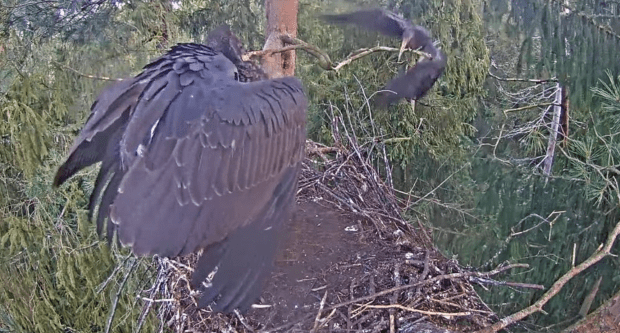
The First Egg for the Collins Street Falcons

Oh, my goodness. The male at the Collins Street Peregrine Falcon nest is nothing short of adorable. I spent all last year wanting to scoop up this stealth fighter in my arms and cuddle with him. Or dreaming of a Peregrine Falcon onsie. Wouldn’t that be cute on a toddler?

The first egg of the 2021 season has been laid on 21 August. Wow. It is eggciting.

You might be asking why the female is not incubating that egg. The female will not start incubating the eggs until the last one is laid. This is because the adults want the nestlings to be about the same size for the first fortnight so that there is no rivalry over food. Last year, the three big girls all hatched within a 24 hour period. There was never any sibling rivalry – that is what I love about falcons and kestrels. Once the last egg is hatched, they will be incubated for 32-40 days.

Mom looks so proud of herself!

These are some images from last year:

Mom brooding the triplets.

Dad feeding the girls when they are a little older – before they lose all that fluffy white down.

This year Mirvac, the property owners, are in charge of the streaming cams of the Victorian Falcon Project. You can watch these falcons from the very beginning.

Telyn at the Dyfi Nest, Wales. 20 August 2021

Some more great news. The Season of the Osprey will premier on PBS October 27 at 8pm! Please check your local stations for the exact time in your area. This is what they are saying about this documentary:

“Birds of prey exist in myriad shapes and sizes. Scores of eagles, hundreds of hawks and countless kites and falcons have all adapted form and behavior to fit diverse habitats. But in all the world, there is only one osprey. Following a single evolutionary path, it has conquered every continent save Antarctica. One bird, one design, unchanged. It is the only truly aquatic raptor, the sole member of its own taxonomic family. This one-hour, blue-chip special brings viewers into the life to this incredible raptor with a depth and intimacy never before attempted. Shot in and around Great Island Marsh, where the Connecticut River meets the Long Island Sound, cameraman Jacob Steinberg has achieved unlimited access to an osprey nest and captured the struggles, failures and triumphs of a single osprey family.”

Oh, I can’t wait!

I am afraid that I am having Malin withdrawal. A week or more ago I took a few video clips of Malin being fed by Marsha. I would like to share one of those with you now.

And another one of Malin exercising his wings.

It is so much easier when you know that the little one fledged, returned to the nest for food for 36 days or so, and then flew off to find their life. There is a level of anxiety when it doesn’t happen that way. I sure miss that little one. I have not, as yet, received any images of the two Osprey chicks found or any other news. I am hoping for tomorrow or Monday. It is a busy time of year for the wildlife rehabbers.

Two of the storklings have fledged at the nest of Grafs and Grafiene near Siguldas – the youngest was first and then the oldest yesterday. Only the middle remains. All have returned to the nest safely. The one that had its wing up against the far branch seems to be alright as well. That is good news. I have heard of no feedings since Grafs came in with some very small fish for the trio on 19 August. That means that if the storklings did not find the feeder – the two that fledged – they have had little food but nothing for two days. This is critical. There is concern that Grafs has left for his migration — it was the very initial concern. I want to remain hopeful.

Jan has fed his storklings but the meal was only tiny fish or worms. Urmas has not brought any more fish to the nest. Since he has fed them once and they accepted the fish, I hope that Urmas will do this again (he also left fish when he banded them and put on the trackers). It is not clear whether the anxiety of starvation is worse than having a human bring food to the nest.

These are very difficult times for everyone but they are especially difficult circumstances for these six starving Black Storks – rare Black Storks!

At the Black Stork Nest in the Karula Forest in Estonia, Karl II was still in the nest area. His transmitter told us. The two early fledges, Tuul and Udu, headed the wrong direction due to weather concerns and then turned south. Pikne travelled south from the beginning. New tracker information should be coming in soon. Safe travels all of you!

Oh, this youngster can really scream for food on the Loch of the Lowes nest. What a beauty. This is another good example of a ‘normal’ fledge. The chicks return to the nest to be fed and fattened up for migration.

I really want to put a plug in for the administration of the lochs in Scotland. No one is allowed on those lakes from April to the end of September so that humans do not disturb the birds. It means that motor boats with their leaking fuel are not chasing the Ospreys and making the water toxic. Gosh, I hope that only human powered boats are allowed. What a great idea – leave the lakes to the birds during breeding season. Three cheers for Scotland! This could well be the case throughout England and Wales also. I will try and find out.

And look what is on the Foulshaw Moss Nest. It is a flounder for the lucky chick that makes it to the nest first. Tiny Little!!!!!!!!! Where are you Tiny Little?

It’s a few minutes later and I missed that lucky fledgling that snagged that flounder! It’s gone. That leads me to believe that it was probably Blue 464, the male, the first to fledge. He likes to take the fish and eat it on the branch of the parent tree.

Thank you so much for joining me. I hope that you are looking forward to those falcons hatching as much as I am. Take care. See you soon.

Thank you to the following for their streaming cams where I took my screen shots and video clips: Scottish Wildlife Trust and Friends of Loch of the Lowes, Mirvac Corporation and the Collins Street Falcon Cam, The Cumbrian Wildlife Trust and the Foulshaw Moss Osprey Nest, The Eagle Club of Estonia, The Latvian Club for Nature, Collins Marsh Nature Centre, and The Dyfi Osprey Project.

Sadly, no word about Malin

I want to thank everyone that took the time to write to me and tell me how much Malin meant to them. My inbox was overflowing with letters expressing love and concern for Malin. Everyone wanted to know if there had been any word. Mom and Dad have both been on the nest with fish and today Marsha (mum) was there around 13:00. She did not have any fish that visit. During her morning visit she called out for Malin. So far there has been no sighting of Malin.

After going through the FB postings of the Nature Center, we were able to determine that Malin was the middle hatch. The youngest just disappeared from the nest and the eldest died in the middle of June leaving Malin, the chick that hatched on 18 June, alive. Malin was then the middle hatch of 18 June. Malin then was 63 days old at fledge. The average age for ospreys to fledge in Wisconsin appears to be 55 days. That would make Malin’s timing within range. Most ospreys spend at least 2 weeks flying and letting their parents feed them. Many stay much longer. Two examples that I give are Tiny Tot and Tiny Little because they were both hatches that suffered from lack of food. Tiny Tot stayed on the nest for a total of four months or 120 days. That is more than twice as long as Malin. Tiny Little remains on the nest in Cumbria. She will probably fledge before Tiny Tot’s 120 days – but she could be on the nest for 90 days.

There is disagreement over whether Malin simply flew or whether or not Malin was frightened off the nest by an intruder. Experts on both sides see that exit differently. It is unfortunate. The result is the same – Malin has not returned to the nest. The reactions to looking for Malin are different depending on which you believe. If Malin just flew because he wanted to then no one would go and really look for him. If one believed that Malin was frightened off the nest, they might worry that he was injured and look harder. Something that has to be kept in mind is that Osprey feed their fledglings on the nest – it is preferable. They do sometimes feed on a branch but I haven’t found an Osprey expert that has ever seen an Osprey parent feed their fledgling on the ground. In fact, if a fish falls off a nest they will not go and retrieve it. Have you ever seen an Osprey eat or feed its chick on the ground?

The research continues to stress that the more food and the longer fledglings stay on the nest the higher the success rate. That is the reality. This nest is really empty. Malin defied the odds – he survived and thrived. We hope that the name we gave him carries him on into his life and that he is somewhere safe eating a fish.

Collins is looking down like he might be seeing Malin.

One of the last times the entire family was together on the nest. It was a real privilege to watch little Malin survive and then – thrive. Let us all continue to send this family positive energy.

19 August 2021. Malin, Marsha, and Collins.

It is about 7am in Latvia and Estonia as I write this. The Black Storklings are waking up and like all birds are a little more energetic than they are at mid-day.

The two images below are from Grafs and Grafiene’s nest near Sigulda, Latvia. At least one of the storklets has fledged. Perhaps today they will all fledge and find the feeder area with the beautiful Grafiene decoy.

It is now just after 9am in Latvia and there is only one storkling on Graf’s nest near Sigulda. This means two have fledged just like my source had indicated. The second fledge is the oldest at 7:43 am. He is 70 days old today. The youngest fledged at day 66 after hatch.

This was not the smooth flight of the youngest. The oldest hit the branch on the other side of the tree. There is concern about the condition of that wing. I will update you as soon as there is any information. Send your strong and positive wishes. I hope it looks worse than it was. How terrifying for this young bird to have that happen.

Even so, I hope that both of the storklings are at the feeder filling themselves with fish – just like we hope Malin is doing the same.

There is now only the middle hatch. Perhaps it will go today. They are 68 days old.

When I checked on Jan and Janika’s storklings in Estonia’s Jogeva County, no more fish have been delivered to the nest. It looks to me like every scrap of the old fish has been eaten – I thought that yesterday. Perhaps one really packed down in the nest is there, the one the storkling on the left is pecking at. All of the birds need food.

Hopefully all of them will fledge and find the feeder set up for them, too.

They are so beautiful with the sunlight filtering through the trees. The storks are 67 and 68 days old today. The average for fledging is 68-72 days. I wonder if Urmas will deliver some more fish?????

Do you watch the peregrine falcons, Xavier and Diamond? If you do, then you will know that part of the pair bonding ritual is Xavier presenting a prey item to Diamond. Diamond is not that particular but, she does not like Starlings. She cannot stand them. She has turned Xavier away when he had a Starling for her. They must taste terrible!

Well, today, Xavier hit the jackpot. Diamond was completely excited about her lunch – although some of you might not be. Xavier had a Superb Parrot for his beautiful Diamond. Make sure your sound is turned up.

Superb Parrots are also known as Green Leek Parrots or the Barraband’s Parakeet. These little beauties are native to southeast Australia living in the dry woodlands of New South Wales and Victoria. They were once considered vulnerable in terms of conservation and have been listed as Least Concern since 2012. Loss of habitation due to timber logging might well see this bird back as being vulnerable.

They are medium sized, growing up to a little over 15 cm or 16 inches in length. The bird in the image below is a juvenile. How do I know that? It has brown eyes while the adults have yellow-orange eyes. The adult male has a bright yellow face and throat while the female looks like the plumage that the juvenile has below. They eat fruits, berries, insects, as well as grains and nuts.

Awww. What a sweet face.

WBSE 27 and 28 continue to charm the socks off of everyone. That beautiful fluffy white down is in transition. They look a little like old terry cloth towels sleeping in their nest this morning in Sydney.

Look closely along the edge of the wing of WBSE 28 on the left. You will see the little pin feathers coming.

The pantaloons are growing too.

Just look at that sweet baby, WBSE 28, looking up at its parent. How adorable.

They are so young and yet, both of them know to pancake when there is an intruder near the nest. They hear their parents alarming and down they go. Look at the concern shown in the eye of WBSE 27 on the left. You can also see the black pin feathers coming in on both in this image better than the other one. But look – their cute little tails are growing!

You cam almost see them growing right before your very eyes.

Tiny Little still makes my heart skip a beat. Oh, what a wonderful bird you have turned out to be. You were so very tiny with that big older siblings but just look at you waiting for your breakfast to arrive.

Oh, you have that ferocious look like Mrs G. I have said that a couple of times but you do, Tiny Little. I hope you live as long as Mrs G and have lots of successful hatches. You really are quite amazing, Tiny Little.

Tomorrow is Saturday but there is no Ferris Akel tour this week. I was hoping to catch up with what is happening with Big Red and her family. It was raining yesterday but the Hornings were able to spot all four of them so we know that K1 and K3 are still with us – how grand, the 21st of August.

I am researching ‘Climate Driven Evolutionary Change’. If you know of bird arrivals or departures that are earlier than normal or later than what has been the norm, please let me know. It is much appreciated.

It is so nice to have you here with me. The rain is still falling – and that is a good thing. Please continue to send your positive wishes to Malin and all the bird families. Take care of yourselves. See you soon.

Thank you to the following for their streaming cams where I took my screen shots and video clip: The Falconcam Project at Charles Sturt University and Cilla Kinross. Collins Marsh Osprey Nest, Cumbrian Wildlife Trust and the Foulshaw Moss Osprey Cam, The Eagle Club of Estonia, The Latvian Fund for Nature, and the Sea Eagles Cam, Birdlife Australia, and The Discovery Centre.

What is better than a Peregrine Falcon Kiss?

Lots of people keep track of hurricanes and tropical storms. Most watch because they or their loved ones, or both, live in the line of the storm. Bird watchers also track weather systems. There are currently two systems that might impact our beloved Big Red and family as well as the birds that are migrating over Hawk Mountain, PA.

Henri is going to give some heavy rain and wind. Ithaca is west of the darkest green band but could get some rain.

Tropical Disturbance Fred will also give some heavy rain in the same area. There were flash flood warnings for Ithaca last night. It is 1:03 am Thursday morning in Ithaca and there are rain drops dripping off the metal supports of the light stand that Big Red and Arthur’s nest is on. The rain does not look heavy at the moment. There is also a peculiar corn plant growing out of the centre of the nest!

Heavy rain will impact the hawks ability to hunt. They would have felt the pressure system coming and hopefully caught more food yesterday.

This isn’t the beginning of the season. Hurricane season runs until 30 November.

Baby Kindness (I wonder if she would mind if I call her that?) is not worried about hurricanes. Today, she is 83 days old. Kindness branched yesterday and all she has on her mind is ___________________. If you said flying you are 100% correct. She has really been putting on a show for the people watching the live stream today.

Oh, she really gets some nice air under those wings going back and forth from the branch to the nest.

Wow. Look at those wings. Magnificent.

Kindness has spent a lot of time considering what is below that branch she is sitting on. Sometimes she gets the branch to bouncing a bit and that seems to unnerve her slightly and she flies back to the nest.

For several days, I have been talking about the migration of Ospreys in Wisconsin, like Malin, or those living in the United Kingdom or in Northeastern Europe. The Bald Eagles in Alaska do not migrate south of Alaska unless there is no food. In 1972, the State Legislature established a long stretch of the In Chilkat River as critical bald eagle habitat. The goal was to protect the birds, some 4000 of them, that move from the interior to the Chilikat River Valley where they feed on the Chum Salmon run during the late fall and winter. The juveniles normally eat spawned and dead salmon or the carcasses left behind by bears.

The Glacier Gardens Rainforest Adventure is located in the Tongass National Forest just fifteen minutes away from Juneau. This is where Liberty and Freedom have their nest and where Kindness will fledge. There are meadows, forests, and glaciers. What a spectacular place to be a Bald Eagle!

“Tongass National Forest” by markcbrennan is licensed under CC BY-SA 2.0

One of the features of the park is the Mendenhall Glacier.

“Mendenhall Glacier – Tongass National Forest” by jcsullivan24 is licensed under CC BY-NC 2.0

Liberty, Freedom, and Kindness are not far from the Chilikat River Valley and the Alaska Chilikat Bald Eagle Reserve.

In the spring, many of the Bald Eagles will head to areas rich with Herring and Eulachon. These include the Stikine River, Copper River Delta, Silka Sound and Kenai Bend. You can see some of those on the map below. The Copper River flows from Prince William Sound while Silka Sound is closer to Juneau on the far right bottom.

Kindness is fortunate to live in such a beautiful state with what we all hope are abundant resources for her and all the wildlife forever.

There are so many worries in the world. The birds bring so much joy to each of us filled with nail-biting anxiety and that bittersweet moment when our friends fledge to begin their lives off the nest.

Malin is beginning to feel the wind beneath his wings. For so long I did not believe that Malin’s feathers would develop and he would fly – but here he is preparing just for that. Joy.

Like other birds, Malin is doing much more wing strengthening flapping as fledge approaches. The energy from the fish he is eating gives rise to lots of exercising after a feed.

For tonight though, Malin is sleeping like a duckling dreaming of fish.

While Kindness and Malin are dreaming of fish and flying, Xavier and Diamond are constantly pair bonding while preparing for their 2021 eggs and hatches. After doing their courtship dance in the scrape box today, they sealed the deal with a kiss – peregrine falcon style.

Can you think of a better way to end this newsletter? I can’t!

Want to catch the adventures of Xavier and Diamond, here is the link:

Well, what could be better than a Peregrine Falcon kiss? Three Black storklings eating the fish that Urmas brought them. That is actually cause for a big celebration!

When the storklings woke up at dawn and found the fish gift from Urmas, they began to eat.

The feeding of the storklings is a success! Congratulations.

Thank you for joining me this morning. Have a wonderful Thursday. Take care all.

Thank you to the following for their streaming cams where I took my screen shots: Cilla Kinross and the Falconcam Project Charles Sturt University, Collins Marsh Nature Centre, Glacier Gardens Rainforest Adventure, Google Maps, Cornell Bird Labs Red Tail Hawk Streaming Cam, and the National Hurricane Centre.

Things are happening in Bird World

Oh, just look who showed up on the NorthEast Florida Eagle’s nest in Jacksonville today – none other than the resident male, Samson! It was 7:23. So very nice to see you, Samson.

Samson is the son of Romeo and Juliet. Samson hatched on this very nest on 23 December 2013. Samson fledged and left the area on 22 April 2014. He was 120 days old.

At the end of the summer in 2019, in August, Samson arrived at the very nest he hatched from and began bringing in sticks. His mate, Gabrielle arrived on the nest on 12 September. In May of 2020, their two chicks, Jules and Romey, named after Samson’s parents, Romeo and Juliett, fledged. In 2021, they fledged their only hatch, Legacy.

The picture below is of Mama Gabby and baby Legacy in February 2021.

Samson has been seen at the nest earlier this month when the technicians came to do the maintenance on the streaming cam. Samson remains in the area of the nest year round while Gabby migrates to a cooler place – although, as I have often said, I don’t know where that would be this year! She will return about the middle of third week in September. It will be wonderful to see her back. Can’t wait.

Samson may be working on a nest but the Peregrine Falcon couple, Diamond and Xavier, are expecting eggs in the nest week or a week and a little bit. Their scrape box is high on a water tower, 170 steps up, on the campus of Charles Sturt University in Orange Australia.

This is Diamond on the ledge of the scrape box today.

Diamond and Xavier’s 2021 fledgling, Izzi, was the joy of everyone. As the only little falcon he was loved and spoiled by his parents. There was some concern he would not leave the scrape box before this year’s eggs are laid. This is the latest message from Cilla Kinross, the head researcher on the Falconcam Project:

“Izzi has not been in the box now for 12 days, but we think he is still around from calls. Parental behaviour continues as normal, with up to three prey a day being delivered to Diamond and preparation of the scrape. Eggs are expected soon (within a week or two). Generally, Diamond starts to spend more and more time in the scrape and her backside looks large and fluffy.”

You can watch Diamond and Xavier here:

Peregrine falcons are nothing short of amazing. Bald Eagles are big but Peregrine falcons are fast.

“Peregrine Falcon” by Jon David Nelson is licensed under CC BY-NC-SA 2.0

The cere is the yellow part above the beak. Now look at the nostrils in the cere. There are small keratinous tubercules – they look like small little bumps inside the nostril. Can you see the one on the right nostril of the falcon above? Those are what help the Peregrine Falcon fly so fast. They serve as a baffle against the wind driven in so forcefully into the lungs of the falcon as they do their high speed dives. Otherwise, their lungs would burst.

“Faucon pèlerin / Peregrine Falcon / Falco peregrinus” by FRITSCHI PHOTOGRAPHY is licensed under CC BY 2.0

Most Peregrine Falcons that you will see on a streaming cam lay their eggs in a scrape box like the one of Diamond’s, above. Some make their nests on the side of cliffs like this one in Japan on the island of Hokkaido.

“Peregrine Falcon Nest” by Ken-ichi is licensed under CC BY-NC 2.0

Peregrine Falcons do not make their nest out of twigs. It is believed that this helps to stop the spread of disease from twig nests pests like flies and parasites.

Here is a short 8 minute video to introduce you to the speed and hunting methods of the Peregrine Falcon:

It’s a great day for Malin! We do not know Malin’s exact hatch date. There were three chicks and the youngest hatched on 18 June. Two chicks perished in the heat. So Malin is either celebrating his two month hatch today or his two month hatch and a couple of days, more or less. His first delivery came around 9am and the second was at around 10:14. Malin is really growing.

Here is Malin next to mum, Marsha, this morning. You can see that Malin’s feathers are growing in nicely. Look at the crossing of those wing feathers. Yippeeeeeee. This chick has really grown with the increase in feedings.

And look at all of the bands on those tail feathers – looks like a clean 7 – while, at the same time, there are no spaces in the wing feathers.

Oh, Malin, aren’t you beautiful?

Malin has gotten very good at self-feeding.

Malin is off to a great start on Wednesday. Terrific.

It is raining heavy in Latvia at the nest of Grafs and Grafiene. There are some concerns on the amount of energy used to keep warm by the nestlings.

This is the nearby ditch. It is 200 m long. A portion of the ditch has been closed off and fish have been placed in there along with the decoy of Grafiene. The decoy of Grafiene was painted by an active chat participant and installed by Janis Kuze, the ornithologist.

I hope you don’t mind if I correct just minor details. The beautiful decoy was painted by the active chat participant B.K. and installed by the ornithologist Jānis Ķuze.

These are the size of fish being put into the feeder for Grafs. So much effort. Now we need Grafs to find this spot for his three storklings. It is a very, very difficult time for everyone especially with the rain. If you would like to check on the Latvian Forum for progress, please go to this link:

The situation of the Black Storklings in the nest in Jegova County, Estonia appears to be better than in Latvia. Jan has come to the nest to feed the storklings 3 times today. The storklings have not almost completely depleted the fish that was brought on the 13th when they received their transmitters and bands. They appear to be healthy and doing well. It is not raining on this nest today.

The three storklings are 63 and 64 days old today. The average for fledging appears to be 71 days but then the young storklings are dependent on their parents for another two to three weeks before leaving the nest area. That only puts us at the end of the first week of September for these three to be totally independent of Jan — but, of course, those numbers are only averages. It appears there is time! We all must hope for these birds. They are very rare and very special and there has not been a lot of studies done on them.

The Forum with ongoing information on the Estonian Black Stork nest is here:

Karl II has been in to feed the one fledgling on the Black Stork Nest in the Karula National Park in Estonia. Oh, that fledgling was so happy. That was at 18:33. It is Urmas, the only chick still being fed by a parent. Kaia has left for her migration and the other two siblings appear to have left the nest area and might be travelling as well.

I know that there is much sadness and anxiety in the region for the two Black Stork nests that had late hatches. But, we must also celebrate the happiness of this nest in Estonia, that of Karl II and Kaia. Three fledglings, all healthy! We need to send the most positive wishes for Kaia and the other two siblings as they make their way through Europe trying to get to Africa. And, then, of course, for Karl II and this storklet when they begin.

I have tried to catch the number to confirm this storkling but it is nearly impossible.

The smudge is right in the way!

For those of you watching the North American migration, it kicked off Sunday, the 15th of August at Hawk Mountain in Pennsylvania. The first over the ridge that day was a Broad-winged hawk. There was a strong wind that day and the count was 4 Bald Eagles, 2 Cooper’s Haws, 25 Broad-winged Hawks, and 3 American Kestrel. If you would like to check on the migration in North American on the route over the mountains with all their thermals, here is the place to go for a day to day check in:

https://www.hawkmountain.org/conservation-science/hawk-count

It’s 17:16 in Cumbria in the UK and our second great Osprey chick survivor this year – Tiny Little Bob on the Foulshaw Moss nest – is waiting for dad, White YW, to bring her the teatime fish! Every day is a blessing to see you on the nest, Tiny Little (Blue 463).

Thank you so much for joining me today. Please send all your positive energy to our friends in Latvia and to Grafs for him to find the feeder and for the safe migration of all of the birds. Take care everyone. See you soon.

Thank you to the following streaming cams and forums where I grabbed my screen shots: The Forum for the Latvian Fund for Nature and the Sigulda Black Stork Nest, The Eagle Club of Estonia and the Black Stork Nest at Jergova County, The Eagle Club of Estonia and the Black Stork nest in the Karula National Park, Collins Marsh Nature Centre, Northeast Florida Bald Eagle Cam and the AEF, Cumbria Wildlife Trust and the Foulshaw Moss Osprey Nest, and Cilla Kinross and the Falconcam Project at Charles Sturt University in Australia.

Monday in Bird World

There is some sad news coming in from the Kakapo Recovery. During routine checks, Tutu was found dead. He hatched in 2019 and the team says he was quite ‘the character’. This brings the total population of Kakapo in the entire world to 201.

Photo of Tutu @ Petrus Hedman Kakapo Recovery FB

The news coming in is not all bad but, it could be a lot better. I reported that Grafs had provided two feedings for the Black Storklings on the nest near Sigulda. As it turns out, after I posted my newsletter, Grafs returned two ore times making a total of four feedings on 15 August. The team are hoping that Grafs will find the feeding table. If Grafs does and accepts the food, this nest could turn around quickly! At the present time the storklings are in a critical condition.

This is the news from Janis Kuze:

“I can report that fish were let into the feeder last night, the place is a few hundred meters from the nest and is easy to see from the air, but the bird still has to find it.
Thanks to everyone who provided support!”
Jānis Ķuze

Grafs arrived with some larger fish for the storklings at 14:47. He has yet to find the feeding table. Some are thinking that it might not be in his territory. There is a discussion about putting a decoy black stork to attract Grafs.

A feeding table has also been set up for the Estonian Black storklings of Jan and Janika. I understand a decoy – a White Stork decoy painted black – is at that table to try and lure the male to the fish for the storklings.

Yesterday I said that the storklings had eaten all of the fish. That was incorrect. They have been stomped into a pile but the Estonian storklings are still eating from them today and they have had a feeding from Jan. You can see the remaining fish today on the back left of the nest. Thankfully the nestlings are eating from them. If you look at their bills they are still a dull colour which is good. They are also not getting stress lines in their feathers like the storklings of Grafs. Stress lines are translucent feathers caused by all manner of stresses not just lack of food. Regular growth in feathers is not translucent.

Here is the link to the streaming cam of the Black Storklings in Latvia:

Here is the link to the streaming cam of the Black Storks in Estonia:

If you want to keep up to the minute with what is happening at either or both of these nests, please look under the information of each streaming cam. You will find the link to the English forums.

Please be mindful that these are extremely difficult times for the moderators and helpers on the chats and the forums. These two nests showed great promise – the best – and as I have said many times — the fate of our birds hangs on a fragile piece of thin thread. It can change any moment. The biologists and vets are doing everything possible. We need for the male storks to find the fish tables. Send your warm thoughts to all. The little ones need a miracle.

UPDATE: It appears that Jan has found the fish table. He has flown in and brought 2 very large fish to the nest in Estonia. There are also fish left there from the bander! Great news. Let us hope this continues and now we just need Grafs to find the fish.

And now on to some rather silly news. Blue 462 at the Foulshaw Moss Osprey Nest in Cumbria, got the breakfast fish. And, of course….Tiny Little was right there making sure her big sibling could not eat in peace. Tiny Little is giving them back what they gave to her as a youngster in the nest!

Tiny Little loves moving around the sticks. It is really disturbing to the one who is trying to eat.

One of the cameras got knocked but what it did was give us a nice close up of all those sticks Tiny Littles moves and returns, moves and returns.

There were others wanting some of that fish – those pesky crows who seem to be around, too.

Tiny Little kept running at the crows to get them to go away but finally, it was 462 that flew away leaving Tiny Little that great big fish all to herself. Do you think Tiny has enlisted the crows to help her? with the promise she will leave some food? Normally, Tiny Little is like a vacuum cleaner removing every piece of fish!!

In the image below, 462 has just flown off the nest. Tiny Little is moving towards that big fish she is going to have for breakfast.

Tiny Little spends some time making sure the siblings and the crows are not going to bother her. At one time or another the crows were climbing and flying around that part of the nest. But never mind. Tiny Little started 16 August off with a nice big crop. Well done Tiny Little.

It’s now 17:30ish on the Foulshaw Moss nest and Tiny Little is there calling White YW for food along with another sibling. It looks like 464 to me but I cannot catch the band number. Tiny Little is the fledgling at the back.

Tiny Little is such a character. She is one of the good news stories of the year for sure! I really hope that when she returns to raise her family it is on one of the nests with a streaming cam.

Do you recognize this view?

That is the scrape box for the Collins Street Falcons in Melbourne! and the YouTube channel is up and running. This is fantastic news to all of us that have waited to see this couple and their eyases again. Dad is just the cutest.

Both parents are working on the scrape box. That is mom in the image below.

Here is the link so you can be in on the action from the very beginning:

It doesn’t get any cuter nor any happier than the little sea eaglets in the nest on the old Ironbark Tree in Sydney’s Olympic Park.

Both of them are thriving! That is 27 facing us with its big crop and 28 is still eating.

Yesterday, Malin went to sleep with his head on a fish and another whole Bullhead on the left side of the nest. He woke up this morning and finished off the “pillow fish” and Marsha flew in and fed him and ate a lot of the Bullhead herself.

Malin has a nice big crop! Mom is getting some fish and that catch did not go to waste. And that is a good thing.

Thank you so much for joining me today. This newsletter comes about six hours earlier than I expected. It is nearly 100 degrees F on the Canadian Prairies and the birds are in hiding. No photography until later. I will continue to monitor the two Black Stork nests and bring updates. Send your prayers and your warm wishes to those two Black Stork nests. They need a miracle to get the males to accept the fish! Bukacek did so we need Grafs and Jan to do the same!

Thank you to the following for their streaming cams or their FB pages where I took my screen shots: The Kakapo Recovery FB, Collins Marsh Nature Centre Osprey Cam, Sydney Sea Eagles, Birdlife Australia, and The Discovery Centre, Cumbrian Wildlife Trust and the Foulshaw Moss Osprey Nest, 367 Collins Falcons, The Eagle Club of Estonia and The Latvian Fund for Nature.

The Great White Egret

Sometimes there are birds that seemingly get forgotten as I rush to find out if Tiny Little beat the big older siblings to the fish or to check on Malin’s feather growth. Clearly one of those has been the Kakapo. There are now only 202 Kakapo, parrots that cannot fly and who love to eat Rimu, on a couple of small islands near New Zealand. They are continually monitored and all have satellite transmitters. They get health checks and are flown off island for care, if needed.

The Kakapo Recovery has partnered with On the EDGE Conservation to create the Kākāpō Run game. As a player you can help the Kakapo evade their predators will collecting Rimu Fruit. Because it is filled with facts about these amazing birds, it is a good way to learn about them. You can download the game here:

https://play.google.com/store/apps/details…

https://apps.apple.com/us/app/kakapo-run/id1569861836

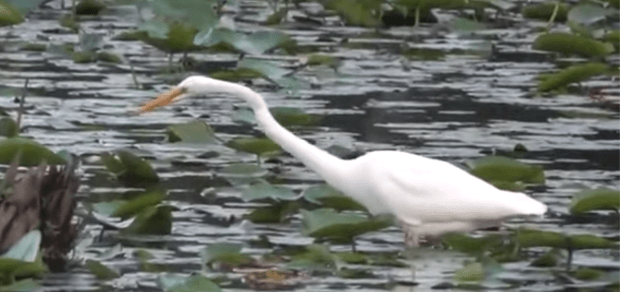
Ferris Akel spent most of the Saturday tour at Sapsucker Lake near Ithaca, New York. It was magical. We never made it to see Big Red and her family at Cornell University but it was a great time. One of the highlights was a Great White Egret which is rare to Sapsucker Lake.

Great Egrets are also called the Common Egret or Great White Heron.

Great Egrets will generally stand and wait to see their fish. They also slowly and quietly wade through the water until their neck snaps quickly and they get their fish.

Patience. Quiet. The Great White Egret gets its dinner.

Great Egrets nest in trees.

The beautiful white plumage that adorns these graceful wading birds was used for women’s hats in the late 19th century. Those silky white plumes are called aigrettes – which gives the bird its name. At the beginning of the 20th century, an ounce of Great Egret feathers was worth $32 USD, more than an ounce of gold according to the authors of Birds of Canada. People were so outraged that some of the first legislation to protect birds and their feathers was because of the Great Egret being brought to near extinction for hats!

In Canada, the Great Egrets nest in a very small number of places – in the very southern parts of Saskatchewan, Manitoba, a small part of southeastern Alberta, and southern Quebec. They are found in the Americas, Asia, and parts of southern Europe.

“Great egret rising” by wolfpix is licensed under CC BY-ND 2.0

The Great Egrets are large birds. They are 94-104 cm (or 37-41 inches) with a wing span of 1.3 m or 4.2 feet. They weight about 1000 grams or 2 pounds. They are all white with black legs and a yellow bill like the one shown above. During breeding season, a patch between its eyes turns neon green and long plumes grow out of its back.

“Great Egret Pointing the Sky” by TexasEagle is licensed under CC BY-NC 2.0

Non-breeding Great Egrets have a small yellow patch between its eyes and bill.

“Great Egret on nest with chicks” by Photomatt28 is licensed under CC BY-NC-ND 2.0

Great Egrets build a flat nest or platform of twigs and sticks. They will lay between 1-6 eggs which are incubated for a period of 23-26 days. It will be another 21-25 days til fledging for the youngsters. Aren’t they cute!

I am getting so excited for Peregrine Falcon season to begin in Australia. The male at the 367 Collins Street Nest also known as the CBD Nest arrived with prey for the female today. He is just such a cutie. The nest camera that streams on YouTube is not up and running. It will begin operations after the eggs are laid (normally). For now there is a camera operated by the owners of the building, Mirvac. Here is the link:

https://367collins.mirvac.com/workplace/building-overview/falcons-at-367-collins?fbclid=IwAR3vGCMkdnScju_KTKjhCrcHRnbsYxJm3kAKTLIOzylSVe8PX3UmwaJEn-s

The other Peregrine Falcon nest is that of researcher, Dr Cilla Kinross, at Charles Sturt University. The scrape box is home to Xavier and Diamond and they have been working on the scrape for some time now. We expect eggs at both nests by the end of August.

If you watch both nests you will get a good glimpse into the difference between a falcon nest on a high rise building in a major city, Melbourne, and the more open rural area of Orange, Australia. The prey is very different!

As it turns nearly midnight on the Canadian prairie, the day is just starting on the Foulshaw Moss Osprey nest in Cumbria. No doubt our beautiful Blue 463, Tiny Little, will fly out from where she is roosting on the branches of the tree in the distance, to the nest. White YW has a trio of big Osprey fledglings to feed. He has demonstrated that he is perfectly capable of feeding a family of five.

Thank you so much for joining me. Take care everyone. I hope to have some local images of bird life in Manitoba for you shortly.

Thank you to the following for their streaming cams where I get my screen shots: Ferris Akel and Cumbrian Wildlife Trust and the Foulshaw Moss Osprey Nest.

Feature Image Credit: “Great egret (Ardea alba) in flight at sunrise at Venice Rookery, Venice, Florida” by diana_robinson is licensed under CC BY-NC-ND 2.0

What’s happening in Bird World?

I don’t know a person watching a nest on a streaming cam that doesn’t get anxious if food is not brought to the nestlings and fledglings on a regular basis. Most of us start doing a bit of nail biting. Today, for example, Malin had 4 feedings. It isn’t as good as five but it is better than nothing! And last Sunday Malin had nothing. We are all hopeful for tomorrow. The weather is cooling off – Malin we are wishing for six fish tomorrow!

Malin 13 August 2021
Malin 13 August 2021 after a feeding

Jake Koebernik of the Wisconsin DNR did a great job answering a lot of questions that some of us have had about Malin’s nest. One was ‘why are the fish that are delivered are so small?’ and the other was ‘why do fish deliveries drop at the weekend?’ This is his answer, “As for the nest at the Collins Marsh NC, the streams and marshes around that territory probably only offer smaller species such as bullhead, bluegills, small bass and northern pike. There aren’t large lakes or real productive rivers in that part of the state, so they are going after what is abundant and available.” Jake’s answers cleared up a lot of the mysteries. —— And tomorrow, when Malin wakes up, Malin will have its official name! Fingers and toes crossed for it to be Malin!!!!!!!

My friend ‘S’ sent a screen shot of a delivery that Telyn made to the Dyfi nest this afternoon. We both agreed that Malin’s eyes would pop out if he saw a fish this big land on the nest at Collins Marsh. That fish is bigger than Blue 491! Wow.

And if you did not hear, Idris had been missing since Wednesday and he was on the nest today, albeit with a completely sunken crop. He brought a nice fish to one of the chicks. Hoping he gets his own fill of fish. Where in the world could he have been? It is worrisome.

Telyn delivered a whopper for 491, Ystwyth who is 82 days old on 14 August

Oh, if only places that have ponds could stock them for the birds. The Pritchett Family in Fort Myers has a stocked pond for Bald Eagles Harriet and M15 and their kids and the water also allows them to cool off and clean their feathers.

We are told by the IPCC that we can expect the droughts and extreme heat to be with us. Since these changes to our climate are known to be directly caused by human activity, maybe it is time to figure out ways to help the wildlife. Providing water and food is a start.

These two little sea eaglets are just adorable and a little spunky, too. They are growing like the sunflowers in my garden that the birds planted.

Both had nice crops after this feeding.

Judy Harrington, the researcher observing the WBSE Nest in the Sydney Olympic Park forest, just released her report on what these two have been eating during the last fortnight (14 days). In fact, it is the first two weeks of their life. Harrington also records the amount of time spent feeding by both the male and the female has been recorded. Lady took on 109 feedings for a total of 21 hours and 20 minutes. Dad did 8 feedings for a total of 42 minutes. Dad has been providing most of the food – he brought in 25 items and Lady brought in 5. These consisted of the following in total: 16 Bream, 4 catfish, 2 fish, 1 Mullet, 2 Whiting, 1 Yellowtail, 1 Ibis chick, 1 nestling, 1 pigeon, and 1 bird. They have now morphed into sea eagles, the second largest bird in Australia.

Sadly, it appears that Lady was hit during the night by Boo, the BooBook Owl that lives nearby in the forest. Despite its very small size the BooBook Owl has caused injuries to the large sea eagles in the past.

It is thought that Boo, as the little owl is so fondly called, has a nest near to the Sea Eagles. To my knowledge, the WBSE have never bothered their nest but, – hey. Every parent is afraid of a larger predator and wants them to leave the area.

“Boobook owl” by jeans_Photos is licensed under CC BY 2.0

Legacy on the Fortis Red Deer Nest has fledged. She has been on and off the nest a few times today. One was to get some fish! Here she is with Mum. After all the nestling deaths during the heat wave, this is just one of the happiest moments from that nest. Look how big Legacy is next to mom. Congratulations.

It is almost impossible to see what is happening on the Fortis Alberta Exshaw nest up at Canmore. Both chicks appear to be on the nest and calling for food. It is unclear to me if one or both have fledged.

The love story of the two Canada Geese has gone viral. It warms our hearts to see these two devoted birds – Amelia finding and waiting for Arnold during his surgery and recovery and now their reuniting. My friend, ‘R’ found two more stories on them and I want to share with you what she sent to me. You could read about these two all day – and you will always walk away with a smile.


https://boston.cbslocal.com/2021/07/15/goose-surgery-visit-mate-new-england-wildlife-center-cape-cod-branch/
Female reporter admits to being teary eyed! 

https://whdh.com/news/goose-who-underwent-emergency-surgery-released-back-into-the-wild-to-be-with-his-devoted-mate-on-cape-cod/Shirts for sale: “Honk If you Love Arnold!”

The story of Arnold and Amelia has taught us all something. If you find an injured Canada Goose and are taking it into care, please take the time to find its mate! The outcome might be much more positive. If you live in an area where there are Canada Geese – let your local wildlife rehabber know about the story of Arnold and Amelia. They will understand why it is important to keep bonded mates together (and their goslings if necessary).

And news about Kona. It is nearing 100 F or 38 C on the nest in Montana. The foster mother, Scout, has been shading Kona. Everything is going well with this foster. How grand.

@ Montana Osprey Porject

Leaving you with a gorgeous image of Loch of the Lowes. It just looks so still and peaceful in the early morning hours of 14 August.

And a last peaceful image of Diamond on the ledge of her scrape box on the water tower at Charles Sturt University in Orange, Australia. We will be looking for eggs before the end of the month. Izzi was last in the scrape box of Xavier and Diamond 6 August. He was photographed on 10 August and someone thought they heard him this morning.

Thanks for joining me today. I am off to try and find some hawks tomorrow so this is coming out early. I will bring you some late Saturday news in the evening. Take care. Stay safe! If you hear of interesting bird stories – and in particular, raptors – let me know.

Thank you to the following for their streaming cams where I took my screen shots: Collins Marsh Nature Centre, Sea Eagle Cam, Birdlife Australia and the Sydney Discovery Centre, Dyfi Osprey Project, Scottish Wildlife Trust and Friends of Loch of the Lowes, Falcon Cam Project at C Sturt University, Fortis Alberta Exshaw and Fortis Alberta Red Deer. Thank you to ‘R’ for sending me the links on the coverage of Arnold and Amelia and to ‘S’ for the information on Telyn and her whopper of a fish delivery. It is much appreciated! Thank you to the Montana Osprey Project FB page for the image of Scout and Kona.

The Hornbill

There are over 50 different varieties of Hornbill. The one that I want to focus on today is the Rhinoceros Hornbill. It is the State Bird of Malaysia. I became acquainted with these amazing birds during a trip to the Sarawak in East Malaysia many years ago.

The arrow points to Sarawak. The Rhinoceros Hornbill is present also in Sabah as well as Borneo, in yellow.

You could not move through the area around the harbour of Kuching without seeing ‘something’ decorated with the motif of a hornbill – from table cloths, batik wall hangings, phone cases, and old and not-so-old wood carvings. To actually see these highly endangered birds you needed a guide to take you to the jungle areas where local tribes still live in their long houses. There the hornbill was also used as a design for the totems on the poles supporting their roof as well as on many of the art of tattoos.

“Iban? Long House near Kuching” by rosskevin756 is licensed under CC BY-NC-SA 2.0

The weavers of the area specialize in ikat. Ikat is a type of resist dying. The threads are resist dyed before they are woven. The pattern in the textile below is called the ‘Feather of the Hornbill’.

Old carving of Hornbill, Ironwood. Sarawak Museum, Kuching.

The Rhinoceros Hornbill is depicted in numerous designs in wood carving. The wooden figure above is a Kenyalang. Historically, these carvings were associated with many of the tribes in Sarawak, Sabah, and Borneo. For the Iban, the figure is an essential part of a celebration called the Gawai Kenyalang. Its role was as a messenger. It called upon the spirit world to give courage to the warriors who went out headhunting. The carvings are still made today and they are still important for the various tribal communities. Head hunting ended in the 20th century and most of the carvings are considered cultural icons.

The Rhinoceros Hornbill is a large bird, 80 to 90 cm (31–35 in) long. The males are larger than the females. The birds are covered with black feathers except for the white tail that has a single black band. Their legs are white. The Hornbill is most notable for its colourful bill which is huge. In fact, that orange and red bill is what gave the bird its name. The Hornbill uses this lightweight beak to gather its food, build its nests, seal the nest, and feed the chicks. The structure on top of the bill is called a casque. It is hollow and its function is to amplify the call of the birds. The eyes of the male are red with black rims while those of the female are white with a red rim like the one below.

“Rhinoceros Hornbill” by shankar s. is licensed under CC BY 2.0

In comparison, this is an image of the male so that you can see the difference in their eye colour. It is the easiest way to recognize each of the genders.

“Rhinoceros Hornbill” by Steve Wilson – over 10 million views Thanks !! is licensed under CC BY 2.0

The Hornbills are very unique in their nesting habits. They are cavity nesters but with a twist. When the female is ready to lay her 1-3 eggs, she will locate a cavity in a tree trunk (or sometimes a rock formation) to make her nest. Once made she helps her bonded-for-life mate seal her into the cavity with mud. The only opening is a small oval hole where the male feeds the female during her confinement that lasts 50 days. He also feeds the nestlings. This arrangement is very practical. It helps protect the nest from any type of predator including lizards and snakes. Ninety days after the chicks hatch, the female will break open the mud covering to the nest.

The Rhinoceros Hornbill is listed as vulnerable. One of the biggest threats to its existence is the loss of the rainforest where it lives and builds its nest. It is also hunted for food as well as for items that are believed to give men virility including the feathers and the skull. The large trees that occupied the forested areas of Borneo are being cut down at an alarming rate. When I was there the wood was being shipped to China on those huge boats. It was overwhelming to see the forest being obliterated.

“Rhinoceros Hornbill (Buceros rhinoceros)” by Mark Louis Benedict is licensed under CC BY-NC-ND 2.0

In other news, Tiny Little Bob or Blue 463 nabbed the first fish of the morning on the Foulshaw Moss Osprey Nest in Cumbria. Tiny Little was busy eating it while sibling 462 waited on the nest. Tiny Little is off to a great start to the day! Go Tiny Little!

Karl II arrived at 8:10 to feed the three fledglings on the Black Stork nest in Estonia. The fledglings were incredible.

The glare of the sun on the camera creates a strong glow so you can’t see clearly what is going on. Karl arrives on the right and feeds the hungry storklings quickly. The nest is in the Karula National Park in Estonia.

One of the Storklings on the Siguldas Black Stork nest in Latvia has decided to get up close and personal with the camera and its supports while it waits for Grafs or Grafiene to bring them their breakfast.

The good news at the Peregrine Falcon Nest in the scrape box on the grounds of Charles Sturt University in Orange, Australia is that Izzi – cute little Izzi – has not been in the scrape box for six days. He has been heard but he has not gone in after several altercations with Xavier. Diamond, Izzi’s mother, is expected to lay her eggs by the end of August. Here is Diamond looking out over her territory.

Also in Australia, the two little sea eaglets, 27 and 28, are just cute. They are really growing. Dad brought in a life fish and was going to feed them today. Lady flew in and stepped on the fish before it could flop all over the chicks. Then she took over the feeding. Both ate well but 27 had an enormous crop.

It continues to be as good a day as it can be in Bird World. The juvenile Ospreys are eating and eating preparing to being their migration. For some of the UK nests the average number of days is around 90 hatch days old for fledging. We will be keeping our eyes open to see who is leaving.

Thank you so much for joining me. Have a wonderful Friday everyone. See you soon.

Thank you to the following for their streaming cams where I took my screen shots: WBSE Sea Eagle Cam, Birdlife Australia and the Discovery Centre, Cumbrian Wildlife Trust and the Foulshaw Moss Osprey Nest, Falconcam Osprey Project, C Sturt University and Cilla Kinross, the Eagle Club of Estonia, and the Latvian Fund for Nature.

Pair Bonding

The term ‘Pair bonding’ was first used in the 1940s. In terms of birds, it refers to a long-lasting relationship that results in breeding, care of one another, the nestlings and fledglings.

Pair bonding is “reinforced by ritual behaviour.” That is a very simple definition. A good example of on going pair bonding, is the ‘Morning Duet’ of Lady and Dad on the White Bellied Sea Eagle nest in Sydney, Australia. In fact, the rituals associated with pair bonding often occur at various intervals as a means of reinforcing the relationship not just before breeding.

This is Lady and Dad doing their duet together.

Pair bonding rituals also take place as many ‘bird couples’ prepare to begin their long migration. Working on nests is also happening, preening one another is on the rise. It reminds me of certain war movies where the couples seal their relationship as the male heads off to the field of battle – that sealing often consisting of an engagement ring or a promise to wait for the other. It is precisely the same with our birds. In this instance, both will migrate and each will hope that the other returns to the nest in the spring to renew their bond.

Aran has undertaken any number of sky dances with fish deliveries for Mrs G this week at their nest in the Glaslyn Valley.

Blue 022 and CJ7 continue to work on a nest in the midst of sky diving, fish deliveries, and mating. Sadly, they have chosen one of the Poole Harbour nests that doesn’t have a camera! Still, it is wonderful that they have remained together since spring and that brings promise to everyone that osprey chicks will hatch in Poole Harbour once again.

This evening, my friend, ‘R’ sent me the links to the two short videos below. It seems that Bukacek, the single father White Stork, in Mlade Buky and his new love, are sealing ‘the deal’. You can see some of the community coming out to watch – what a happy ending to such a tragic season for Bukacek.

Xavier and Diamond, the resident bonded pair of Peregrine Falcons whose scrape box is on top of the water tower of Charles Sturt University, are not migrating. Indeed, they are just beginning their breeding season. They continue to pair bond in the scrape. Here is a short video clip I made today so you can see this ritual:

According to the Falcon Cam Project of Dr Cilla Kinross, the average date for the first egg is 27 August. Here is the historical information for Diamond:

  • 2015 with Bula. 31 August, 2 September, 6 September
  • 2016 with Bula. 31 August, 2 September, 6 September
  • 2017 with Xavier. 26 August, 28 August, 31 August
  • 2018 with Xavier. 20 August, 22 August, 24 August
  • 2019 with Xavier. 28 August, 31 August, 2 September
  • 2020 with Xavier. 27 August, 29 August, 1 September

It is going to be so exciting when the little white balls of fur hatch. Can’t wait!

Other Nest News:

Some of us watching Malin on the Collins Marsh Osprey Cam are simply left shaking our heads. The female has been absent from the nest the last three Saturday nights in a row. There is no perch to the nest (they seriously need one). In addition, fish delivery just goes ‘off’ at the weekend. Malin slept alone through a thunder storm with lighting and rain last night and did not receive a single fish today – Sunday. Oh, I can hear you thinking that Ospreys do not need to eat every day and you are absolutely right. In fact, Tiny Tot on the Achieva Nest had 12 full 24-hour days that she did not get food. Often the parents teach the chicks that food does not always come every day. Still, the weekend pattern with this pair of adults mystifies me. Both came to the nest for short spurts without fish today. Malin was food calling (finally) late in the day. She is such a sweet little Osprey – and everyone is delighted that her droopy wing and feathers seem to be filling in and correcting themselves. So, once again, let’s put the optimist’s hat on and hope that there will be 5 fish deliveries tomorrow for Malin! Come on Mom and Dad prove me wrong and bring 6 big ones.

Malin’s beautiful feathers quickly dried out.

At one point, Malin was so excited when Mom arrived that she began to flap her wings and so some little hops. It is reassuring to see those feathers improve every day. We are all hoping for some big fish for your tomorrow, Malin!

A few of us have been calling the Collins Marsh chick, Malin which means ‘mighty little warrior’. That is because it had neither a number or a name. The Neustadter Nature Center at Collins Marsh is having an official naming contest. My friend ‘S’ just told me about this. I am so sorry it is such short notice but please go to their FB site and enter a name in the comments. Put in your favourite name – it doesn’t have to be Malin! I want the Nature Centre to see that there are many people, from around the world, interested in these Ospreys! But be fast. The names must be in by closing time tomorrow, Monday, 10 August. Here is the link where you can go and simply add a name in the thread:

https://www.facebook.com/Neustadter-Nature-Center-at-Collins-Marsh-140052786074932

After Monday, the names will be short listed. Please go back to this FB site and vote for your favourite. Thank you!

There are now three eggs in the Port Lincoln Osprey Nest. They were laid on 3, 6, and 9 August. That means that there is already six days between the first and the last. This nest always makes me nervous because of its history of siblicide. But, I am going to strike an optimistic note this year and take a wait and see attitude.

The White Rock Fire that was threatening Dr Christian Sasse’s property where he live streams his programmes on Ospreys and Bald Eagles is no longer out of control. Rain and the gallant efforts of the firefighter’s seem to have stifled this wildfire. This is great news for all the people and the wildlife. Let us hope that rain pours down on all the wildfires.

Thank you for joining me. It is so nice to have you here. Please go on line and put in a name for the little chick. Take care. See you soon.

Thank you to the following for their streaming cams where I took my screen shots and video clips: Port Lincoln Osprey Project, Collins Marsh Nature Centre, Bywyd Gwyllt Glaslyn, Sea Eagles, Birdlife Australia and the Discovery Centre, Falcon Cam Project at Charles Sturt University and Dr C Kinross.

Late Wednesday and early Thursday nest check in

Kindness, the Bald Eagle nestling in the Glacier Gardens Bald Eagle Nest in Juneau, Alaska is 70 days old today (5 August). Bald Eagles are considered fully grown at 12 weeks. The average age of fledging on the Glacier Gardens nest is 89 days while the rest of Alaska is 80 days. Kindness had a quiet Thursday. It was misting rain. Mid-afternoon Dad brought Kindness a small live fish. She ate it all!

Kindness is very good at mantling.

Kindness was fascinated by the flopping of the tail of the live fish.

She is growing into such a beautiful juvenile.

Kindness is such a sweet little Eaglet.

You can watch her here:

The little osprey nestling, Malin, on the Collins Marsh Nature Cam, had at least five feedings on Wednesday. A big shout out to ‘S’ in Hawaii for counting those feedings! Malin’s tail and wing features are looking so much better.

It was nice to see Malin with a bit of a crop early Wednesday afternoon. Those feathers are really developing and that girl loves to use her eye liner. Can’t wait to see what Malin looks like when she has all of her juvenile plumage.

Malin’s crop got bigger. So happy to see this. When Tiny Tot on the Achieva Nest needed food to really grow and begin to catch up, it arrived. Everyone’s warm wishes must be working for Malin! I do hope she grows feathers back over that shiny crop. I don’t think I have ever seen that in an Osprey chick, have you?

Malin is becoming quite the character. She is so happy when mom is on the nest. I wish I could sit in that yoga position like Malin does!

The Collins Marsh Osprey Cam is here:

At the White Bellied Sea Eagle nest in Sydney, it is all about the feedings. Unlike Kindness who eats more and requires less feedings, these little nestlings require lots of feedings with fewer bites. Lady and Dad have both been taking turns feeding and brooding. Lady does do all of the night time brooding. 27 and 28 can melt your heart. I have been told the bonking is minimal.

27 is 7 days old and 28 is 5 days old. These two are really sweet.

Lady just adores these little ones. She is so happy to be a mom again.

You can catch all of the action at the WBSE Nest in the Sydney Olympic Park here:

Hob Osterlund reports that Amazonia, the last of the Laysan Albatross Colony to hatch, fledged sometime between Monday and Tuesday off Kauai. For me, there are always a few tears when the birds fledge but no more so than for the Albatross who spend 4-6 years at sea before ever returning to land. What a leap of faith that first flight brings and how astounding it must be to fly. Take care H958. We hope to see you in Kauai in a few years with your sea legs on.

@ Hob Osterlund

There is troubling brewing down in Orange, Australia. Xavier and Diamond have been preparing the scrape box for the 2021 season. Izzi was officially 10 months old yesterday. There was a confrontation in the scrape box with Xavier. Neither bird was injured but it was Xavier that left the box. Most people feel that Xavier and Diamond will now have to treat Izzi like any other intruder – unless, of course, he wants to join in raising his siblings. It has happened – actually worked well – in the UK. We wait and watch.

Cilla Kinross posted a very short video of the unfortunate encounter:

It is a new day in the scrape box. Xavier arrives with a male Red-rumped Parrot as a food gift for Diamond around 11:20. He calls Diamond and she quickly arrives accepting the gift and fleeing the scrape box. Xavier waits and leaves after. This is good. I did not see anything of Izzi!

Diamond must have been so happy that Xavier brought a parrot than a Starling!

She grabs it quickly and goes out to enjoy her meal.

Here is the link to the camera for the Falcon Cam at Charles Sturt University:

The female at the Port Lincoln Osprey Barge laid her first egg of the 2021 season two days ago. Today should be egg#2. It wasn’t there at 12:32 on August 5 (nest time) but Mum looked restless and uncomfortable.

Still only one egg. Old timers tell me that there can be 4 days between eggs.

The 2018 hatch, Calypso, has been seen hunting just north of the barge. She was the first Osprey banded for a long, long time in Australia. She stays within 10 km of the barge – a real difference from Solly who remains up near Eba Anchorage, more than 200 km away.

Those beautiful Black Stork nestlings are doing very well. Everyone worries because these lovely nestlings hatched so very late. It is hoped their parents will stay with them and not leave for migrate before they can fly.

My friend in Latvia, ‘S’, also included a video that was made showing how the nest looked after last year’s season was ending. Wow, that nest is really narrow at the base. Have a peek!

The light in the forest changes throughout the day. There has been lovely misty rain in the early mornings with the sun bursting through later in the day. I must rewind the streaming cam today to find the parents returning to this nest to feed this trio.

There is still plenty of time before these beauties fledge. You can watch this rare Black Stork nest in Latvia of Grafs And Grafiene here:

Thank you so much for checking in with our birds today. It looks like everyone is doing fine except for Xavier and Izzi. We hope that is sorted and Izzi, the little cutie pie that no one wants to leave, is on his way to start his journey and find a mate! Take care all. See you soon.

Thank you to the following for their streaming cam where I took my screen shots: The Latvian Fund for Nature, the Glacier Gardens Bald Eagle Cam, Collins Marsh Nature Centre, Sea Eagles, Birdlife Australia and the Sydney Discovery Centre, Port Lincoln Osprey Project, Falcon Cam Project at Charles Sturt University in Orange, and to Hob Osterlund for the photo of Amazonia on her FB page.