Hi Everyone. It has been a nice day on the Canadian Prairies. The Dark Eyed-Juncos, that I have mentioned earlier, are descending on lawns all over our City today. It is lovely to have them back with us!
Cal Falcons posted a link to an Instagram feed that features some beautiful images and a lovely tribute to our beloved, Grinnell. Please read the text. Go to the feed to see the images. If you missed this, here is the link:
Cal Falcons also had a super cute image of ‘New Guy’ relaxing on the ledge. Like everyone in Berkeley, I hope – as I know you do – that the rest of the time for hatching and feeding eyases and fledging is completely and utterly boring and uneventful. This Peregrine Falcon nest has had enough drama!
New Guy is really growing on me.
Thought the day could not get any better until it was discovered that both female CJ7 who has been longing for a mate and found one too late last year – and Blue 022 – who became smitten with her – have reunited on the Poole Harbour nest!!!!!
If this couple hatches osprey chicks this year, it will be the first time Ospreys have hatched in Poole Harbour in over 200 years. And that is a big Wow in the Osprey world.
Aran returned as previously reported and him and Mrs G are getting reacquainted. Aran is one handsome Osprey!
Here is the link to the streaming cam for Mrs G and Aran at Glaslyn:
One of the things that I really admire about Emyr Evans and the Dyfi team is the amount of data they collect on their Ospreys. Here is Telyn on the nest.
Idris is unringed. Tely is Blue 5F. Idris is known for his great fishing abilities and his long legs which often earns him the nickname, ‘Daddy Longlegs’. Here he is enjoying a fish on his perch today.
If you look at the chart below, you will see that Idris replaced Monty at the Dyfi nest in 2020. They fledged two chicks and in 2021 they also fledged two chicks, a male and a female, not recorded yet on the chart.
This is a highly recommended Osprey nest to watch with chat. Emry Evans often stops in to answer questions and say hi. Here is the link to the streaming cam.
There are expectations that Blue NC0 is thinking of laying her first egg of the season with mate LM12, Laddie, grew more intense today as she kept close to the nest.
Ospreys have been breeding at the idyllic site for more than 50 years.
No eggs yet. I often think that Laddie could treat NC0 a little better. Last year she proved that she was as good a fisher as he was – if not better – hauling in large fish for the kids as they grew bigger and demanded more.
Here is the link to the camera at the Loch of the Lowes:
Blue 33 (11) and Maya always seem to be ahead of everyone else! They arrive early and get down to business. Their three eggs were laid on 31 March, 3 and 6th of April.
Their nest is often comical and/or sweet. Blue 33 is a great dad. There is fish on the nest at first light for Maya and the kids once the osplets hatch. Here is the link to their webcam at Rutland Water:
It is always a great day when Middle Little at Dale Hollow eats well and has a big crop. That would be today. Click on the streaming cam and Middle Little is looking good.
A big headless fish came in at 13:01:04. The parent did not immediately feed the eaglets but returned at 14:50:37 and fed Middle Little with Big looking on (below).
Middle Little did a lot of snatch and grabs when Big came up to get some nice fish, too.
Middle Little’s crop looks like it wants to pop. All is well.
The Ospreys at Skidaway Island have checked on their nest on and off while the Great Horned Owl raised Little Grey. Little Grey has branched and the Ospreys are anxious to reclaim their nest and start working on it.
As I have always said, Thunder and Akecheta’s triplets just put a smile on my face. This nest has done fabulous this year – no pecking, no fighting, no one scared to eat. Well done!
Thank you so much for joining me today in Bird World. Always good to have you here. Take care everyone. Stay safe!
Thank you to the following for their streaming cams and/or FB pages where I took my screen captures: Cal Falcons, Poole Harbour Ospreys, Brywd Gwyllt Glaslyn, Dyfi Osprey Project, People’s Post Code Lottery and Scottish Wildlife Trust, LWRT, DHEC, Cornell Bird Lab, and Explore.org and the Institute for Wildlife Studies.
Gracious. Andy is sure hauling in the fish. There have been 9 fish deliveries at the Captiva Osprey nest before 14:30!!!!!! Needless to say everyone has eaten well and all chicks are sporting blood feathers, tail feathers, and contour feathers. It is a good day at Captiva. Lena is even looking much refreshed.
It is busy at the West End Nest of Thunder and Akecheta. The newness of parenthood has not worn off Cheta. He is bringing in fish, brooding babies, and being security guard. The third hatch had its first taste of fish juice, saliva, and fish flake at 11:28. There it is in the image below.
Thunder and Cheta with their three babies on a beautiful California morning. This just puts a smile on my face! Beautiful.
Here is a video of the third chick getting its first meal from Thunder and one of the older siblings doing a great poop shot. Its plumbing is definitely working!
There is now going to be no time to rest. The UK Ospreys are arriving and it looks like the first one at a streaming cam is Laddie, LM12, at the Loch of the Lowes nest! So Laddie is here on 13 March. Last year he arrived on the 21st of March. He is eight days earlier than in 2021. Last year Laddie and NC0 raised two beautiful chicks to fledge. NC0 arrived on 25 March last year.
To see the Osprey you need to go to the lettering at the top. Stop at the ‘c’ in camera and looking down. Laddie is sitting in his favourite spot on the very top of the dead Silver Birch tree.
Here is the link to the Loch of the Lowes Osprey Cam:
I was expecting Blue 33 and Maya to be the first to return! That nest looks very empty. I cannot wait til they get back. They are one of my absolute favourites of the UK nests.
There is a new camera at the Loch Garten nest in Scotland. Here is the link:
Loch Garten holds a very special place in the heart of Osprey lovers in the UK. In the 1950s, a pair of Ospreys settled on the nest and began breeding. It was then the very first nest to have a breeding pair after the ospreys were made extinct in the UK. Indeed, the pair returned to the ancient Caledonian forest, part of Abernethy Forest Wildlife Reserve, near Aviemore, in 1959. It was a perfect place for Ospreys. There were lochs, rivers and estuaries full of fish. There is a little paperback that tells the story of the nest and the return of the Ospreys to the UK. It is Lady of the Loch. The Incredible Story of Britain’s Oldest Osprey by Helen Armitage.
There are high hopes for attracting a new breeding pair to the fine new nest that has been erected for them!
Talk about hoping to have a new breeding pair. The folks at Poole Harbour cannot wait for CJ7 the resident female who did not have a mate and Blue 022, a male who courted her last year, to return and raise chicks on CJ7’s nest. It this happens it will be the first time in 200 years that an Osprey chick has hatched at the site! Incredible.
Turning back to North America, everyone is on pins and needles waiting for Iris, the oldest osprey in the world, to return to her nest at Hellgate Canyon in Missoula, Montana. No one expects Iris to raise chicks. Her mate, Louis, has another nest that he cares for. I have a soft spot for Iris and feel that at 29 years old it is time she enjoyed her summer holiday. Raising chicks is a lot of work and really diminishes the health of the mother who loses approximately 30% of her weight.
Each of the three chicks at the Dale Hollow nest of River and Obey had a good feed around 11:28ish. Even Little Bit. They all stood in line and were very good as River fed them.
The wee one is doing well. The two older siblings are generally well behaved towards it – such a relief.
You can see that the snow is really melting as we see more and more of the edge of the nest. All of the babies are having a nice sleep in the warm sunshine.
I happened to look over at the Captiva nest. Andy just delivered the 10th fish of the day and it is a nice one. Little Bob is really enjoying this fish. Everyone is being civil and the kids are stuffed to their eyeballs…It is 15:48. Look at Little Bob open his mouth wide for delicious fish. Big is not paying him any mind at all. Food security is back in the mind of Big. Yippeeee. And well it should.
little Bob is still up near the table. Big looks like she has eaten so much she is going to get sick.
Little says there is room for more Mum!!!
What a beautiful image. All three chicks so full that they are passing out in food comas and Lena is getting some nice fish to herself. It just puts tears in your eyes. This nest has had a few really rocky days but today is one for the record books.
Every nest is doing really well. That is just wonderful. We can all rest easy tonight. Here is a sweet moment at the nest of Jackie and Shadow. Keep your eyes on the little one.
Thank you for joining me. Take care everyone. See you soon!
Thank you to the following for their streaming cams and/or FB Pages where I took my screen captures: Captiva Ospreys and Window on Wildlife, Dale Hollow Lake Bald Eagles, Explore.org, Cornell Bird Lab and the Montana Osprey Project, Scottish Wildlife Trust and Loch of the Lowes, Loch Garten, Poole Harbour Ospreys, Rutland Wildlife Trust, and West EndBald Eagles.
Good afternoon Everyone! The sun is shining bright on the Manitoba prairies this morning. Even 2 metres of snow looks beautiful! It is a balmy -8 C and it feels like summer. It is too hot for winter coats today. Now if all of this snow will melt slowly…ever so slowly so we do not have floods. The soil needs the moisture!
If you missed it yesterday, there is real cause for celebration at the American Osprey nests. Rosie has returned form her migration to be reunited with Richmond on the Whirley Crane in San Francisco Bay yesterday. Richmond had been hanging around the nest for three weeks. Some of us were beginning to worry a little and then…Rosie showed up right at dawn 06:43 on 25 February! If you are new to watching Osprey nests in the US, this is a rock solid nest. I am a huge fan of the UK nests and this is my number 1 for stability and the occasional humorous moment in the US. Richmond is great at fishing at night amongst other antics.
As you can see this is the couple’s sixth season on the Whirley Crane. Last year they fledged three fine Juveniles! Here is that great reunion video again.
Here is the link to their camera for those who do not have it. It is not on YouTube. The camera is, as I write this, currently off line.
Ervie did not come to the nest yesterday as far as I could tell from having eyes glued on the screen and doing a lot of rewinds. The barge was visited by a number of the pigeon clean up crew and a lovely Cormorant. There was also another bird that landing on the moorings but I cannot accurately identify it. In the image below, the Cormorant is on the perch and the other bird is on the perch.
Port Lincoln has not updated Ervie’s sat-pak tracking yet. So, it remains a mystery where he captures his delicacies – those puffers!
There is sad news coming out of the Hilton Head Island Bald Eagle nest of Harriet and Mitch. I report on this nest occasionally. Two eaglets hatched and the last time I checked on them they had their juvenile feathers and were self-feeding. Yesterday one of them was found on the ground below the nest. It has been taken to Corvian Avian Conservation, a wildlife rehab clinic. It is unclear the state of the eaglet at the time it was rescued. This morning food has been brought to the nest. The remaining eagle did mantle the prey and is seen eating but not enthusiastically. The nest is being monitored. There is some concern that the bird prey brought might have avian flu, the highly pathogenic H5N1 strain that is spreading. I assume the remaining eaglet might also be removed from the nest for testing if authorities are concerned. Will monitor and post.
I will do a post just on Avian flu early nest week. There are other nests where the eaglets have fallen over the edge of the nest and they are being tested. Do not discount it. This is very, very serious. There are virologists looking at these deaths to try and understand the spread and the remedies. It could impact much of the nests other than the Ospreys who seem to be less prone because they eat fish almost entirely.
We all worry when these things happen and it is easy in small nests where there is prey competition, parental neglect, and a lot of wingersizing. I want you to watch, when you have time, this lovely video of a rescue of two eaglets in Sweden so you will understand that wildlife rehabbers can do amazing things. This is a heart warming story of individuals who really wanted a success.
The number of people watching the nest of Jackie and Shadow at Big Bear, California continues to grow. It was 2131 not long ago. Today is pip watch and you can join in, too.
While we were focused on the Captiva Osplets, Ervie, or Jackie and Shadow, something wonderful was happening over at the nest of River and Obey at Dale Hollow Lake. Twins hatched at 11:16 and 11:51 yesterday. There is a pip in the third egg. Wow.
If you are wondering where Dale Valley Lake is, it is in Kentucky. It is one of the oldest human made lakes in the region, created out of the Obey River, in 1943. Now you know how these two eagles who have used this nest for six years came by their names. The lake has 27,700-acres of water and is well stocked with fish for the Baldies.
Just when I praise the nest for being located right above the lake, I see Dad has brought in a rabbit for the eaglets lunch! Too funny.
Here is a link to the streaming cam so you can join this nest with the two grey little bobbles and another on the way:
I suggest you put this nest on your watch list. I am really hoping that the parents will not bring in any birds to this nest due to H5N1’s potential spread.
Kincaid is doing really well at the Kisatchie Forest Bald Eagle Nest near Alexandria, Louisiana. Louis brought in another big fish and Kincaid is really enjoying this late morning feed. Like many nests located near a stocked body of water, Louis mostly brings in fish but he also brings in Coots and other waterfowl. If you are new to watching Bald Eagles and want to add a nest to your long list, I highly recommend the KNF nest. It is on YouTube. Cody and Steve have made sure the image is great and the sound is awesome. Next year they will have the two nests on Kincaid Lake on camera. Great moderators on chat. Cody and Steve are often on there to answer your questions along with Tonya.
Normally I start with the Captiva Osprey Nest but, today, I will almost close with it. Lena was hollering at Andy to get a fish on the nest at dawn. I could not see a delivery. Please correct me if I am wrong. By 09:34:03 Big Bob was getting agitated and did some beaking.
Little Bob was smart. He moved far to the right out of harm’s way. You can barely see him. He has his neck stuck down in the twigs. Smart.
Their last feeding was in the afternoon yesterday and the trio were very hungry by the time Andy landed that fish on the nest at 10:30:42.
It was a large fish and Lena moved around the nest making sure that each of the babies was full.
They are all lined up nicely to eat. Big Bob’s slight aggression ended as soon as food arrived. Please note that if you are reading the chat, the moderator calls this ‘playtime’. They are all a week old and some aggression is typical at this age but more so now that the early regular and very stable feeding routine has been thwarted.
I hope that Little Bob gets up in the front despite the fact that he has one of the longest necks I have seen on an osplet!
Lena will continue to fed until the fish is gone if that is what it takes to fill her and the babies to the brim.
Nice crop!
It is now 12:43 nest time in Florida and Lena is yelling at Andy for fish.
It is 13:32. Lena is calling Andy again and you can hear him in the distance along with the cheeping Bobs.
There are so many recreational vehicles on the water today. I wonder if this is hampering Andy’s fishing. It is also quite warm in Florida today. Lena is doing a good job of shading the babies who cannot yet regulate their own temperature.
Til later…
We all need a giggle and today’s laugh is brought to you by a Raven in Poole Harbour, England at the nest of Osprey CJ7 (Rutland fledge 2015). The Raven is leaving two lovely chocolates that it will bury in the nest. How romantic a gesture this could be. I hope that this is for the arrival of CJ7 and the male, Blue 022, that we hope will also return and have their first successful breeding season together. If you want to see the whole video posted the Poole Harbour Osprey Project, please head over to their FB page. You do not need to be a member.
Here is the link to this streaming cam. Last year it was too late for this potential couple who delighted observers with their mating antics all over the town. If we get a hatch and a fledge, it will be the first time in over 180 years since their extinction! That is something to cheer about.
And on that happy note, I will say goodbye. Keep your eyes out for Ervie and a pip at Big Bear and a successful hatch for Dale Hollow. Things are really gearing up. Take care everyone. See you soon.
Thank you to the following for their streaming cams or FB pages where I took my screen captures: Poole Harbour Osprey Project, KNF Bald Eagles, Captiva Ospreys and Window on Wildlife, Port Lincoln Ospreys, Dale Hollow and Golden Gate Audubon and SF Bay Ospreys.
By 18:30, the smoke and the temperatures were cooperating and it seemed like a good time to go and check on the Cooper’s Hawk family in Assiniboine Park. When I arrived at the Park, there were several cricket games going on, families were meeting and sharing a pot luck outside – many for the first time since spring 2020, there were birthday parties and children running around.
When I found the spot and knew where the hawks had their nest and were hunting for bugs and chipmunks the other day, there were children running around. I could see the hawks in the sky circling. They never went to the nest tree or came to the ground. It is the life of a birder. It would be wonderful to see them a few more times before migration. The Canada Geese do not usually begin leaving until the middle of September through to the end of October. I have seen some miss the group and wind up walking about on an early snow. Weather is such a significant factor in the challenges our birds face.
For those who are not sure what migration actually is. Our feathered friends Move from one area for breeding during the spring and summer to another area for winter. They have adapted to the pattern of coming and going in order to survive. It is based on food supplies.
Different species travel different routes to their winter homes. These are long journeys. For example, the Ospreys in the United Kingdom will travel some 8,000 kilometres or 5,000 miles to places in Africa. The birds will fly over land, sea, and desert to reach their destinations. People wonder why the birds just don’t live in Africa all the time. The answer is rather simplistic: there would not be enough nesting sites or food for all of them plus their chicks. There are also a lot of very hungry predators ready to take those lovely fluffy little ones. So they disperse from Africa to sites in the United Kingdom and Europe.
The birds decide when it is time for them to migrate. The hormones in their body begin to change. Unlike spring when this hormone change leads to breeding, the autumn sees the birds restless until they know that it is time to depart. These hormones trigger a lot of eating. Fat begins to gather under their skin. They gain weight. It is that fat that will see them through their migration. Still, they stop and feed along the way. Normally they hunt for food in the early mornings and late afternoons. High pressure systems are good for flying but low pressure systems bring winds and rain. When the birds get into a low pressure system, they will normally stop flying, if they can, and wait til another high pressure system comes through. Migration times vary because of the winds and the weather. Birds that soar and ride the thermals can travel as much as 465 km or 300 miles in a stretch. Some gather in flocks like the storks in Latvia and Estonia. Sometimes birds pair up to migrate. For the Ospreys, the female leaves and the male stays behind until there are no fledglings crying for food.
Not all birds migrate. Even I have a sedentary Sharp-shinned Hawk that defies all logic to stay on the Canadian prairies for the winter. The Osprey in Australia do not migrate. The birds in the Amazon Rainforest do not migrate. There is plenty of food and nesting sites for them year round. This past spring and early summer there was much discussion over the migration of birds from Florida. In Jacksonville, Samson, the father of Legacy, stays in the area of the nest year round. Gabrielle, on the other hand, migrates north – yes north – to cooler summer climates. This year she might have discovered it is hotter up north! Even some of the Ospreys in Florida do not migrate; they stay year round. There are plenty of fish for them as well as nests.
Birds take different routes. The White Storks from Latvia either taken a western route or an eastern route. Dr Erick Greene and his team in Montana study the migratory movements of the Ospreys from the Clark Fork River area with satellite transmitters. In the United States, some fly over Hawk Mountain where there is an annual count. In fact, you can go to this site to see the number of birds traveling over this marvellous area with its thermals. Here is the link for you for their autumn migration count that will being in about a week!
Migration is extremely challenging and we hope that all of the adults will return to their nests the following spring and that we will see the juveniles who take their first flight to Africa in a couple of years.
And now for some birding and nest news
Poole Harbour: Blue 022 and CJ7 who were so visible until a few weeks ago sky dancing, mating, and working on the nest with the streaming cam are now working on another nest in the area. There is no camera. They are still doing everything together and everyone is looking forward to the first hatches in Poole Harbour for 200 years.
Dahlgren: A large part of the nest in King George, Virginia, collapsed today. It will be fixed in the fall well after Jack and Harriet’s migration.
Kielder Forest: All 16 of the 2021 juveniles have fledged successfully. Everyone is elated. This is 6 more fledglings than their previous best year. Congratulations everyone!
Mlade Buky: Bucachek and his new love spent the night on the nest in Mlade Buky, Czechoslovakia. Oh, how sweet! Just as the dawn is beginning to appear, they are both preening.
Balloons, something that impacts all birds: Virginia, Maine, Maryland, and Delaware have or are going to pass shortly the release of balloons. Hawaii has already passed a law on helium balloons.
Port Lincoln Ospreys, Australia: Dad and Mom have been taking turns incubating the eggs. Here is dad on the nest. A little earlier he had been pestering Mom. He kept pulling on that turquoise rope wanting his turn. It was too funny. The Port Lincoln Ospreys are an example of sedentary birds. They do not migrate. There is no need.
Loch Arkaig: The two juveniles of Louis and Dorcha have now fledged. I have not heard anything about the chosen names yet.
Collins Marsh: Malin was a little wet off and on during Saturday. S/he is sleeping on the nest alone tonight. There is no perch – let us hope that the parent or both parents are in a nearby tree in case there are any owls about. It seems like a pattern. Does mom always spend Saturday night off the nest?
WBSE, Sydney Olympic Forest: 27 and 28 continue to eat until their crops almost burst and sleep. Meanwhile there has been an intruder today and Lady and Dad were honking in alert.
And last but very special, A Place Called Hope. Along with other wildlife centres, they are receiving quite a number of starving Great Blue Herons and other herons. Why would they be starving? It has been raining in the Connecticut area and all the herbicides and pesticides that people put on their lawns and gardens makes its way into the environment, into the water table, into the ponds. It is poison. If your gardening centre or lawn care person tells you that the chemicals they use are ‘Green’ – well, think again. Whatever they are using kills. So sad. It is OK if your lawn doesn’t look emerald green.
Thank you so much for joining me today. Have a lovely Sunday. Take care of yourselves. I look forward to seeing you soon.
Thank you to the following for their streaming cams and their FB pages where I grab my screen shots: A Place Called Hope, Mlade Buky White Stork Cam, Collins Marsh Osprey Nest, Port Lincoln Osprey Project, and Sea Eagles, Birdlife Australia and the Discovery Centre.
The featured image is Dad at the Port Lincoln Osprey Barge taking his turn incubating his two eggs.
If you have watched Kindness, the Bald Eagle nestling at Glacier Gardens, then you might have caught her nipping at her mum’s beak. It looks like she is trying to kiss mum. A couple of days ago a video was made showing Kindness interacting with her mum. My goodness, Kindness, you are lucky your mum is so patient! Have a look.
At the Port Lincoln Osprey barge, it looks like the final touches have gone on the nest renovations. The egg cup is now lined with very soft pieces of bark. Mom decides to try it out!
Dad flies in with something else on his mind! No eggs yet but mating is taking place. Season will begin soon!
As we approach fledging at all of the Northern Hemisphere Osprey nests and migration in a month to six weeks, if you fear Osprey withdrawal, here is the link to this nest. Just a warning. This nest has had instances of siblicide in the past.
The Port Lincoln’s eldest chick from the 2020 season, a female named Solly, was fitted with a satellite tracker. Solly is 301 days old and she is still hanging out at Eba Anchorage and Kiffin Island. It sure seems that Solly has found her forever home at Eba Anchorage. For those of you unfamiliar, the movements of Solly changed what everyone understood about Ospreys in Australia. It was believed that ospreys stayed near to where their natal nest was located. Solly travelled over 200 km to Eba Anchorage and Perlubie giving the researchers fresh insights to the behaviour of these ospreys.
To my knowledge there has been no sighting of DEW, her younger brother. He did not receive a tracker but he did get a metal ring and a Darvic colour band.
Suzanne Arnold Horning was on the Cornell Campus again this evening. How lucky she was to get some great images of Big Red with a squirrel down on the ground – and it wasn’t raining. (Send the rain to the Canadian Prairies when you get tired of it, Suzanne!).
It was wonderful to see Big Red with prey that she was going to eat herself. She needs to build up her strength after laying eggs, incubating those eggs, and feeding and caring for the three Ks until fledge. Even now she is doing some prey drops and is busy training the Ks to hunt.
Big Red with Squirrel. @ Suzanne Arnold Horning
The Robins were giving Big Red a lot of grief. Could it be because Arthur has been up at their nest eating their babies? Or the fact that K1 caught a bird today and it was rumoured to be a young Robin?
Robins being rather assertive around Big Red. @ Suzanne Arnold Horning
Big Red and her squirrel also attracted another visitor – a Turkey Vulture!
Would you mind sharing asks the Turkey Vulture. @ Suzanne Arnold Horning
The pair also attracted a human who was said to have tried to interfere with the situation. Both of the birds were fine. Big Red was eating and the Turkey Vulture appeared to be waiting to see if she left anything.
One of the things that I have learned is that hunting is difficult and prey is not abundant always. Raptors can wait for hours, half a day, or even a day to catch prey to eat. It is estimated that only 1 out of 3 juveniles live to the age of two years – mostly due to starvation. Humans should not interfere when a raptor is eating. As a result of the human intrusion, Big Red chose to fly away from the human who was interfering. This also caused her to leave part of her meal. The vulture did eat the rest – so in the end everyone ate- but it was a situation that should never have happened. Remember if you see a hawk hunting or eating, please leave them alone. Finding their meal is not that easy.
Turkey Vulture at Cornell. @Suzanne Arnold Horning
The scientific name for the Turkey Vulture – Carthartes Aura – means ‘cleansing breeze’. They are scavengers, eating mainly carrion. They have dark espresso coloured feathers, red legs and head, with a white beak. Like the condor, there are no feathers on their head. This is a great evolutionary trait so that pieces of the dead do not stick to them causing disease or parasites. The Turkey Vulture’s sense of smell is so great that they can find a fresh killed animal a mile away! The only raptors larger than the Turkey Vultures are the Eagles and the Condors. What I find interesting is that they are the only raptor that cannot kill their own prey. They simply do not have the right talons to do this – their feet are more like that of a chicken. That said they can tear through really tough hides with their beak. In other words, the Turkey Vulture was never a threat to Big Red.
As I prepare to settle in for the night, Tiny Little is waking up. The early morning fog over the marsh is just starting to clear. You can see the parents, or siblings, or both back on the parent tree. Tiny Little is still sleeping like a duckling on the nest. Good Morning Tiny Little! Let’s get that gear box into forward today.
Tiny Little is also checking the nest for any little tidbits of leftover fish. And just like Tiny Tot he has found some lurking under those sticks.
Tiny Little was doing some prey calling and looking up in the sky. The morning fog doesn’t seem to be clearing. What a beautiful colour it is – that sort of golden pink gradually fading into the grey-blue-green. Lovely.
Update: Tiny Little had a huge breakfast. It is now mid-afternoon and Blue 462 is working on a fish that arrived. 464 is standing next to that fish and Tiny Little, 463, is ignoring it right now. She is probably still full enough from the morning not to bother. Unclear if Tiny Little has taken a second flight today. I stayed up waiting! But had to give in to being tired.
This is the image of the afternoon line up for a fish! 462 is eating, 464 is pretending to be Tiny Little and bugging his big sibling. Tiny Little is over at the side duckling style. Tiny Little is full from breakfast and knows that Mum will come to the rescue later if she gets hungry.
There is a beautiful peachy almost coral sky as the morning begins at the Poole Harbour Osprey nest. CJ7 and Blue 022 are roosting elsewhere.
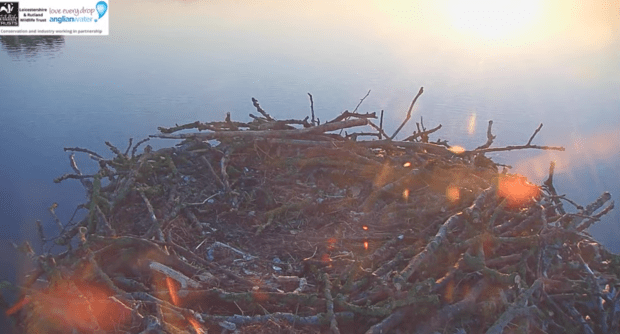
Golden diamonds are falling on the nest of Blue 33 and Maya at Rutland Manton Bay. No one is home. They are all perched elsewhere. Blue 33 does make food drops at the nest for the two Bobs.
A little later, Blue 095 flies into the nest and settles down and then flies out again.
Blue 095
Oh, wow. Just look at that sun coming up over the Dyfi nest of Idris and Telyn in Wales. It is so bright you cannot see the perch!
A very short video of Ystwyth fledging at 7:59 am on 17 July is here:
It is serene up at The Loch of the Lowes. No one is home but it sounds like there is a fledgling on the camera perch.
What you don’t see here is that later, NC0 is on the nest, spots a fish, goes out and gets it, and gives it to LM2.
Early Morning at Loch of the Lowes. 18 July 2021
The only thing you can hear at Glaslyn are either bees or wasps on the microphone! Oh, it is so beautiful and green. It has been hot at this nest, 26-29 degrees C – and the birds are staying cool in the shade of the trees. Even with the heat the landscape looks so lush. What a gorgeous way to begin the day.
Early morning at Glaslyn. 18 July 2021
Thank you so much for joining me today. I so enjoy hearing from all of you. Stay safe! See you soon.
Thank you to the following for their streaming cams where I took my screen shots: Byrwd Gwyllt Glaslyn, Dyfi Osprey Project, Scottish Wildlife Trust and Friends of the Loch of the Lowes, Cumbrian Wildlife Trust and the Foulshaw Moss Osprey Nest, Poole Harbour Osprey Project, LRWT and the Manton Bay Ospreys. I would also like to thank the Port Lincoln Osprey Research Project and the PLO FB page where I took a screen shot of Solly’s recent tracking. And last but never least, I would like to say a huge thank you to Suzanne Arnold Horning for allowing me to use her images on my blog. She holds the copyright on them so please do not use elsewhere. Thank you.
There are a number of Ospreys named Louis but the one that I am writing about today is the Louis of the Loch Arkaig Osprey Nest. His mate, Aila, did not return from migration this year and there is a new Mrs Louis. Her name is Dorcha. Louis chose not to make their nest on the one that he had shared with Aila. As a result, news of Louis and Dorcha comes from those who have access to see the nest. Today’s news is from the person who ringed the chicks. They report there are two healthy 4-5 week old nestlings. How grand. Louis is a fabulous dad – he even went fishing at night for Aila and the three chicks last year.
I am doing a bit of nest hopping. For whatever reason I am unable to access the Foulshaw Moss Osprey Nest. Others are having difficulties too but some seem to have some success. It is, of course, slightly frustrating because this is the nest of Tiny Little!
The eaglet on the Bucovina, Romanian Golden Eagle nest is hungry. Yesterday he only had a small bird and a bone. There seem to be days of bounty and then not much of anything on this nest. Is there enough prey? how far to the parents have to travel? are both parents still delivering food for the baby? For many this is the haunting memory of Spilve and Klints last year. The young Golden Eaglet cannot live on a little bird. Zenit is a beautiful bird and it will not be long til fledge. Let us all hope that Zenit gets a large prey drop today.
Zenit saw his reflection in the camera for the first time yesterday. It is so cute when they do this – the reactions to seeing another bird like them! Lady Hawk caught this precious interaction.
Wishes come true! I checked on Zenit just a minute ago and Zenit has an enormous crop! Looks like he swallowed a softball.
Scrolling back, Zenit’s mother came in to feed him. This was at 14:12. It also appears that a bird delivery was made around 17:00. It is not clear what the mother brought but as you can see above, Zenit has a very large crop and this is a good thing. It remains unclear to me how much prey there is in the area. Let us all hope it is good!
When the Royal Albatross chick was weighed on Tuesday (NZ time), she had dropped from 8.2 kg to 8.0. The rangers were monitoring Taiki’s weight and were considering whether or not she needed a supplementary feeding. Perhaps that won’t be necessary after today because her mother Lime-Green-Lime flew in for two feedings and her dad, Lime-Green-Black was there for one. Three feedings in a single day at 9:58 (LGL), 13:57 (LGK), and LGL arrives twenty minutes after LGK departed at 14:17. These were quick in and outs but it looked like Taiki got a lot of food.
LGL is so happy to see her daughter. Taiki would like her mum to dispense with all the formalities – the sky calls, the welcome – but LGL will insist. Her daughter needs to learn all of these and imprint them in her mind. Taiki will fledge in mid-September. She will not return to land for 4-6 years. At that time she will do a skycall just like Mum is doing now. Can you imagine being at sea and never stepping foot on land for that long?
Taiki is so excited to have a parent come in for breakfast.
LGK saunters in after Taiki has had her breakfast and is ready to feed her lunch at 13:57. It always looks like the adults have difficulty walking – and maybe they do if the chicks are digging holes and building play nests everywhere. Here comes dad!
It is so interesting that these little Albies stay put on their nest without moving about so much (at least at this stage). LGK does several sky calls but Taiki just wants food!
Taiki settles down to work on her play nest after LGK leaves and gets dirt all over her beak. It sure doesn’t matter. Look at how beautiful she is.
This is LGL’s second visit to feed her daughter. Taiki is so excited to see her again. I wonder if she told mum that she just missed dad? LGL does several skycalls when she greets her daughter.
The baby down is falling off and revealing a beautiful pattern on the back of Taiki.
LGL always looks like she is smiling.
Taiki must be about to pop after three big feedings! LGL must be fishing near to Taiaroa Head as she is returning so often. Taiki is lucky.
It was a golden morning on the Loch of the Lowes. No one was on the nest- they were all out flying and learning to fish. There are some trees around the nest that are apparently good perches for the birds. What a beautiful place. It looks so tranquil —- and safe for Ospreys.
It was just as beautiful at Mlady Buky in Czechoslovakia this morning. There is a mist, low lying clouds, or a fog hugging the mountains. The three storklings are on the nest. Everything is so quiet – you can almost hear the stillness.
Father Stork arrives at 6:19 with breakfast for the three almost fledging storklings.
The three continue to find small morsels on the nest after the frenzy when dad arrives.
The feeding gives them energy. The sun is up and they are warm and two are flapping madly on the nest.
The female is really covering the nest and moving her wings. She was getting some lift this morning as well. Father Stork and the people of Mlady Buky have done well. After the loss of the female, it has been simply a miracle to watch these three thrive. In a way, the people of the community stepped in and took over when supplementary feeding was necessary – just like the New Zealand Department of Conservation rangers.
Sadly, there is no one stepping in for Zenit if it is needed. I wonder if the people who operate the camera would consider setting up a food table if it were needed?
My goodness. Blue 022, the two year old who returned from his migration and stopped off at the Poole Harbour nest of CJ7, is so enthusiastic. He has been helping fix up the nest and has even provided fish for CJ7. He has also been seen ‘sky dancing’ on several occasions. This morning was no exception!
They make such a lovely couple. Oh, goodness. Everyone is already crossing their fingers and toes that these two return from their migration safely. The months will not pass quickly enough. Imagine – no chicks born in this area of England in 200 years! Incredible. There will be lots of celebrating!
Dylan and Seren are both on the nest at 7am watching and waiting for Only Bob to come and have some breakfast. He loves to go and fly often landing on the camera stand. It is so different when they fledge – at first babies always on the nest and hungry and then parents having to wait with food as they fly about.
Kindness is getting her legs stronger every day. She is standing straight and walking some on the nest. She is certainly growing fast – an advantage to being the only chick on the nest.
Kindness loves to do kissey-kissey with Mom. It is so funny watching these two.
At the Osprey nest on the Port Lincoln barge, Mom is on the nest and Dad was over on the ropes. Eggs arriving soon.
Oh, it is a bit like a bad joke. The camera at the Foulshaw Moss Osprey nest just started working. Both 462 and Tiny Little are on the nest. It is around 7am and they are watching for a parent to arrive with breakfast. Look at that nice necklace that Tiny Little has. Interesting. (TL is on the right) They are being kissed by diamond rain from the sun.
And when he wasn’t watching for a delivery, Tiny Little was flapping his wings dreaming of flying.
The more flapping he does the more the last tidbits of baby down disappear. It won’t be long Tiny but you were four days younger than everyone and you were behind in growth. You will get there just like Tiny Tot!
Hopefully that fish arrives! These two are both hungry. And it did. Tiny Little went over and ate some of the remaining fish and Blue 35 comes in and removes what is left (piece at the front) and will fly off with it.
The camera was still on the blink. I just checked and Tiny is fine. It is tea time and both Tiny and big sib are waiting for a delivery. It is so interesting that the big siblings know when to show up for food.
And last but never least, a lovely picture of Aran and Mrs G on the Glaslyn Nest together. This is a beautiful sight. There has been some bonding over the last few days. I was concerned that Aran was not in top form and Z2, Aeron, of the PC nest might want to take over this one. They are being kissed by golden raindrops, too! Mrs G doesn’t look like she is 21 years old, the oldest osprey in the United Kingdom. She is in really good shape. So sad that they lost their three chicks this year. That can cause issues but they seem to be a solid couple.
Thanks for joining me everyone. It is lovely to see the Golden Eaglet doing well today. That nest is a constant worry. And speaking of worry. The comments section on my blog seems to not be working all the time. It is like Tiny Little’s camera. Please feel free to send me an e-mail: maryannsteggles@icloud.com. I know that some of you had concerns and I regret that technology has caused you any worry. For the next while, til things step up in Australia, there may be only one blog per day. I hope to get more local Osprey news for you this coming week.
Thank you to the following for their streaming cams. This is where I grabbed my screen shots: Bucovina Golden Eagle Nest Cam, Cumbria Wildlife Trust and the Foulshaw Moss Osprey Nest, Cornell Bird Lab and NZ DOC, Mlady Buky, Port Lincoln Osprey Cam, Glacier Gardens Eagle Cam, Dyfi Osprey Project, Clywedog Opsrey Cam and Carnyx Wild, Byrwd Gwyllt Glaslyn, Poole Harbour Ospreys, and Scottish Wildlife Trust and Friends of Loch of the Lowes.
Today it not just about Ospreys. There have been some nests that have been overlooked lately so I am going to try and catch up on some of those for all of us.
I love how the wildlife rehabbers go to great lengths to make certain that the babies they rescue do not imprint on humans. Have a look at an eaglet that came into care and how it is being fed:
The female White Storkling at the nest in Mlady Buky, Czechoslovakia is ready to fledge! Look how beautiful she is with her wings spread. She looks like a dancer bowing to her audience. She was making all the right moves this morning. She began flapping her wings as the sun was rising and got very enthusiastic around 6am. She is restless and continues flapping and looking out to the world beyond the nest.
Father Stork comes in to feed the three youngsters. This generous community continues to provide supplementary food for Father Stork so that he and his three babies can survive. You can see, in the background, Father Stork eating from the fish table that is provided to him and his family. Sadly, their mother was killed on one of the electrical lines and these three are alive today because of this community. It is heart warming to see that the storklings are ready to fledge. Everyone can be so proud of their efforts!
The Bucovina Golden Eaglet, Zenit, grabbed the prey delivery from Mom and completely self-fed today for the first time. Zenit mantled and flapped all the while telling Mum to go away he could do this himself. Wow. Another milestone to independence. Lady Hawk caught this magical moment in a video:
There has been a lot of discussion about goshawks lately because they have raided and killed many Osprey both in Latvia and an eagle in Spain. There is a Crested Goshawk nest in a park in Taipei. The adults failed at their first breeding attempt and had one hatch on their second. The eaglet is three weeks old. So cute.
Crested goshawks live in Asia. Their territory is from the Indian subcontinent to Taiwan. In terms of its range and numbers it is of ‘least concern’. It is, however, a protected species in Hong Kong because of the encroachment on its forest environment. The hawks are now adapting to urban living. The Crested Goshawk is 30-46 cm in length or 12-16 inches. Like other raptors, there is reverse sex size diamorphism – the female is larger than the male. They feed on insects, birds, and mammals. The nest is normally made of sticks in a tree and most often the female will lay between two and three eggs.
The image below shows a Crested Goshawk Female. Look at that gorgeous plumage.
In size comparison, the Northern Goshawk that has caused issues related to the death of the Osprey chicks in Latvia and Spain is approximately twice the size of the Crested Goshawk. Each species has a long tail and shorter broad wings to help them speed around the forest area where they hunt. They are more adapt at living in the forest and often lure their prey into that environment.
Here is the mom in her nest with her eaglet.
The eaglet has been ringed with two official bands.
The eaglet will fledge in 2-3 weeks. You can watch this little one grow up here:
Now let’s check on some of those Ospreys!
Foulshaw Moss. Tiny Little is still moving in to get fed. I have seen some people worrying about him but, honestly, this little one is going to be grand. At tea time on Sunday, 464 was self-feeding. Self-feeding is hard work and the chicks spend a lot of time and energy fighting with the bones in the head. They get tired. So when 464 finished eating, Blue 35 took over and fed Tiny Little and Middle Bob.
In the image below, 464 is self-feeding. Mom, Blue 35, is waiting and it is Tiny Little stretching his wing. As we will all be saying, Tiny Little isn’t so Tiny anymore. And that is a good thing!
Blue 35 has taken over the feeding and, of course, Tiny Little is right there for the bites! Tiny Little and Middle Bob have always done well together. It is really good that 464, the big female, fledged first. It is hard to imagine but a couple of days ago Tiny Little looked like an extremely young chick. Now, unless the bands are visible and you follow the chicks it is hard to tell them apart. Now that is magnificent and it shows precisely what getting a good feeding means to these chicks.
Dyfi. Right now it is pitching down rain. Earlier it looked like Dysynni was hovering so high that he was going to fledge – but, he didn’t. Ystwyth is in awe! Dysynni is 52 days old today and Ystwyth is 48 days.
I imagine that Sir Richard Branson whose Virgin Galactic’s Unity Spaceplane took off from Spaceport America this morning successfully returning to Earth from space would really like to fly like a bird. Laura Culley, falconer and great mind, told me once that humans have the DNA for feathers and flight we just haven’t turned them on. Any geneticists out there to confirm that?
And then the rains came and Idris delivered a really nice fish that Telyn is feeding the nestlings. No more thoughts of fledging today!
Poole Harbour. Both CJ7 and Blue 022 were at the nest at Poole Harbour today. They continue bonding. There is at least a month or six weeks til they head off on their migration. Let us all hope that this lovely new couple return in late March or early April – both of them – and entertain us with their antics while raising chicks.
Clywedog. Oh, it is wet and miserable at this nest in Wales today. Only Bob looks pretty miserable.
Never fear. Dylan went out and got a nice perch for Only Bob’s (Blue 496) tea time treat. Seren is happily feeding her little one. Soon Only Bob is going to be thinking about fledging too.
Look at Dylan’s strong thin legs. The other day he flew 13 km to get a trout for his family’s dinner. Thanks John Williams for confirming that distance!
Loch of the Lowes. It is raining in Scotland, too. NC0 is on the nest feeding her nestling and her fledgling their tea time meal. NC0 has been flying with Fledgling Bob over the loch. It will be wonderful to see her spend time flying with both her babies once Second Bob has fledged. NC0 has become a very good mother. She struggled at the beginning with the feeding and many thought that Second Bob would not survive and perish like little third Bob. But, look at these two now. Fantastic. NC0 really came into her own. Laddie has done his part, too!
Are you interested in France’s plan for their Osprey and White Tailed Eagles? If so, Stephanie Scofield posted the French government’s document on the Ospreys (Pandion haliaetus) FB page. If you cannot read French, have a look anyway. The graphics are very helpful. Here is that report:
Thank you so much to the person who forwarded me an image of Z1, Tegid. I do not know who to credit for the image so thank you to that individual. I hope you do not mind my posting it today!
I am so grateful to my friend ‘T’ for telling me about this brave little osprey. As many of you know, I am setting about on a ten year plan to follow the osprey hatches that were beaten and battered and deprived of food but, who made it despite all the odds against them to fledge! I want to see how their lives unfold. Sadly, many like Tiny Tot on the Achieva Osprey nest are not ringed and most are not seen on camera. So my list is short. It includes Z1 Tegid, JJ7 Captain, Tiny Little Bob Blue 463, and Tiny Tot. If you know of others please alert me. You can leave me a comment or send the information through e-mail (maryannsteggles@icloud.com). It is much appreciated.
Here is Tegid. He has a nest with chicks for the second year in Snowdonia in Wales! Look at those strong little legs, too.
It is a soaring hot day on the Canadian prairies. The birds are really enjoying the water dishes and baths – they are keeping us busy filling them. I am taking a break from cleaning my tiny home office. It got stuffed with all manner of everything during the pandemic and now it is time to get that sorted. It is so nice, like now, to stop and check in on our friends with feathers!
Thank you so much for joining me and thank you for all the letters, comments, and pictures. I love hearing from you.
Thank you to the following for their streaming cams where I take my screen shots: Scottish Wildlife Trust and Friends of Loch of the Lowes, CarnyX Wildlife and Clywedog Ospreys, Dyfi Osprey Project, Poole Harbour Osprey Project, Cumbria Wildlife Trust and the Foulshaw Moss Osprey Nest, Crested Goshawk Nest Cam in Taipei, and the Mlady Buky White Stork Nest Cam.
I have been thinking about Electra all day…and have spent several blogs trying to gain some insight into her behaviour on the Cowlitz PUD nest since her last chick died of heat stroke. She has spent more time at the nest today than yesterday when it was deathly hot. She food calls when she sees Wattsworth. She stands like a sentry. She spent the night at the nest.
I have been given examples of raptor behaviour when the eggs have been broken and the female continues in incubation mode because of her hormones. Many of you have also seen other raptors incubating eggs for long periods of time when they are unviable. That is one behaviour. But, I am going to go out on a limb and say that the behaviour displayed by Electra is different.
There are no eggs to hatch. How does an Osprey mourn? While I believe that Electra ‘understood’ the death of the first by siblicide, she returned to find her second chick had died – a chick with a crop and seemingly healthy. This just took me back to the situation on Captiva Bald Eagle Nest on Santibel Island this early spring.
Some of you will remember that traumatic event. Joe had brought a rat to the nest and had fed baby Hope and Peace. Peace died almost before anyone could realize how ill she was. Hope grew and only died when one of her blood feathers broke and she bled out. It was the rodenticide, the rat poison that did not allow her blood to coagulate. The father, Joe stood over the body of Peace in the Captiva Bald Eagle Nest in Santibel, Florida. Joe stayed with his baby until the corpses of both Peace and Hope were removed for autopsy. In the end, Joe was so traumatized by the events on the nest that his role as dominant male was usurped.
Joe is not the only male that has shown a response to trauma. Another good example is Romeo on the NE Florida Nest. When Juliette was injured by an intruding female and did not return, Romeo tried to take care of the nest. When he went to get food for the eaglet the intruder returned and took the chick. Romeo left and never returned to his nest.
What I am saying is that I do not think that we can always put behaviours of the birds down to ‘hormones’ or instincts. What Electra is doing is different than incubating and she is not brooding the chicks. She is standing over them, like Joe at Captiva.
We will never get into the mystery of precisely how Joe or Electra are feeling. My thoughts on this behaviour are simply my own observations based on deaths at other nests. I do not know how Electra has responded to the death of her chicks in the past and if this current behaviour is any different.
Other females have lost Osprey chicks and left the nest completely not to return. Landa did not, as I recall, return to the Urdaibai Biosphere Park in Spain after her last two chicks died of hypothermia this year. Others like Mrs G moved her dead chicks to the edge of the nest and she now spends time eating fish and being on the nest with Aran. Mrs G and Aran also accepted the community fish and those were brought to the nest. At other times an only chick dies and the mother has to continue to care for other little ones.
The response to tragedy is not always uniform and predicted.
Tiny Tot has had to deal with an intruder today. Jack owes Tiny lots of fish! There is also concern as Tropical Storm moves from the Caribbean to Florida early nest week. It should be dissipated enough to only cause 34 mph winds. I will keep you posted.
I want to close with leaving you something beautiful to watch. You might never have seen it before. It is a sight not seen in Poole Harbour, England for 200 years. Imagine. 200 Years. It is an Osprey doing a sky dance. This is two year old male 022 trying to impress CJ7. They will not raise a family until next year but 022 is extremely earnest in his desire to bond with CJ7 at the Poole Harbour Nest!
Thank you for joining me today. Take care everyone.
Thank you to the COWLITZ PUD for their streaming cam where I grabbed my screen shots of Electra and the chicks.