As the Nest Turns 11 Sept

The female on the Port Lincoln Osprey barge woke up to some rain and by mid-day there was rough weather. The moderator of the PLO chat said they hoped that the chick would choose to stay in the egg!

It is currently 12 degrees C with a wind speed of 42 km/h or 26.09 miles per hour. Blustery. Not good for fishing. Best wrapped up in a cosy blanket with a cup of tea and a good book. Hang in there mum.

Aran is still in the Glaslyn Valley. Doesn’t he look grand on one of his favourite perches looking over ‘his’ territory. As much as others might have their eyes on their natal nest, Aran doesn’t intend to hand it over to either Tegid or Aeron, Monty’s boys, Z1 and Z2, respectively.

Some are worried. My notebook just said that ‘Aran migrates after the middle of September.’ That was accurate but not precise enough.

As it happened, Tiger Mozone on the PLO chat and so I was able to ask him. Immediately – literally – there was a link to ‘Tiger and Chloe B’s Osprey Data’.

https://www.imagicat.com/Glaslynstats2021.html?fbclid=IwAR1uxYgOaHJ85Yo7zbbEpttPlKvHn_N4zWrrL-TLutWheHwn_AQQRZPLr8c

These are the dates that Aran was last seen at the Glaslyn nest from 2015-2020:

  • 2015. 25 September
  • 2016. 16 September
  • 2017. 12 September
  • 2018. 22 September
  • 2019. 16 September
  • 2020. 15 September

The average is September 17th. That is six days from now. There is no need for anyone to be alarmed that Aran is still in the Valley, worrying that he is unable to migrate due to his earlier injury. Aran is ‘being Aran.’

Everyone that watches the Royal Cam Chick at Taiaroa Head, Tiaki, you should be giving a shout out to Ranger Sharyn. She located Tiaki 150 metres from her natal nest and the streaming cam. She carried her back to the general area of the nest – and just in time. LGL flew in and fed her daughter shortly after.

Here is Tiaki seeing her mom and coming quickly for that delicious squid shake. These chicks can really move when food is involved — or running away from ‘the dreaded basket’ when the rangers come round to weigh the chicks.

Victor Hurley, the Peregrine Falcon specialist who uses the streaming cam in Melbourne to study the falcons, is looking for some help. He was on the 367 Collins Street Falcons FB page today asking for individuals to accurately provide the time stamp for the incubation hand over duties. Later, he will be looking for time stamps for prey delivery. If you would like to help, please go to the 367 Collins Falcon Watchers and PM Hurley.

Here is a great example of what he is looking for. Mum is getting off the eggs and Cutie Pie ‘Dad’ is falcon walking on the ledge. They are such a good team.

It is windy in Sydney, too. WBSE 27 and 28 had a tiny bird – looks like another gull chick – around 6:29. 28 held back until almost all of the bird had been eaten by 27. That is a bit unusual for the first feeding in the morning. Normally 28 is right up front ready to go.

Notice that 27 stood for its breakfast! Oh, these two are really developing. Both have been standing more and trying to walk.

Another food item comes to the nest around 10:00. This time Lady splits the meal between both of the chicks.

28 is on the left and 27 on the right. You will notice that while the wing and back feathers are growing in nicely on both, 27’s tail is longer and 27 is noticeably larger.

In his book, Soaring with Fidel, David Gessner reminds readers that at the time of migration the juvenile Ospreys are transformed in appearance from when they were first fledglings. Gone is the white scallop on the feathers, gone is most of the down, the eyes are yellow, the dark feathers are darker, and the birds have ‘slimmed down’ somewhat.

So today an Osprey appeared on the Achieva Nest in St Petersburg. Help me out here. Could we be looking at a slightly older Tiny Tot?

The top two images are of the visitor today. The top one looks more like the face of Tiny Tot with the trademark ‘heart’ on the top of the head.

These are the first images that I grabbed of Tiny Tot out of the hundreds that I have. I wish that I could get both of the birds in the exact position.

Of course, it could be my mind playing tricks. I would dearly love for this to be Tiny Tot.

When I was scrolling for images of Tiny Tot, I cam across this one of Tiny Little. The Two Tinys are the stars of survival for 2021. The most amazing, clever, determined to live little birds who beat the odds. What I wouldn’t give for Tiny Tot to have a Darvic ring! Then we would not be guessing who is on that nest.

I will leave all of you with this mystery and a reminder of how inspiring these two little ospreys are to all of us.

Thank you so very much for joining me today. Take care everyone. Stay safe.

Thank you to the following for their streaming cams where I took my screen shots: PLO Osprey Project, Cumbrian Wildlife Trust and the Foulshaw Moss Osprey Nest, Sea Eagles @ Birdlife Australia Discovery Centre, Achieva Credit Union St Petersburg, 367 Collins Street Falcons, and Bywyd Gwyllt Glaslyn.

Osprey Migration

Dr Tim Mackrill, the Osprey specialist that worked with Glaslyn on how to set up the fish table for Aran and Mrs G this past late spring and early summer when Aran injured his wing, gave a wonderful Webinar on Osprey migration. He has taped the entire talk and you can watch it on YouTube. It is free – and worth every minute. You can, of course, start and stop the presentation as needed. Here is that link to everything you wanted to learn about Osprey migration and more!

The wait continues for the female adult at Port Lincoln’s first hatch. Any time! It’s 12 August in Australia and that was the day I guessed on the FB page. Come on hatch!!!!!!

The nest at Port Lincoln is known for its siblicide. There will be no intervention of any kind – other than putting on the Darvic rings and maybe another satellite tracker this year (if they choose to do this). If you take the number of days different from the day egg 1 was laid and egg 3 and then add the number of days between when they hatched, you will get a real number that tells you the difference in age between 1 and 3 – sometimes ten days. Some of these little ones survive. Tiny Little Bob at the Foulshaw Moss had extraordinary parents. Tiny Tot at the Achieva Nest was simply an extraordinary bird. Many aren’t. So please keep this in mind. Here is the link to the streaming cam.

There is news coming out of Loch Arkaig. Louis might still be at the lake along with one of the juveniles. Louis is very devoted to his chicks and he will wait til one of them leaves – for certain – before he does. Stay tuned. People will be checking this to make sure.

There has been no confirmation about Iris, the grand dame of all Ospreys, having left for her migration. The last certain sighting was by Sharon Leigh Miles on 6 September.

Put a bookmark on the Osprey migration video if you can’t watch it soon. On one of those rainy days when you are wanting something to watch, it is a great resource.

Thank you for joining me this morning. Take care everyone. Stay safe.

The featured image is Iris. Iris is believed to be the oldest Osprey in the world. She summers in Montana but no one knows where she stays for the winter.

Thank you to the following for their streaming cams where I took my screen shots: Port Lincoln Osprey Project and Montana Osprey Project and the Cornell Bird Lab.

Friday Night with the Birds

Do all the successful birders get up before 5am and head out to find that rare bird that landed near to where they live? Even if I were an Osprey and had Rutland’s Blue 33 delivering me breakfast, I would surely be out of sorts. That is precisely why that Juvenile Green Heron that has been near Winnipeg will never grace my eyes! Still, we gave it another try. Perhaps the heron would be back at its fishing spot a few hours before sunset?

I wish you could hear my big sigh. We arrived and right before our eyes was the largest group of kayakers I have ever seen! Even so, there was a man sitting in the rocks in the middle of the river with his long lens focused on the shore on the other side. Was it the heron? After examining the shore, the trees, the water, nothing. Maybe he was hoping that the heron would fly in and he would have the ideal position for the best shot?

Or was he watching this pair of Hairy Woodpeckers? They were chasing one another around a tree. (Or are these a pair of Downy Woodpeckers?) They looked quite large compared to the little Downy that comes to our suet.

One of the most interesting events came at our third stop. This was one of the many ponds located in a residential area – the same one where the Cormorants were yesterday. We sat down and observed nothing short of ‘Canada Goose Airlines’ taking off. Let me explain.

When we arrived there were approximately 300 Canada Geese on the water or foraging around the shore.

This scene looks pretty chaotic, right?

Then in a blink a flock gets orderly. They group together and swim to the shore seemingly ignoring everything around them.

The geese then follow one another up the incline. Then very quickly they turn and face the water.

In a split second they are off! Heading South on their way to the Southern US for winter.

This was repeated until the water was almost emptied of Canada Geese.

As they get organized in the sky, the Canada Geese will get into their standard ‘V’ formation. Did you know that the leader is actually the lowest in the sky? It is. Moving from front to back, the geese get higher. The front goose is the one really flapping its wings. All of the others benefit from its wing power and the swirling air. Aerodynamic engineers have studied this method and have determined that flying in a ‘V’ formation with the front goose doing most of the work adds 71% more distance than if a goose travels alone.

But who gets to be the leader? Do they have an election? The geese actually take turns. When the front goose gets tired it drops back for some rest. Working together like this, Canada Geese can travel up to 2414 kilometres or 1500 miles in a single day! Wow.

Geese like to fly at night for various reasons. One is the turbulence. Geese do not soar like eagles, hawks, and falcons. Those raptors rely on thermals to help them. Because they do not soar, geese do not need the thermals during the daytime. In fact, those thermals can actually disturb the wind turbulence that the geese need to fly. Secondly, it is cooler flying at night especially for birds that travel by flapping. This means the geese do not overheat like they might do on a hot sunny day. Because raptors sleep during the night, it is so much safer to fly then. Raptors often attack by hitting their prey in the air. Peregrine falcons are masters at this and yes, they can take out a goose. But the falcons are diurnal hunter meaning they hunt during the day and sleep at night! The geese are safe from them when they travel at night.

One thing our beloved Canada Geese are threatened by at night are cities where the buildings have their lights on. They fly toward them and die. This is why there are ongoing campaigns to have cities ‘brown out’ during spring and fall migration. Does your city have a policy of shutting out the lights for all the birds – not just our geese? Find out. Those skyscrapers with their all glass windows are a tragedy in the making. You might want to get together with your local bird group and approach the Mayor’s office. It certainly doesn’t hurt to inform them of the issue and ask for their cooperation.

I will leave you with some shots from our second stop. Oh, the little Wood Ducks are growing and the adults in moult are getting all their feathers back. It won’t be long until they are flying South also.

Oh, isn’t he gorgeous? He has finished his moult and now has all of those amazing coloured feathers back. For several weeks this fella looked like he had mange. I felt so sorry for him.

Male Wood Duck

Some of the female Wood Ducks are so tiny. They are very shy especially around the geese.

This is an American Black Duck. I poured over my guide books to make sure. The question remains: is the bill a dull yellow or is it olive? If it is dull yellow then it is a male but if it is olive, it is a female.

American Black Ducks are fairly rare in Manitoba. They are not even mentioned in the Manitoba Birds book. We are in the centre of Canada and American Black Ducks mostly locate in eastern Canada for their spring and summer breeding grounds. This is because they like remote wooded swamps – areas that one of their biggest threats doesn’t like, the Mallard. The birds are highly protected in Canada and there are hunting restrictions to help with those protections.

Another tiny little female Wood Duck. She looked like she was lost around the Mallards and the American Black Duck. She kept looking around like she was looking for her family. Am I anthropomorphizing too much?

It has been fantastic to go exploring in my own neighbourhood this summer. What a delight to see how organized Canada Geese really are. Those organized flights were nothing short of amazing.

If you are having a problem with empty Osprey nests, the female on the eggs at Port Lincoln looks increasingly uncomfortable today. We are in the pip and hatch zone. So check it out:

Thank you so much for joining me today. Take care all. See you soon.

Thanks to Port Lincoln Osprey Project for their streaming cam where I took my screen capture.

The Birds ‘Down Under’

As people in North America wait for the Bald Eagles to begin preparing their nest and breeding, much of the ‘bird’ action is in Australia. I pulled up a map so that we can locate the nests that are on streaming cams in Australia – fondly known as ‘Down Under’ here in Canada.

I made the map a little larger just so it is easier to see. Or is it just me that is having trouble reading all that small print?!

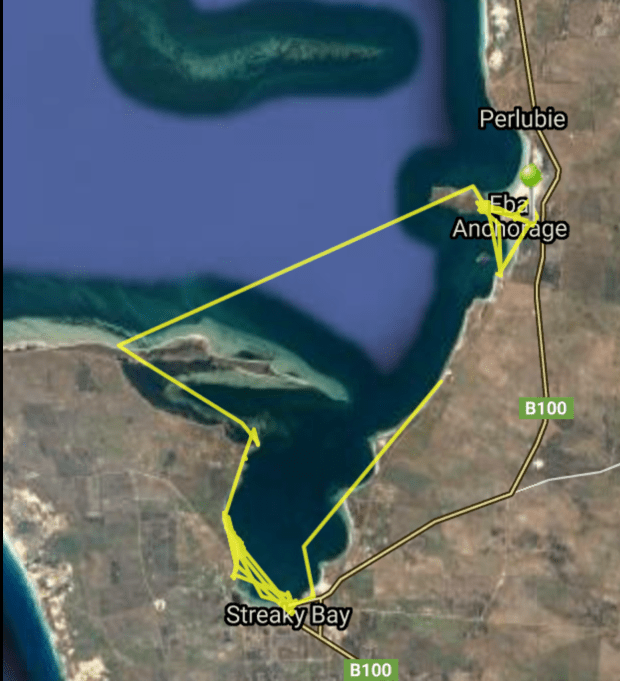
The White-Bellied Sea Eagle Nest is in Sydney. On the map it is in bold letters on the lower right hand side. The Peregrine Falcon Nest of Xavier and Diamond is in Orange. Orange is just outside of Sydney. Trace your finger to 10 o’clock from Sydney and you should see Orange in grey letters. The 367 Collins Street Falcons are in Melbourne. It is at the very bottom in black letters. The Port Lincoln Osprey Barge is in Port Lincoln. This is a small place. Locate Adelaide which is up the coast from Melbourne on the left. Take your finger and move it over in a straight line to the left from Adelaide to the bottom of the second peninsula. There is Port Lincoln. I am also going to include Solly’s Location so you can see where she is relative to where she hatched and fledged at Port Lincoln. Solly is currently staying the majority of the time at Eba Anchorage. Solly is 311 km from the place she fledged. Prior to Solly, the general understanding was that Eastern Ospreys stayed much closer to their natal nest. The evidence from the satellite tracking is changing the understanding of how far these fledglings might travel upon fledging.

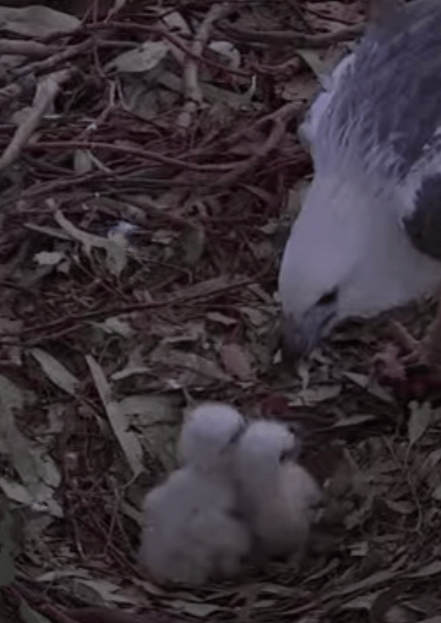
Time flies. It was only a blink and Pippa Atawhai, the 2020 Royal Cam chick, had fledged — BUT, that was a year ago. Now we are waiting for Tiaki to fledge soon. It seemed like the month of August just melted. It was on the 3rd, the 6th, and the 9th that Mum at the Port Lincoln Osprey Barge laid her eggs for the 2021 season. At this very moment, the PLO FB Page is taking guesses on when the eggs will hatch. Yes, we will be moving into hatch watch within a week. Baby Ospreys are coming. Oh, those lovely little reptiles!

Dad continues to bring in materials for the nest. They are all over the place – big strips of bark and moss – even some more rope. He is a bit of a pack rat. Thank goodness he hasn’t been bringing in toys like Richmond and Jack in the US. It would be awfully crowded if that were to happen.

Watching this nest is not for the faint of heart. Siblicide is a regular occurrence.

The dominant hatch of 2021 was Solly. She is 352 days old on 7 August, Australian time. Solly was considered, out of the two surviving chicks, to be the one that would succeed. We have no news of DEW and unlike Solly, DEW was not equipped with a satellite transmitter. Solly has, however, demonstrated that she can survive and today she flew rom her normal home tree in Eba Anchorage to Perlubie to check out the fish. This is the graph from the satellite transmission.

The Port Lincoln Osprey Project is taking guesses as to the date of the first hatch on their FB page. You don’t need to be a member to pick a day – go and have some fun!

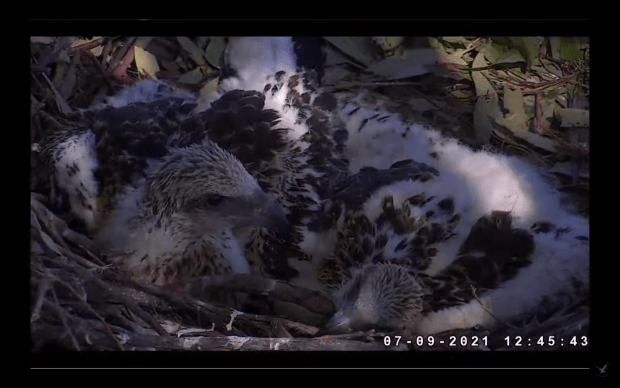
The White Bellied Sea Eaglets are doing fine. They are well fed and protected and they are growing so fast. Those beautiful juvenile feathers are coming in changing their appearance almost daily. They had a good fish feast the morning of the 6th and the wee ones slept and then woke up and began picking up sticks and leaves on the nest moving them about with their beak. They are not yet steady on their feet but they are standing more and 27 was attempting to walk today.

Both still had big crops after the fish breakfast. 28 got the majority.

Just look at those beautiful colours coming in. 27 is on the left and 28 is on the right.

Here 27 is standing watching 28 play with some sticks with its beak and talons. The sea eaglets are developing at a normal pace. It is all good.

The golden glow of morning fills the scrape box of the Peregrine Falcons, Xavier and Diamond, in Orange.

Each parent takes turns incubating the eggs so that the other can have a break. Diamond will do the overnight incubation and Xavier will be the security guard.

Here is a short video of the hand over of incubating duties from Diamond to Xavier:

Remember that the males are about 30% smaller than the females. Xavier works with his feet and wings to get those three large eggs under him so they can all be warm.

It is even harder for the tiny male at the 367 Collins Street nest who has four eggs to warm!

Mom arrives for her turn.

She is working her wings too to get those four eggs under her.

Looked at how poofed out all those feathers are. Wow.

Here is Dad. His feathers are all poofed, too. He is so tiny compared to mom. My goodness – he really does have to work to get all four under him properly.

After wiggling about he gets everything settled. We will be looking for hatch towards the end of September.

Thank you so much for joining me. All of the birds in Australia seem to be doing just fine. We will watch the sea eagles change colour before our eyes and anticipate the arrival of the Ospreys. It’s a few weeks before falcons start hatching. Take care everyone.

Thank you to the following for their streaming cams where I took my screen shots and video clips: The 367 Collins Street Falcons, The Falcon Cam at Charles Sturt University and Cilla Kinross, Sea Eagle Cam @ Birdlife Australia Discovery Centre, and the Port Lincoln Osprey Project and FB Page.

PLEASE NOTE: I am taking my computer in for servicing. I hope to have it returned to me sometimes on Thursday so I will be back with another newsletter Thursday or Friday.

Tracking…birds and hurricanes

Hurricane Ida has made landfall on the sixteenth anniversary of Hurricane Katrina that wrecked havoc and caused so much destruction to Louisiana. Throughout the day I have been checking on the Kisatchie National Forest, the home of Bald Eagles, Anna and Louis. The Bald Eagles are likely north of the storm area as they do not spend the hot summer, as far as is known, at Lake Kincaid (although they could).

The winds were getting stronger and the waves more choppy as the morning broke into the afternoon. That camera quit working at 15:39:19. You just get a circle. The KNF is in parishes that are northwest of New Orleans. They include Grant, Natchitoches, Winn, Rapides, and Vernon.

Isn’t that just the most beautiful area to raise a Bald Eagle family?

Cody and Steve did a great job running the camera, answering all of the chatters questions, and even held a contest to name the eaglet. Please send them warm wishes to stay safe.

At 18:00, Hurricane Ida just went through Mathews, Louisiana.

There are several other maps that I am also watching today. One of those is just fantastic. If you want to follow the Black Storks on their migration, you need to know this link.

http://birdmap.5dvision.ee/EN

The ‘Birdmap’ has several Ospreys along with the Black Storks who have satellite trackers. They are first sorted into species and then by name of the bird. Click on the name of the bird and you can see where the birds are located. It is magnificent.

I clicked on Karl II’s name. Then I clicked on the player at the bottom and I could see the precise route that Karl II has taken since he left the nest in the Karula National Forest. He is heading to the Black Sea. I wonder if Karl has a favourite spot there?

I owe Karl a big apology, too. I know that Pikne and Udu are ‘his’ storklings and brain keeps telling my fingers to type Grafs. Big apology, Karl!

Oh, how I wish Tiny Little had a tracker. It would be so much fun (well, if everything went well) to watch her journey rather than hoping by mere chance that someone would see her blue Darvic Ring and record the number. Perhaps it would be too much to ask them to take a photo, too?

There is not a lot of news in Bird World. Maya was photographed at Rutland Water today so she has not left for her migration. The Collins Street Falcons have started the hard incubation now that the 4th egg has been laid.

This is mom. She always has a bit of grumpy face and she takes up most of the scrape box.

This is cute little dad. He is much smaller as you can see – he doesn’t take up so much room in that scrape box. If in doubt, he has really neat bright yellow “goggles” around his eyes.

I know that it is hard to see what is going on and you are afraid that you will miss all of the action. There is another scrape box at the other end of the ledge with a camera and these parents have a tendency to move the chicks about. There is nothing funnier than seeing 3 large juvenile females chase after poor little dad with his pigeon. This year it will be 4! I hope the pigeon population in Melbourne is robust!

Diamond is keeping everyone guessing. The latest that she has ever laid an egg is the 31st of August and that is tomorrow, Australia time! At this point I am not even going to guess. Diamond has been fooling me for days on end.

When in Australia, I have to remind myself to check on Solly. She is 344 days old – my goodness, almost a year since she hatched on the PLO barge. Look at this map of her travels. She is so confident now that she is taking the short cut back to Eba Anchorage from the coast near Streaky Bay instead of going the land route. Well done, Solly! So proud of you.

The nest of Mom and Dad looks so much more together than it did after Solly and DEW fledged last year! Oh, I hope that there is lots of food and all three of those eggs hatch and fledge. Wouldn’t that be wonderful? I have to admit that I did not feel so kind towards Solly last year but, in the end, I was glad to see two strong birds fly off that old boat. The satellite tracker put on Solly opened up everyone’s eyes to how far the Eastern Ospreys travel from their natal nest. I do hope they will do this again this year. At the same time, I would like to see trackers on all the birds from this nest. Everyone wants to also know where DEW is. If it is the cost, do some crowd funding up front – there will be people from around the world willing to chip in and help with the costs.

‘S’ sent me some images of the Osprey juveniles in Alberta this morning. My goodness did I ever feel guilty. I checked in on them for the first time yesterday in ever so long – and that was because I had heard of an unmonitored nest fledging two from the interior of British Columbia this morning.

There were three eggs that hatched at the Red Deer Osprey nest in June. Two of the three died on 3 July during the wretched heat and then rainy/stormy weather.

This beautiful juvenile fledged sometime the first two weeks of August when the cameras were down. This is a strong bird, a real survivor. It has been given the name, Little Braveheart, by her fans.

The two juveniles at the Fortis Exshaw nest up at Canmore are doing really well, too. Both fledged and they are waiting, just like the juvenile in Red Deer, for the call to fly south. That is such an incredibly beautiful spot to have an Osprey platform with the Canadian Rockies in the background.

Thank you so much for joining me. Do check the Birdmap and see how it works. Satellite trackers are wonderful tools. And please send your warm wishes and positive thoughts to those in the path of Hurricane Ida. Take care and stay safe. See you soon.

Thank you to the following for their streaming cams where I took my screen shots: Fortis Alberta Red Deer, Fortis Alberta Exshaw, 367 Collins Street by Mirvac, The Falcon Cam Project at Charles Sturt University in Orange and Cilla Kinross, the KNF Bald Eagle Cam, and the Port Lincoln Osprey Project.

Oh, our lovely fish eating birds

I love Ospreys – bet you can tell! Still, the anxiety rises when there are three eggs on a nest that, historically, simply cannot support that many mouths to feed. Right now the Mum at the Port Lincoln Osprey barge in Australia is incubating three eggs. In 2020, a drop in fish deliveries around day 16 of the youngest life meant that food insecurities hit the two older and much bigger siblings. Tapps was a victim of siblicide. Will 2021 be different?

So far the two adults are working like a super machine. Today Dad came in with a fish delivery for mom. She left and he incubated the eggs for a half hour. Have a look at that smooth exchange:

The 2019 female fledgling of the PLO nest has been seen and photographed at Tulka yesterday. Solly, the 2020 fledgling with the satellite tracker still seems to prefer Eba Anchorage but she has spent some crazy time at Streaky Bay again. Solly is 339 days old on 26 August Australian time.

If it has been awhile since you watched an Osprey catch a fish, have a look at this slow-motion video shot in the Scottish Highlands. Incredible. When you are watching this remember that Ospreys and Owls are the only birds whose outer toe is reversible to help them hold on to their prey. It allows them to grasp with two toes in the front. Great design.

The Ospreys that live in Australia along the coasts and the rivers are Eastern Ospreys, Pandion cristatus. Eastern Ospreys do not migrate. Their status ranges from secure to vulnerable and rare in various states of Australia.

Ospreys have a system of communication between one another that individuals, such as yourself, will recognize if you have been watching Osprey nests. There are 11 physical and visual displays that show they are resting, alarming, soliciting for food, in a defensive posture, nest protecting, under attack, or sky dancing to impress their mate. In addition to the body language Ospreys use they also have 8 sounds that they make alongside the physical signs. Those include alarming, food solicitation ranging from a very low sound to an extremely high pitched sound, a sound for guarding, being excited, screaming, and the sound during copulation. These findings were published in 1993 by Vincent Bretagnoll and Jean-Claude Thibault. The article is “Communicative Behavior in Breeding Ospreys (Pandion haliaetus): Description and Relationship of Signals to Life History.” It was published in The Auk, Volume 110, Issue 4, 1 October 1993, Pages 736–751.

The British Library and the Cornell Bird Lab have an extensive library of bird sounds that you can access. Also, just watch the birds intently on their nests in different situations. You will soon be able to recognize their different visual postures. For those working in situations that deal with Ospreys, it is essential that they learn the communication and behavioural signals of these birds. These skills would definitely have helped those reviewing Malin’s flight off the nest and, in the future, could save a bird’s life.

Blue 33 (11) has delivered Maya a nice fish for breakfast. So Maya is still here. It doesn’t mean she won’t eat and fly! We just need to wait and see.

Either White YW left Tiny Little an early fish or the silvery white object is a leftover piece of fish from last night’s late feed. Is Tiny home to eat it? and will she be in Cumbria all day?

Ooops. Looks like Tiny Little is too late!!!!!!!! Mr Crow has found a nice breakfast. Does this mean Tiny Little has started her first migration?

UPDATE: Tiny Little is still here. I didn’t get the photograph but someone else did. Yippee. Will try and chase her down today.

It is another misty morning. Aran is on his perch almost in the exact same position as he was yesterday morning.

And here is Aran with Mrs G. She remains in the UK still.

At the Dyfi nest, Telyn was last seen on 21 August at 12pm while Ystwyth was last seen on 24 August at 09:26. Dysynni and Idris were both at the nest on 25 August. Idris brought Dysynni a whopper.

Yesterday, Laddie, LM12, delivered a fish to LR2 on the nest. LR2 was 97 days old.

After a pesky crow flew around the nest, LM2 decided it was safer to take that whopper over to his favourite Birch tree to eat it. Wow, Laddie, great fish!

LR1 left for her migration on 15 August. This was only the second time in the history of this nest that a fledgling has left before the female.

Oh, it is lovely to see some of them still home. Thank you, Tiny Little! News in other news is there are now three eggs for the Collins Street Falcons! That last egg arrived at 23:53 last night. Congratulations. And last, if you follow the Loch of the Lowes Nest a wonderful surprise. A 2015 fledgling, FR2, flew over Guardbridge in Fife yesterday. They got a photo. Fantastic. A survivor! There is sad news today. The Black Stork fledglings received their names yesterday. 7181 (no 1) was named Julge meaning Brave. 7181 (no 2) was named Malbe meaning Sedate. 7183 (no 3) was named Tasane meaning Peaceful. You might have recalled some animal sounds being heard at the base of the nest tree. It is now confirmed, so sadly, that Malbe has been killed by an animal. Urmas has taken the body of Malbe to be examined. Word has also come that Tuul, Karl’s fledgling, has also perished. The Black Storks are so rare – it is so sad to hear of these deaths. Our hearts go out to all who loved these beautiful families and to those who so diligently worked to make sure Jan’s nestlings were fed and healthy to fledge. There has been some problems with the tracking and posting of Karl II and his fledglings locations. I will bring this to you as I locate it. Did you follow Milda? You will know that this brave White Tailed Eagle from Durbe lost her mate and sat on her eggs for eight days without food and then a potential mate came. But last year turned to be a sad year for Milda. She is now working on the nest with her new mate, Mr K. So happy for her. There is word that WBSE 28 did, finally, get some food. Send your warm and positive wishes off to all of the birds.

Correction to earlier news letter. Karl II has only had a transmitter for two years. I said ‘many’. Thank you!

Have a wonderful day everyone. Take care. See you soon.

Thank you to the following for their streaming cams where I took my screen shots: The Cumbrian Wildlife Trust and The Foulshaw Moss Osprey Nest, Bywyd Gwyllt Glaslyn, Dyfi Osprey Project, The Scottish Woodland Trust and the Friends of the Loch of the Lowes, LWRT and the Manton Bay Osprey Nest, the Port Lincoln Osprey Project and FB Page.

Checking in on Australia

It is raining in parts of Australia. Orange got 50 mm and there are floods about while there was 37 mm out at the Campus where the scrape box of Peregrine Falcon couple, Xavier and Diamond, have their scrape box.

Diamond has spent time on the ledge and going back to the scrape box looking like she is concentrating on that first egg. What do you think? Maybe today?

Sadly, the poor weather might be impacting Dad’s ability to bring in prey to the two babies in the Ironbark Tree. Until now, there has been little to no demonstrations of dominance but yesterday the prey diminished and WBSE 27 started telling the little one who is boss. It is unclear if WBSE 28 had any of the morning fish. WBSE 27 is 26 days old today and WBSE 28 is 24 days old. Oh, I hope this stops. There is enough for everyone! Most people say that the parents will not step in. And, as you know, if I hear survival of the fittest one more time I might scream loud enough for someone to hear me in Australia! All you have to do is to think about Tiny Tot on the Achieva Nest or Tiny Little — those tortured little ones turned out to be a force to be reckoned with. I wish Tiny Tot had a tag and a satellite transmitter. I sure would like to see what she is doing in a couple of years. If there are two Ospreys that will survive it is those two. And they started out like WBSE 28. Of course, only worse for Tiny Tot.

Mom was looking particularly beautiful over in the Port Lincoln Osprey Nest. The colour of the water contrasted with the nest lining — well, it is gorgeous.

The female at Collins Street in Melbourne certainly looks like she is going to lay her second egg today. She is getting full in the bottom just like Diamond. She is certainly plunked down in that scrape box with that stern look she can give. It must be quite uncomfortable laying eggs!

I don’t do a lot of reporting on the Albatross despite the fact that not only am I fond of them but I really want our oceans to be cleaned up and the fish stocks renewed so that all of the sea birds are promised some kind of a decent life. Sharon Dunne does a great job running the FB group as well as keeping us abreast of everything ‘Tiaki’, the Royal cam chick of the 2021 year.

Ms Pippa Atawhai was just the cutest little albatross chick and her parents were incredible. She was the 2020 Royal Cam Chick. Her nest was close to the visitor’s centre. Tiaki’s nest is down close to other nests. Some are less than 3 metres away. This has led to a lot of ‘drama’ between the chicks! Seriously. I thought it was only the juveniles that caused mischief. Oh, no. These gals can seriously get with the squabbling.

The Cornell Bird Lab caught that on camera today. Have a look:

It reminds me of my garden. Before I seriously started watching birds and their behaviour, it seemed they all got along and lived in some kind of sing song happy land. Oh, geez. There is even a hierarchy in our garden! Incredible. Have you noticed this behaviour at your feeders? Is this why we say ‘Pecking Order’?

This was a quick check in. I am restless – not knowing for sure if Malin is alive or dead or nothing can be determined. But I want to leave you with an uplifting story and a lesson. Yesterday I reported on the Osprey that had been hanging upside down in a tree for two days because of being entangled in fishing line. The beautiful bird had pulled all of its muscles from being upside down. The bird, at 45 feet, was ten feet more than the climber could reach so he used an extension net and a pole saw to cut the line and catch the bird in one swoop. On the ground the bird was detangled from the line. A stainless steel treble hook – for catching 3 fish at once – had gone through the talons of this baby. Today, this young one is healing. The lesson is ——- clean up after you go fishing. Join in groups to clear the shores of rivers and lakes of fishing debris that gets caught in them. Help our water birds!

I took these screen shots from A Place Called Hope’s FB page. They have a wonderful video on their site of this rescue and I urge you to search FB, find their home page, and watch it. It is very moving. What wonderful people these people are – there is not a situation too challenging and if a bird can be saved, A Place Called Hope will give it that chance.

Thank you for joining me today. I am certain that Collins Street will have another egg tomorrow and well, Diamond might have one as well. Take care everyone. Stay safe.

Thank you to the following for their streaming cams: Sea Eagle Cam, Birdlife Australia and the Discovery Centre, 367 Collins Street by Mirvac, Cornell Bird Lab, The Falcon Project with Cilla Kinross and Charles Sturt University, the Port Lincoln Osprey Project, and A Place Called Hope FB page.

Pair Bonding

The term ‘Pair bonding’ was first used in the 1940s. In terms of birds, it refers to a long-lasting relationship that results in breeding, care of one another, the nestlings and fledglings.

Pair bonding is “reinforced by ritual behaviour.” That is a very simple definition. A good example of on going pair bonding, is the ‘Morning Duet’ of Lady and Dad on the White Bellied Sea Eagle nest in Sydney, Australia. In fact, the rituals associated with pair bonding often occur at various intervals as a means of reinforcing the relationship not just before breeding.

This is Lady and Dad doing their duet together.

Pair bonding rituals also take place as many ‘bird couples’ prepare to begin their long migration. Working on nests is also happening, preening one another is on the rise. It reminds me of certain war movies where the couples seal their relationship as the male heads off to the field of battle – that sealing often consisting of an engagement ring or a promise to wait for the other. It is precisely the same with our birds. In this instance, both will migrate and each will hope that the other returns to the nest in the spring to renew their bond.

Aran has undertaken any number of sky dances with fish deliveries for Mrs G this week at their nest in the Glaslyn Valley.

Blue 022 and CJ7 continue to work on a nest in the midst of sky diving, fish deliveries, and mating. Sadly, they have chosen one of the Poole Harbour nests that doesn’t have a camera! Still, it is wonderful that they have remained together since spring and that brings promise to everyone that osprey chicks will hatch in Poole Harbour once again.

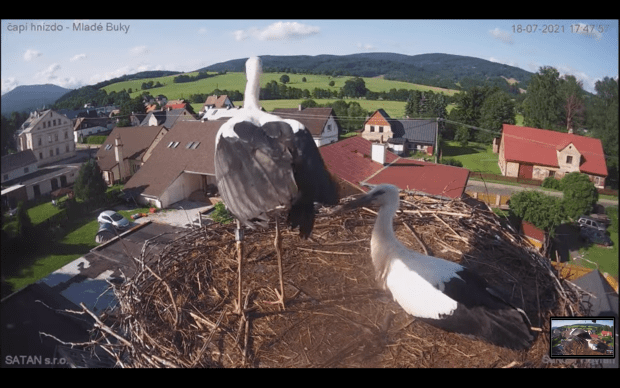
This evening, my friend, ‘R’ sent me the links to the two short videos below. It seems that Bukacek, the single father White Stork, in Mlade Buky and his new love, are sealing ‘the deal’. You can see some of the community coming out to watch – what a happy ending to such a tragic season for Bukacek.

Xavier and Diamond, the resident bonded pair of Peregrine Falcons whose scrape box is on top of the water tower of Charles Sturt University, are not migrating. Indeed, they are just beginning their breeding season. They continue to pair bond in the scrape. Here is a short video clip I made today so you can see this ritual:

According to the Falcon Cam Project of Dr Cilla Kinross, the average date for the first egg is 27 August. Here is the historical information for Diamond:

  • 2015 with Bula. 31 August, 2 September, 6 September
  • 2016 with Bula. 31 August, 2 September, 6 September
  • 2017 with Xavier. 26 August, 28 August, 31 August
  • 2018 with Xavier. 20 August, 22 August, 24 August
  • 2019 with Xavier. 28 August, 31 August, 2 September
  • 2020 with Xavier. 27 August, 29 August, 1 September

It is going to be so exciting when the little white balls of fur hatch. Can’t wait!

Other Nest News:

Some of us watching Malin on the Collins Marsh Osprey Cam are simply left shaking our heads. The female has been absent from the nest the last three Saturday nights in a row. There is no perch to the nest (they seriously need one). In addition, fish delivery just goes ‘off’ at the weekend. Malin slept alone through a thunder storm with lighting and rain last night and did not receive a single fish today – Sunday. Oh, I can hear you thinking that Ospreys do not need to eat every day and you are absolutely right. In fact, Tiny Tot on the Achieva Nest had 12 full 24-hour days that she did not get food. Often the parents teach the chicks that food does not always come every day. Still, the weekend pattern with this pair of adults mystifies me. Both came to the nest for short spurts without fish today. Malin was food calling (finally) late in the day. She is such a sweet little Osprey – and everyone is delighted that her droopy wing and feathers seem to be filling in and correcting themselves. So, once again, let’s put the optimist’s hat on and hope that there will be 5 fish deliveries tomorrow for Malin! Come on Mom and Dad prove me wrong and bring 6 big ones.

Malin’s beautiful feathers quickly dried out.

At one point, Malin was so excited when Mom arrived that she began to flap her wings and so some little hops. It is reassuring to see those feathers improve every day. We are all hoping for some big fish for your tomorrow, Malin!

A few of us have been calling the Collins Marsh chick, Malin which means ‘mighty little warrior’. That is because it had neither a number or a name. The Neustadter Nature Center at Collins Marsh is having an official naming contest. My friend ‘S’ just told me about this. I am so sorry it is such short notice but please go to their FB site and enter a name in the comments. Put in your favourite name – it doesn’t have to be Malin! I want the Nature Centre to see that there are many people, from around the world, interested in these Ospreys! But be fast. The names must be in by closing time tomorrow, Monday, 10 August. Here is the link where you can go and simply add a name in the thread:

https://www.facebook.com/Neustadter-Nature-Center-at-Collins-Marsh-140052786074932

After Monday, the names will be short listed. Please go back to this FB site and vote for your favourite. Thank you!

There are now three eggs in the Port Lincoln Osprey Nest. They were laid on 3, 6, and 9 August. That means that there is already six days between the first and the last. This nest always makes me nervous because of its history of siblicide. But, I am going to strike an optimistic note this year and take a wait and see attitude.

The White Rock Fire that was threatening Dr Christian Sasse’s property where he live streams his programmes on Ospreys and Bald Eagles is no longer out of control. Rain and the gallant efforts of the firefighter’s seem to have stifled this wildfire. This is great news for all the people and the wildlife. Let us hope that rain pours down on all the wildfires.

Thank you for joining me. It is so nice to have you here. Please go on line and put in a name for the little chick. Take care. See you soon.

Thank you to the following for their streaming cams where I took my screen shots and video clips: Port Lincoln Osprey Project, Collins Marsh Nature Centre, Bywyd Gwyllt Glaslyn, Sea Eagles, Birdlife Australia and the Discovery Centre, Falcon Cam Project at Charles Sturt University and Dr C Kinross.

Hawks definitely do not like children

By 18:30, the smoke and the temperatures were cooperating and it seemed like a good time to go and check on the Cooper’s Hawk family in Assiniboine Park. When I arrived at the Park, there were several cricket games going on, families were meeting and sharing a pot luck outside – many for the first time since spring 2020, there were birthday parties and children running around.

When I found the spot and knew where the hawks had their nest and were hunting for bugs and chipmunks the other day, there were children running around. I could see the hawks in the sky circling. They never went to the nest tree or came to the ground. It is the life of a birder. It would be wonderful to see them a few more times before migration. The Canada Geese do not usually begin leaving until the middle of September through to the end of October. I have seen some miss the group and wind up walking about on an early snow. Weather is such a significant factor in the challenges our birds face.

For those who are not sure what migration actually is. Our feathered friends Move from one area for breeding during the spring and summer to another area for winter. They have adapted to the pattern of coming and going in order to survive. It is based on food supplies.

Different species travel different routes to their winter homes. These are long journeys. For example, the Ospreys in the United Kingdom will travel some 8,000 kilometres or 5,000 miles to places in Africa. The birds will fly over land, sea, and desert to reach their destinations. People wonder why the birds just don’t live in Africa all the time. The answer is rather simplistic: there would not be enough nesting sites or food for all of them plus their chicks. There are also a lot of very hungry predators ready to take those lovely fluffy little ones. So they disperse from Africa to sites in the United Kingdom and Europe.

The birds decide when it is time for them to migrate. The hormones in their body begin to change. Unlike spring when this hormone change leads to breeding, the autumn sees the birds restless until they know that it is time to depart. These hormones trigger a lot of eating. Fat begins to gather under their skin. They gain weight. It is that fat that will see them through their migration. Still, they stop and feed along the way. Normally they hunt for food in the early mornings and late afternoons. High pressure systems are good for flying but low pressure systems bring winds and rain. When the birds get into a low pressure system, they will normally stop flying, if they can, and wait til another high pressure system comes through. Migration times vary because of the winds and the weather. Birds that soar and ride the thermals can travel as much as 465 km or 300 miles in a stretch. Some gather in flocks like the storks in Latvia and Estonia. Sometimes birds pair up to migrate. For the Ospreys, the female leaves and the male stays behind until there are no fledglings crying for food.

Not all birds migrate. Even I have a sedentary Sharp-shinned Hawk that defies all logic to stay on the Canadian prairies for the winter. The Osprey in Australia do not migrate. The birds in the Amazon Rainforest do not migrate. There is plenty of food and nesting sites for them year round. This past spring and early summer there was much discussion over the migration of birds from Florida. In Jacksonville, Samson, the father of Legacy, stays in the area of the nest year round. Gabrielle, on the other hand, migrates north – yes north – to cooler summer climates. This year she might have discovered it is hotter up north! Even some of the Ospreys in Florida do not migrate; they stay year round. There are plenty of fish for them as well as nests.

Birds take different routes. The White Storks from Latvia either taken a western route or an eastern route. Dr Erick Greene and his team in Montana study the migratory movements of the Ospreys from the Clark Fork River area with satellite transmitters. In the United States, some fly over Hawk Mountain where there is an annual count. In fact, you can go to this site to see the number of birds traveling over this marvellous area with its thermals. Here is the link for you for their autumn migration count that will being in about a week!

https://www.hawkmountain.org/conservation-science/hawk-count

Migration is extremely challenging and we hope that all of the adults will return to their nests the following spring and that we will see the juveniles who take their first flight to Africa in a couple of years.

And now for some birding and nest news

Poole Harbour: Blue 022 and CJ7 who were so visible until a few weeks ago sky dancing, mating, and working on the nest with the streaming cam are now working on another nest in the area. There is no camera. They are still doing everything together and everyone is looking forward to the first hatches in Poole Harbour for 200 years.

Dahlgren: A large part of the nest in King George, Virginia, collapsed today. It will be fixed in the fall well after Jack and Harriet’s migration.

Kielder Forest: All 16 of the 2021 juveniles have fledged successfully. Everyone is elated. This is 6 more fledglings than their previous best year. Congratulations everyone!

Mlade Buky: Bucachek and his new love spent the night on the nest in Mlade Buky, Czechoslovakia. Oh, how sweet! Just as the dawn is beginning to appear, they are both preening.

Balloons, something that impacts all birds: Virginia, Maine, Maryland, and Delaware have or are going to pass shortly the release of balloons. Hawaii has already passed a law on helium balloons.

Port Lincoln Ospreys, Australia: Dad and Mom have been taking turns incubating the eggs. Here is dad on the nest. A little earlier he had been pestering Mom. He kept pulling on that turquoise rope wanting his turn. It was too funny. The Port Lincoln Ospreys are an example of sedentary birds. They do not migrate. There is no need.

Loch Arkaig: The two juveniles of Louis and Dorcha have now fledged. I have not heard anything about the chosen names yet.

Collins Marsh: Malin was a little wet off and on during Saturday. S/he is sleeping on the nest alone tonight. There is no perch – let us hope that the parent or both parents are in a nearby tree in case there are any owls about. It seems like a pattern. Does mom always spend Saturday night off the nest?

WBSE, Sydney Olympic Forest: 27 and 28 continue to eat until their crops almost burst and sleep. Meanwhile there has been an intruder today and Lady and Dad were honking in alert.

And last but very special, A Place Called Hope. Along with other wildlife centres, they are receiving quite a number of starving Great Blue Herons and other herons. Why would they be starving? It has been raining in the Connecticut area and all the herbicides and pesticides that people put on their lawns and gardens makes its way into the environment, into the water table, into the ponds. It is poison. If your gardening centre or lawn care person tells you that the chemicals they use are ‘Green’ – well, think again. Whatever they are using kills. So sad. It is OK if your lawn doesn’t look emerald green.

Thank you so much for joining me today. Have a lovely Sunday. Take care of yourselves. I look forward to seeing you soon.

Thank you to the following for their streaming cams and their FB pages where I grab my screen shots: A Place Called Hope, Mlade Buky White Stork Cam, Collins Marsh Osprey Nest, Port Lincoln Osprey Project, and Sea Eagles, Birdlife Australia and the Discovery Centre.

The featured image is Dad at the Port Lincoln Osprey Barge taking his turn incubating his two eggs.

Fledge at Mlade Buky and other news in Bird World

We have a fledge at the White Stork nest in Mlade Buky!

Oh, this is just so wonderful. The people of this community can be so proud as these three beautiful birds leave their nest. It was their help that made it possible for these three to be alive today. Bravo.

Here is the video so you can watch it.

The heat wave has taken more tolls on birds in the Pacific Northwest not just the Osprey chicks that literally roasted in the nests. Cooper’s Hawks have been jumping off the edge of the nests so they do not get cooked by the hot sun. This is a real tragedy in the making. Even the number of birds at my feeders is down. They spend the day in the myriad of vines in the shade of the house and the lilac bushes only coming out to drink and return to shade. The outside temperature near the water bowls reads 34 C. That is hotter than it is in the West Indies! So please put out water for the birds! Find old dishes and provide them with something. Thank you!

I hope that you are able to open this. If not you could Google ‘hawks jumping out of nests to avoid heat’. This is just so sad.

The streaming cams for many of the nests are being turned off as the season ends. Glaslyn will turn off the feed to Aran and Mrs G’s nest shortly as will Rutland Water on the Manton Bay Nest of Blue 33 and Maya. We will look forward to another season with them in the future. Blue 33 and Maya are a super Osprey couple – celebrities if you will allow me to call them that. They have been together since 2015 and have fledged 17 chicks. They raised a nest of four in 2019. That is almost unheard of and really takes a strong male to feed that many. I am impressed. I told someone if I came back as an Osprey in another life I wanted Blue 33 for my mate. He is incredible. They will return to the Rutland Manton nest in late March – usually within an hour of one another.

I expect many others will follow as it is costly to run the cameras. If you go to the camera and it is not functioning check the nest’s FB page. They have probably turned off the camera til the next season. But please remember that the breeding season is only beginning in Australia with the Peregrine Falcons, Port Lincoln Ospreys, and the WBSE.

NC0 up at the Loch of the Lowes nest is out fishing for her chicks. She is incredible. She spots the fish from the nest and dives down and gets it. Here is a very rough cut of a video of the two Loch of the Lowes chicks enjoying themselves.

I never thought I would say that a Golden Eagle nestling was cute but Zenit certainly is.

Zenit is really working on his wing flaps and from his crop it appears that he has had a feeding. That is good. I am just thinking how lucky Zenit is to be in a tree nest with shade.

Kindness is one of the cutest Bald Eagle nestlings I have ever seen! Here she is again trying to nibble around mom.

Oh, how beautiful. Kindness sitting next to Mom. Everyone thinks Kindness is a female because her Dad loves to feed her!

You are getting to be a big girl, Kindness. You are 52 days old today! More than halfway to fledge which will be around 89 days – the average for the Glacier Gardens nest. (The average in Alaska is 80 days).

Tiny Little has been in the nest every time I checked on her. A fish came in and 462 ate and ate. Then 464 came and couldn’t get the fish tail down. Tiny Little was playing with it when White YW brought in another fish. Tiny Little ignored it and dad left with the fish! Silly Tiny! Some dads will feed their chicks but White YW doesn’t seem to do this very often preferring that Blue 35 take on those duties almost exclusively. Tiny Little has yet to get confident in opening up a fish with a head.

White YW returned to the nest at 17:39 and Blue 35 flew in to feed Tiny Little. Tiny did not ignore that fish this time!!!!!!!

Oh, she just loves being fed by mum. Tiny Little eats for about forty minutes.

This kiddo should be stuffed.

At 21:00, Tiny Little and big sib 462 were cuddled up duckling style read to sleep.

It is not clear to me if Tiny Little ever did a second flight today. She was flapping those wings really hard and walking around the nest looking down for a long, long time. Often I had to leave only to return to find Tiny on the nest. Maybe someone saw her fly again?

Tiny tried everything but getting over on the middle left side of the nest and just going for it like she did when she fledged was something she did not do. There were a few good hovers. Fingers crossed for tomorrow. Need to get those wings strong and self-feeding down for migration.

The couple who saved the little osprey chick that fell into the river at the Putuxent Osprey Nest 2 were surprised that so many people from around the world watch their birds! I mentioned to them the need for an emergency number on the streaming cam. Fingers crossed! Thank you to everyone that sent them a thank you note. The chick is doing well.

Thank you for joining me for a quick look at a few nests on a Sunday evening. Take care. It is very hot in so many places or there are torrential rains and flooding. So where ever you are be careful.

Thank you to the following for their streaming cams where I took my screen shots: Glacier Gardens Park, Cumbrian Wildlife Trust and the Foulshaw Moss Osprey Nest, Mlade Buky White Stork Cam, Patuxent Park Osprey Cam 2, and Asociatia Wild Bucovino.