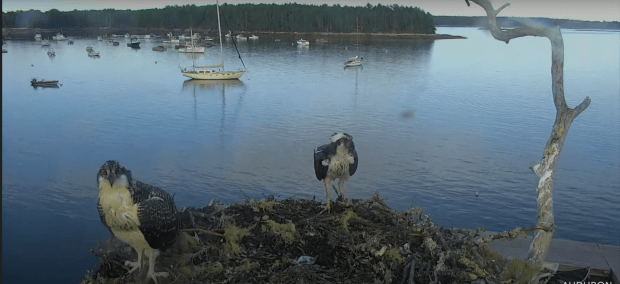
I cannot thank the boots on the ground near the St Joseph River for keeping us informed about Little Bit 17. Without his tale tale tonsure, we might never know that it is him. I know that many of you are not members of FB so I took a couple of screen captures but, if you are members go over to Notre Dame Eagles and see the latest posting by Doreen Taylor. There are some great videos of 17 soaring as well as one of the parents.
The St Joseph River where Little Bit is perching and soaring. One of the adults flying over the nest tree. Note the white head.A capture from the video of Little Bit 17 perched preening.
Just seeing him out in the wild living his life – thank you Humane Wildlife Indiana. Tears.
There has been some discussion about whether or not a chick – not sure which one – had fledged or not. Our ‘osprey eyed reader ‘H’ kept questioning this. Today after watching one osplet on that nest move around all day and not fly, it has been confirmed that only 2 of the osplets from Boat House have fledged! Thank you ‘H’.
And there the osplet is…stuffed with fish, flying no where soon. With the camera off for 2-3 weeks it was really difficult to even identify which osplet was which – not sure it has been done yet!
Keep your most positive thoughts for Dad at the Port Lincoln Osprey barge. Mum and Dad are into hard incubation of the three eggs. Let us hope that he does not have another ‘spell’.
Beautiful Mum.Dad comes to give Mum a break.
Last. SE30 is doing great. He is flapping his wings and crawling out of the egg cup. Don’t tell 29 but 30 is figuring out how to get up to Lady and get the first of the fish!!!!!!!!
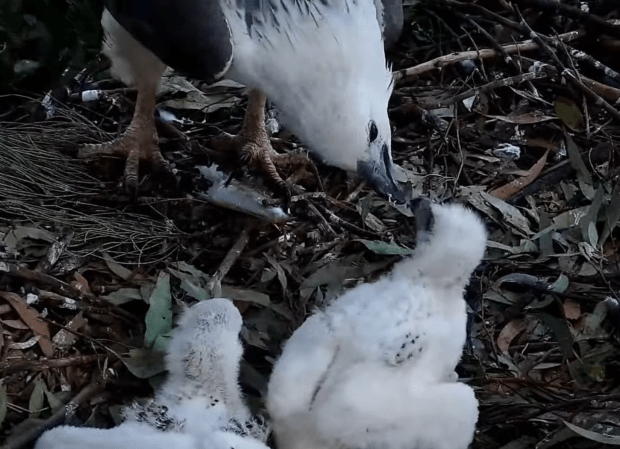
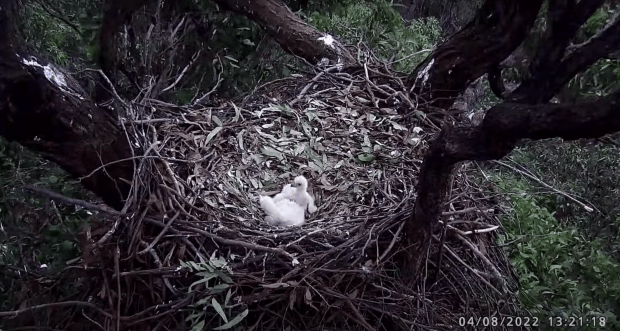
Sea eagles have wide and long wings. The pin feathers coming in so nicely on the part of the wing closest to the body in image 1 are the secondaries. They have 15 secondary feathers and 10 primaries – the ten closest to the wing tip. You can get a glimpse of those coming in.
As you can see SE29 is moving around the nest keeping balance using those wings! You can feathers appearing slightly on the shoulders (as black dots) and back of 29 in subsequent images. They will start to flap those wings more.
We are getting ready for the biggest plumage and development changes during the next two weeks. They will go from mostly being a fluffy chick to looking more and more like an eaglet. They will stand on their two feet and begin to make efforts to self-feed. So lots of exciting things to come!
‘B’ sent me a note after the images of Lancer appeared in yesterday’s blog. He reminded me that Dr Sharpe had saved so many eaglets this past season including Lancer who clung to the side of the cliff. Yes, Lancer also had a second chance at life! Thanks Dr Sharpe.
Thank you for being with me. I knew you would want to hear about Little Bit. Take care everyone. See you soon!
Thank you to the following for their FB posts and streaming cams where I took my screen captures: Doreen Taylor and the Notre Dame Eagles FB, Audubon Explore and ‘H’, Port Lincoln Osprey, and Sea Eagles @Birdlife Australia Discovery Centre Sydney Olympic Park.
The hoped for blog on migration will be written tonight and appear Wednesday morning. Lots of good information has come in! Thanks to all. If you are still thinking about migration challenges – even in your own area – send them to me before 1800 CDT Tuesday the 16th.
When will Diamond lay her first egg of the season with Xavier at Charles Sturt University in Orange, Australia? That seems to be the question on everyone’s mind. Xavier continues to bring in lovely prey items – some not so welcome like the Starlings but, it would seem that Diamond is in really good shape for this breeding season. Many of you might have noticed that Diamond appeared to be in less that stellar form last year and there was some concern that little Yurruga did not have good feather development. We are wishing Xavier and Diamond a successful season – meaning lots of prey items for the hatchlings, good weather for fledge, and success.
Surviving Poole Harbour fledgling, 5H1, immediately flies away when it hears a predator approaching. Everyone learned fast after 5H2’s death by Goshawk. Today it was a Buzzard – a friendly. The little one is taking no chances though. Well done. You even took your fish dinner with you!
There was a question: Do goshawks eat fish? Goshawks are carnivores. They eat mammals and large sized birds found near the edge of the forest. They also eat amphibians, insects – and, yes, fish!
I had a comment in more the form of a question from my good friend, ‘T’. She noted that for years people have loved looking at the Osprey nests in the UK. The only things that were of concern were the weather and enough fish. They brought a lot of solace. Now Goshawks? ‘T’ wonders when the UK is so active in reintroducing the Ospreys to their country that there are now goshawks – long time enemy in the forests.
‘T’ here is your answer. A reintroduction project began in 2018 with Goshawks taken from Norway and Sweden to the UK.
Watching our raptors lay their eggs can emit all kinds of empathy especially if the eggs are big and more hard than soft when laid. At the Port Lincoln Osprey nest, Mum laid her third egg of the 2022 breeding season right on time. She looks tired. Watching birds incubate eggs is like watching water boil when the heat on the stove is ‘off’. But, Mum will get a rest and then in about 38-43 days she is going to be really busy. Should I wish for a clutch of all males or all females so life is civil again this year?
Sadly, it appears that Dad might have had another issue like he did a number of days ago. ‘H’ caught it! Is Dad having some kind of a seizure? or is the wind whipping him and his beak gets caught in nest material? It really is not clear but please send warm wishes to this amazing male – Ervie’s best buddy. Here is the video:
What a treat it is to check on a steaming cam and have a fledgling sitting right there as the sun sets. That is what happened when I went to see if Lancer had visited Two Harbours today. She is probably hoping for food! Chase & Cholyn haven’t delivered anything on camera for a few days. Not to worry. Lancer is not going to starve to death. They are seasoned parents. Cholyn is 24 years ‘young’.
Remember we talked about the things that wildlife rehabilitation centres need – besides cash donations. We talked about old clean towels – well, add old clean sheets and egg cartons to your list. Collect them from neighbours, friends, and family. Create a box. Everything helps! Most centres offer enrichment to the animals in their care. This comes in many forms from using toys to crumbled up paper to egg cartons!
The very latest on our Little Bit ND17. What a fantastic image. We can all be assured that Little Bit has been eating and that his flying is getting stronger. He has been back in St Patrick’s Park for many weeks now! So grateful to those on the ground who continue to track Little Bit and send us images. Thank you Stephen Basly!
The Sydney Sea Eaglets are fine. They ate and ate yesterday. Both had enormous crops – and yes, they do still get a little scrappy but I will venture to say that there is nothing to worry about unless there is an absolute food shortage. SE29 is the dominant bird. 30 knows it but sometimes doesn’t like it!
I continue to track Kaia, Karl II’s mate as she migrates towards Africa. She did a round turn and left the Ukraine and went back to Belarus! Dates on second image below.
What caused Kaia to flee the area and return to a safe spot she knew? Will she be resting and trying to figure out a different route? will she feed up so that she does not have to stop in the Ukraine? This is an extremely worrisome situation for both Kaia and Karl II but also for the four Black Stork fledglings – they represent the only storklets to survive this year.
War is a very terrible thing no matter where it is happening. We read about the costs to people and infrastructure but never to the wildlife that are suffering. Most of the birds from Estonia will be flying through the Ukraine – or have traditionally. Send them your most positive wishes.
While Kaia tries to work her way around a war zone, Karl II is keeping the four fledglings full — they will need to fatten up and so will Karl II for their long journeys.
There is a rumour that all of the chicks on the Boathouse Osprey platform have now fledged.
Chicks are doing fine on the Osoyoos Osprey Platform. BC was self-feeding and LC was enjoying being fed by Soo. Hats off to them. They have survived the two heat domes and it continues to look good for this nest in Canada!
That’s it for today in Bird World. Thank you so much for joining me. I will be keeping my eyes on Kaia’s movements and, at the same time, I will be trying to find out what is happening in the area of The Ukraine where she had landed that sent her back to Belarus.
Thank you to the following for their streaming cams and/or postings where I took my screen captures: Osoyoos Ospreys, Audubon Explore, Eagle Club of Estonia, Looduskalender, Sea Eagles@Birdlife Australia Discovery Centre Sydney Olympic Park, Notre Dame Eagles FB, Explore and the IWS, Port Lincoln Ospreys, Poole Harbour ospreys, Charles Sturt University Falcon Cam.
Sadly, the attacks by Goshawks on Osprey nests is becoming more common than one would like. Today, Dylan had no more than brought a fish in for the three fledglings and left – followed by the two – than the Goshawk that has been seen in the area knocked Blue 553 off the nest along with the fish. It was only 8 days ago that another Goshawk attack – this time in Poole Harbour – took the life of 5H2.
Here is the video of that attack in real time at Llyn Clywedog:
Here is that attack in slow motion:
The nest remained empty for the night.
There are two fledglings on the Llyn Clywedog nest this morning. One of them is Blue 554. I cannot read the other Darvic ring.
The attack happened so late at night. It is unclear if Blue 553 has been located or what the situation is but John Williams should be letting us know as soon as he can. He keeps very good track of Dylan and Seren and the chicks.
It is 05:54 and two are waiting for Dylan to arrive with breakfast.
There are new pictures of Victor looking rather bright eyed! The Ojai Raptor Rehabilitation Centre and Dr. Sharpe & Co really gave Victor a chance at a second life. They did not give up on him! You are doing great Victor.
Just look how clear and bright his eyes are – oh, Victor, we are all cheering you on to good health and a successful release ——– and a long life.
Titi has not returned to the Janakallan nest since fledging. This is a huge worry with the goshawk around the forest and the nest. If you know of any visits by Titi, please do let me know. I am concerned that he has fallen victim to the goshaw who would have lured him into the forest.
I lost about 2 hours of work – it flew off into the sunrise with all the fledging ospreys! I will include that news tomorrow but will put in two that survived on my screen because they are hugely important.
Kaia is now in the Ukraine. Kaia is the mate of Karl II, the Black Storks in the Karula National Forest in Estonia. She is in very dangerous territory – if migration were not enough! Please send her your warm thoughts.
SE30 had a nice big crop in the mid afternoon feeding. Lady is feeding it in the top image. Look at that crop. You can tell SE30 because it is whiter with less wing feathers showing. SE30 got a top up in the nest feeding. All is well at the Sea Eagles nest! Breathe.
Please send all the birds your best wishes! They are all fattening up in the Northern Hemisphere for migration – a challenge in itself without the local goshawk attacks. Thank you for being with me. Take care everyone. See you soon.
Thank you to the following for their streaming cams and/or posts which formed my screen captures: CarnyxWild, Ojai Raptor Center, Finnish Osprey Foundation, Looduskalender, and Sydney Sea Eagles at Birdlife Australia Discovery Centre Sydney Olympic Forest.
It is a gorgeous day. A perfect 21 degrees C or 69.8 F with blue skies and sun. Rain is to come on Monday. It must be a good day to go and check on the ducks and ducklings! Dyson would not cooperate so I could not get his photo as he clung, swaying back and forth, on the tallest sunflower eating seeds. Hopefully he will do it again and I will be ready! This year Dyson and his friends planted those seeds. Next year we are going to have a big plot of them for everyone! Mr Crow and the juveniles have refused to ‘visit’ since I returned. It only happened a few moments ago once cheesy hotdogs were put out. Are they on strike against peanuts!!!!!!!!!
News came in from ‘H’ this morning. The second osplet at the Boathouse Osprey platform has fledged! Thanks, ‘H’ for keeping us informed. It is so sad that the camera is down and we cannot see this great transition in their lives. Happy to hear they are flying!
While I was away – or this morning – there was a fledge at the Osoyoos. BC has flown! Both chicks are looking good. They have survived some of the worst temperatures. So grateful.
Nest is empty except for LC at 0835.
Waiting for a delivery.
LC is really working those wings. On fledge watch for this one.
The wind is really helping us get a good look at Love and Peace on the Glacier Gardens nest in Alaska this morning. Oh, beautiful birds. Love has branched. Waiting for Peace. Enjoy these lovely eaglets while you can.
Stephen Basly continues to keep us informed about the comings and goings of our dear Little Bit ND17. Here he is fishing over the St Joseph River. Way to go Little Bit!
SE29 on left with a small crop. SE30 on right. It had not had food earlier.
The food deliveries at the Sea Eagles nest were few and small yesterday. SE30 did get some – eventually – but not before it had been beaked enough to cause it fear from SE29. Let us hope that this was a one off and not a pattern for several days.
SE30 withdraws -frightened – when there is a feeding.
SE 30 got some food but not enough to even make a dent on its crop.
Wish for fish! This was a nest that was calming down. It was 10 degrees C yesterday in the Sydney Forest. Fishing should be good?
Suzanne Arnold Horning captured some images of Arthur and L2 yesterday. L2 was on the Bradfield Building perches at Big Red and Arthur use at night. SAH got the shot and whee….L2 was off heading towards another favourite hunting spot, Beebe Lake.
Oh, it would be so grand if Arthur was to look up and L4 was back near the natal nest. I have not seen any recent updates on either L3 or L4 as they heal from their injuries.
Every moment with the fledglings is precious. Any day L2 could take to the skies to find his own territory.
It could be any day that the Black Storks on Karl II and Kaia’s nest in the Karula National Forest in Estonia depart the forest for that long and arduous flight to the centre of Africa where they will winter. Urmas has given trackers to the strongest of the four so that we can follow their flights. (I wish little Ilks had gotten a tracker!) Bonus is 83 days old today, Waba and Voog are 77 and little Ilks is 74. He missed the nest flying in and everyone was worried but he is OK. Each of the four are there around noon wishing for a food delivery from Karl II.
Karl II arrives with a pouch full of frogs for the storklets.
Everyone is hungry!
We have not seen Kaia. She has begun her migration on 10 August, one day earlier than last year. In that first day she flew 325 k and is in a forest in Belarus.
She rested and flew 314 km on 12 August. She is at the edge of another forest in Belarus.
There is very real concern for an area in Poland called the Oder. Thousands and thousands of fish and birds have died. The Storks and White-tail Eagles are also dying along with beavers. It is a popular place for the Storks to feed. Let us hope that Kaia and all her family will avoid this gathering place.
Chemical waste has been dumped into the river! It is all over the European newspapers and is of concern to everyone.
The Prime Minister Mateusz Morawiecki said, “Huge amounts of chemical waste were probably dumped in the Oder River with full awareness of the risks and consequences,” he said in a video on Facebook. “We will not let this matter go. We will not rest until the guilty are severely punished.”
Punishing the guilty after the fact does not help the birds, the animals, and the humans in the wake of this catastrophe. The German authorities are saying that the poison is mercury. Sadly, industry and governments dump unseen toxins and waste into rivers and oceans daily. Humans need to get a moral compass so that they will stop these practices immediately. Pollutants like human waste and toxins join with warming seas. What life will there be for our birds in a decade?
Kaia’s transmitter has sent no further updates. We wait with worry. Please follow the travels of Karl II and Kaia and the storklets with transmitters here:
Of course, the migrating wildlife are caught in many dangerous situations. Poisoned waters in Poland and maybe other parts of Europe and an unrelenting war where the practice of the birds was to stop and stay for a period resting and eating to help them make it across the long deserts of Africa. This migration is fraught with obstacles that are highly dangerous to our beloved birds.
Poole Harbour has put together a short tribute to CJ7 and Blue 022’s second hatch that was predated by the goshawk.
If you missed it, Lady Hawk finished her tribute to Junior, the Bald eaglet that accepted Malala, the Red-tail Hawk as its sibling on Gabriola Island. Junior was killed when it landed on an unprotected hydro pole near the nest. Warning: Any tribute by Lady Hawk requires a stack of tissues!
Plucky, one of Nova Scotia’s juvenile ospreys, survived a Bald Eagle attack. Thanks to the quick reactions of everyone, Plucky is safely back on its nest!
Checking in at Port Lincoln. Mum and Dad have 2 eggs for the 2022 season. Ervie continues to fly by the barge to check on things but he is avoiding Mum’s wrath. Hopefully we will get some new images of Ervie and Dad fishing soon.
That’s a wrap in Bird World for this Saturday. I hope each of you is having a super day. Looking forward to having you with us again soon.
Thank you to the following for their postings and streaming cams where I took my screen captures: Port Lincoln Ospreys, Cobequid Wildlife Rehabilitation, Notre Dame Eagles, Lady Hawk and GROWLS, Poole Harbour Ospreys, Eagle Club of Estonia and Looduskalender, Suzanne Arnold Horning and Cornell Hawk Chatters, Osoyoos Ospreys, Glacier Gardens, and Sea Eagles@Birdlife Australia Discovery Centre Sydney Olympic Park.
The most wonderful aspect of the trip to Hecla Island was not what I went for – to do a survey of the Bald Eagle nests for David Hancock – but, the two sightings of the Osprey at the Gimli Marina. Last night was simply a blessing. Those quiet wings helping the male to hover about 5 or 6 metres (or less) than 20 feet above my head. It was nice to see the pelicans and the cormorants and the swans. It is not the lack of any Bald Eagle sighting but the REASON there was not a single sighting that is worrisome.
Hecla Island is known as one of the Bald Eagle hotspots in our province. Every tourist brochure inevitably mentions the Bald Eagles. My brother-in-Law’s cabin would normally have a dozen eagles flying up and down catching fish within eye distance any day of the week from May-September.
So what happened this spring? One of those unexpected ‘Black Swan Events’ known in economics as an outlier (thanks CE for educating me on this phrase). It was the consistent heavy rain and flooding. There is still water standing and some cottages around Lake Winnipeg still have basements and yards full of water. As I noted in my blog last evening, despite there being an abundance of trees, the Bald Eagles have, according to the park rangers, historically made their nests around the edge of the lake along Black Wolf Trail which is on the causeway leading into the park. It is still flooded there. They are ‘afraid of what they will find’ when they are able to clear the area. So I was left with many questions:
Did the eagles abandon the traditional nests and lay a second clutch in a newly made tree nest?
Did the eagles abandon the area heading further north? Did they then lay a second clutch?
What was the real number of eagles arriving at Hecla this year?
Did Avian Flu play any part in any of this?
A single adult bald eagle has been recorded and a juvenile the end of June. I could not locate any tree nests other than a single old long abandoned/falling apart one. I was told the eagles had been nesting there for some 35 years. I think it is a sad situation but there should be some clarity as the birds begin their fall migration and counts are started. So while not seeing the Bald Eagles is a bit of pickle, the worrisome aspect is that those eagles – and many others – lost their opportunity to raise young this year just like other water fowl that breed in our province in the summer. That includes Pelicans, Cormorants, Geese, and ducks.
Thanks, ‘M’ for reminding me about the unringed visitor to the Dyfi Osprey nest in Wales. This is a fledgling about the same age as the three ‘Ps’ of Idris and Telyn. Where did she come from? The theories are quite interesting.
This bird is a beauty!
It is always stories like this that prompt a conversation between me and Tiger Mozone and they tend to waiver back and forth about the history of Welsh nests leading to more questions. She is unringed. So where did she come from? What you also have to realize is that Aran on the Glaslyn nest and Idris on the Dyfi nest are also unringed. This leads to the very heart of the issue. Idris and Aran are males. So was Dai Dot. Tiger believes that there is at least one other nest, a very significant nest connected with the early Ospreys – the Welsh pool- that is producing these males. He asks, ‘Otherwise where did these males come from?’
The story coming out of Wales that I am really keen on is Tegid’s children. Tegid is Z1, 2016 son of Glesni and Monty at the Dyfi Nest. He was the third egg. Egg 1 hatched that year, Ceri. Egg 2 did not hatch. Tegid was egg 3. Tiger did not believe that Tegid would ever return. Well, he did and he took over the ON4 nest, the first osprey platform erected in Wales by the group, Friends of the Osprey. His two chicks of 2020 (his first ever clutch) have returned. They are Z5, daughter, and KC8, a male. There is really good DNA floating around those two – they are the grandchildren of Monty and Glesni.
Looking at the Dyfi Family Tree and adding these two birds to my return list, gives me the following data for my third hatch survivors/returnees for the Dyfi nest:
34 chicks hatched from 2011-22
29 out of the 34 chicks lived to fledge
14 male chicks to 15 females fledged
9 chicks have returned out of 28 eligible
5 first hatches and 4 third hatches have returned. Big Note: Not a single instance of a second chick returning has been recorded.
Of the 9 returning, 7 were male and 2 were female.
Return survival rate is 32.14%
I wish that every other osprey nest kept such good records as Emyr Evans at the Dyfi Osprey Project in Wales. Rutland did until 2015. This kind of information is really enlightening. For example, the likelhood of a second hatch female fledgling returning using these stats is nil. Despite the low sample size, how accurate for the broader population of Western Ospreys is that 32% survival rate? This would mean that 68% of all ospreys will perish during their first or second year. Something to think about as we move into our discussion on migration Monday.
This is a beautiful little video of Cholyn, the matriarch of the Two Harbours Eagle Nest in the Channel Islands. Mum to Lancer this year and to Thunder who is the mate of Akecheta at the West End, Cholyn is 23 years old.
It was nice to come home and see that the little sea eaglets are as spunky as ever! and being fed like crazy. Just look at the crops on those two! Remember there are now less frequent feedings but they will eat much, much more at a single meal.
Those feathers are really coming in and the chicks are itchy – and they are preening. Lady or Dad are not far away but you will find, as has been the practice for a bit, that Lady is leaving them in the nest alone more and more.
They are also wandering out of the nest cup. Development is spot on.
We have egg 2 at the Port Lincoln Osprey Barge. Well done Mum and Dad. Right on time.
All of the Black storklets at the nest of Karl II and Kaia have fledged. They are now often off the nest flying in when an adult arrives with fish. Today it was Karl II delivering lots of fish. I wonder if Kaia has started her migration? Must check!
Karl II waited for the chicks to arrive at each of the two deliveries below.
Karl II arrives with no one on the nest…they will rush in!
‘H’ writes to say that at least one of the osplets on the Boathouse nest has fledged. The only way to observe the nest is from a distance using a different streaming cam. What a disappointment after watching Dory and Skiff raise those three this year.
I have had no confirmation that Titi has returned to the Janakkalan nest in Finland after fledging.
Victor and 16 were spotted today on the branches of the trees at the St Joseph River in South Bend.
It is always reassuring to see the fledglings and especially Little Bit 17.
I have not seen any recent updates on L3 and L4, the Red-tail fledglings of Big Red and Arthur at Cornell.
Thank you so much for joining me this evening. Take care everyone. See you soon.
Thanks to the following for their streaming cams and/or posts where I took my screen captures: Notre Dame Eagles FB, Eagle Club of Estonia and Looduskalender, Finnish Osprey Foundation, Sea Eagles@Birdlife Australia Discovery Centre Sydney Olympic Forest, Port Lincoln Ospreys, Explore.org and the Institute for Wildlife Studies, and Dyfi Osprey Project.
First a correction! Shame on me for saying we know where Telyn winters. It is not Telyn but, the beautiful Seren from Llyn Clywedog that spends her winters in The Gambia. I knew that and wrote Telyn. Thanks, ‘C’ for alerting me. Much appreciated!
One other clarification that ‘CE’ caught that needs explaining. Osprey fledglings are the raptors that do not require their parents to teach them to hunt or fish. Others do. You will have seen the eagles and hawks showing their fledglings how to hunt prey! I bet Ervie did chase Dad around in his efforts to find some good fishing spots, though!
Ervie, dear Ervie. Port Lincoln posted images after I had sent out my blog last evening so our dear Ervie is up first. Thanks to ‘B’ for alerting me to these.
As so many of you are aware, Port Lincoln Ospreys is working hard to introduce our fish eagles to Southern Australia. They are getting attention from government agencies and, of course, the population is growing to love these birds – many because of our dear Ervie. Here are the latest postings from Port Lincoln and the beautiful pictures of Ervie out fishing with Dad by Fran Solly. There are more on the Port Lincoln Osprey FB page. Head over and have a look. This is the place to continue checking on Ervie and his antics with Dad — or alone.
It is always good to see you, Ervie.
Is there room for you, Ervie??????!!!!!!
Remember when we worried that Ervie would only be able to catch puffers? Well, he has certainly adjusted to fishing without that other talon (I have not seen it fully grown in on the pictures but I would love to be corrected!). That is a beautiful fish. Well done, Ervie.
At the Black Stork nest in the Karula National Forest of Karl II and Kaia, Bonus, the adopted storklet of Jan and Janika, Bonus, fledged first today. He was followed by Volks who hears Bonus in the forest and flies off to the left.
Both returned to the nest. Ilks is looking at his reflection in the camera. Will you fly next? So funny when they find themselves. After fledging the Black Storks will stay at least a week around the nest being fed. If the food is plentiful they may stay longer before venturing out to find food for themselves and beginning migration.
As ‘B’ says, it is hard to beat the WBSE for cuteness. SE30 is a bit of a corker. When it was 2 days old, 30 beaked at 29. Not a good thing to do. We have all worried about 30 but unless there is an unexpected ‘something’, they should both be fine. SE30 gives as good as it gets and they both fool around with one another and then seem to stop before it gets too rough.
Chubby little bottoms. Their soft down on the head is giving way to pin feathers and the feathers are coming in nicely along the wings. They will begin to do a lot more preening as things get itchy. You can see their black talons and those big clown feet getting started. So cute.
Of the streaming cams in Australia, we now have the WBSE eaglets and the first egg at the Port Lincoln Osprey barge for Mum and Dad as of yesterday. We are awaiting the beginning of the season for Peregrine falcons Xavier and Diamond and the Melbourne CBD – 367 Collins Street. Xavier and Diamond are amping up the bonding in the scrape! Eggs before the end of the month?
The only chick on the Landscape Arboretum platform at the University of Minnesota fell off yesterday. It has not fledged. Here is the video of that incident. This could have turned out badly – and would have if not for the quick actions at finding the chick and getting it back on the nest. Thanks to all involved!
Boris and Titi (yet to fly) on the Janakkalan nest in Finland. 9 August 2022. Handsome!
All of the White Storklings of Betty and Bukacek have fledged. They seem to spend their time finding the parents and following them back to the nest for good feedings.
Look carefully. Bukacek is flying into the nest from the left (right above the grassy area at 930 on the nest).
All of the storklings came to the nest quickly so as not to miss a meal.
All of the UK chicks have fledged. This year the three at Foulshaw Moss did not get the best attention from me – in terms of publicizing the nest activities here on the blog. Last year I followed every move because of the third hatch – Blue 463 who survived and did extremely well. Waiting for her return next year! The Cumbrian Wildlife Trust have put out a very nice blog with an overview of the nest activities including some links to videos.
There appears to have been a fledge this morning at the Fortis Exshaw Osprey platform near Canmore Alberta. Thanks ‘H’ for the tip off! They seem to all be relatively equal – perhaps the others will fly today. You can see Mum looking on over the nest at her three beautiful chicks from the perch.
The fledge was a quick take off, fly around the nest and return landing on the right side.
I am counting a fledge as a flight off the nest and a return. In my mind, the chicks jumping up or getting to the many perches is equivalent to branching for Eagles, not a full blown official fledge. The real question is how far away is the perch? It is too difficult to tell. Mum certainly looks small and if it is a distance, then it might be counted as a fledge. If that is the case, then there were two fledges at Canmore this morning so far.
Big Red, Arthur, and L2 have all been accounted for by Suzanne Arnold Horning this week. Excellent news. Still no recent updates on L3 or L4.
L2 in the top picture screaming for a prey item and Big Red and Arthur calmly relaxing in the second.
Everyone remains curious as to how Victor got so much zinc in his system that he almost died. The Institute for Wildlife Studies has indicated that there are fishing lures coated with zinc. Thanks ‘B’. Here is the posting on the chat at the IWS. The question still remains: how much zinc does a fledgling eagle have to ingest to almost kill it? I do not know the answer to that question but I hope to find out.
The posting of the images of Little Bit 17 prompted a lot of mail. Everyone is thrilled and so very reassured that it is our little tenacious eagle. So grateful to the boots on the ground for chasing after this family and sharing their photos and videos with us on the Notre Dame Eagles FB.
‘CE’ had a very interesting analogy that seems quite fitting given the sponsors of the camera and the university that they are associated with – Notre-Dame. CE noted that the image of Little Bit looks like a Franciscan Friar with his friar’s crown. He said, “In the 5th century, the tonsure was introduced as a distinctive sign. In the East, the Pauli tonsure was used (all hair was cut), in the West, the Petri tonsure (only the top of the head was shaved). This was also called Corona Christi (Crown of Christ). Since the 16th century, the tonsure of regular clerics has been reduced to a small circle.” Friar Little Bit. It sounds nice.
Thank you so much for joining me today. It is lovely to have you with us and the birds. I will continue to monitor the nests during the day. Tomorrow I am heading north for two days to count and enter the GPS for the Bald Eagle nests in and around Hecla Island. That information will be sent to David Hancock whose foundation monitors bald eagle nests in Canada. I hope to get some good images of the adults and juveniles before they leave for their winter homes. There will not be a newsletter tomorrow morning but I will try my best to get some images out to you tomorrow evening. Please take dare. I look forward to seeing you again soon.
I want to thank everyone who wrote in and sent me news. I still have some of your images to post! Much appreciated. I want to also thank the following for their streaming cams and/or posts or their photographs that I used for my screen captures: Fran Solly and the Port Lincoln Ospreys, Suzanne Arnold Horning, the Notre-Dame Eagles FB, the Eagle Club of Estonia and Looduskalender, Mlade Buky White Storks, Fortis Exshaw, the Finnish Osprey Foundation, the IWS, Charles Sturt University Falcon Cam, Landscape Arboretum Ospreys, and Sea Eagles@Birdlife Australia Discovery Centre, Sydney Olympic Park.
The condolences continue to pour into Poole Harbour for the loss of 5H2 due to the goshawk attack and to Loch Garten’s 1C1 to unknown causes. It is worse when the osplets are older and flying. The number of Osprey in the UK is very small compared to North America and the loss of these two chicks on significant nests took its toll today. Last year the osplets died due to weather issues when they were so little. This year we lost a wee one at Llyn Brenig, the third hatch at Loch Arkaig when its foot caught and it could not get under Mum during the worst weather. Siblicide at Loch of the Lowes. It is hard either way but raising chicks to fledge and then losing them is just tragic.
I have had many letters asking if Loch Garten is doing a post-mortem. Yes, they are! The cameras will be turned off during the removal of the chick and then turned back on. We have seen three ‘mysterious’ deaths this year on streaming cams of Ospreys -Big at Captiva, Molate at SF Bay, and now 1C1 at Loch Garten. I included Big because there was no confirmation of why she died. Molate was visibly unwell for a few days, just like 1C1. Is it the same? (It is unclear to me as to whether GG Audubon ever removed Molate’s body from the grid as fledglings Brooks and the Visitor continue to come to the nest. Speculation is a lung infection. I do recall Molate also had trouble breathing. Curious.
Elsewhere in Bird World, life seems reasonably stable but everything can change in a few seconds – without any warning – as was the case of H52.
The great experiment by Urmas and Dr Madis to save the Black storklets of Jan and Janika would have been significant if not for the loss of all the chicks on Eedi’s nest due to predation (possibly another Goshawk attack). There is one survivor, Bonus. Bonus is doing tremendously well. He is 78 days old today. Karl II and Kaia have found the filled fish baskets and the chicks are so full that when Karl II comes in with a delivery the four of them cannot eat all the fish. Yes, it is true!
Fledging could come at any time. Bonus is overdue but because of his delayed development due to stress and lack of food, he will fly once he is ready, not by a calendar. Kaia often leaves by 11 August so we are watching to see what will happen this year.
It is mostly quiet. Many of us are watching the females in the UK to spot on leaves when. Maya is still at Manton Bay in Rutland.
I could not get a good look at her face but this is that amazing female who raised three big girls with Blue 33 this year! She is the mother of Telyn at Dyfi.
1H3 has enjoyed a nice fish delivery today.
1H1 is screaming to goodness for Mum or Dad to get a fish on the nest for her!!!!!!!!! What a beauty.
All of the fledglings could catch their own fish. The parents do not have to teach them – 60 million years is hardwired into their DNA. The fledglings just do not know that they can do it! During migration they will have to begin to fiend for themselves.
These females are such characters. Blue 33 could hear his girl across the lake! “I want a fish now!” Blue 33 is one of my great loves as far as ospreys go. He is 11 years old this year and is ending his 9th breeding season. He has raised two sets of four osplets to fledge with Maya…They are a super couple in a realm of their own.
Remember that flapping fish that we thought had killed at least one of the little ones – they survived. All three nice big girls!
It is hot at the Dyfi nest in Wales of Idris and Telyn. Tomorrow it will be 30 C. Telyn is still here. She has been chasing off an intruder which appears to be annoying her to no end. I do not blame her. Now is not the time for an injury. Telyn will leave Wales and fly to The Gambia. According to Chris Woods who travels to The Gambia in the winter, he knows precisely where her favourite perch is. Brilliant. It is always reassuring to know she has arrived safely.
Just look at all the cameras.
Relaxing down by the Dyfi River.
Emyr Evans has posted a very interesting blog testing different hypotheses about the unringed visitor to the Dyfi Nest. It has some information about fledging ages and the start of migration. Thanks EE – we love the Dyfi Data!
I see no word that Blue NC0 has left the Loch of the Lowes either. Both chicks have been flying for at least 3 weeks and they are doing some fancy landings and take offs from the nest. I was able to catch them on the nest today – one with a fish and the other screaming to Laddie LM12 (Dad) to bring another pronto! These males sure get a work out at the end of the season. No wonder their legs are so strong and muscular.
These two look to be in brilliant shape!
Mrs G is still here. She is on the perch to the left while Aran is on the one at the right.
Aran and Mrs G looking out on their territory from the Glaslyn nest. Aran is in the back, Mrs G, the oldest osprey in the UK, is in the front.
Fledgling eating a fish on the Glaslyn nest while Mrs G is at the nest.
I cannot read the Darvic rings but this looks like a different fledgling enjoying a meal earlier in the day.
I was also able to catch Seren and one of the chicks on the Llyn Clywedog nest in Wales. It is so rare to see chicks on the nest that I feel fortunate checking all of the nests and finding at least one today.
Dorcha and the two fledgling chicks were on Loch Arkaig! I did not see Louis but he is about bringing in fish.
This one desperately wants a fish!
They do not know that they are getting ready for the most challenging two years of their lives. If they live to get to the South of England or parts thereabouts, they will feed up. There are scores of birds that will be at Poole Harbour making their way to their winter homes. How many of them will survive? When we hear averages, it must be the entire raptor family, not just specific species. We know that the UK birds will either land on the Iberian Peninsula and winter or they will continue to Africa and winter in The Gambia and Senegal. I hope to get some figures for Ospreys only. It will be easy to get UK figures of 2 year survival – or thereabouts – as from the Dyfi note – all known birds have Darvic Rings except for a few nests in Scotland and maybe one hiding in Montgomeryshire in Wales. The figure is going to be low and it could provide us with more insights. Less than 1 in 3 I suspect.
Remember – send me the stories you remember about migration. I am particularly interested in the huge challenges these birds face. Get it to me by Thursday night. Thanks!
I peeked in at the Osoyoos and Fortis Exshaw nest briefly throughout the day. The heat dome is definitely hitting BC again but Soo and Olsen seem to be weathering it fine. I have also checked on Titi who has been hovering but has not fledged. Titi is in a very dangerous position if he cannot fly – he is literally the sitting osprey for that Goshawk that continues to fly around the nest! I wonder why he is not moving? We saw Nuppu try to beak her youngest to fly. Titi has no mother, only a sibling and Dad and he needs to work those wings and get out of there.
The latest updates on Victor came on 3 August. If you missed it, here it is. There has been nothing since. We must assume that Victor is continuing to progress. Treatments for heavy lead toxicity take a long time.
Thank you so much for joining me today. Take care everyone. See you soon.
Thank you to the following for their streaming cams and/or posts where I took my screen captures: Finnish Osprey Foundation, The Eagle Club of Estonia and Looduskalender, Dyfi Osprey Project, Bywyd Gwyllt Glaslyn, Friends of Loch Arkaig and the Woodland Trust, CarnyXWild, LRWT, Friends of Loch of the Lowes and the Wildlife Trust.
This is just a quick evening report. There is some news that you might not have seen.
Here goes. Isn’t L4 handsome? There has been an update on L4, Big Red and Arthur’s youngest and it is good news. A soft tissue injury. He should be up and about in a few weeks if all goes well. Here is the announcement from the Janet Swanson Wildlife Hospital.
My beef continues to be that Cornell is a leader in the study of Birds. They should have the best anti- bird strike buildings in North America! By doing that, Big Red and Arthur’s fledglings would have less fatalities and injuries.
SF Ospreys has posted a video of Brooks’ visit yesterday.
The ospreys at the Mispillion Harbour Osprey Platform do not visit nearly as frequently as they did even a week ago. Nevertheless, Dad was on the nest and defended it valiantly against another Osprey interloper today. Thanks ‘H’ for the head’s up!
Later there was a parent with a fish on the perch and one of the fledglings visiting the nest.
There will be no word about the Poole Harbour Osprey Nest until tomorrow. Everyone is hoping to see the family back on the nest after the Goshawk attack.
The Pitkin County Trails Osplet that was pulled off the nest (its sibling died) when Mum was tangled in monofilament line continues to do well in care.
Want to see more images of Little Bit 17? Then go to the Notre Dame Eagles FB page. There is a clear video. It is THE place to get the latest news on our beloved fledgling.
This is a capture of 17 from a video that Doreen Taylor posted. Thank you Doreen for your images of Little Bit. 17 is looking very well, indeed! I like the crop that is storing some food. So proud of you, 17. We always knew that you were a resilient survivor if given the chance. Thanks Humane Indiana Wildlife.
Beautiful Lindsay has been napping on the ledge near the scrape at The Campanile on the campus of UC-Berkeley. So nice to see you, Lindsay!
A friend just sent me the following article. Ireland has been working with Norway to translocate White-tailed Eagles back into their country. The first release was in 2006. The second was today! Thanks, ‘R’. Here is the article.
Thank you for stopping in. There is not a lot happening in Bird World but it seems it is dramatic when it does. Lots of intruders about. Take care everyone. See you soon!
Thank you to the following for their postings, videos, or streaming cams where I took my images: Notre Dame Eagles FB, SF Bay and Golden Gate Audubon, Cornell Hawk Chatters, and Mispillion Harbour Ospreys and the DDNR and Cal Falcons FB. Thank you to Doreen Taylor and the Notre-Dame Eagles. I used their image of Little Bit as the cover photo.
Good Morning Everyone! It is a hazy day on the Canadian Prairies. The birds have been up early feeding as temperatures are set to rise to 29 degrees C today. The plants in the garden are looking a little droopy despite watering – we have been lucky to have all that rain. Some areas are really struggling. It is now a little after noon and the Crows and Blue Jays are reminding me that they need more peanuts and want their water changed! They are so smart. Wonder if I could teach them how to use the water hose?
I hope that you enjoyed seeing those beautiful pictures of Brooks back on the nest with Mum and Dad, Rosie and Richmond, at the WWII Whirley Crane. HE is well and beautiful. In case you missed it, Brooks (Blue XA) arrived back to the nest yesterday in the late afternoon and DNA testing has confirmed that Brooks is a male. Molate was also confirmed to be a male. This is a photo of him. He is very handsome.
Richmond does not migrate but Rosie does. Wonder which Brooks will choose? It is much safer to stay put!
Rosie has brought Brooks a lovely fish. Welcome home, Brooks.
Fish hooks and monofilament line are dangerous for all birds that eat fish like Ospreys and eagles. This is a reminder that things on nests can happen quickly — and for us to clean up our environment! Join a riverbank of lake clean up. It will make you proud that you have helped.
As we get ready to begin the great autumn migration, it is perhaps best if we take a deep breath. Migration is extremely dangerous especially for first year fledglings but it is becoming increasingly difficult for ‘seasoned’ birds as well.
I was surprised when I brought home a book from our nature centre, Atlas of bird Migration. Tracking the Great Journeys of the World’s Birds. It has good solid information on species with maps, information on the difference of gender in certain species as to migration —– and, hold on, out of 176 pages, four are devoted to “Threats and Conservation.” Out of those four, two pages had large photographs. The book lists: water (they show an oil spill), field and forest (they show fires), hunting and caging. Can you think of good current examples of these that will impact the birds we love heading to their winter quarters? what are they missing? Send your ideas to me and they will be included in a special blog on migration next Friday, 12 August.
Do you live anywhere near Hawk Mountain in Pennsylvania? You can visit but, you can also take part in the annual count. Here are the dates that the birds fly over. Even if you didn’t help with the count what a special time to see the birds flying with the thermals, soaring over the mountains on their way to South America.
Hawk Mountain has kept track of spring and autumn migrations since 1934. You can go to their link and see population shifts. It is an eye-opener in some cases.
Each of the nests below has faced or is facing challenges like many others. If you looked at the picture of the nest could you come up with issues they have faced? Try it before reading my text!
The two osplets at the Osoyoos Osprey nest have not fledged yet. They are working on some wingersizing. Caught them enjoying an early fish from Olsen this morning. Today will be good but by Sunday the temperatures at the nest will be 36 rising to 38 on Monday and 40 on Tuesday. Extreme heat has been an issue at this nest for several years with the temperatures continuing to rise and rise.
Thanks to the lovely people who live around the Notre-Dame Eagle nest we have more pictures of ND 15, 16, and Little Bit 17. It is always so funny…Little Bit seems to love to hide behind the small branches with leaves. So grateful to all those keeping track of the trio!
Hi Sweetheart.
The Parramatta River and Sydney Harbour have some significant toxins in the water that impacts the fish eaten by the sea birds.
The toxins leaked into the river from a shipping container company as reported in The Sydney Morning Herald on 16 May 2009. The article said, “The Patrick’s site on the Camellia peninsula, near Rosehill Racecourse, has been found to be leaking the chemical Chromium VI, posing a risk to people and marine life.”
In 2017, 2ser 107.3 reported that the Parramatta River was a “toxic time bomb.” They said, “Fifty years of toxic chemical residue is sitting on the bottom of Sydney Harbour and the Parramatta River. It’s a toxic time-bomb and disturbing this sediment could worsen already dire pollution levels. And now sweeping developments along the shore of the River could be bringing more pollution to the already sullied waters.” While many might have hoped to swim in the river before they were too elderly to do so, contaminated storm water was pumped into the river in December 2020 causing more problems.
It is unclear what impact this is having on the White-bellied Sea Eagles who are at the top of the food chain along the river. Despite research being carried out, the direct implication to these WBSE is not normally discussed. If you know of a study with results, please let me know.
Lady with WBSE 29 and 30. They are filling up the nest cup!
Karl and Kaia missed each other by a flap of a wing. The fish basket has been replenished! Karl II rains down fish on the storklets. You can see the fish on the nest in the image below and then in the video. So grateful for Urmas and his fish baskets that have kept this family in good health. Areas where the Black Storks used to fish is becoming too developed and it is becoming more difficult to find fish – so grateful for the intervention. I continue to question whether or not it would work -in nests impacted by human action such as Osoyoos – to place a fish basket for the Ospreys? Would they use it? We are constantly told that the temperatures we are experiencing now are not going to alter but will get hotter. We need to work on plans for the birds.
Kaia has also been collecting fish for the four.
The four were stuffed after the feedings from both Karl II and Kaia. They will not fledge in rainy weather nor will they fledge when they are so full.
Urmas posted this note on Looduskalender yesterday. It has some information about what will happen once the storklets fledge.
The storklets now have names. Bonus will keep his name. The other three are Voog, Wada, and Iks.
The three storklets of Karl II and Kaia are Voog. This is Voog standing up
Waba is on the perch.
Iks is preening Waba. So there are the three!
Last year Kaia left for her migration on 11 August. These storklets should have fledged last week but they have not. Recent heavy rains have halted this or large feedings. The longer they stay on the nest and eat the stronger they will be.
The storks will travel to the centre of Africa for their migration. Have a look at a map and remember that that they often stop west of Odessa at a nature reserve. What particular issues will they face during migration?
The migration threats to the White Storks of Mlade Buky in the Czech Republic are similar to the ones that Klepetan faced when he migrated back and forth from Croatia to South Africa. He would visit his mate, Malena in Croatia for the breeding period. The person who cared for Malena was particularly concerned with the White Storks passing over Lebanon? S Vokic even wrote to the Prime Minister and President of Lebanon. Do you remember what his concerns were?*
Dad continues to provide fish on the Janakkalan Osprey nest in Finland. I have not seen Titi fly.
He can fly. He just does not know it and he has no mother like Nuppu to encourage him. As such he continues to be a target for predators. It is good to remember that Ospreys talons are for holding fish – getting them out of the water and transporting them – not for fighting. They are too curved inward.
Despite concerns over migration or intruders, the birds on the nests are doing fine. Their health appears good and food is coming in on a regular basis – even at Osoyoos where Olsen brings fish in early on the hottest of days and late in the day. Once the birds fledge they can also cool off in the water. Keep sending them your warmest wishes. Life is getting ready to get difficult as they fly, perfect their flying, and set off on their own course in life.
There is some great news coming out of Yorkshire! More firsts for the UK Osprey population. Fantastic.
Sharon Dunne posted an update on when the Royal Cam chick will be banded. They ran out of time yesterday. Here is the announcement:
The Albatross face particular threats that some of the other migrating birds do not face. QT chick will fledge in September. When she flies off Taiaroa Head she will head out to sea where she will spend 4-6 years before ever returning to land. Then she will return as a juvenile with wobbly legs for a bit partying it up with the others hoping to find a mate for future years. What could happen to these lovely birds on the high seas for all those years?
In the Northern Hemisphere, the lovely sea birds around the UK continue to die from Avian Flu. They thought it was over and it has come back with a fury. Dutch scientist, Thijs Kuken says the solution for future outbreaks is to stop the factory farming of poultry. So far the Ospreys in the UK seem to have not fallen victim to the latest outbreak.
Thank you for joining me today. Remember do your research on threats to our feathered friends due to migration. Think about it. Send me your findings by Thursday of next week. That would be 11 August on the Canadian Prairies. Take care everyone. See you soon!
If you said shooting for sport you would be correct.
Thank you to the following for their posts and/or streaming cams where I took my screen captures: SF Ospreys and Golden Gate Audubon, Notre Dame Eagles FB, Sea Eagles@Birdlife Australia Discovery Centre Sydney Olympic Park, Finnish Osprey Foundation, Eagle Club of Estonia and Looduskalender, Mlade Buky White Storks, and the Osoyoos Osprey nest.
Good Morning Everyone! I was not going to write my newsletter until the end of the day but some of you might wish to know about the banding of the Royal Cam chick. There is a bit of other news as well. Both chicks at the Loch Garten Osprey platform fledged today – so every osprey chick in the UK has now fledged. Fantastic. I am getting notices that the cameras at the SWFlorida Bald Eagle nest of Harriet and M15 and the NEFlorida Bald Eagle nest of Gabby and Samson will go live in two weeks. Wow. Time is speeding by. Those cameras will turn on just about the time we have Osprey and falcon eggs in Australia.
The little fledgling Blue Jay has decided that it is time that I get some more peanuts outside for the three of them! Too funny. These wee ones can be quite loud when they want to be. They are getting their beautiful blue crests. I believe this is the smaller of the three – a little female -. She has that developing crest raised up high because she is excited! They are so cute and so animated.
The NZ DOC rangers will be banding the chicks on Taiaroa Head today. Here is the announcement by Ranger Sharyn Broni posted by Sharon Dunne on the Royal Cam FB page. There is no mention of the time. There will be an archived video of the banding of QT if you miss it!
I know many of you are anxious to also find out about the naming of QT. They may mention how this will be done this year. On line voting took place during the pandemic but this might change now.
Here is the link to the camera:
An Osprey rescue in Scotland that warms our hearts. You might have to keyboard the URL if it doesn’t give you an automatic link. It is the story of the collapse of the Balgavies Osprey nest mentioned a few weeks ago in my blog – this one has pictures!
scottishwildlifetrust.org.uk
The youngest chick on the Janakkalan Nest has yet to fledge. Titi often remains on the nest now that Boris is flying about for longer periods of time. With intruders and goshawks in the area, it is dangerous for Titi not to be flying.
Boris arrives in the bottom image to protect the nest. Hopefully s/he will take care of its sibling.
This brings me back to the mystery of why a normally wonderful Mum on a Finnish Osprey nest would attack her children. Nuppu on nest #4 attacked her youngest who had not fledged and the eldest who had fledged (much less) last week. Humans wondered how this loving mother could turn on her children. One of my readers ‘L’ suggested that it might have been to get the youngest to fly. Nuppu, knowing that a goshawk was in the area, wanted both of her chicks off the nest and flying free to lessen the threat of predation. I spent some time asking several osprey experts if this could be the case and they said, ‘absolutely’. The youngest did not fly and was predated when the intruder came to the nest. The eldest flew. So, there we are – the mystery of the physical attacks was to get the second chick off the nest and flying. Nuppu wanted to save her chicks, not harm them.
The only surviving fledgling on nest #4.
I do not understand why Titi on the Janakkalan nest has not flown yet. S/he has been doing some exercising of the wings. Hopefully soon!!!!! This is the nest without a female so Boris has taken on the job of security when Dad is not around.
The Sydney Sea Eaglets are doing fantastic. The tips of the wing feathers are beginning to show. You can see them coming in on both chicks – look carefully at the wings.
You will notice that the time between feedings is a little longer. That is because the eaglets can eat much more at a sitting than when they had just hatched and needed a few morsels of fish every 45-60 minutes from dawn to dusk.
SE30 even did a little beaking of 29 yesterday. Nothing major but it was cute when it sat up and gave it a bop.
Both had nice crops! Fish will not be stacked on the nest so much now because it could cause predators to become interested in the nest and the eaglets. They are not big enough yet to be out of danger. They need to be 28-30 days old.
It is raining in Orange and Diamond arrives at the scrape box on the water tower soaking wet! But with a full crop. Looking for eggs in a couple of weeks.
The high temperature for the day will be 23 C at the Osoyoos nest. What a change! A nice fish arrived early on the nest and Soo fed both of the chicks. They made it! Olsen and Soo you should receive a reward – you did fantastic in your strategies to protect the two osplets. Just look at them.
Right now the camera is fairly clear at the Fortis Exshaw Osprey nest in Canmore, Alberta. We can get a good look at those three good looking osplets! We are on fledge watch for this nest. At least two are flapping and starting to hover. It will not be long.
Karl II delivered a number of fishes just a few minutes ago to the four Black storklets in the Karula National Forest in Estonia. So far all is well. The storklets are hovering and jumping and practising their perching to prepare for fledge.
A portrait of the three females at the Loch Arkaig nest this year. From left to right: Willow, Sarafina, and Mum Dorcha (unringed). When we talk about the females having beautiful necklaces have a look at these three! Gorgeous.
I am not sure I have ever seen three females with such elaborate necklaces. Dorcha is really influencing the genetics at this nest. Bravo!
A blast from the past. The four Peregrine Falcon eyases being fed at the CBD-367 Collins Street scrape in Melbourne. Time is ticking away. The camera will be up and running in September. Just in case you forgot how incredibly cute little falcons are!!!!
Thank you for joining me this morning. Things look pretty good in Bird World. Take care. See you soon!!!!!!!!!
Thank you to the following for their posts and their streaming cams where I took my screen captures: Friends of Loch Arkaig and the Woodland Trust, Eagle Club of Estonia, Fortis Exshaw, Sea Eagles@Birdlife Australia Discovery Centre Sydney Olympic Park, Osoyoos Ospreys, Charles Sturt Falcon Cam, Finnish Osprey Foundation, CBD-367 Collins Street Falcon Cam, and Royal Cam Albatross NZ.